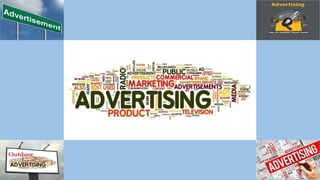
Advertising
BY
MANUPATI PUNITH
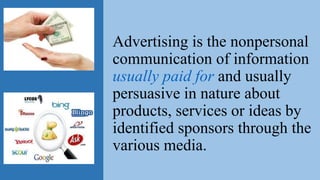
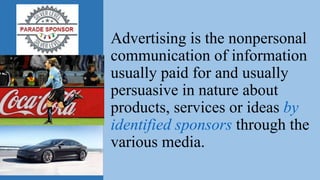
Advertising is the nonpersonal
communication of information
usually paid for and usually
persuasive in nature about
products, services or ideas by
identified sponsors through the
various media. Bovee/Arens
ADVERTISEMENT
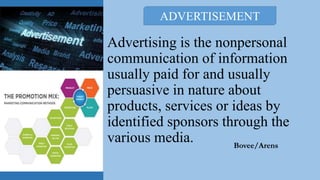
Advertising is the nonpersonal
communication of information
usually paid for and usually
persuasive in nature about
products, services or ideas by
identified sponsors through the
various media.
Advertising is the nonpersonal
communication of information
usually paid for and usually
persuasive in nature about
products, services or ideas by
identified sponsors through the
various media.
Advertising is the nonpersonal
communication of information
usually paid for and usually
persuasive in nature about
products, services or ideas by
identified sponsors through the
various media.
Advertising is the nonpersonal
communication of information
usually paid for and usually
persuasive in nature about
products, services or ideas by
identified sponsors through the
various media.
Advertising is the nonpersonal
communication of information
usually paid for and usually
persuasive in nature about
products, services or ideas by
identified sponsors through the
various media.
Advertising is the nonpersonal
communication of information
usually paid for and usually
persuasive in nature about
products, services or ideas by
identified sponsors through the
various media.
Advertising is the nonpersonal
communication of information
usually paid for and usually
persuasive in nature about
products, services or ideas by
identified sponsors through the
various media.
Advertising is the nonpersonal
communication of information,
usually paid for and usually
persuasive in nature about
products, services or ideas by
identified sponsors through the
various media
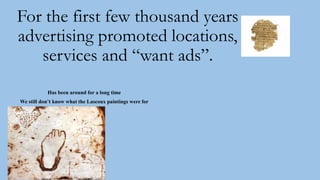
For the first few thousand years
advertising promoted locations,
services and “want ads”.
Has been around for a long time
We still don’t know what the Lascoux paintings were for
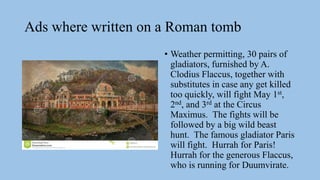
Ads where written on a Roman tomb
• Weather permitting, 30 pairs of
gladiators, furnished by A.
Clodius Flaccus, together with
substitutes in case any get killed
too quickly, will fight May 1st,
2nd, and 3rd at the Circus
Maximus. The fights will be
followed by a big wild beast
hunt. The famous gladiator Paris
will fight. Hurrah for Paris!
Hurrah for the generous Flaccus,
who is running for Duumvirate.
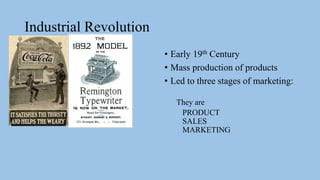
Industrial Revolution
• Early 19th Century
• Mass production of products
• Led to three stages of marketing:
They are
PRODUCT
SALES
MARKETING
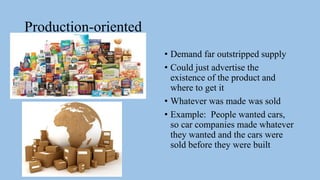
Production-oriented
• Demand far outstripped supply
• Could just advertise the
existence of the product and
where to get it
• Whatever was made was sold
• Example: People wanted cars,
so car companies made whatever
they wanted and the cars were
sold before they were built
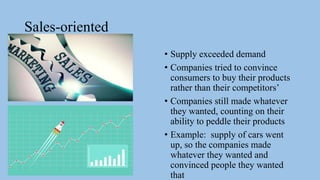
Sales-oriented
• Supply exceeded demand
• Companies tried to convince
consumers to buy their products
rather than their competitors’
• Companies still made whatever
they wanted, counting on their
ability to peddle their products
• Example: supply of cars went
up, so the companies made
whatever they wanted and
convinced people they wanted
that
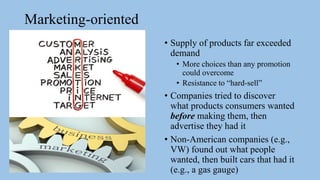
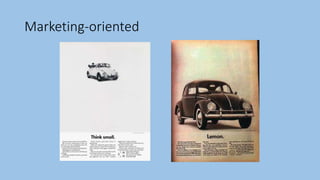
Marketing-oriented
• Supply of products far exceeded
demand
• More choices than any promotion
could overcome
• Resistance to “hard-sell”
• Companies tried to discover
what products consumers wanted
before making them, then
advertise they had it
• Non-American companies (e.g.,
VW) found out what people
wanted, then built cars that had it
(e.g., a gas gauge)
Marketing-oriented
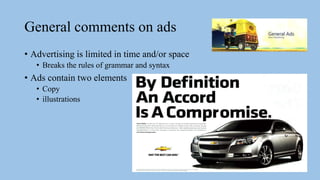
General comments on ads
• Advertising is limited in time and/or space
• Breaks the rules of grammar and syntax
• Ads contain two elements
• Copy
• illustrations
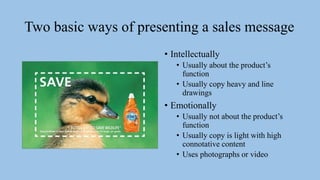
Two basic ways of presenting a sales message
• Intellectually
• Usually about the product’s
function
• Usually copy heavy and line
drawings
• Emotionally
• Usually not about the product’s
function
• Usually copy is light with high
connotative content
• Uses photographs or video
•Advertising aims at consumers’
subconscious minds much more than
their conscious minds
•It’s all about getting the consumer to
react on a basic, instinctive level, and
not think at all
•It’s about “act now” on your basic
desires – think only of yourself
•It’s usually selfish and anti-social
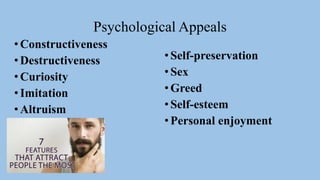
Psychological Appeals
•Self-preservation
•Sex
•Greed
•Self-esteem
•Personal enjoyment
•Constructiveness
•Destructiveness
•Curiosity
•Imitation
•Altruism
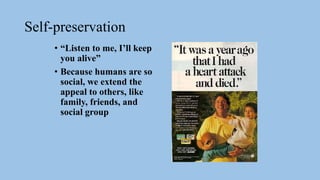
Self-preservation
• “Listen to me, I’ll keep
you alive”
• Because humans are so
social, we extend the
appeal to others, like
family, friends, and
social group
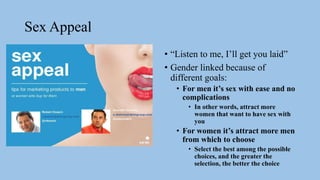
Sex Appeal
• “Listen to me, I’ll get you laid”
• Gender linked because of
different goals:
• For men it’s sex with ease and no
complications
• In other words, attract more
women that want to have sex with
you
• For women it’s attract more men
from which to choose
• Select the best among the possible
choices, and the greater the
selection, the better the choice
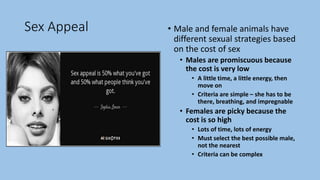
Sex Appeal • Male and female animals have
different sexual strategies based
on the cost of sex
• Males are promiscuous because
the cost is very low
• A little time, a little energy, then
move on
• Criteria are simple – she has to be
there, breathing, and impregnable
• Females are picky because the
cost is so high
• Lots of time, lots of energy
• Must select the best possible male,
not the nearest
• Criteria can be complex
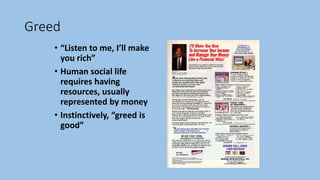
Greed
• “Listen to me, I’ll make
you rich”
• Human social life
requires having
resources, usually
represented by money
• Instinctively, “greed is
good”
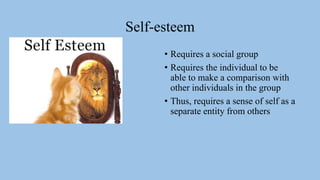
Self-esteem
• Requires a social group
• Requires the individual to be
able to make a comparison with
other individuals in the group
• Thus, requires a sense of self as a
separate entity from others
Self-esteem
• Again, there’s an instinctive
gender link
• For men, it’s competitive
• Demonstrate he’s the best male
around
• Self-esteem comes from a sense of
superiority
• For women, it’s cooperative
• Make and maintain as many
connections as possible
• Self-esteem comes from a sense of
connection
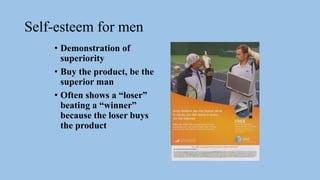
Self-esteem for men
• Demonstration of
superiority
• Buy the product, be the
superior man
• Often shows a “loser”
beating a “winner”
because the loser buys
the product
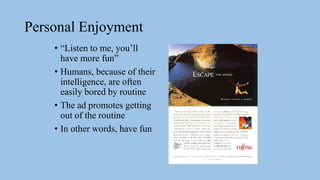
Personal Enjoyment
• “Listen to me, you’ll
have more fun”
• Humans, because of their
intelligence, are often
easily bored by routine
• The ad promotes getting
out of the routine
• In other words, have fun
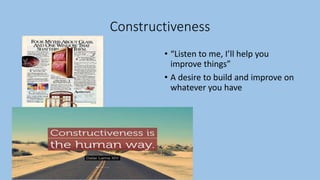
Constructiveness
• “Listen to me, I’ll help you
improve things”
• A desire to build and improve on
whatever you have
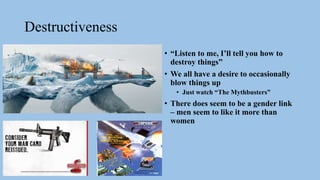
Destructiveness
• “Listen to me, I’ll tell you how to
destroy things”
• We all have a desire to occasionally
blow things up
• Just watch “The Mythbusters”
• There does seem to be a gender link
– men seem to like it more than
women
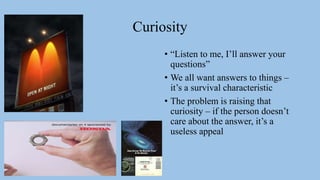
Curiosity
• “Listen to me, I’ll answer your
questions”
• We all want answers to things –
it’s a survival characteristic
• The problem is raising that
curiosity – if the person doesn’t
care about the answer, it’s a
useless appeal
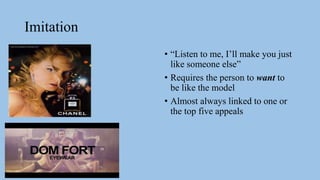
Imitation
• “Listen to me, I’ll make you just
like someone else”
• Requires the person to want to
be like the model
• Almost always linked to one or
the top five appeals
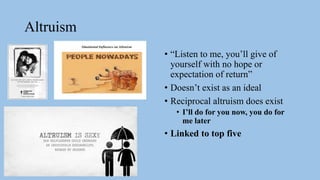
Altruism
• “Listen to me, you’ll give of
yourself with no hope or
expectation of return”
• Doesn’t exist as an ideal
• Reciprocal altruism does exist
• I’ll do for you now, you do for
me later
• Linked to top five
Tricks of the Trade
• Advertising often uses logical fallacies rather than giving logical
reasons to buy the product advertised.
• You think the ad is saying one thing when it fact it’s saying something
else, or saying nothing at all
Buzz Words
• Words that seem to say
something, but what?
• “Crisp”
• “Natural”
• “Organic”
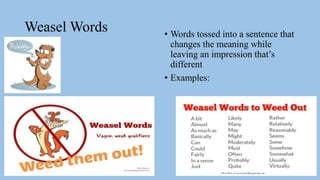
Weasel Words • Words tossed into a sentence that
changes the meaning while
leaving an impression that’s
different
• Examples:
“Our [canned] corn is as good as fresh cooked corn.”
Libby’s Vegetables
• Note it doesn’t say it’s as good as fresh corn, but as
good as fresh cooked corn.
• Cooked corn has had vitamins and minerals boiled out
in the cooking process.
• And now you have to heat the corn again, which takes
out even more nutrients.
• The weasel is “cooked”
“Our dog food contains as much meat
protein as 10 pounds of sirloin steak.
Alpo dog food
• Targets people who love their dogs
• Doesn’t contain sirloin steak, only as much meat
protein as sirloin steak
• That could be any kind of meat – it’s sure not sirloin, and
may not even come from a cow
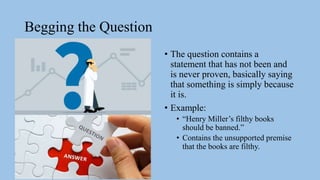
Begging the Question
• The question contains a
statement that has not been and
is never proven, basically saying
that something is simply because
it is.
• Example:
• “Henry Miller’s filthy books
should be banned.”
• Contains the unsupported premise
that the books are filthy.
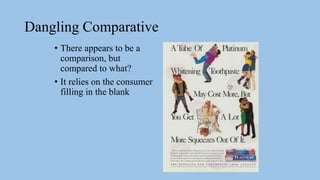
Dangling Comparative
• There appears to be a
comparison, but
compared to what?
• It relies on the consumer
filling in the blank
Complaints about advertising
• It perpetuates stereotypes
• Absolutely true
• It has to
• Makes people buy things they don’t need
• Not true
• Advertising can’t make anybody do anything
BY
manupati punith
Thanks to Google

Advertising

  • 1.
  • 2.
    Advertising is thenonpersonal communication of information usually paid for and usually persuasive in nature about products, services or ideas by identified sponsors through the various media. Bovee/Arens ADVERTISEMENT
  • 3.
    Advertising is thenonpersonal communication of information usually paid for and usually persuasive in nature about products, services or ideas by identified sponsors through the various media.
  • 4.
    Advertising is thenonpersonal communication of information usually paid for and usually persuasive in nature about products, services or ideas by identified sponsors through the various media.
  • 5.
    Advertising is thenonpersonal communication of information usually paid for and usually persuasive in nature about products, services or ideas by identified sponsors through the various media.
  • 6.
    Advertising is thenonpersonal communication of information usually paid for and usually persuasive in nature about products, services or ideas by identified sponsors through the various media.
  • 7.
    Advertising is thenonpersonal communication of information usually paid for and usually persuasive in nature about products, services or ideas by identified sponsors through the various media.
  • 8.
    Advertising is thenonpersonal communication of information usually paid for and usually persuasive in nature about products, services or ideas by identified sponsors through the various media.
  • 9.
    Advertising is thenonpersonal communication of information usually paid for and usually persuasive in nature about products, services or ideas by identified sponsors through the various media.
  • 10.
    Advertising is thenonpersonal communication of information, usually paid for and usually persuasive in nature about products, services or ideas by identified sponsors through the various media
  • 11.
    For the firstfew thousand years advertising promoted locations, services and “want ads”. Has been around for a long time We still don’t know what the Lascoux paintings were for
  • 12.
    Ads where writtenon a Roman tomb • Weather permitting, 30 pairs of gladiators, furnished by A. Clodius Flaccus, together with substitutes in case any get killed too quickly, will fight May 1st, 2nd, and 3rd at the Circus Maximus. The fights will be followed by a big wild beast hunt. The famous gladiator Paris will fight. Hurrah for Paris! Hurrah for the generous Flaccus, who is running for Duumvirate.
  • 13.
    Industrial Revolution • Early19th Century • Mass production of products • Led to three stages of marketing: They are PRODUCT SALES MARKETING
  • 14.
    Production-oriented • Demand faroutstripped supply • Could just advertise the existence of the product and where to get it • Whatever was made was sold • Example: People wanted cars, so car companies made whatever they wanted and the cars were sold before they were built
  • 15.
    Sales-oriented • Supply exceededdemand • Companies tried to convince consumers to buy their products rather than their competitors’ • Companies still made whatever they wanted, counting on their ability to peddle their products • Example: supply of cars went up, so the companies made whatever they wanted and convinced people they wanted that
  • 16.
    Marketing-oriented • Supply ofproducts far exceeded demand • More choices than any promotion could overcome • Resistance to “hard-sell” • Companies tried to discover what products consumers wanted before making them, then advertise they had it • Non-American companies (e.g., VW) found out what people wanted, then built cars that had it (e.g., a gas gauge)
  • 17.
  • 18.
    General comments onads • Advertising is limited in time and/or space • Breaks the rules of grammar and syntax • Ads contain two elements • Copy • illustrations
  • 19.
    Two basic waysof presenting a sales message • Intellectually • Usually about the product’s function • Usually copy heavy and line drawings • Emotionally • Usually not about the product’s function • Usually copy is light with high connotative content • Uses photographs or video
  • 20.
    •Advertising aims atconsumers’ subconscious minds much more than their conscious minds •It’s all about getting the consumer to react on a basic, instinctive level, and not think at all •It’s about “act now” on your basic desires – think only of yourself •It’s usually selfish and anti-social
  • 21.
  • 22.
    Self-preservation • “Listen tome, I’ll keep you alive” • Because humans are so social, we extend the appeal to others, like family, friends, and social group
  • 23.
    Sex Appeal • “Listento me, I’ll get you laid” • Gender linked because of different goals: • For men it’s sex with ease and no complications • In other words, attract more women that want to have sex with you • For women it’s attract more men from which to choose • Select the best among the possible choices, and the greater the selection, the better the choice
  • 24.
    Sex Appeal •Male and female animals have different sexual strategies based on the cost of sex • Males are promiscuous because the cost is very low • A little time, a little energy, then move on • Criteria are simple – she has to be there, breathing, and impregnable • Females are picky because the cost is so high • Lots of time, lots of energy • Must select the best possible male, not the nearest • Criteria can be complex
  • 25.
    Greed • “Listen tome, I’ll make you rich” • Human social life requires having resources, usually represented by money • Instinctively, “greed is good”
  • 26.
    Self-esteem • Requires asocial group • Requires the individual to be able to make a comparison with other individuals in the group • Thus, requires a sense of self as a separate entity from others
  • 27.
    Self-esteem • Again, there’san instinctive gender link • For men, it’s competitive • Demonstrate he’s the best male around • Self-esteem comes from a sense of superiority • For women, it’s cooperative • Make and maintain as many connections as possible • Self-esteem comes from a sense of connection
  • 28.
    Self-esteem for men •Demonstration of superiority • Buy the product, be the superior man • Often shows a “loser” beating a “winner” because the loser buys the product
  • 29.
    Personal Enjoyment • “Listento me, you’ll have more fun” • Humans, because of their intelligence, are often easily bored by routine • The ad promotes getting out of the routine • In other words, have fun
  • 30.
    Constructiveness • “Listen tome, I’ll help you improve things” • A desire to build and improve on whatever you have
  • 31.
    Destructiveness • “Listen tome, I’ll tell you how to destroy things” • We all have a desire to occasionally blow things up • Just watch “The Mythbusters” • There does seem to be a gender link – men seem to like it more than women
  • 32.
    Curiosity • “Listen tome, I’ll answer your questions” • We all want answers to things – it’s a survival characteristic • The problem is raising that curiosity – if the person doesn’t care about the answer, it’s a useless appeal
  • 33.
    Imitation • “Listen tome, I’ll make you just like someone else” • Requires the person to want to be like the model • Almost always linked to one or the top five appeals
  • 34.
    Altruism • “Listen tome, you’ll give of yourself with no hope or expectation of return” • Doesn’t exist as an ideal • Reciprocal altruism does exist • I’ll do for you now, you do for me later • Linked to top five
  • 35.
    Tricks of theTrade • Advertising often uses logical fallacies rather than giving logical reasons to buy the product advertised. • You think the ad is saying one thing when it fact it’s saying something else, or saying nothing at all
  • 36.
    Buzz Words • Wordsthat seem to say something, but what? • “Crisp” • “Natural” • “Organic”
  • 37.
    Weasel Words •Words tossed into a sentence that changes the meaning while leaving an impression that’s different • Examples:
  • 38.
    “Our [canned] cornis as good as fresh cooked corn.” Libby’s Vegetables • Note it doesn’t say it’s as good as fresh corn, but as good as fresh cooked corn. • Cooked corn has had vitamins and minerals boiled out in the cooking process. • And now you have to heat the corn again, which takes out even more nutrients. • The weasel is “cooked”
  • 39.
    “Our dog foodcontains as much meat protein as 10 pounds of sirloin steak. Alpo dog food • Targets people who love their dogs • Doesn’t contain sirloin steak, only as much meat protein as sirloin steak • That could be any kind of meat – it’s sure not sirloin, and may not even come from a cow
  • 40.
    Begging the Question •The question contains a statement that has not been and is never proven, basically saying that something is simply because it is. • Example: • “Henry Miller’s filthy books should be banned.” • Contains the unsupported premise that the books are filthy.
  • 41.
    Dangling Comparative • Thereappears to be a comparison, but compared to what? • It relies on the consumer filling in the blank
  • 42.
    Complaints about advertising •It perpetuates stereotypes • Absolutely true • It has to • Makes people buy things they don’t need • Not true • Advertising can’t make anybody do anything
  • 44.