The document provides information on prescription writing including:
1. The definition of a prescription as a written order from a physician to a pharmacist with the patient's name, medicines, doses, frequencies, and durations.
2. The ideal components of a prescription including superscription with patient/prescriber details, inscription with medicine names/doses, subscription with instructions to the pharmacist, and signatura with directions to the patient.
3. Guidelines for rational prescribing with the right diagnosis, medicine, dose, duration, administration route, and cost versus irrational prescribing.
AIM: Introduction toPrescription Writing
By
Manoj Kumar
Assistant Professor
Department of Pharmacology
Adesh Medical College & Hospital Ambala Can’t
2.
Prescription
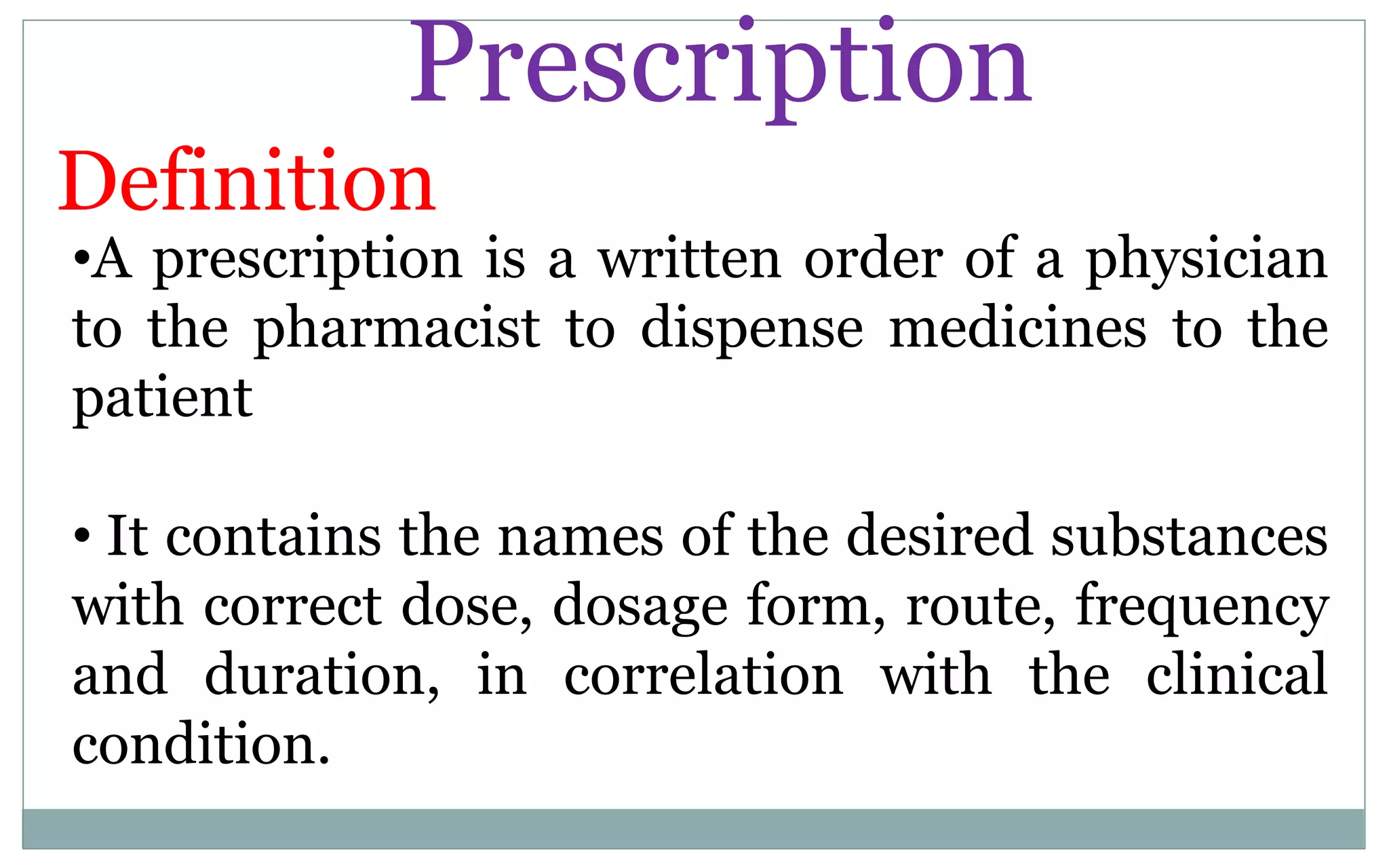
Definition
•A prescription isa written order of a physician
to the pharmacist to dispense medicines to the
patient
• It contains the names of the desired substances
with correct dose, dosage form, route, frequency
and duration, in correlation with the clinical
condition.
3.
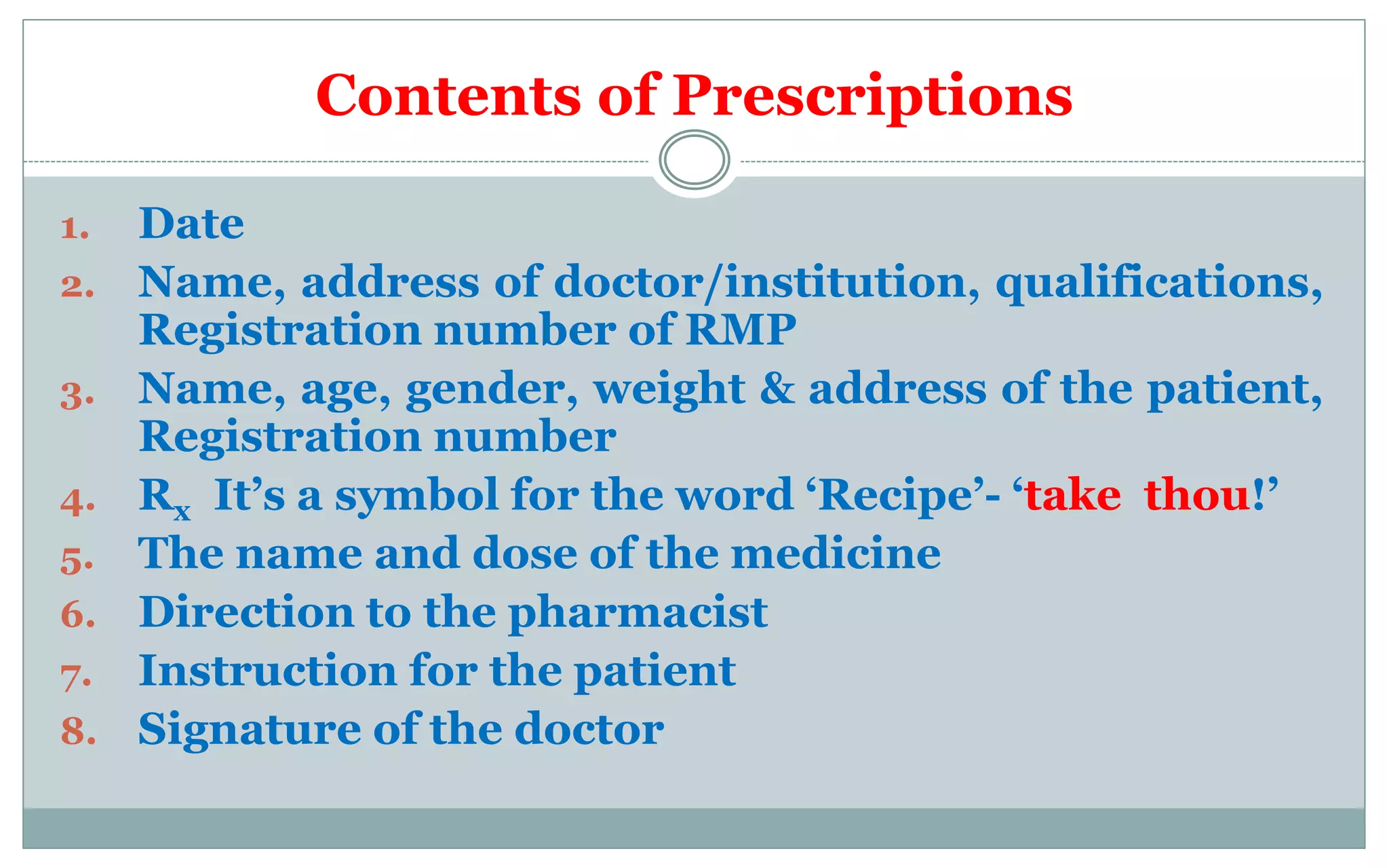
Contents of Prescriptions
1.Date
2. Name, address of doctor/institution, qualifications,
Registration number of RMP
3. Name, age, gender, weight & address of the patient,
Registration number
4. Rx It’s a symbol for the word ‘Recipe’- ‘take thou!’
5. The name and dose of the medicine
6. Direction to the pharmacist
7. Instruction for the patient
8. Signature of the doctor
4.
Parts of Prescription:
Anideal prescription should have the
following parts:
1. Superscription
2. Inscription
3. Subscription
4. Transcription/Signa
5.
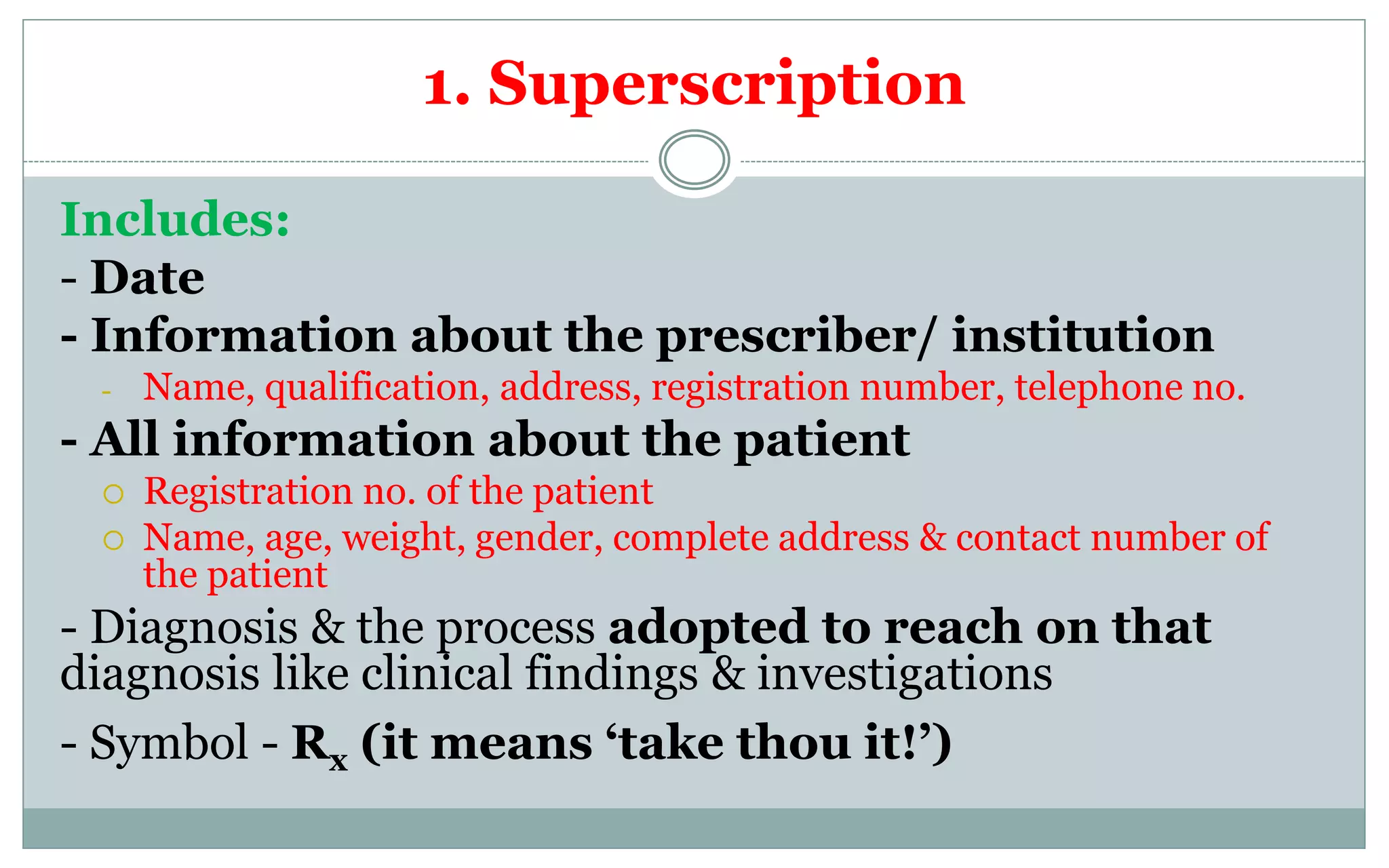
1. Superscription
Includes:
- Date
-Information about the prescriber/ institution
- Name, qualification, address, registration number, telephone no.
- All information about the patient
Registration no. of the patient
Name, age, weight, gender, complete address & contact number of
the patient
- Diagnosis & the process adopted to reach on that
diagnosis like clinical findings & investigations
- Symbol - Rx (it means ‘take thou it!’)
6.
2. Inscription
Mainbody of the prescription. It is the complete
information about the medicines.
It directs for:
Name of drug (preferably generic name)
Dosage form (to be used like capsules, tablets,
injections, syrups, rotacaps etc)
Strength, dose, route, frequency & duration of
administration of medicines
7.
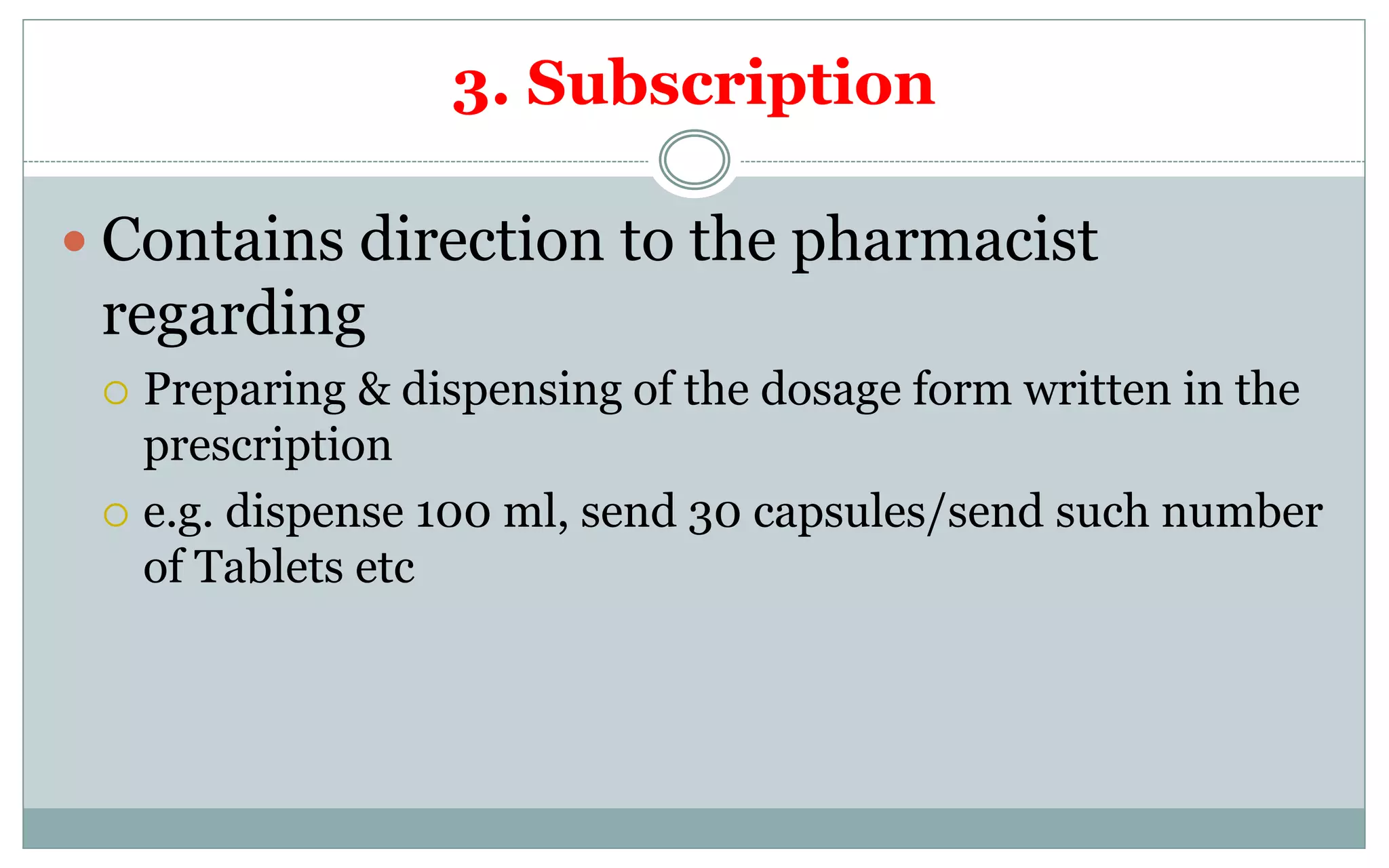
3. Subscription
Containsdirection to the pharmacist
regarding
Preparing & dispensing of the dosage form written in the
prescription
e.g. dispense 100 ml, send 30 capsules/send such number
of Tablets etc
8.
4. Signa orSignatura or Transcription
Includes instructions to the patient regarding intake of
the prescribed drugs
How much of the drug is to be taken, how often & any specific
instructions & warnings
Instructions can also be written in the local language for the benefit
of the patient.
May include non-pharmacological instructions to be followed by the
patient
Physicians name & signature with registration number
Signa: means to write, make or label
Instructions for refill, if required
Review (follow-up)
9.
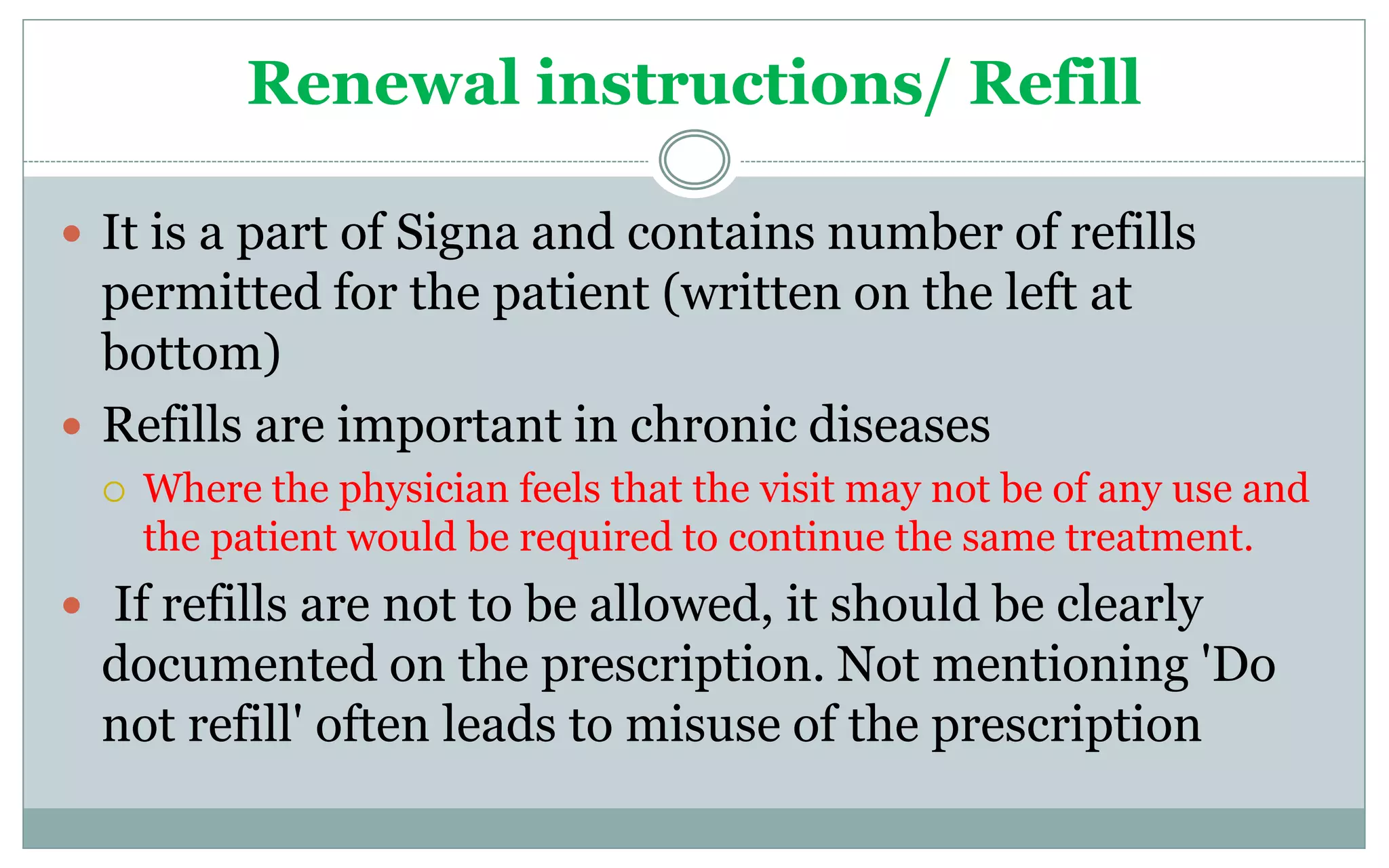
Renewal instructions/ Refill
It is a part of Signa and contains number of refills
permitted for the patient (written on the left at
bottom)
Refills are important in chronic diseases
Where the physician feels that the visit may not be of any use and
the patient would be required to continue the same treatment.
If refills are not to be allowed, it should be clearly
documented on the prescription. Not mentioning 'Do
not refill' often leads to misuse of the prescription
10.
Superscription
Dr. Ajay KumarMBBS. MD (Cardiology) Mob: 9917385421
Address: Ambala Cantt
Patients Name ……. Date ……….
Age……. month / year ∆ …………….
Gender…Male / female
Mob……..
Address …..
Occupation .. professor
Rx
Inscription
Name of drugs, Frequency, Duration, Route of drugs administration, Choice of drugs name
generic names or non proprietary or official name.
Subscription
It has physicians dispensing direction to the pharmacist e.g. send such number of capsule/send such
number of Tab.
Transcription/Signature or signi
Pharmacist direction to the patient.
Dr. name & signature
REG.NO --------------
11.
Superscription
Date: ------------- Reg.No.-----------------
Name:------------ Age----------------------
Sex---------------- (M/F)------------- wt.---------
Address:-------------------------
Chief complaints : Headache on the back of scalp for one month.
On examination, blood pressure is 150/1 00 mm Hg.
Diagnosis: Mild hypertension
Rx
Inscription
Tab Losartan50 mg, once daily
Subscription
Dispense 30 tablets
Signatura
Take one tablet by mouth daily in the morning with a glass of water
Signature
Name and address of the Prescriber
Registration number
12.
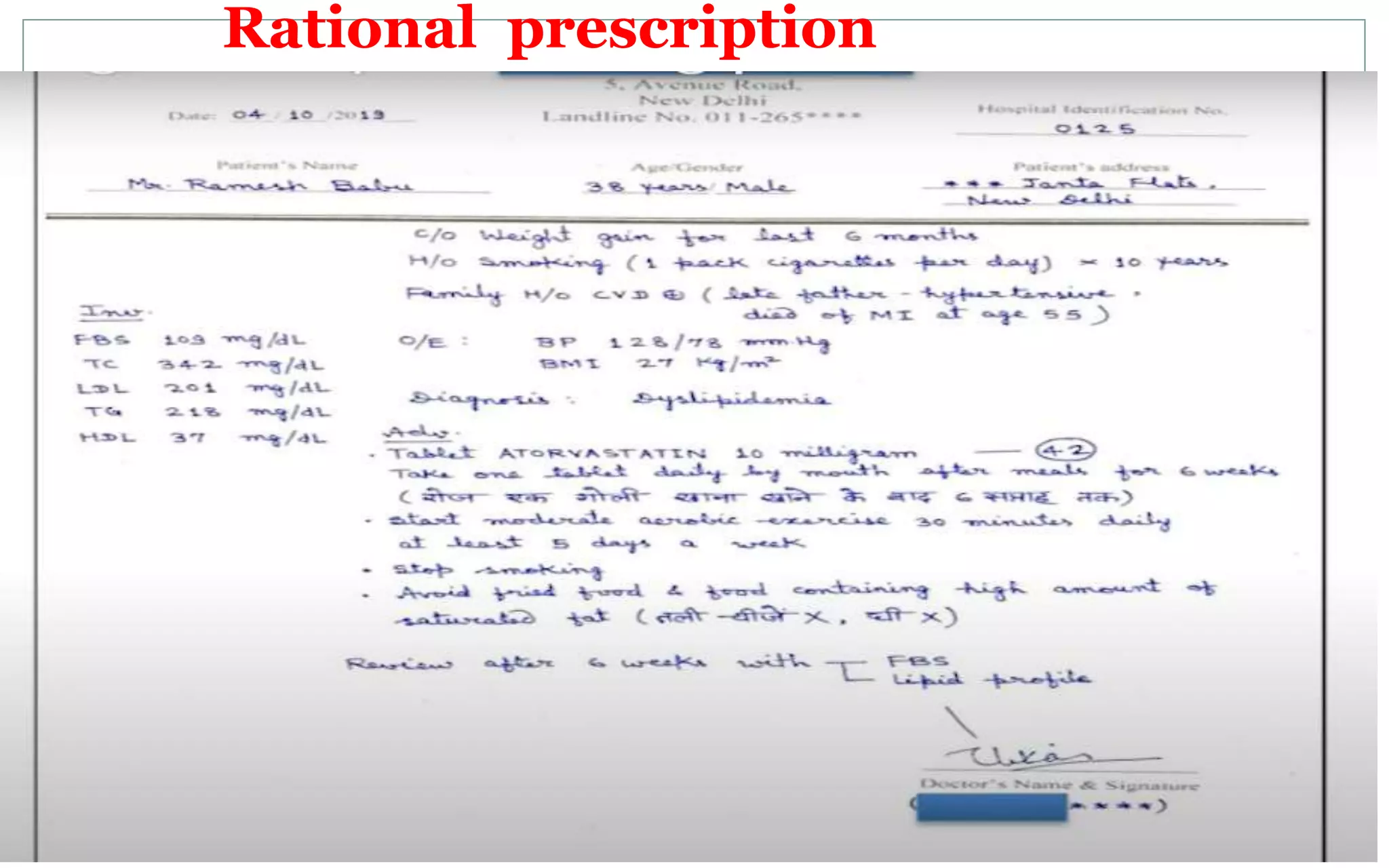
Rational Prescribing:
It fulfillsthe following criteria's–
1. Right diagnosis
2. Right drug
3. Right dosage
4. Right duration
5. Right route of administration
6. Right cost
Irrational Prescribing:
When medicallyinappropriate, ineffective &
economically inefficient drugs are used
Some common irrational prescribing:
1.Excessive use of drugs.
2.Over use of antibiotics.
3.Prescribing new costly drug, when an
alternate cheaper drug is available etc.
15.
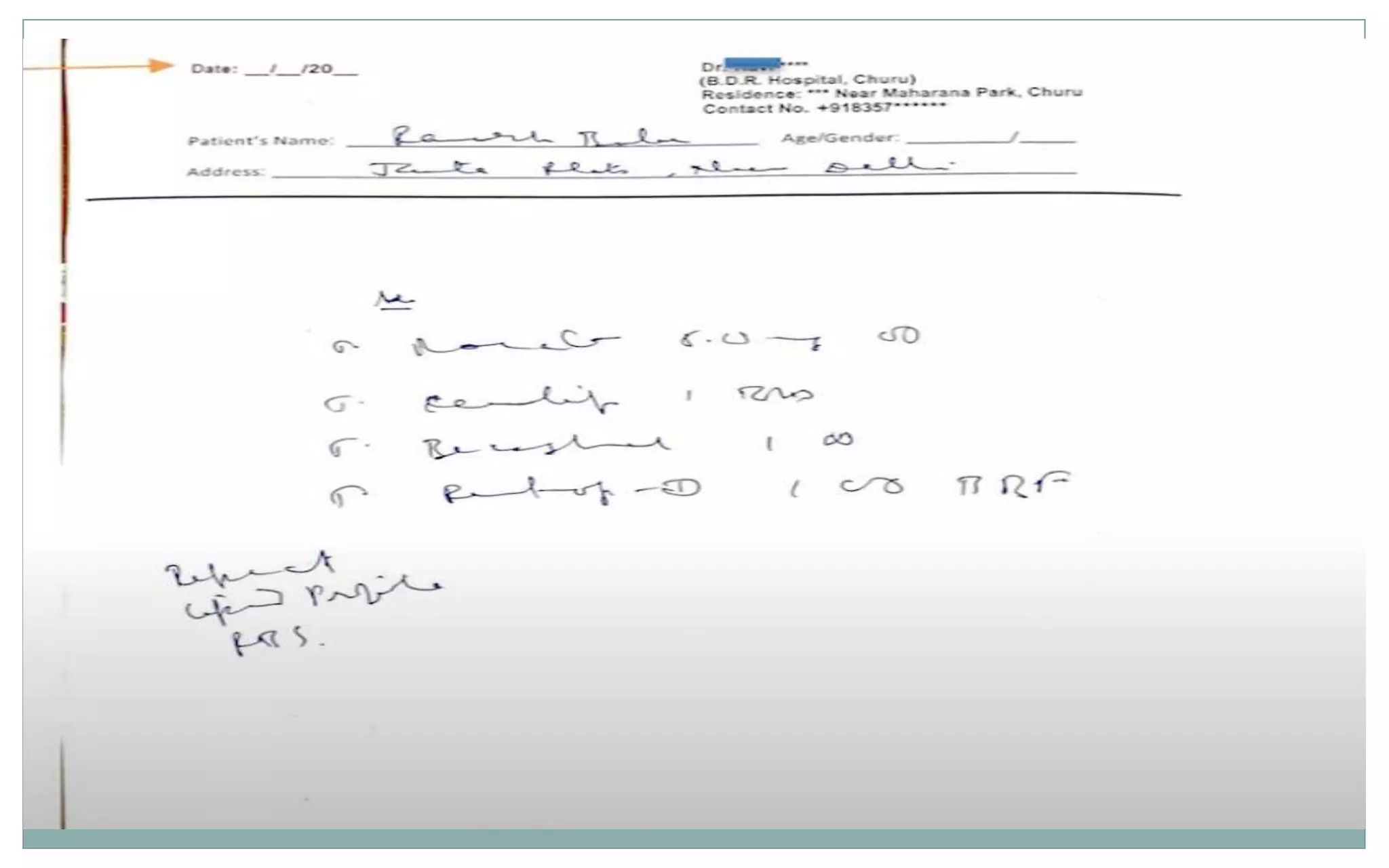
Irrational prescription
Illegiblehandwriting
Missing on any of the following
Date
Age, Gender, Medical history of patient
Instructions to patient, pharmacist
Qualification & registration no, Signature of doctor
Name of drug in capital, only generic name,
Not using abbreviations
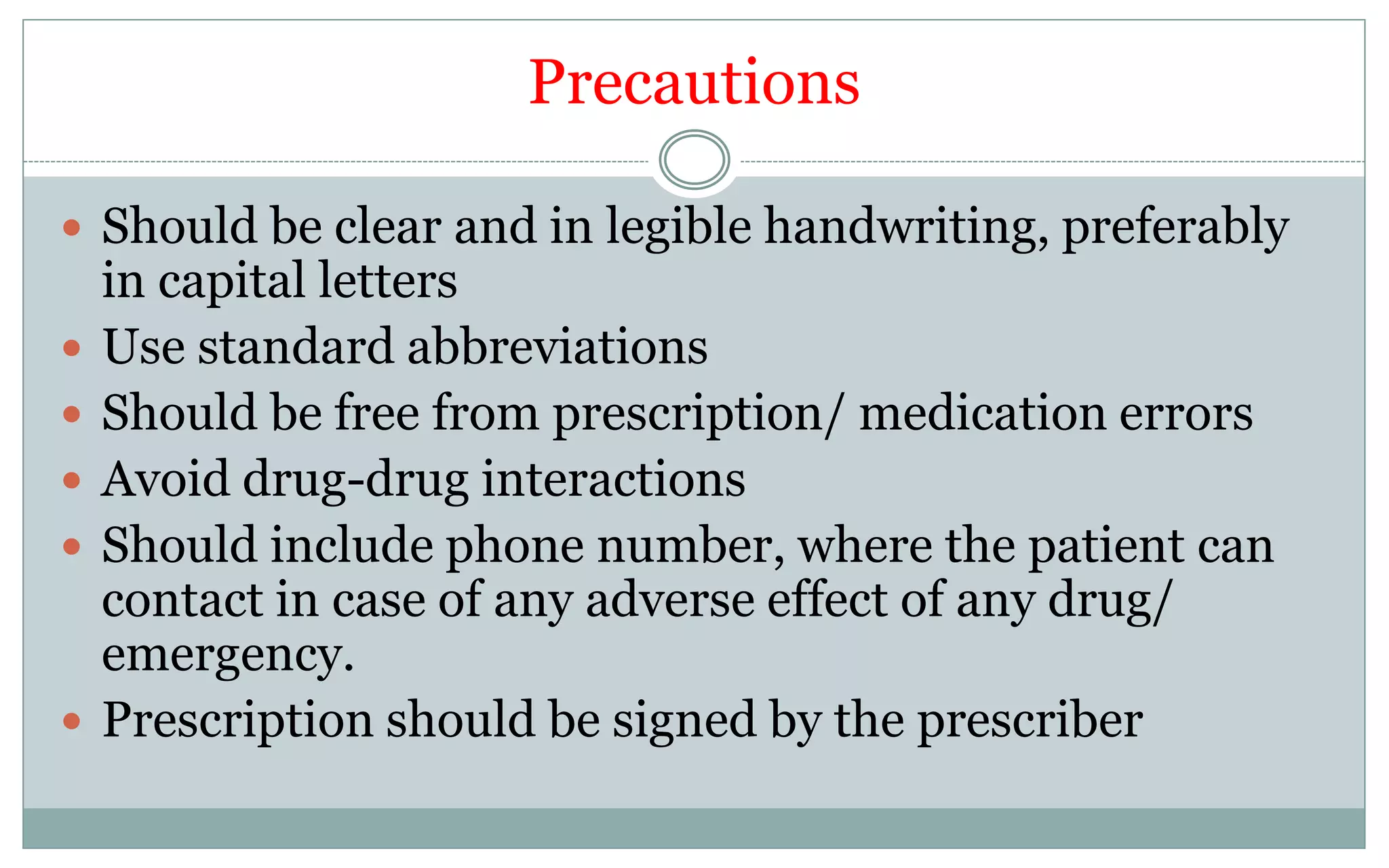
Precautions
Should beclear and in legible handwriting, preferably
in capital letters
Use standard abbreviations
Should be free from prescription/ medication errors
Avoid drug-drug interactions
Should include phone number, where the patient can
contact in case of any adverse effect of any drug/
emergency.
Prescription should be signed by the prescriber
20.
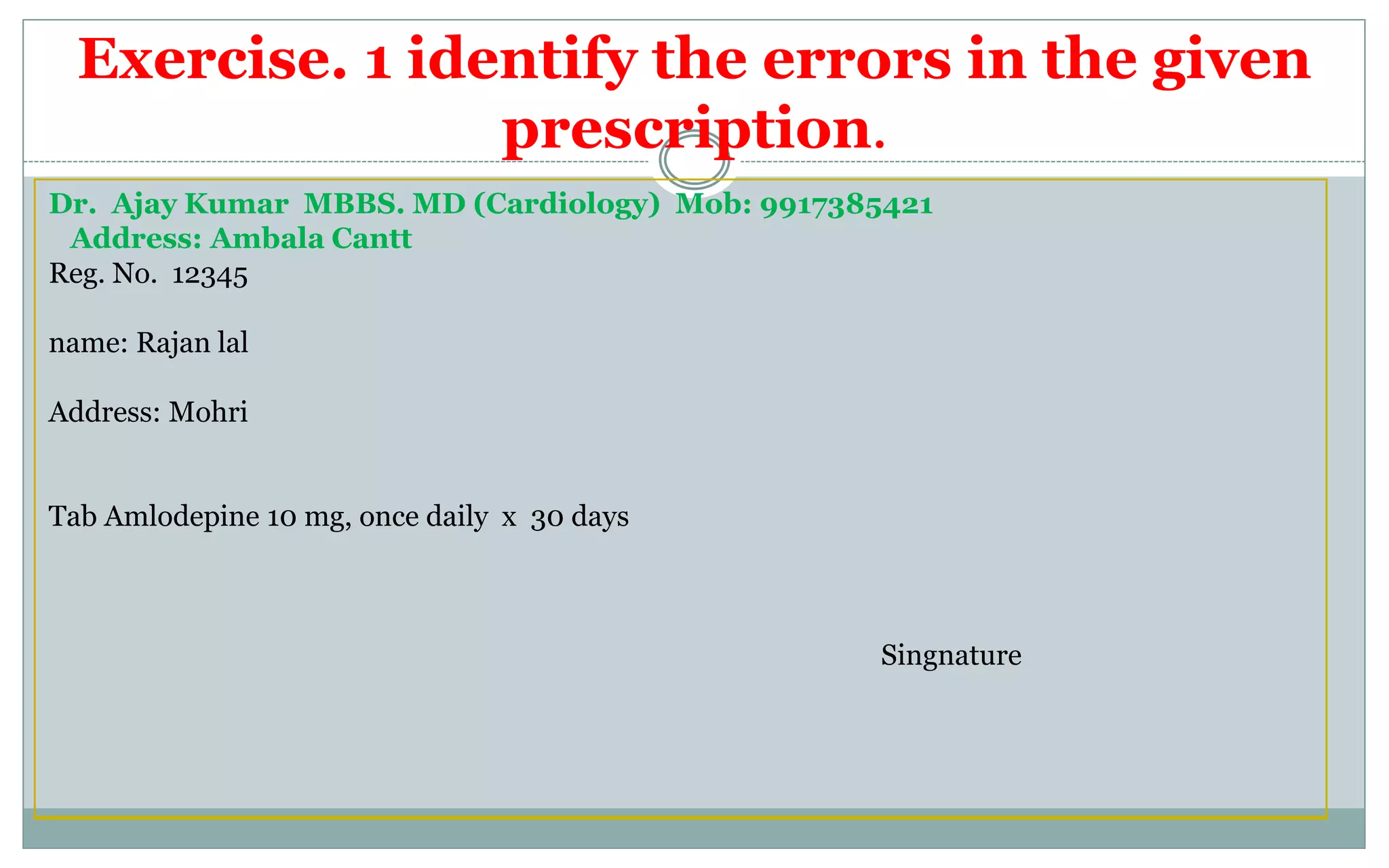
Exercise. 1 identifythe errors in the given
prescription.
Dr. Ajay Kumar MBBS. MD (Cardiology) Mob: 9917385421
Address: Ambala Cantt
Reg. No. 12345
name: Rajan lal
Address: Mohri
Tab Amlodepine 10 mg, once daily x 30 days
Singnature
21.
Exercise. 2 identifythe errors in the given
prescription.
Reg. No. 10345
name: Maden lal Age: 60
Address: Ambala cantt
Inj. Frusemide 20 mg stat.
Singnature