INTRODUCTION
 WORLD OCEAN
 WAVES INTHE OCEAN
 TSUNAMIES
 INDIAN OCEAN
 CREATURESTHAT SURVIVE IN SALTWATER
 OCEANOGRAPHY
About the world ocean
 The oceans that make up three-
quarters of the Earth's surface are
realms of boundless energy.
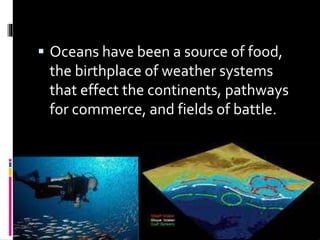
 Oceans have been a source of food,
the birthplace of weather systems
that effect the continents, pathways
for commerce, and fields of battle.
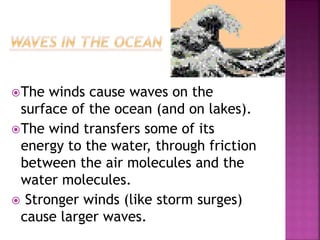
The winds cause waves on the
surface of the ocean (and on lakes).
The wind transfers some of its
energy to the water, through friction
between the air molecules and the
water molecules.
 Stronger winds (like storm surges)
cause larger waves.
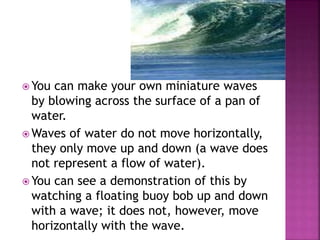
 You can make your own miniature waves
by blowing across the surface of a pan of
water.
 Waves of water do not move horizontally,
they only move up and down (a wave does
not represent a flow of water).
 You can see a demonstration of this by
watching a floating buoy bob up and down
with a wave; it does not, however, move
horizontally with the wave.
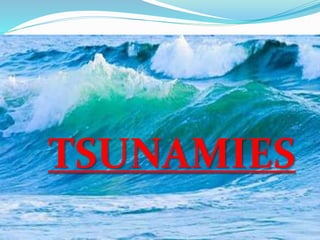
TSUNAMIES
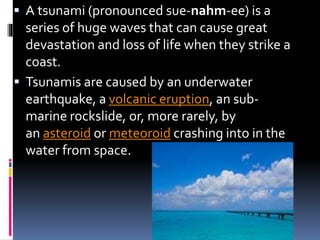
 A tsunami (pronounced sue-nahm-ee) is a
series of huge waves that can cause great
devastation and loss of life when they strike a
coast.
 Tsunamis are caused by an underwater
earthquake, a volcanic eruption, an sub-
marine rockslide, or, more rarely, by
an asteroid or meteoroid crashing into in the
water from space.
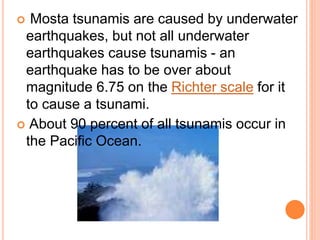
 Mosta tsunamis are caused by underwater
earthquakes, but not all underwater
earthquakes cause tsunamis - an
earthquake has to be over about
magnitude 6.75 on the Richter scale for it
to cause a tsunami.
 About 90 percent of all tsunamis occur in
the Pacific Ocean.
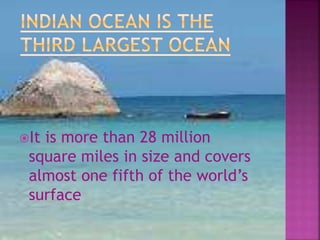
It is more than 28 million
square miles in size and covers
almost one fifth of the world’s
surface
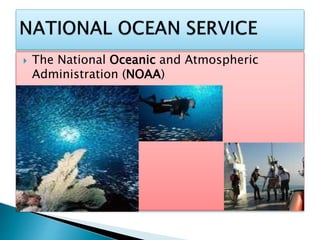
 The National Oceanic and Atmospheric
Administration (NOAA)
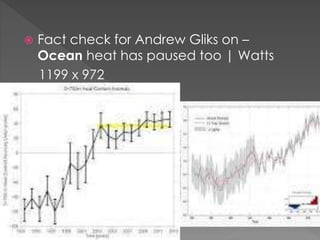
 Fact check for Andrew Gliks on –
Ocean heat has paused too | Watts
1199 x 972
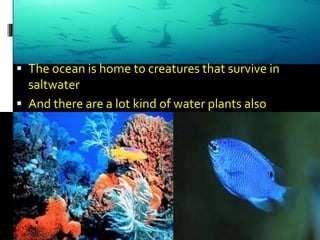
 The ocean is home to creatures that survive in
saltwater
 And there are a lot kind of water plants also
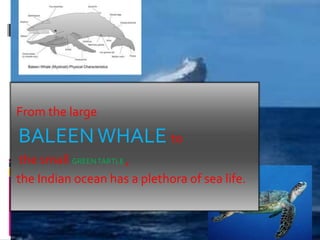
From the large
BALEENWHALE to
the small GREENTARTLE ,
the Indian ocean has a plethora of sea life.
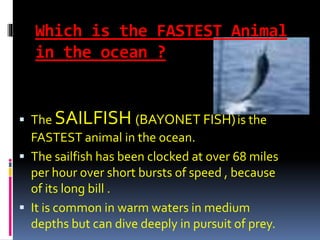
Which is the FASTEST Animal
in the ocean ?
 The SAILFISH (BAYONET FISH)is the
FASTEST animal in the ocean.
 The sailfish has been clocked at over 68 miles
per hour over short bursts of speed , because
of its long bill .
 It is common in warm waters in medium
depths but can dive deeply in pursuit of prey.
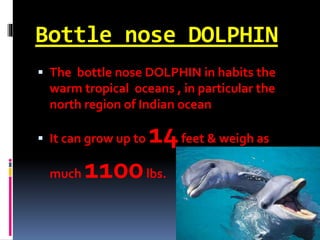
Bottle nose DOLPHIN
 The bottle nose DOLPHIN in habits the
warm tropical oceans , in particular the
north region of Indian ocean
 It can grow up to 14feet & weigh as
much 1100lbs.
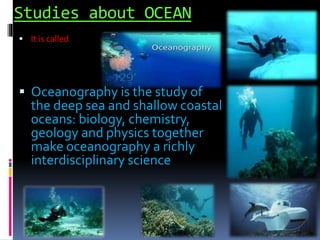
Studies about OCEAN
 It is called
 Oceanography is the study of
the deep sea and shallow coastal
oceans: biology, chemistry,
geology and physics together
make oceanography a richly
interdisciplinary science
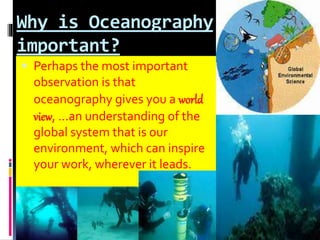
Why is Oceanography
important?
 Perhaps the most important
observation is that
oceanography gives you a world
view, ...an understanding of the
global system that is our
environment, which can inspire
your work, wherever it leads.
 Humans first acquired knowledge of the
waves and currents of the seas and oceans in
pre-historic times.
 Observations on tides were recorded
by Aristotle and Strabo.
 Early modern exploration of the oceans was
primarily for cartography and mainly limited
to its surfaces and of the creatures that
fishermen brought up in nets, though depth
soundings by lead line were taken.
Indian ocean

Indian ocean

  • 2.
    INTRODUCTION  WORLD OCEAN WAVES INTHE OCEAN  TSUNAMIES  INDIAN OCEAN  CREATURESTHAT SURVIVE IN SALTWATER  OCEANOGRAPHY
  • 3.
    About the worldocean  The oceans that make up three- quarters of the Earth's surface are realms of boundless energy.
  • 4.
     Oceans havebeen a source of food, the birthplace of weather systems that effect the continents, pathways for commerce, and fields of battle.
  • 5.
    The winds causewaves on the surface of the ocean (and on lakes). The wind transfers some of its energy to the water, through friction between the air molecules and the water molecules.  Stronger winds (like storm surges) cause larger waves.
  • 6.
     You canmake your own miniature waves by blowing across the surface of a pan of water.  Waves of water do not move horizontally, they only move up and down (a wave does not represent a flow of water).  You can see a demonstration of this by watching a floating buoy bob up and down with a wave; it does not, however, move horizontally with the wave.
  • 7.
  • 8.
     A tsunami(pronounced sue-nahm-ee) is a series of huge waves that can cause great devastation and loss of life when they strike a coast.  Tsunamis are caused by an underwater earthquake, a volcanic eruption, an sub- marine rockslide, or, more rarely, by an asteroid or meteoroid crashing into in the water from space.
  • 9.
     Mosta tsunamisare caused by underwater earthquakes, but not all underwater earthquakes cause tsunamis - an earthquake has to be over about magnitude 6.75 on the Richter scale for it to cause a tsunami.  About 90 percent of all tsunamis occur in the Pacific Ocean.
  • 10.
    It is morethan 28 million square miles in size and covers almost one fifth of the world’s surface
  • 12.
     The NationalOceanic and Atmospheric Administration (NOAA)
  • 13.
     Fact checkfor Andrew Gliks on – Ocean heat has paused too | Watts 1199 x 972
  • 14.
     The oceanis home to creatures that survive in saltwater  And there are a lot kind of water plants also
  • 15.
    From the large BALEENWHALEto the small GREENTARTLE , the Indian ocean has a plethora of sea life.
  • 16.
    Which is theFASTEST Animal in the ocean ?  The SAILFISH (BAYONET FISH)is the FASTEST animal in the ocean.  The sailfish has been clocked at over 68 miles per hour over short bursts of speed , because of its long bill .  It is common in warm waters in medium depths but can dive deeply in pursuit of prey.
  • 17.
    Bottle nose DOLPHIN The bottle nose DOLPHIN in habits the warm tropical oceans , in particular the north region of Indian ocean  It can grow up to 14feet & weigh as much 1100lbs.
  • 18.
    Studies about OCEAN It is called  Oceanography is the study of the deep sea and shallow coastal oceans: biology, chemistry, geology and physics together make oceanography a richly interdisciplinary science
  • 19.
    Why is Oceanography important? Perhaps the most important observation is that oceanography gives you a world view, ...an understanding of the global system that is our environment, which can inspire your work, wherever it leads.
  • 20.
     Humans firstacquired knowledge of the waves and currents of the seas and oceans in pre-historic times.  Observations on tides were recorded by Aristotle and Strabo.  Early modern exploration of the oceans was primarily for cartography and mainly limited to its surfaces and of the creatures that fishermen brought up in nets, though depth soundings by lead line were taken.