Environmental Science
A Study of Interrelationships
Thirteenth Edition

Enger & Smith

Chapter 8
Energy and Civilization: Patterns of Consumption

Copyright © The McGraw-Hill Companies, Inc. Permission required for reproduction or display.
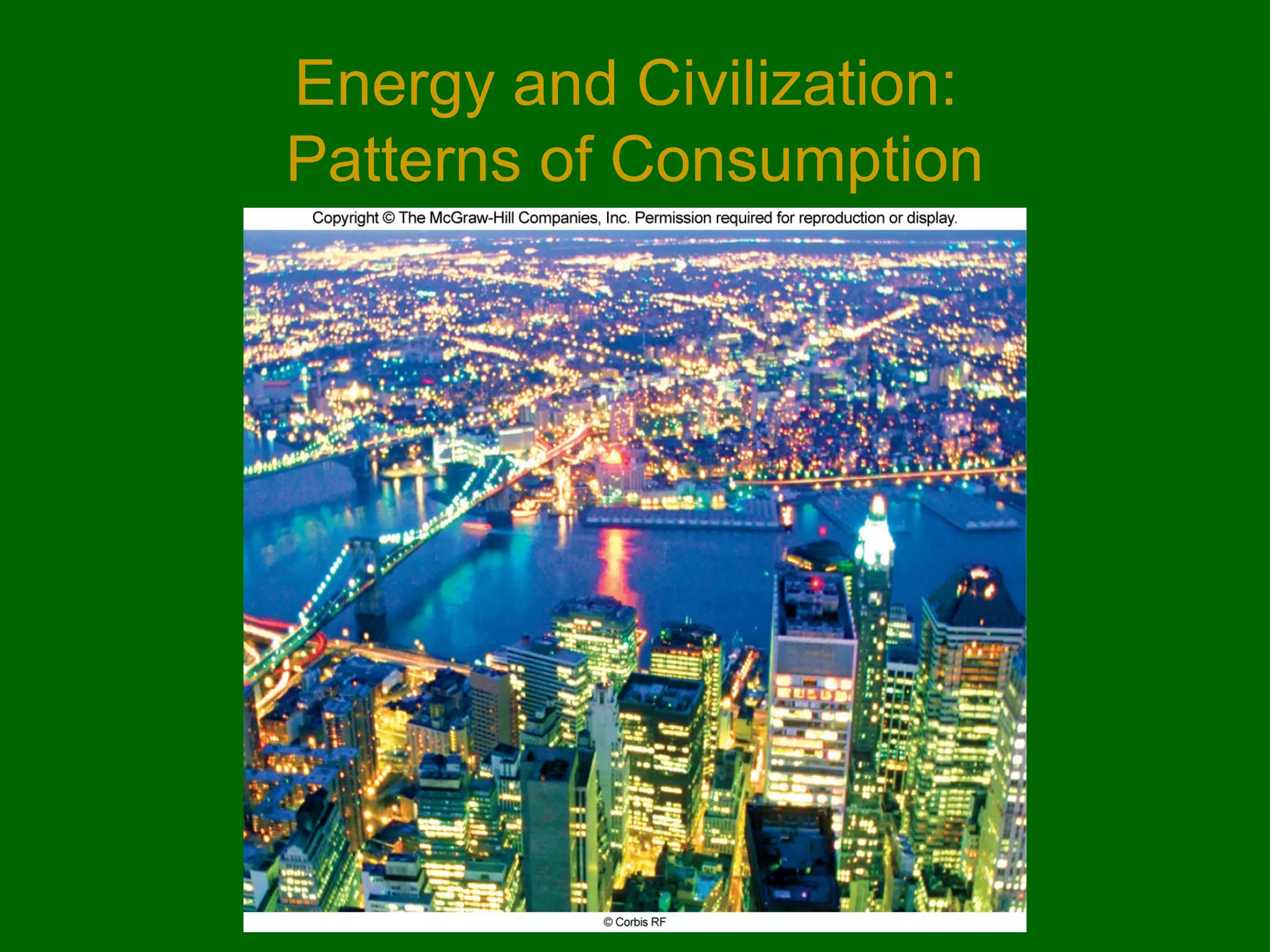
Energy and Civilization:
Patterns of Consumption
8.1 History of Energy Consumption
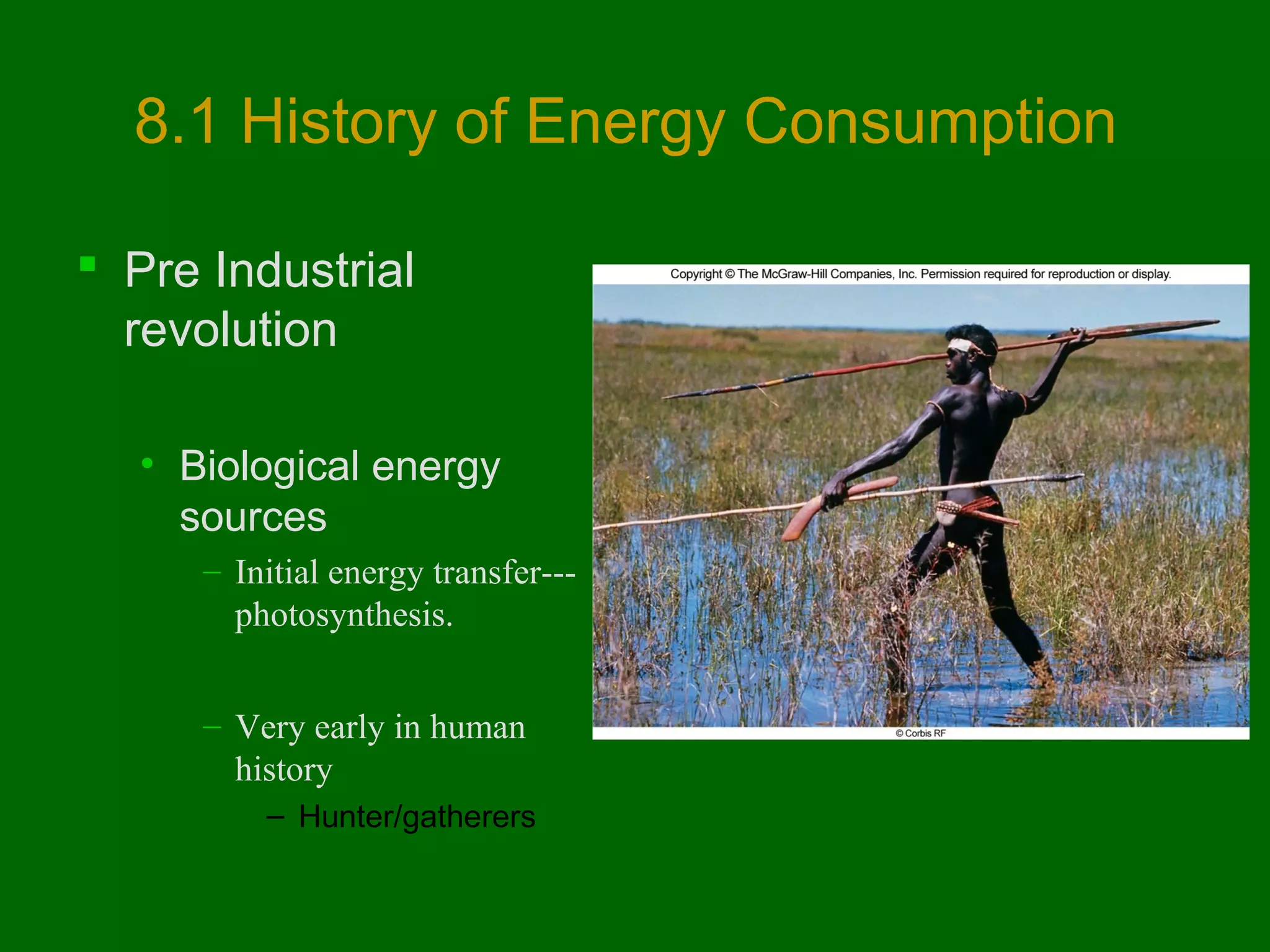
 Pre Industrial
revolution
• Biological energy
sources
– Initial energy transfer--photosynthesis.
– Very early in human
history
– Hunter/gatherers
8.1 History of Energy Consumption
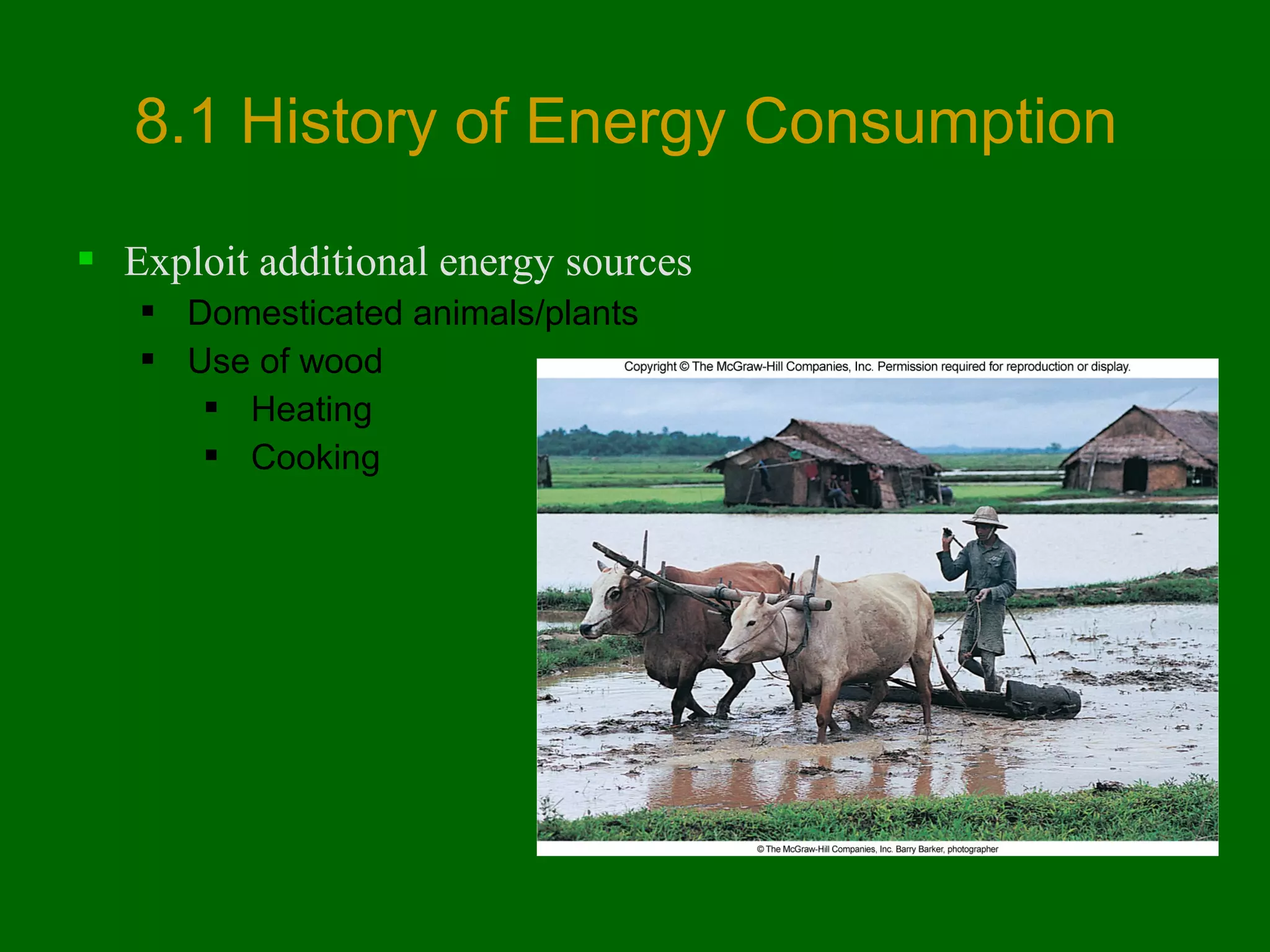
 Exploit additional energy sources
 Domesticated animals/plants
 Use of wood
 Heating
 Cooking
8.1 History of Energy Consumption
• Increased Use of Wood
– Dense, rapidly growing settlements outstripped wood
production
– new fuel sources such as coal
8.1 History of Energy Consumption
 Fossil Fuels
• modified remains of plants, animals, microorganisms
that lived million of years ago

 Coal
• 286-362 million years ago
• Plant material under heat/pressure

 Oil and natural gas
• one-celled marine organisms.
8.1 History of Energy Consumption
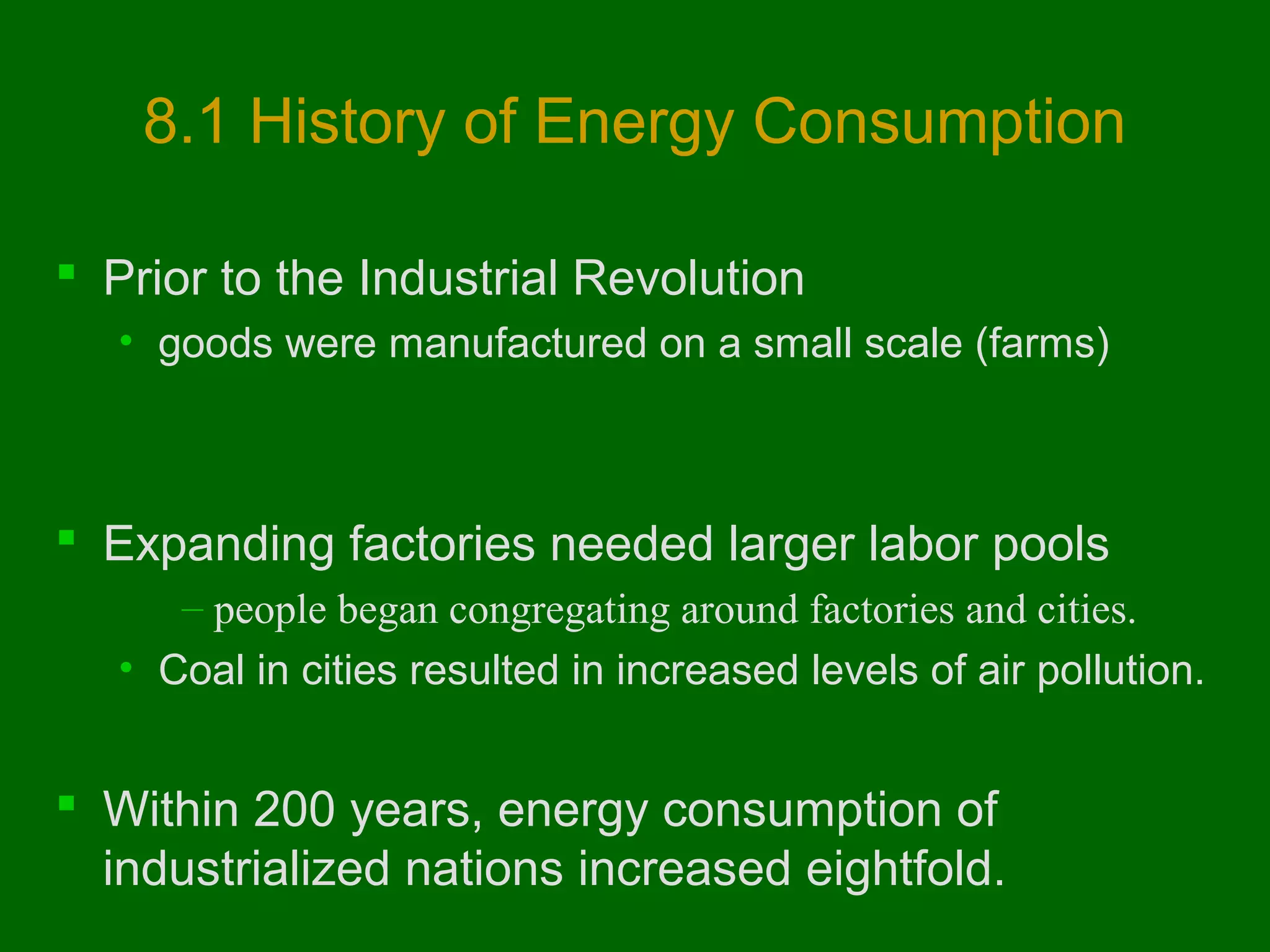
 During the Industrial
Revolution
• machines replaced
human/animal labor in
manufacture and
transportation
• Steam engines (heat
energy into forward
motion)
• Countries or regions
without large coal
deposits left behind.
8.1 History of Energy Consumption
 Prior to the Industrial Revolution
• goods were manufactured on a small scale (farms)

 Expanding factories needed larger labor pools
– people began congregating around factories and cities.
• Coal in cities resulted in increased levels of air pollution.

 Within 200 years, energy consumption of
industrialized nations increased eightfold.
8.1 History of Energy Consumption

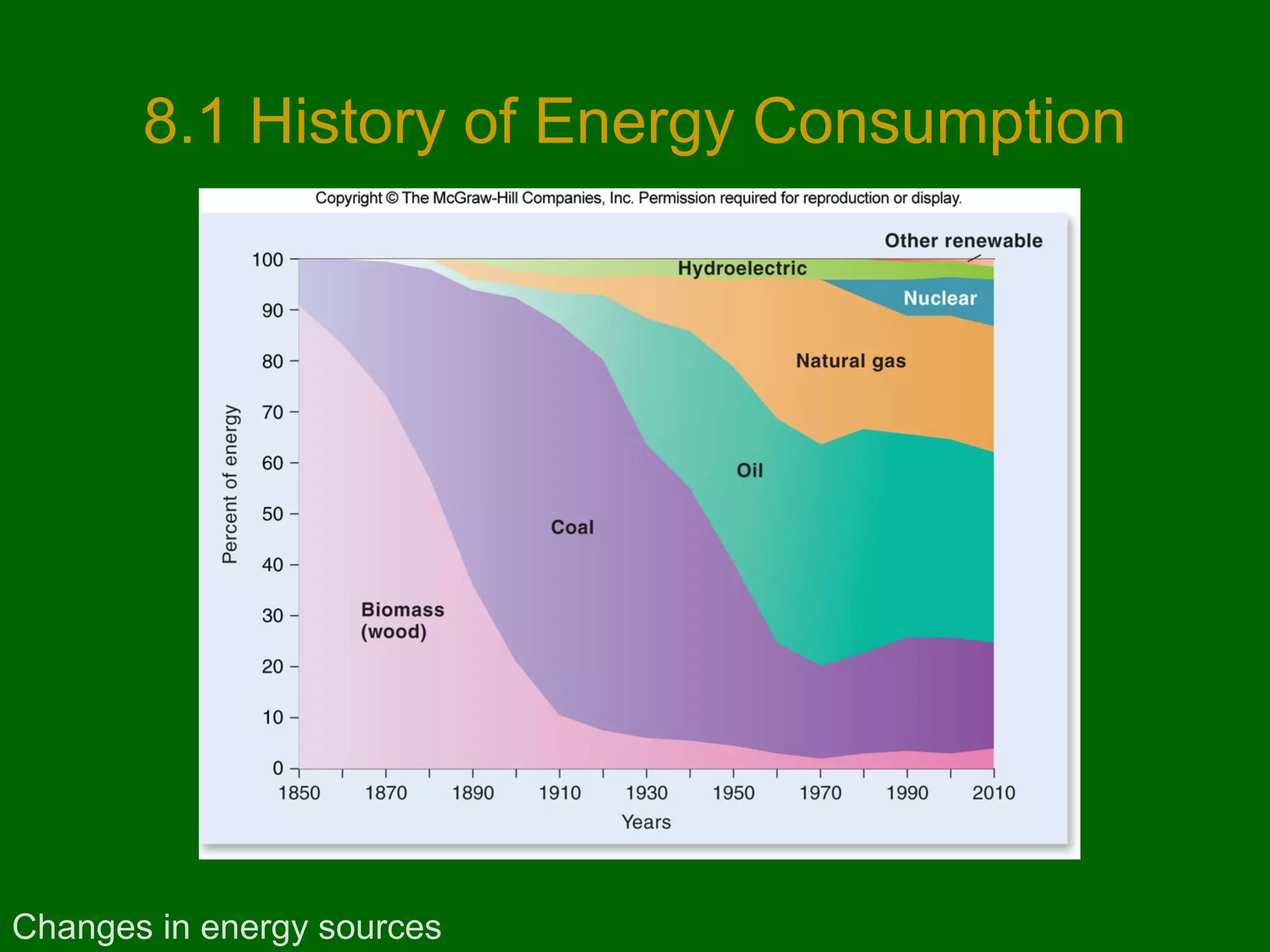
Changes in energy sources
8.1 History of Energy Consumption
 The invention of the automobile
• increased the demand for oil products
• 2% in 1900 to 40% in 2010

 Automobile industry led to roadway construction,
which required energy.
•
•
•
•

Better roads---higher speeds.
Higher speeds---bigger, faster cars.
Bigger, faster cars---better roads.
“More chasing more”
8.1 History of Energy Consumption
 More cars
• Job growth in automobile-related industries.
• Major role in development of industrialized nations.
 Cars altered people’s lifestyles:
• Vacationers --greater distances.
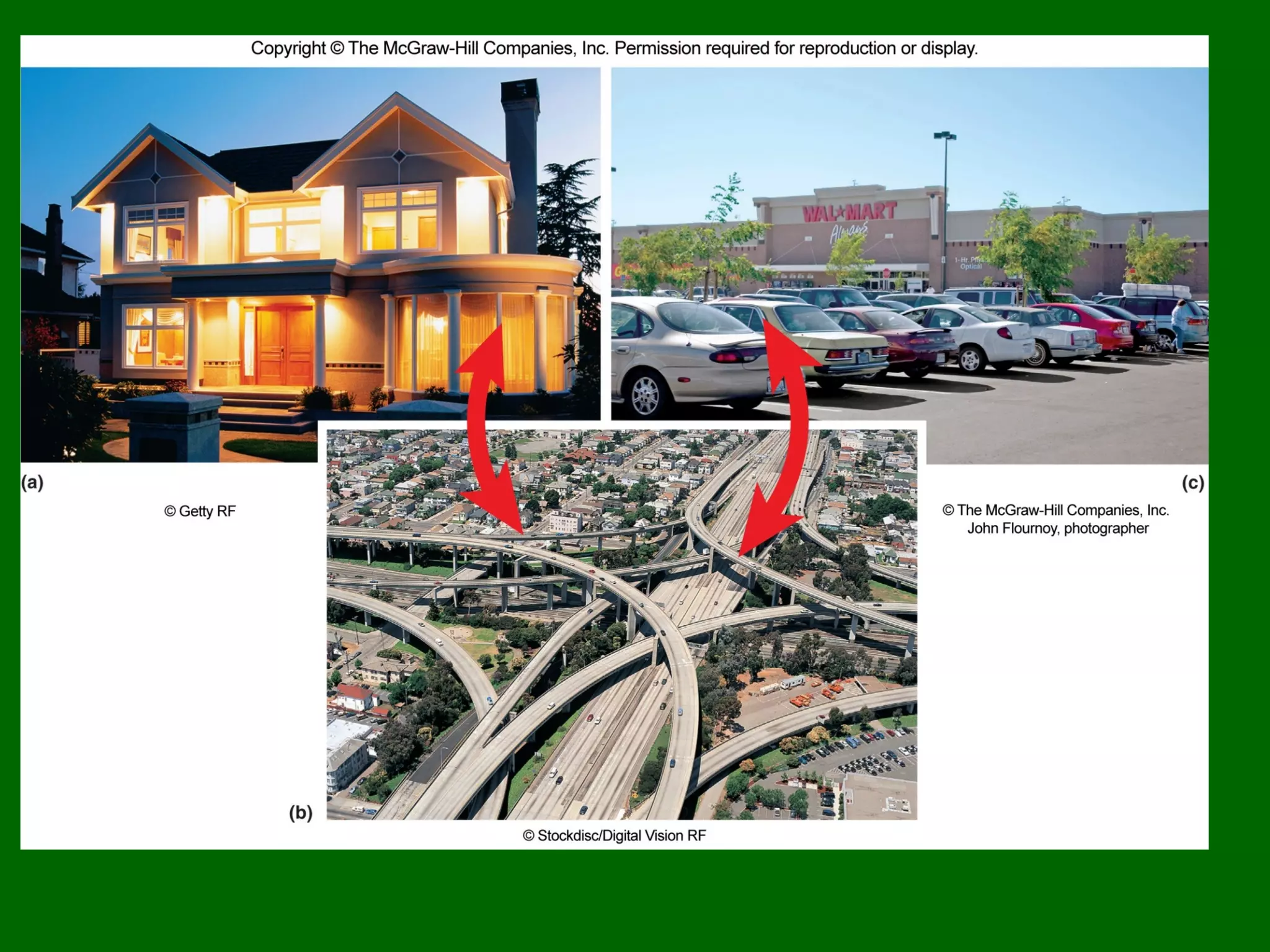
• People could live farther from work
– Led to cities and suburbs.
– labor-saving, energy-consuming devices became
essential
– Energy dependent
Discussion
 http://www.cbsnews.com/news/the-ethanol-solution/
 Page 220 and 230 in text
8.2 How Energy Is Used
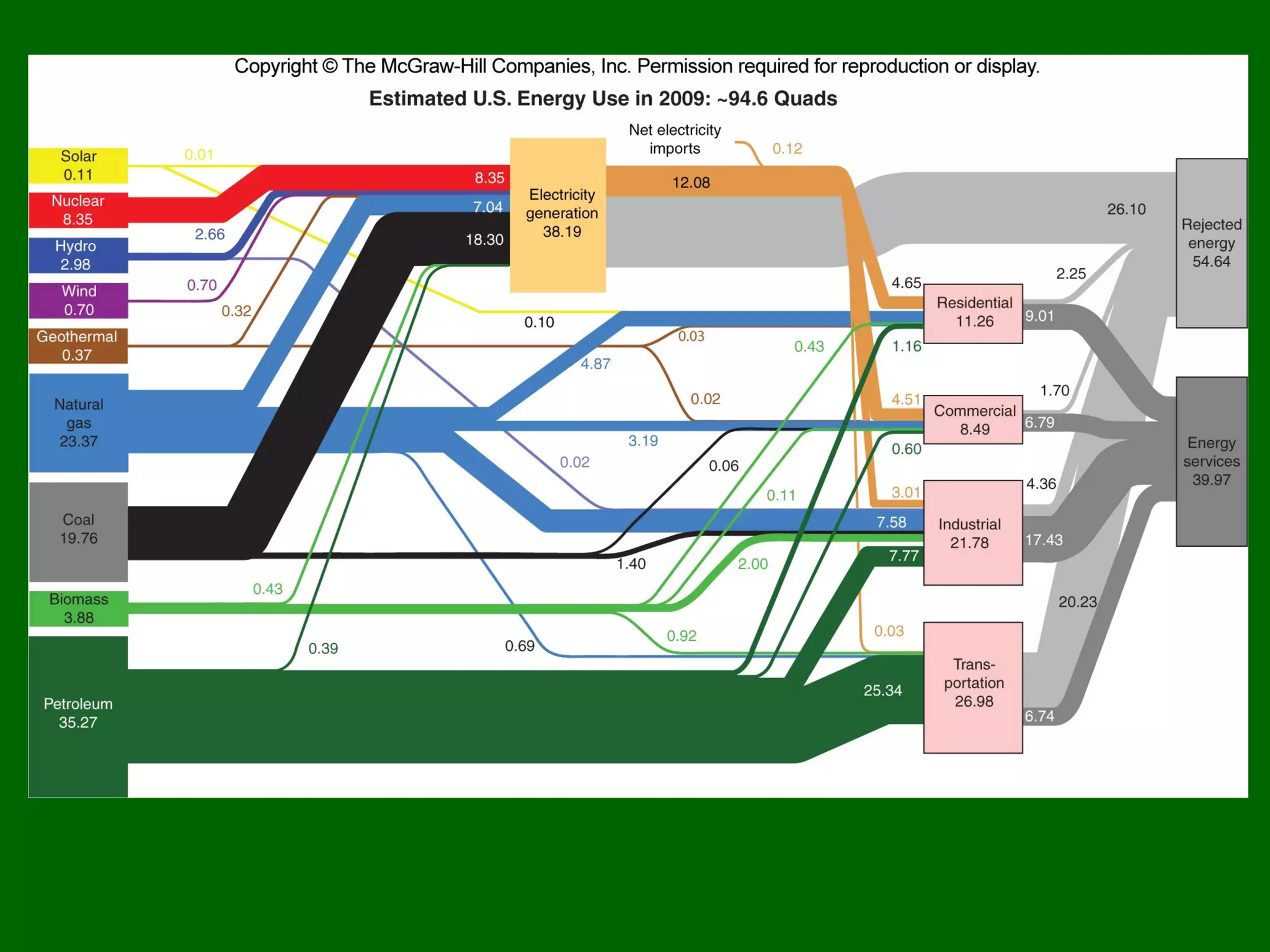
 Industrialized nations use energy roughly equally
for:
• Residential / commercial uses
• Industrial uses
• Transportation

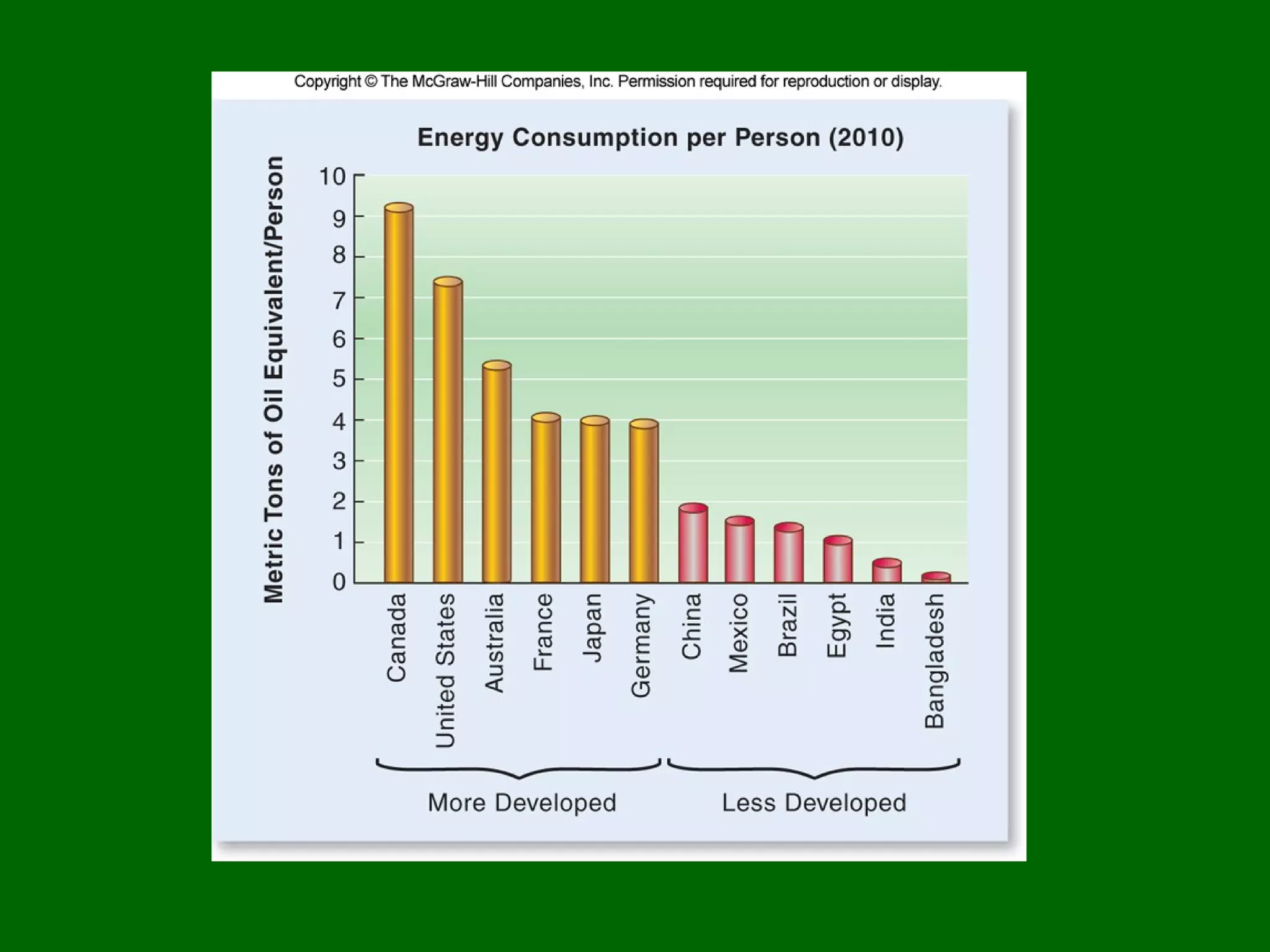
 Less-developed countries--residential purposes.
• Cooking and heating

 Developing countries--develop industry.
8.2 How Energy Is Used
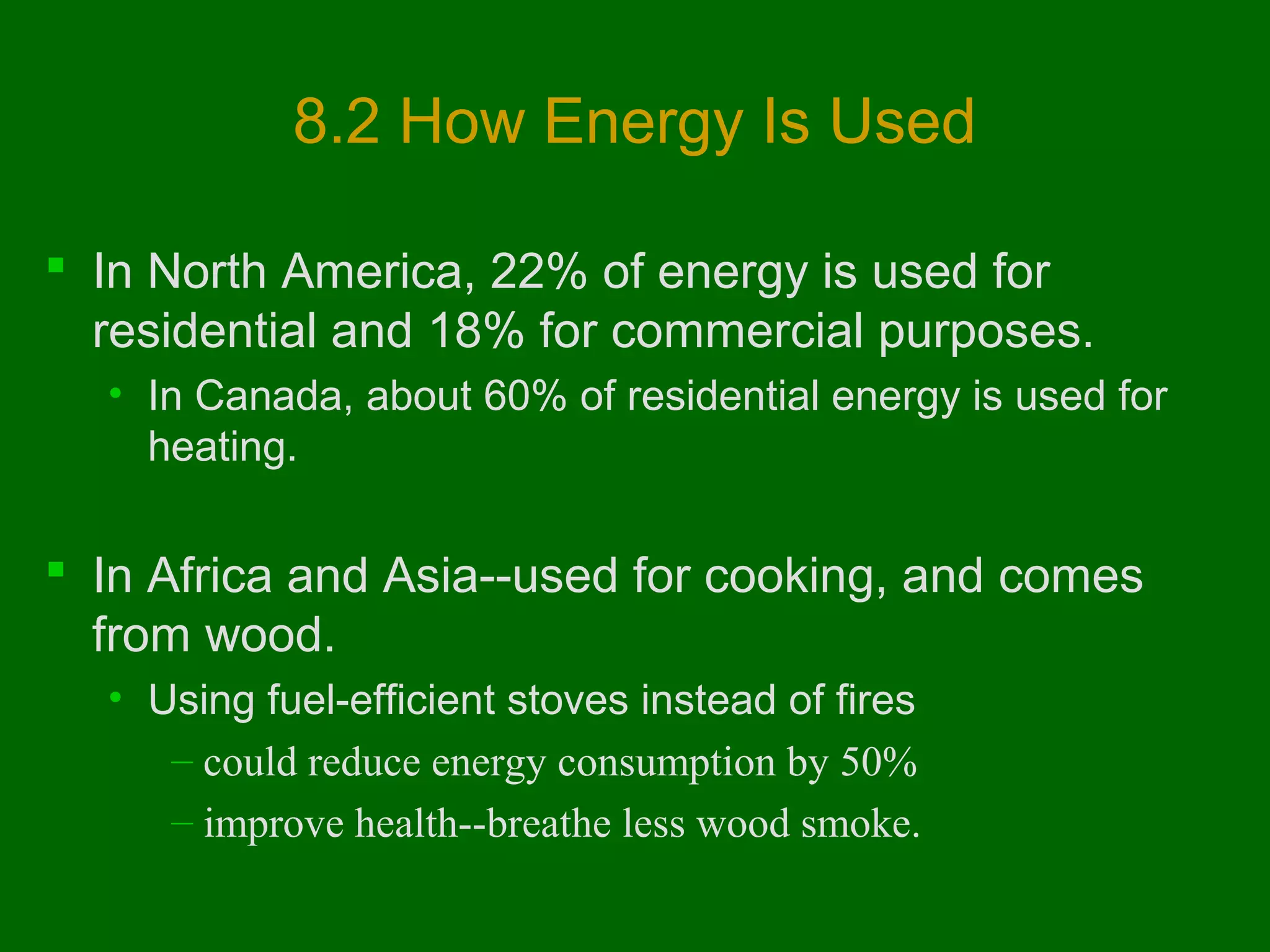
 In North America, 22% of energy is used for
residential and 18% for commercial purposes.
• In Canada, about 60% of residential energy is used for
heating.

 In Africa and Asia--used for cooking, and comes
from wood.
• Using fuel-efficient stoves instead of fires
– could reduce energy consumption by 50%
– improve health--breathe less wood smoke.
Transportation Energy Uses
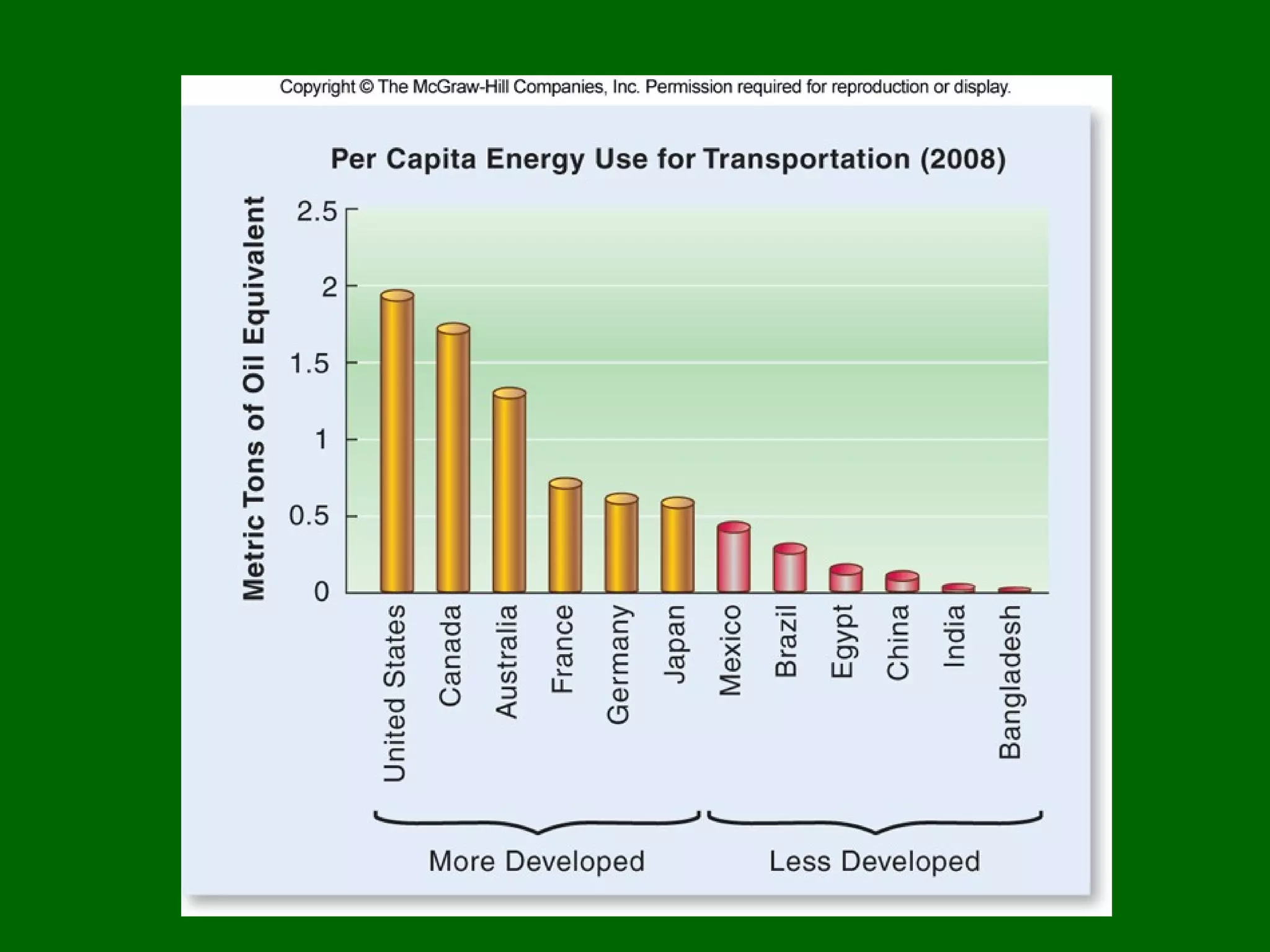
 Per capita energy use for transportation is
• high in developing countries
• highest in highly developed countries

• The specific combination
– bus, rail, waterways, and private automobiles
– main factor in determining a country’s energy use for
transportation.
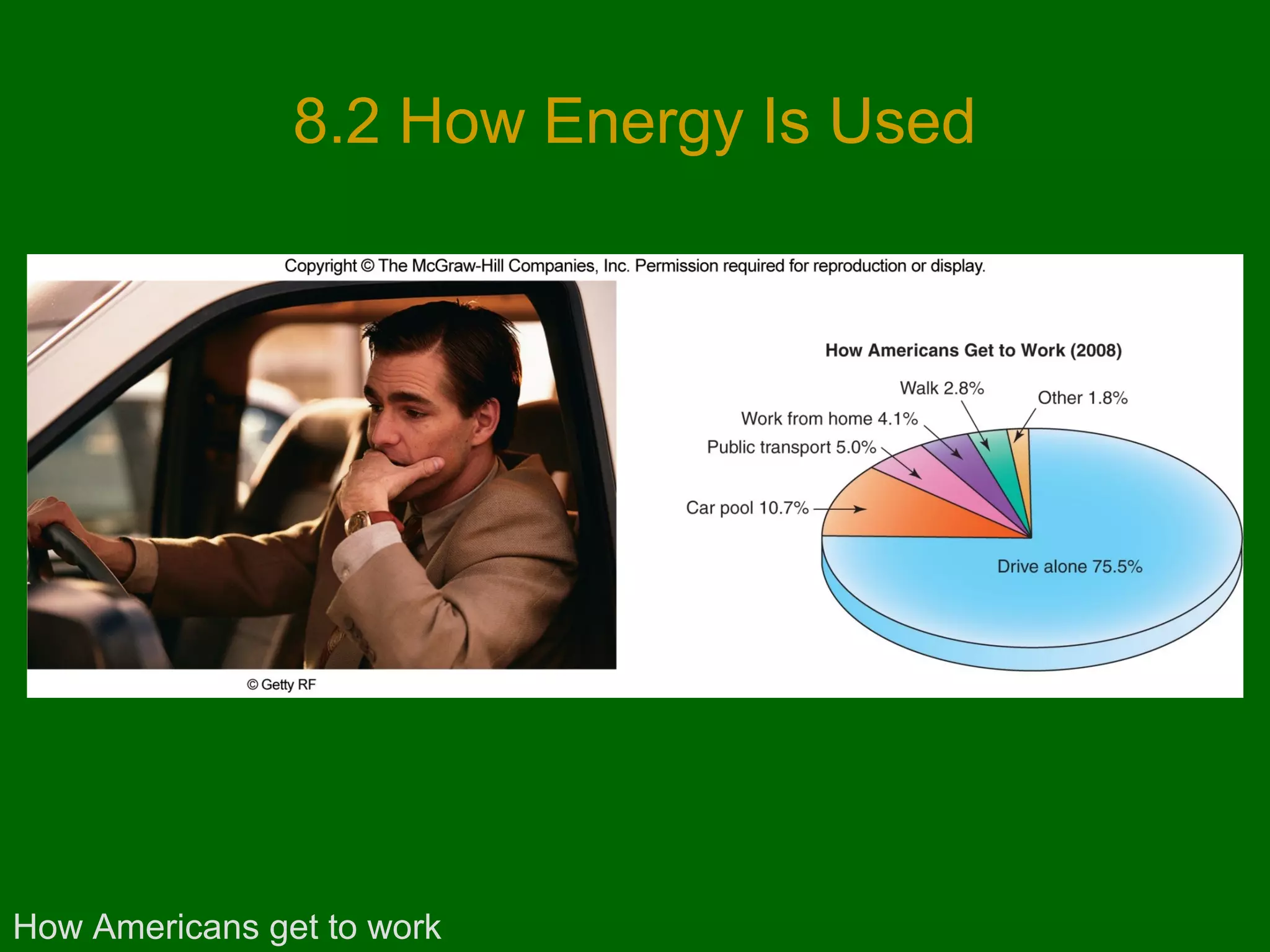
8.2 How Energy Is Used

How Americans get to work
8.3 Electrical Energy
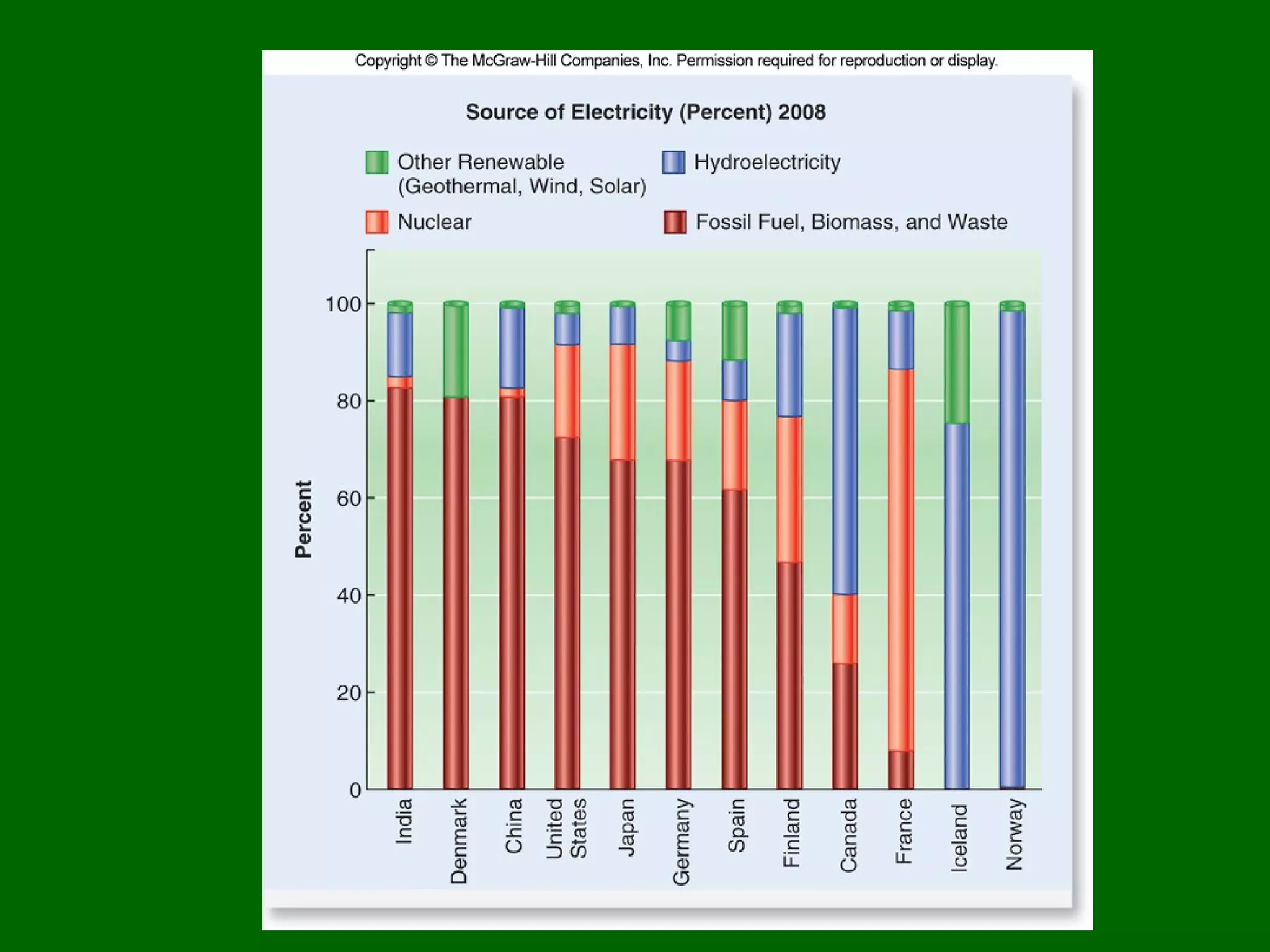
 Most electrical energy
• burning fossil fuels.

 Electricity is easily transported
• uses are so varied
• electricity is a major world energy source
• Industrialized nations have 20% of the world’s
population, but use 55% of the world’s electricity.
8.4 The Economics and Politics
of Energy Use
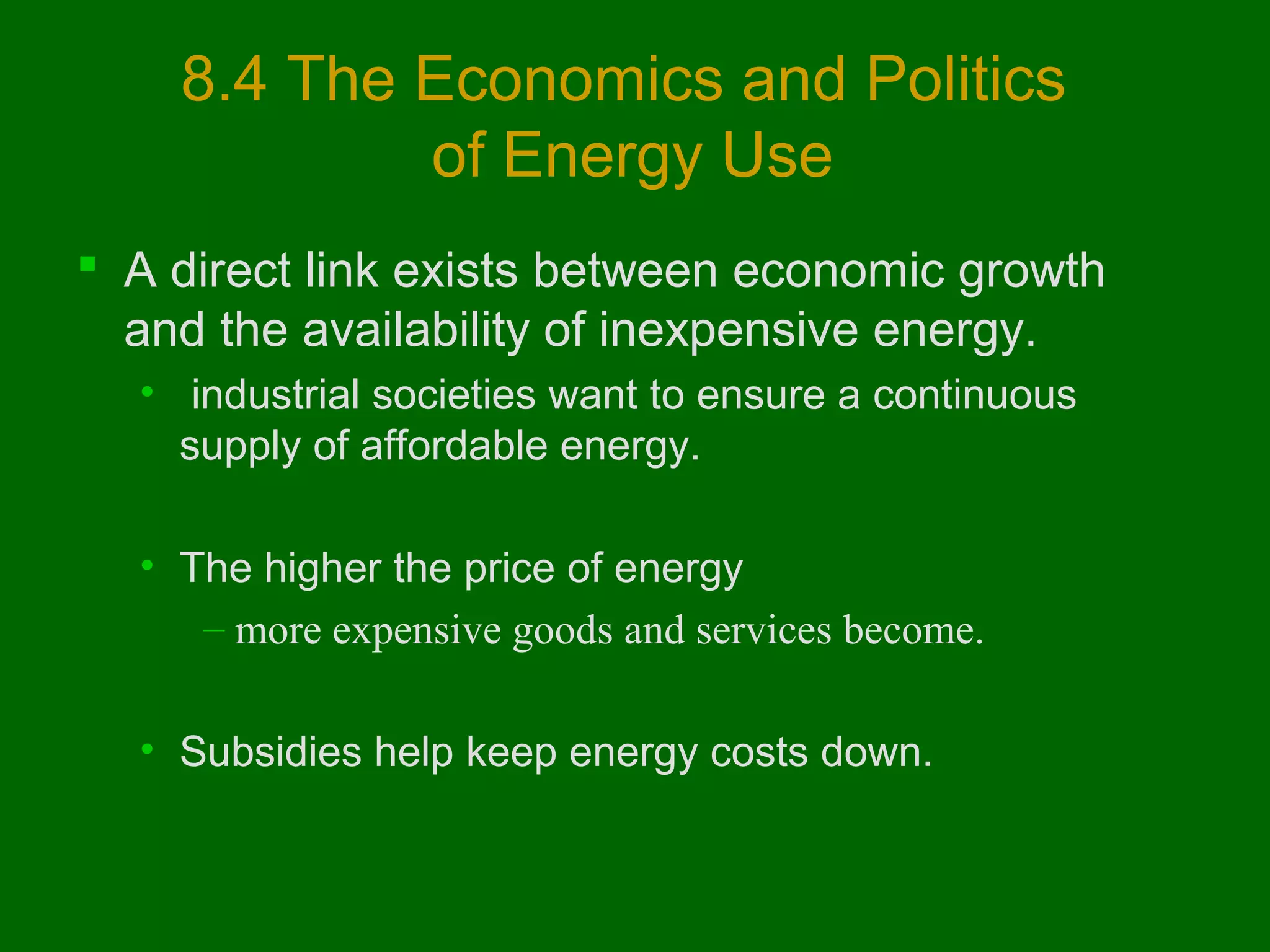
 A direct link exists between economic growth
and the availability of inexpensive energy.
• industrial societies want to ensure a continuous
supply of affordable energy.
• The higher the price of energy
– more expensive goods and services become.
• Subsidies help keep energy costs down.
8.4 The Economics and Politics
of Energy Use
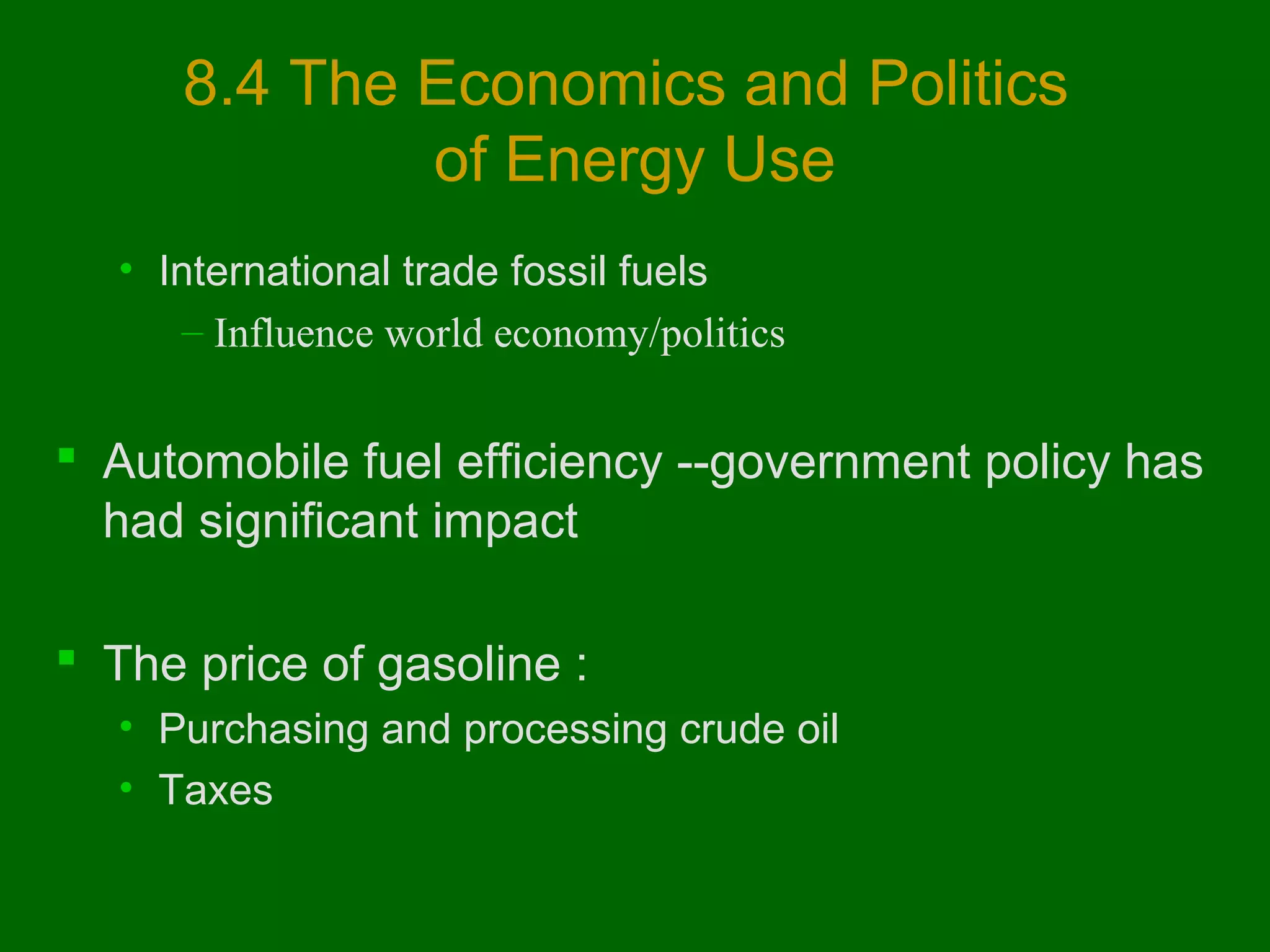
• International trade fossil fuels
– Influence world economy/politics

 Automobile fuel efficiency --government policy has
had significant impact
 The price of gasoline :
• Purchasing and processing crude oil
• Taxes
8.4 The Economics and Politics
of Energy Use
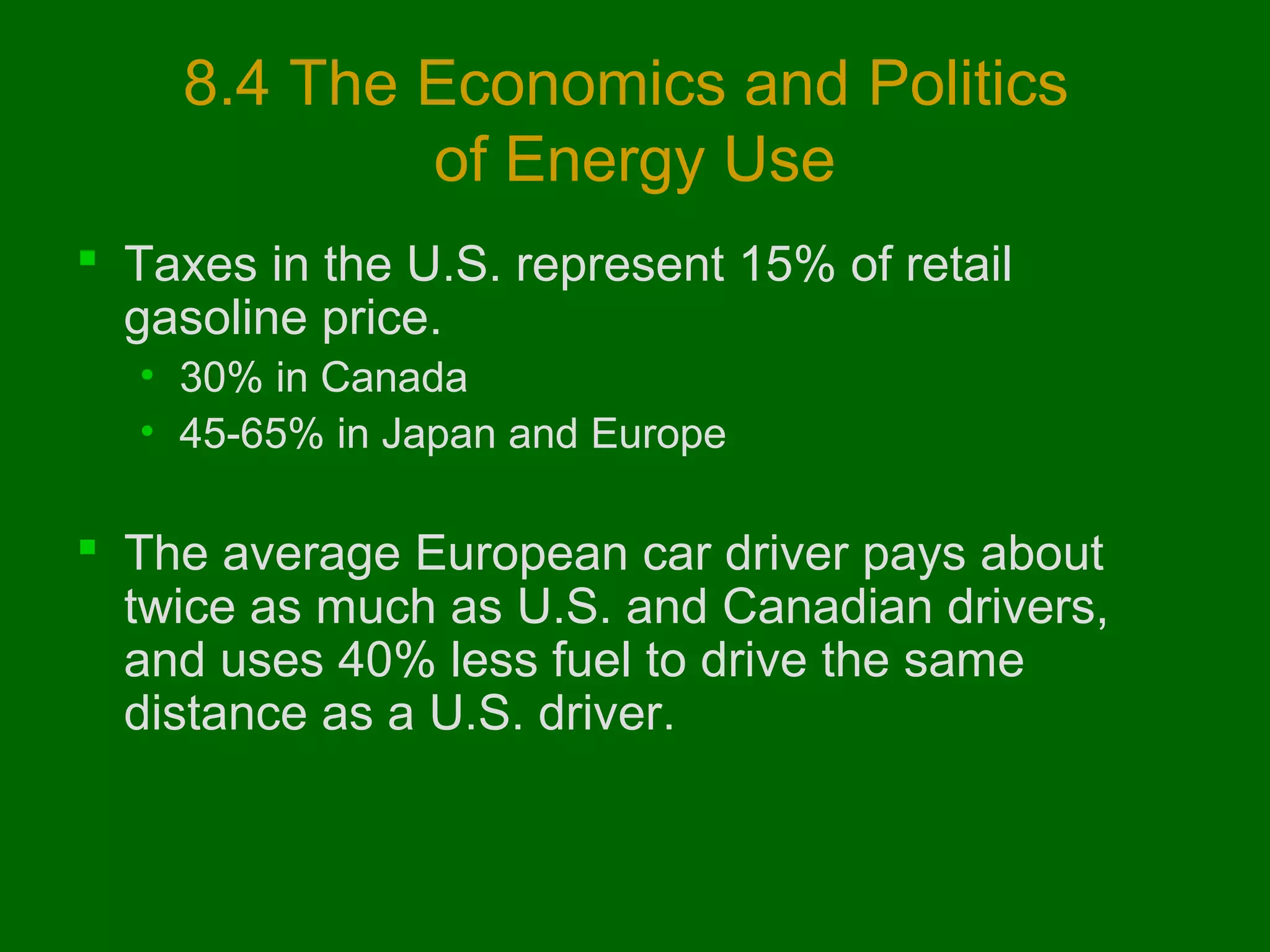
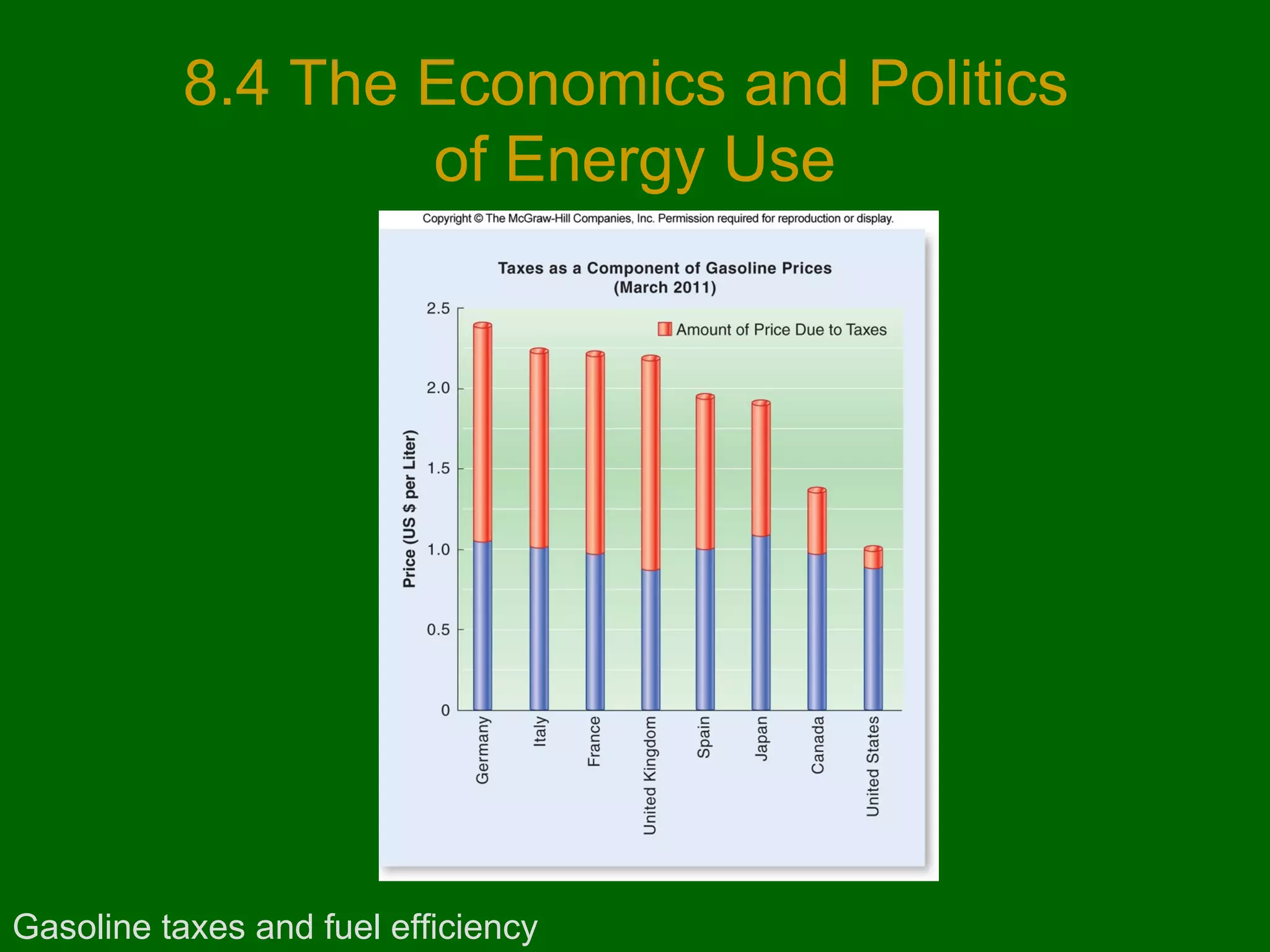
 Taxes in the U.S. represent 15% of retail
gasoline price.
• 30% in Canada
• 45-65% in Japan and Europe

 The average European car driver pays about
twice as much as U.S. and Canadian drivers,
and uses 40% less fuel to drive the same
distance as a U.S. driver.
8.4 The Economics and Politics
of Energy Use

Gasoline taxes and fuel efficiency
8.4 The Economics and Politics
of Energy Use
 Governments often charge road users to help build
and repair roads by taxing fuel.
• U.S. only raises 60% of monies needed for roads from
fuel taxes.
– Low fuel costs in the U.S. encourage more travel, which
increases road repair costs.
Kyoto Treaty
 Kyoto Treaty
• The Kyoto Protocol was adopted in Kyoto, Japan, on
December 1997 and entered into force on February
2005
–  37 industrialized countries and the European 
Community committed to reduce GHG emissions
• Mandates reductions in carbon dioxide into
atmosphere
• U.S. has not signed into treaty
8.4 The Economics and Politics
of Energy Use
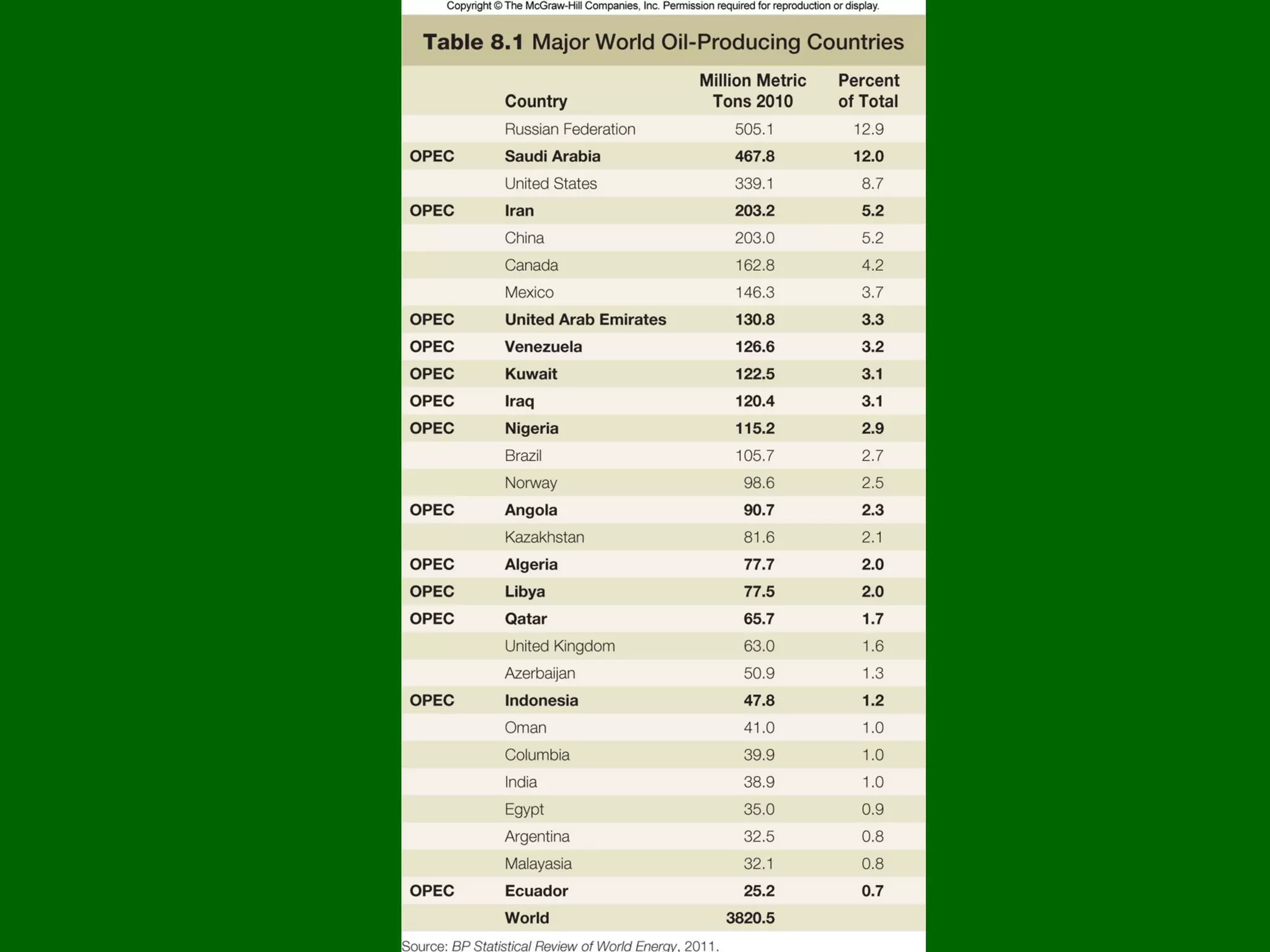
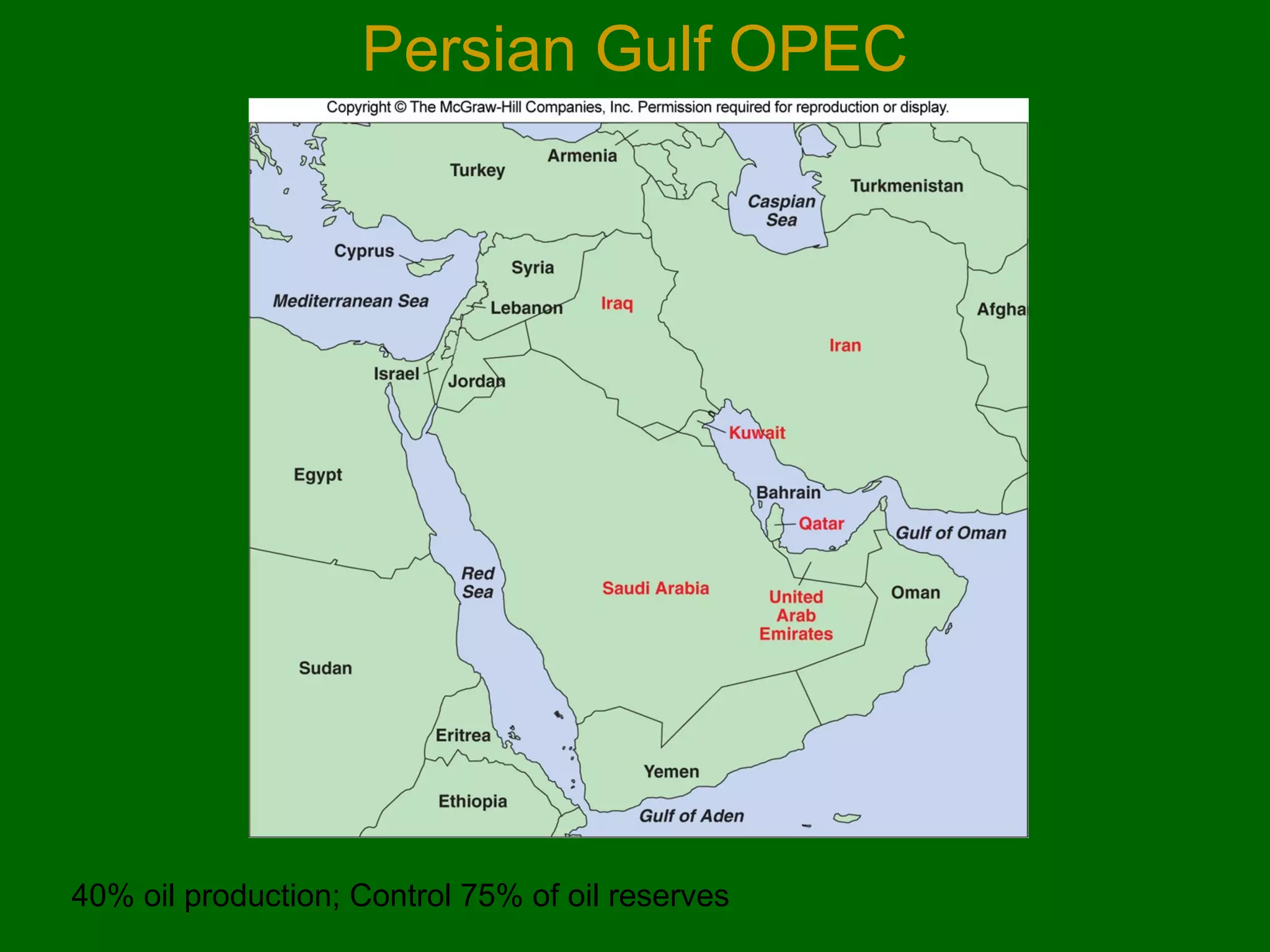
 The Organization of Petroleum Exporting
Countries (OPEC) consists of 13 countries.
 OPEC nations control over 75% of the world’s
estimated oil reserves (1,400 billion barrels).
 With increased solidarity among OPEC
countries,
• oil prices have continued to rise and reached over
$147 per barrel in 2008
• before falling at the end of 2008
– world economy entered a recession.
Persian Gulf OPEC

40% oil production; Control 75% of oil reserves
8.5 Energy Consumption Trends
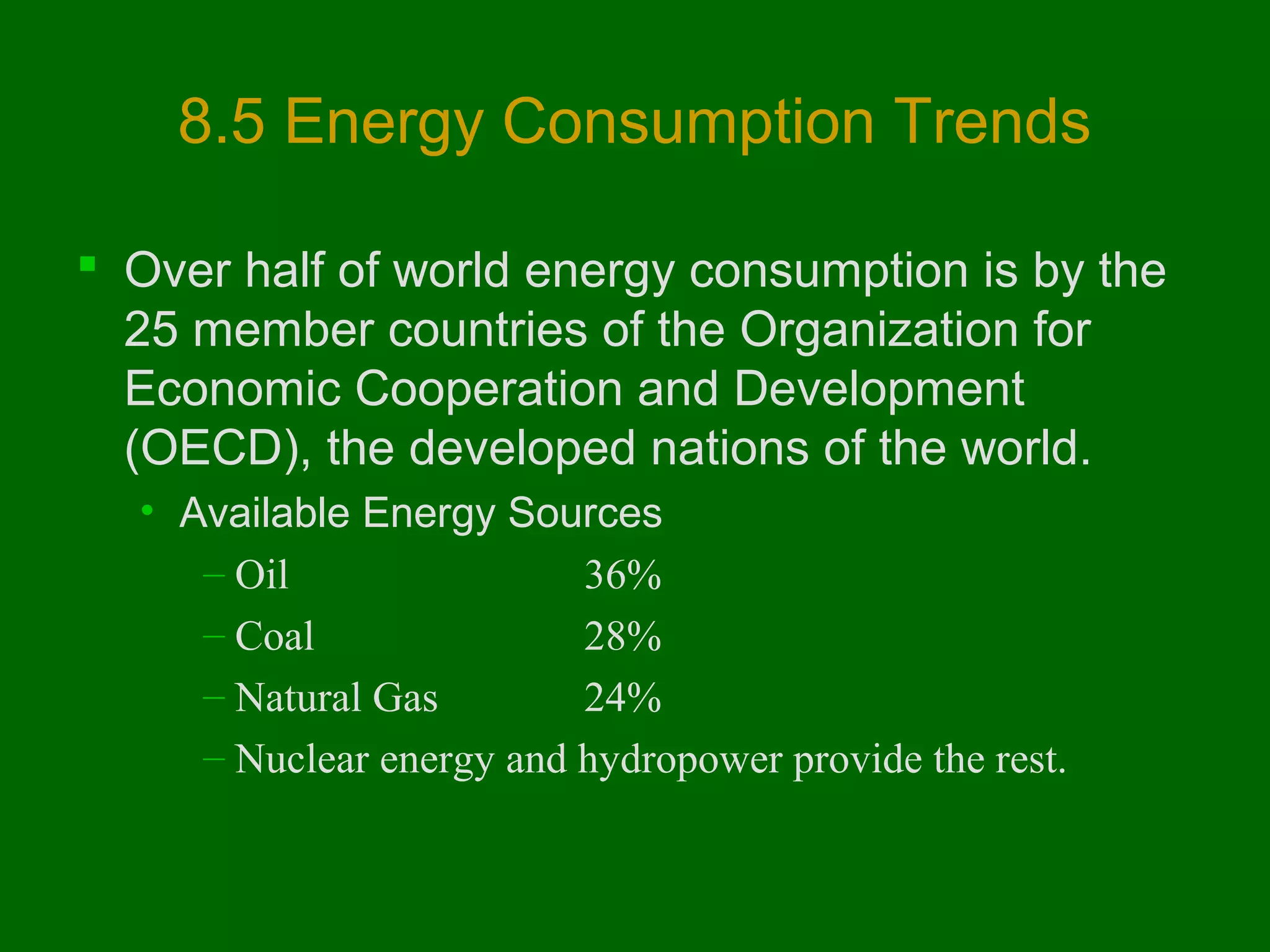
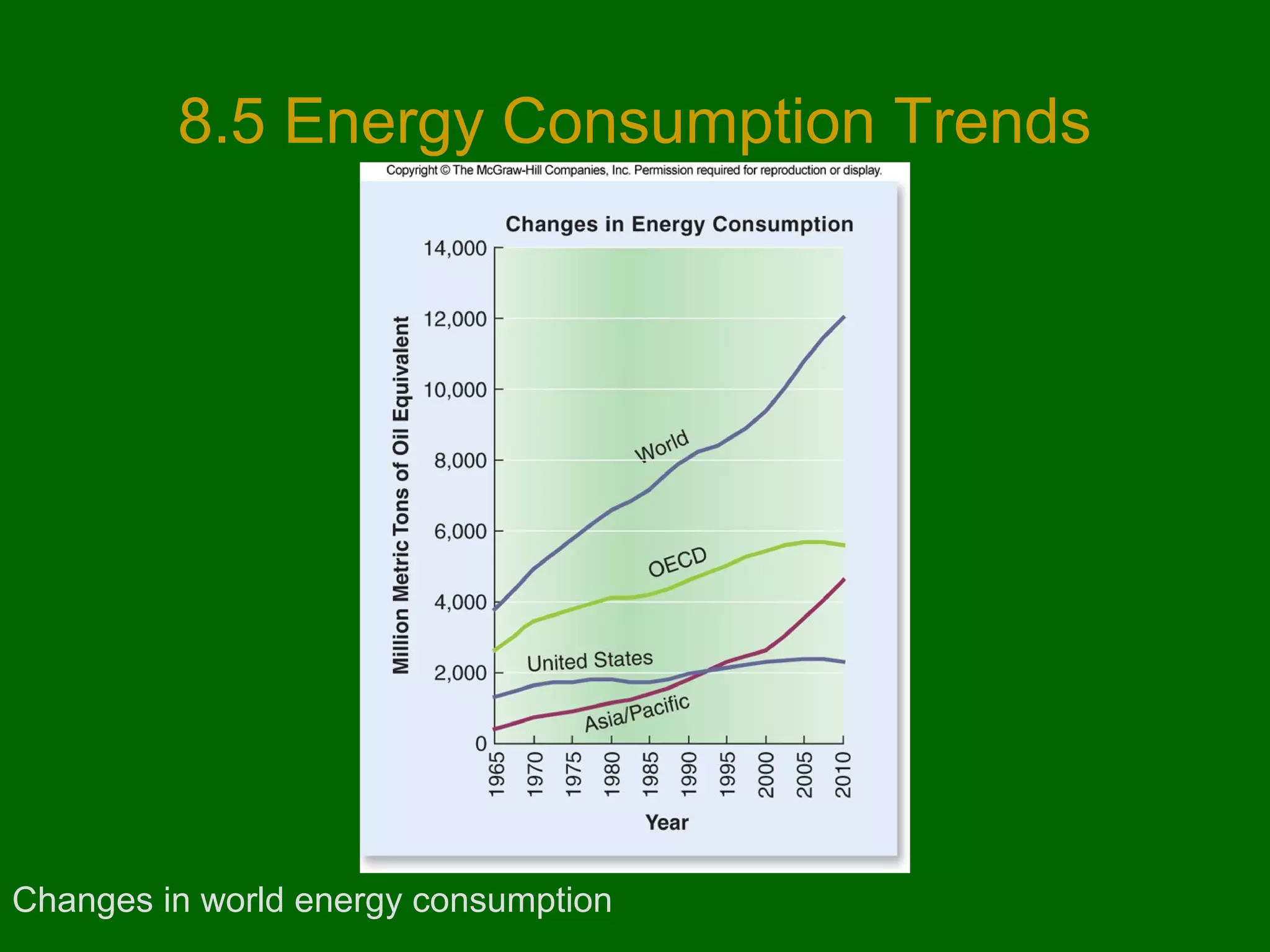
 Over half of world energy consumption is by the
25 member countries of the Organization for
Economic Cooperation and Development
(OECD), the developed nations of the world.
• Available Energy Sources
– Oil 
36%
– Coal
28%
– Natural Gas
24%
– Nuclear energy and hydropower provide the rest.
8.5 Energy Consumption Trends

Changes in world energy consumption
Summary
 A direct correlation exists between the amount of
energy used and the complexity of civilizations.
 Fossil-fuel consumption in conjunction with the
invention of labor-saving machines resulted in the
Industrial Revolution, which led to the development
of technology-oriented societies today in the
developed world.
 The invention of the automobile caused major
changes in the lifestyles of people that led to
greater consumption of energy.
Summary
 Because of the high dependence of modern
societies on oil as a source of energy, OPEC
countries can set the price of oil through
collective action.
 In general, rich countries use large amounts of
energy and poor countries use much less.
 Analysts expect the worldwide demand for
energy to increase steadily and the growth in
energy usage by those countries becoming
industrialized to be greater than that of alreadyindustrialized nations.
FUEL
 http://topdocumentaryfilms.com/fuel/

Intro to energy lecture 6

  • 1.
    Environmental Science A Studyof Interrelationships Thirteenth Edition Enger & Smith Chapter 8 Energy and Civilization: Patterns of Consumption Copyright © The McGraw-Hill Companies, Inc. Permission required for reproduction or display.
  • 2.
  • 3.
    8.1 History ofEnergy Consumption  Pre Industrial revolution • Biological energy sources – Initial energy transfer--photosynthesis. – Very early in human history – Hunter/gatherers
  • 4.
    8.1 History ofEnergy Consumption  Exploit additional energy sources  Domesticated animals/plants  Use of wood  Heating  Cooking
  • 5.
    8.1 History ofEnergy Consumption • Increased Use of Wood – Dense, rapidly growing settlements outstripped wood production – new fuel sources such as coal
  • 6.
    8.1 History ofEnergy Consumption  Fossil Fuels • modified remains of plants, animals, microorganisms that lived million of years ago  Coal • 286-362 million years ago • Plant material under heat/pressure  Oil and natural gas • one-celled marine organisms.
  • 7.
    8.1 History ofEnergy Consumption  During the Industrial Revolution • machines replaced human/animal labor in manufacture and transportation • Steam engines (heat energy into forward motion) • Countries or regions without large coal deposits left behind.
  • 8.
    8.1 History ofEnergy Consumption  Prior to the Industrial Revolution • goods were manufactured on a small scale (farms)  Expanding factories needed larger labor pools – people began congregating around factories and cities. • Coal in cities resulted in increased levels of air pollution.  Within 200 years, energy consumption of industrialized nations increased eightfold.
  • 9.
    8.1 History ofEnergy Consumption Changes in energy sources
  • 10.
    8.1 History ofEnergy Consumption  The invention of the automobile • increased the demand for oil products • 2% in 1900 to 40% in 2010  Automobile industry led to roadway construction, which required energy. • • • • Better roads---higher speeds. Higher speeds---bigger, faster cars. Bigger, faster cars---better roads. “More chasing more”
  • 11.
    8.1 History ofEnergy Consumption  More cars • Job growth in automobile-related industries. • Major role in development of industrialized nations.  Cars altered people’s lifestyles: • Vacationers --greater distances. • People could live farther from work – Led to cities and suburbs. – labor-saving, energy-consuming devices became essential – Energy dependent
  • 13.
  • 14.
    8.2 How EnergyIs Used  Industrialized nations use energy roughly equally for: • Residential / commercial uses • Industrial uses • Transportation  Less-developed countries--residential purposes. • Cooking and heating  Developing countries--develop industry.
  • 16.
    8.2 How EnergyIs Used  In North America, 22% of energy is used for residential and 18% for commercial purposes. • In Canada, about 60% of residential energy is used for heating.  In Africa and Asia--used for cooking, and comes from wood. • Using fuel-efficient stoves instead of fires – could reduce energy consumption by 50% – improve health--breathe less wood smoke.
  • 18.
    Transportation Energy Uses Per capita energy use for transportation is • high in developing countries • highest in highly developed countries • The specific combination – bus, rail, waterways, and private automobiles – main factor in determining a country’s energy use for transportation.
  • 20.
    8.2 How EnergyIs Used How Americans get to work
  • 21.
    8.3 Electrical Energy Most electrical energy • burning fossil fuels.  Electricity is easily transported • uses are so varied • electricity is a major world energy source • Industrialized nations have 20% of the world’s population, but use 55% of the world’s electricity.
  • 23.
    8.4 The Economicsand Politics of Energy Use  A direct link exists between economic growth and the availability of inexpensive energy. • industrial societies want to ensure a continuous supply of affordable energy. • The higher the price of energy – more expensive goods and services become. • Subsidies help keep energy costs down.
  • 24.
    8.4 The Economicsand Politics of Energy Use • International trade fossil fuels – Influence world economy/politics  Automobile fuel efficiency --government policy has had significant impact  The price of gasoline : • Purchasing and processing crude oil • Taxes
  • 25.
    8.4 The Economicsand Politics of Energy Use  Taxes in the U.S. represent 15% of retail gasoline price. • 30% in Canada • 45-65% in Japan and Europe  The average European car driver pays about twice as much as U.S. and Canadian drivers, and uses 40% less fuel to drive the same distance as a U.S. driver.
  • 26.
    8.4 The Economicsand Politics of Energy Use Gasoline taxes and fuel efficiency
  • 27.
    8.4 The Economicsand Politics of Energy Use  Governments often charge road users to help build and repair roads by taxing fuel. • U.S. only raises 60% of monies needed for roads from fuel taxes. – Low fuel costs in the U.S. encourage more travel, which increases road repair costs.
  • 28.
    Kyoto Treaty  KyotoTreaty • The Kyoto Protocol was adopted in Kyoto, Japan, on December 1997 and entered into force on February 2005 –  37 industrialized countries and the European  Community committed to reduce GHG emissions • Mandates reductions in carbon dioxide into atmosphere • U.S. has not signed into treaty
  • 29.
    8.4 The Economicsand Politics of Energy Use  The Organization of Petroleum Exporting Countries (OPEC) consists of 13 countries.  OPEC nations control over 75% of the world’s estimated oil reserves (1,400 billion barrels).  With increased solidarity among OPEC countries, • oil prices have continued to rise and reached over $147 per barrel in 2008 • before falling at the end of 2008 – world economy entered a recession.
  • 31.
    Persian Gulf OPEC 40%oil production; Control 75% of oil reserves
  • 32.
    8.5 Energy ConsumptionTrends  Over half of world energy consumption is by the 25 member countries of the Organization for Economic Cooperation and Development (OECD), the developed nations of the world. • Available Energy Sources – Oil  36% – Coal 28% – Natural Gas 24% – Nuclear energy and hydropower provide the rest.
  • 33.
    8.5 Energy ConsumptionTrends Changes in world energy consumption
  • 34.
    Summary  A directcorrelation exists between the amount of energy used and the complexity of civilizations.  Fossil-fuel consumption in conjunction with the invention of labor-saving machines resulted in the Industrial Revolution, which led to the development of technology-oriented societies today in the developed world.  The invention of the automobile caused major changes in the lifestyles of people that led to greater consumption of energy.
  • 35.
    Summary  Because ofthe high dependence of modern societies on oil as a source of energy, OPEC countries can set the price of oil through collective action.  In general, rich countries use large amounts of energy and poor countries use much less.  Analysts expect the worldwide demand for energy to increase steadily and the growth in energy usage by those countries becoming industrialized to be greater than that of alreadyindustrialized nations.
  • 36.