ANIMAL ADAPTATIONS
REMEMBERING
HOW TALL CAN A GIRAFFE GROW?
 Giraffes can grow to 14-19 feet long
 Their legs can be 6 feet long alone and their neck can be even longer
UNDERSTANDING
WHAT WOULD AN ALIEN HAVE TO CHANGE TO
ADAPT ON EARTH?
You need to adapt to have hands and claws to walk and claws to grab and kill prey, some sort of
defence to protect yourself from predators, teeth to eat prey and some sort of defence against the sun
and rain.
APPLYING
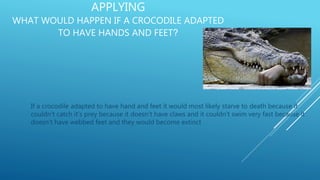
WHAT WOULD HAPPEN IF A CROCODILE ADAPTED
TO HAVE HANDS AND FEET?
If a crocodile adapted to have hand and feet it would most likely starve to death because it
couldn't catch it’s prey because it doesn't have claws and it couldn't swim very fast because it
doesn’t have webbed feet and they would become extinct
ANALYZING
HOW HIGH CAN A HUMAN JUMP ON DIFFERENT
PLANETS?
A human can jump different planets like mars you can jump
79.255319ft on mercury you can jump 78.421052ft on Pluto you can
jump 359.03614ft you can jump different heights on different
planets moons comets and asteroids all you have to do is measure
how high you can jump than divide how high you jump by the
gravity of the planet , comet, moon and asteroid
EVALUATING
WHICH IS MORE IMPORTANT ANIMALS OR
HUMANS SURVIVING?
 I think it’s better that animals survive more than humans because
humans are taking to many resources endangering other animals
and other primates may evolve to be like us and protect other
animal species from being extinct
CREATING
COULD YOU CREATE AN ENVIRONMENT THAT IS
PERFECT FOR 10 ANIMALS FROM DIFFERENT
ENVIRONMENTS?
The animals are a cheetah, a buffalo, a snowy owl, a king cobra, an
anteater, army ants, a fish eagle, fish, whale and some wolves.
No you can not create a perfect environment for these 10 animals
but they can all live together in and adapt to an environment that
has grasslands, trees, temperate climate, fertile soil, salt water &
fresh water .
UNDERSTANDING THE NATURAL HABITAT OF THE 10
ANIMALS & THEIR ABILITY TO ADAPT
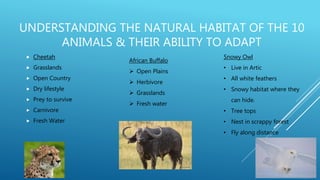
 Cheetah
 Grasslands
 Open Country
 Dry lifestyle
 Prey to survive
 Carnivore
 Fresh Water
African Buffalo
 Open Plains
 Herbivore
 Grasslands
 Fresh water
Snowy Owl
• Live in Artic
• All white feathers
• Snowy habitat where they
can hide.
• Tree tops
• Nest in scrappy forest
• Fly along distance
UNDERSTANDING THE NATURAL HABITAT OF THE 10
ANIMALS & THEIR ABILITY TO ADAPT
King Cobra
 Carnivore
 Rainforest &
plains of Asia
 Change Colour to
adapt
 Live in trees
 Live on land
 Can be in water
Giant Ant Eater
• Grasslands
• Humid forest
• Woodlands
• Eats termites
and fruit
Army Ants
• Build temporary homes
• Migrate
• Nest of hanging trees
• Live in South Africa and
Central America
Fish
• Live in water
• Wetlands
• Coral Reefs
• Seagrasses
• Rivers
UNDERSTANDING THE NATURAL HABITAT OF THE 10
ANIMALS & THEIR ABILITY TO ADAPT
 Fish Eagle
 Lives in a variety of
habitats
 Eats fish –any size
 Lives next to water
 Dry spells will eat
insects, dead animals,
small birds
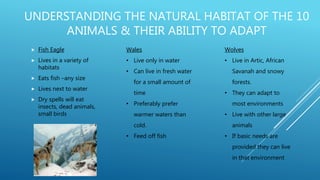
Wales
• Live only in water
• Can live in fresh water
for a small amount of
time
• Preferably prefer
warmer waters than
cold.
• Feed off fish
Wolves
• Live in Artic, African
Savanah and snowy
forests.
• They can adapt to
most environments
• Live with other large
animals
• If basic needs are
provided they can live
in that environment
SO CAN THEY ALL LIVE TOGETHER IN A
PERFECT ENVIRONMENT?
Whilst all these animals generally live in different environments it may be possible for them to
adapt to living together in a modified environment. The environment would need to have a
moderate climate, grasslands, fresh and salt water.
They all would have to adapt to not only their new environment but the possibility of new
predators and other dangers they haven’t faced before.
THE END
BY JACK FOWLER

Animal adaptations by jack

  • 1.
  • 2.
    REMEMBERING HOW TALL CANA GIRAFFE GROW?  Giraffes can grow to 14-19 feet long  Their legs can be 6 feet long alone and their neck can be even longer
  • 3.
    UNDERSTANDING WHAT WOULD ANALIEN HAVE TO CHANGE TO ADAPT ON EARTH? You need to adapt to have hands and claws to walk and claws to grab and kill prey, some sort of defence to protect yourself from predators, teeth to eat prey and some sort of defence against the sun and rain.
  • 4.
    APPLYING WHAT WOULD HAPPENIF A CROCODILE ADAPTED TO HAVE HANDS AND FEET? If a crocodile adapted to have hand and feet it would most likely starve to death because it couldn't catch it’s prey because it doesn't have claws and it couldn't swim very fast because it doesn’t have webbed feet and they would become extinct
  • 5.
    ANALYZING HOW HIGH CANA HUMAN JUMP ON DIFFERENT PLANETS? A human can jump different planets like mars you can jump 79.255319ft on mercury you can jump 78.421052ft on Pluto you can jump 359.03614ft you can jump different heights on different planets moons comets and asteroids all you have to do is measure how high you can jump than divide how high you jump by the gravity of the planet , comet, moon and asteroid
  • 6.
    EVALUATING WHICH IS MOREIMPORTANT ANIMALS OR HUMANS SURVIVING?  I think it’s better that animals survive more than humans because humans are taking to many resources endangering other animals and other primates may evolve to be like us and protect other animal species from being extinct
  • 7.
    CREATING COULD YOU CREATEAN ENVIRONMENT THAT IS PERFECT FOR 10 ANIMALS FROM DIFFERENT ENVIRONMENTS? The animals are a cheetah, a buffalo, a snowy owl, a king cobra, an anteater, army ants, a fish eagle, fish, whale and some wolves. No you can not create a perfect environment for these 10 animals but they can all live together in and adapt to an environment that has grasslands, trees, temperate climate, fertile soil, salt water & fresh water .
  • 8.
    UNDERSTANDING THE NATURALHABITAT OF THE 10 ANIMALS & THEIR ABILITY TO ADAPT  Cheetah  Grasslands  Open Country  Dry lifestyle  Prey to survive  Carnivore  Fresh Water African Buffalo  Open Plains  Herbivore  Grasslands  Fresh water Snowy Owl • Live in Artic • All white feathers • Snowy habitat where they can hide. • Tree tops • Nest in scrappy forest • Fly along distance
  • 9.
    UNDERSTANDING THE NATURALHABITAT OF THE 10 ANIMALS & THEIR ABILITY TO ADAPT King Cobra  Carnivore  Rainforest & plains of Asia  Change Colour to adapt  Live in trees  Live on land  Can be in water Giant Ant Eater • Grasslands • Humid forest • Woodlands • Eats termites and fruit Army Ants • Build temporary homes • Migrate • Nest of hanging trees • Live in South Africa and Central America Fish • Live in water • Wetlands • Coral Reefs • Seagrasses • Rivers
  • 10.
    UNDERSTANDING THE NATURALHABITAT OF THE 10 ANIMALS & THEIR ABILITY TO ADAPT  Fish Eagle  Lives in a variety of habitats  Eats fish –any size  Lives next to water  Dry spells will eat insects, dead animals, small birds Wales • Live only in water • Can live in fresh water for a small amount of time • Preferably prefer warmer waters than cold. • Feed off fish Wolves • Live in Artic, African Savanah and snowy forests. • They can adapt to most environments • Live with other large animals • If basic needs are provided they can live in that environment
  • 11.
    SO CAN THEYALL LIVE TOGETHER IN A PERFECT ENVIRONMENT? Whilst all these animals generally live in different environments it may be possible for them to adapt to living together in a modified environment. The environment would need to have a moderate climate, grasslands, fresh and salt water. They all would have to adapt to not only their new environment but the possibility of new predators and other dangers they haven’t faced before.
  • 12.