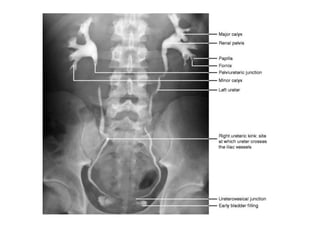
INTRAVENOUS UROGRAPHY
DR MANOJ A
INTRODUCTION
• Radiographic examination of urinary tract
including renal parenchyma, calyces and pelvis
after intravenous injection of contrast media.
• Intravenous pyelogram (IVP) is a misnomer as
it implies visualisation of the pelvis and
calyces without the parenchyma. The term
pyelogram is used for retrograde studies
visualising only the collecting system.
INDICATIONS
Adults
• 1. Screening of entire urinary tract especially in
cases of haematuria or pyuria.
• 2. Diseases of renal collecting system and renal
pelvis.
• 3. Differentiation of function of both kidneys.
• 4. Abnormalities of the ureter.
• 5. Obstructive uropathy-IVU is the gold standard.
• 6. TB of the urinary tract.
• 7. Calculus disease.
• 8. Potential Renal Donors.
• 9. Prior to endo-urological procedures and
surgery of urinary tract.
• 10. Suspected renal injury.
• 11. Renal colic or flank pain.
Children
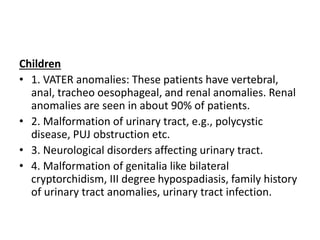
• 1. VATER anomalies: These patients have vertebral,
anal, tracheo oesophageal, and renal anomalies. Renal
anomalies are seen in about 90% of patients.
• 2. Malformation of urinary tract, e.g., polycystic
disease, PUJ obstruction etc.
• 3. Neurological disorders affecting urinary tract.
• 4. Malformation of genitalia like bilateral
cryptorchidism, III degree hypospadiasis, family history
of urinary tract anomalies, urinary tract infection.
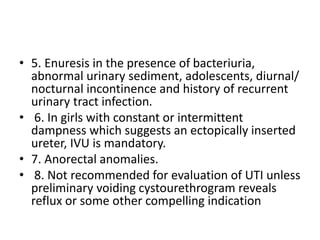
• 5. Enuresis in the presence of bacteriuria,
abnormal urinary sediment, adolescents, diurnal/
nocturnal incontinence and history of recurrent
urinary tract infection.
• 6. In girls with constant or intermittent
dampness which suggests an ectopically inserted
ureter, IVU is mandatory.
• 7. Anorectal anomalies.
• 8. Not recommended for evaluation of UTI unless
preliminary voiding cystourethrogram reveals
reflux or some other compelling indication
CONTRAINDICATIONS
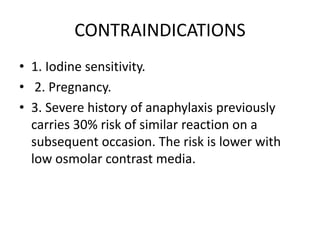
• 1. Iodine sensitivity.
• 2. Pregnancy.
• 3. Severe history of anaphylaxis previously
carries 30% risk of similar reaction on a
subsequent occasion. The risk is lower with
low osmolar contrast media.
RISK FACTORS
• l. Cardiac failure
• 2. Dehydration
• 3. Diabetes with Azotemia
• 4. Previous allergic reaction
• 5. History of Pheochromocytoma
Mode of injection
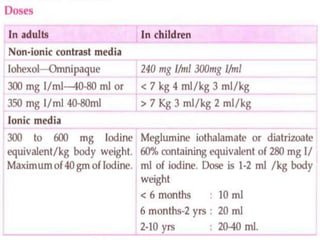
• Contrast media is usually given as a IV. bolus
injection within 30-60 seconds.
• The density of the nephrogram is directly
proportional to the plasma concentration of
contrast media.
• More iodine increases the density of the
nephrogram.
• Large doses of contrast media increase diuresis
which distends the collecting system thus
increasing the diagnostic information from the
urogram.
PREPARATION
• 1. History of Diabetes mellitus, Pheochromocytoma,
Renal disease, or allergy to drugs and any specific
foods.
• 2. Fasting for 4 hours.
• 3. Do not dehydrate the patient.
• 4. Bowel preparation:
Low residue diet
Bowel wash is given till bowel is clear of faecal
matter on the previous night.
Dulcolax (Biscodyl) is given 2-4 tablets
Castor oil -dose of 30-60 ml
For Children
• 1. No paediatric patient should be dehydrated
• 2. Bowel preparation- Suppositories are better
for this purpose. Cleansing enemas are used in
children older than 2 years.
• 3.Child should not be given anything by mouth
for 3-4 hours prior to the procedure.
PROCEDURE
• Patient is placed in supine position.
• Support is placed under patient's knees to
reduce lordotic curvature of lumbosacral spine
and provide comfort.
• scout film is taken including the kidneys,
ureters, bladder and urethral regions.
• Contrast media is injected intravenously.
• Cortical nephrogram is seen within 20 seconds
This depicts the renal parenchyma opacified
by contrast.
• The nephrogram is made up of cortical phase
due to vascular filling and a tubular phase due
to contrast within the lumen of renal tubule.
• Density of the nephrogram depends on the
dose of contrast and the peak plasma level.
• Pyelogram (contrast in calyces) is seen 2
minutes.
• Concentrated as much as 50 times producing
a dense pyelogram.
• kidney fails to excrete detectable amount of
contrast media into collecting system, it is
termed as non-visualising kidney. This does
not necessarily mean that the kidney is not
functioning.
In Children
• Equipment should be capable of short
exposures to avoid motion blurring.
• Usually a moving grid is used.
• Source to image distance- 40 inches or 1
metre.
• Contrast - non-ionic best.
• Dose 1-2 ml/kg.
• Filming: The concentrating ability of the
kidney is not fully developed in neonates, so
delay is given for initial films. First film is taken
15 min after
• Gonadal protective shields should be used.
• If bowel gas obscures the renal region, either
paddle compression technique should be used
or place the child in prone position.
FILMING TECHNIQUE
Standard Films
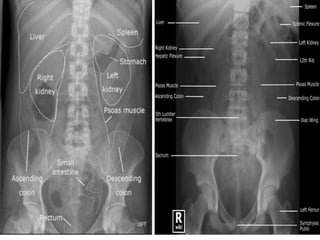
• Plain X-ray KUB /Scout film
• 1 minute
• 5 minute
• 10 minute
• 15 minute
• 35 minute
• Post void
Plain X-ray KUB -Useful in assessing
• Calculus
• Intestinal abnormalities
• Intestinal gas pattern
• Calcification
• Abdominal mass
• Foreign body
• 1 minute film shows nephrogram. This
radiograph is often omitted as the renal
outlines are usually adequately visualised on 5
minute film.
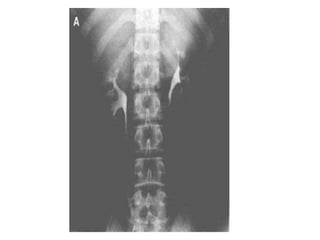
• 5 minute film shows nephrogram, renal pelvis,
upper part of ureter. Compression band is now
applied on patient's abdomen and the balloon
is positioned on anterior superior iliac spine
where ureters cross pelvic brim.
• Compression contraindicated
• 1. Renal trauma
• 2. Large abdominal mass
• 3. Abdominal aneurysm
• 4. After abdominal surgery
• 5. If 5 minute film shows dilated calyces or if
calyces and pelvis are not adequately opacified,
obstruction exists and compression band should
not be applied.
• 15 minute film: Visualisation of ureter is better in
prone position as they fill better.
• This position reverses the curve of the inferior
course of the ureters making it anti-dependent to
gravity.
• Another method to see ureter is modified
trendelenberg technique with 15-20 degrees
head low tilt .
• 35 minute film: It gives complete overview of the
urinary tract ; kidney, ureter, bladder. Bladder
distension can be evaluated.
• Post void film: Taken immediately after voiding. It
is used to assess
• 1. Residual urine
• 2. Bladder mucosal lesions
• 3. Diverticula
• 4. Bladder tumour
• 5. Outlet obstruction
• 6. VUR.
All films are taken in full expiratory phase only.
Thank you

INTRAVENOUS UROGRAPHY INDICATIONS CONTRAINDICATIONS

  • 1.
  • 2.
    INTRODUCTION • Radiographic examinationof urinary tract including renal parenchyma, calyces and pelvis after intravenous injection of contrast media. • Intravenous pyelogram (IVP) is a misnomer as it implies visualisation of the pelvis and calyces without the parenchyma. The term pyelogram is used for retrograde studies visualising only the collecting system.
  • 3.
    INDICATIONS Adults • 1. Screeningof entire urinary tract especially in cases of haematuria or pyuria. • 2. Diseases of renal collecting system and renal pelvis. • 3. Differentiation of function of both kidneys. • 4. Abnormalities of the ureter. • 5. Obstructive uropathy-IVU is the gold standard.
  • 4.
    • 6. TBof the urinary tract. • 7. Calculus disease. • 8. Potential Renal Donors. • 9. Prior to endo-urological procedures and surgery of urinary tract. • 10. Suspected renal injury. • 11. Renal colic or flank pain.
  • 5.
    Children • 1. VATERanomalies: These patients have vertebral, anal, tracheo oesophageal, and renal anomalies. Renal anomalies are seen in about 90% of patients. • 2. Malformation of urinary tract, e.g., polycystic disease, PUJ obstruction etc. • 3. Neurological disorders affecting urinary tract. • 4. Malformation of genitalia like bilateral cryptorchidism, III degree hypospadiasis, family history of urinary tract anomalies, urinary tract infection.
  • 6.
    • 5. Enuresisin the presence of bacteriuria, abnormal urinary sediment, adolescents, diurnal/ nocturnal incontinence and history of recurrent urinary tract infection. • 6. In girls with constant or intermittent dampness which suggests an ectopically inserted ureter, IVU is mandatory. • 7. Anorectal anomalies. • 8. Not recommended for evaluation of UTI unless preliminary voiding cystourethrogram reveals reflux or some other compelling indication
  • 7.
    CONTRAINDICATIONS • 1. Iodinesensitivity. • 2. Pregnancy. • 3. Severe history of anaphylaxis previously carries 30% risk of similar reaction on a subsequent occasion. The risk is lower with low osmolar contrast media.
  • 8.
    RISK FACTORS • l.Cardiac failure • 2. Dehydration • 3. Diabetes with Azotemia • 4. Previous allergic reaction • 5. History of Pheochromocytoma
  • 10.
    Mode of injection •Contrast media is usually given as a IV. bolus injection within 30-60 seconds. • The density of the nephrogram is directly proportional to the plasma concentration of contrast media. • More iodine increases the density of the nephrogram. • Large doses of contrast media increase diuresis which distends the collecting system thus increasing the diagnostic information from the urogram.
  • 11.
    PREPARATION • 1. Historyof Diabetes mellitus, Pheochromocytoma, Renal disease, or allergy to drugs and any specific foods. • 2. Fasting for 4 hours. • 3. Do not dehydrate the patient. • 4. Bowel preparation: Low residue diet Bowel wash is given till bowel is clear of faecal matter on the previous night. Dulcolax (Biscodyl) is given 2-4 tablets Castor oil -dose of 30-60 ml
  • 12.
    For Children • 1.No paediatric patient should be dehydrated • 2. Bowel preparation- Suppositories are better for this purpose. Cleansing enemas are used in children older than 2 years. • 3.Child should not be given anything by mouth for 3-4 hours prior to the procedure.
  • 13.
    PROCEDURE • Patient isplaced in supine position. • Support is placed under patient's knees to reduce lordotic curvature of lumbosacral spine and provide comfort. • scout film is taken including the kidneys, ureters, bladder and urethral regions. • Contrast media is injected intravenously.
  • 14.
    • Cortical nephrogramis seen within 20 seconds This depicts the renal parenchyma opacified by contrast. • The nephrogram is made up of cortical phase due to vascular filling and a tubular phase due to contrast within the lumen of renal tubule. • Density of the nephrogram depends on the dose of contrast and the peak plasma level.
  • 15.
    • Pyelogram (contrastin calyces) is seen 2 minutes. • Concentrated as much as 50 times producing a dense pyelogram. • kidney fails to excrete detectable amount of contrast media into collecting system, it is termed as non-visualising kidney. This does not necessarily mean that the kidney is not functioning.
  • 16.
    In Children • Equipmentshould be capable of short exposures to avoid motion blurring. • Usually a moving grid is used. • Source to image distance- 40 inches or 1 metre. • Contrast - non-ionic best.
  • 17.
    • Dose 1-2ml/kg. • Filming: The concentrating ability of the kidney is not fully developed in neonates, so delay is given for initial films. First film is taken 15 min after • Gonadal protective shields should be used. • If bowel gas obscures the renal region, either paddle compression technique should be used or place the child in prone position.
  • 18.
    FILMING TECHNIQUE Standard Films •Plain X-ray KUB /Scout film • 1 minute • 5 minute • 10 minute • 15 minute • 35 minute • Post void
  • 19.
    Plain X-ray KUB-Useful in assessing • Calculus • Intestinal abnormalities • Intestinal gas pattern • Calcification • Abdominal mass • Foreign body
  • 20.
    • 1 minutefilm shows nephrogram. This radiograph is often omitted as the renal outlines are usually adequately visualised on 5 minute film. • 5 minute film shows nephrogram, renal pelvis, upper part of ureter. Compression band is now applied on patient's abdomen and the balloon is positioned on anterior superior iliac spine where ureters cross pelvic brim.
  • 21.
    • Compression contraindicated •1. Renal trauma • 2. Large abdominal mass • 3. Abdominal aneurysm • 4. After abdominal surgery • 5. If 5 minute film shows dilated calyces or if calyces and pelvis are not adequately opacified, obstruction exists and compression band should not be applied.
  • 22.
    • 15 minutefilm: Visualisation of ureter is better in prone position as they fill better. • This position reverses the curve of the inferior course of the ureters making it anti-dependent to gravity. • Another method to see ureter is modified trendelenberg technique with 15-20 degrees head low tilt . • 35 minute film: It gives complete overview of the urinary tract ; kidney, ureter, bladder. Bladder distension can be evaluated.
  • 23.
    • Post voidfilm: Taken immediately after voiding. It is used to assess • 1. Residual urine • 2. Bladder mucosal lesions • 3. Diverticula • 4. Bladder tumour • 5. Outlet obstruction • 6. VUR. All films are taken in full expiratory phase only.
  • 27.