By:
Jananie
Roll no = 29
*
• IUCD is an effective, reversible and long term method of
contraception
• Why is IUCD being preferred in the recent times?
• No replacement needed for long time
• Independent of patient compliance
• No interference with sexual activity
STRUCTURE :
• Made of Polyethylene
• Flexible body
• Impregnated with Barium sulphate ( makes it Radio – opaque)
• Nylon thread is attached to its lower end
GENERATIONS OF IUD:
FIRST
GENERATION
• Inert
SECOND
GENERATION
• Copper
containing
THIRD
GENERATION
• Hormone
containing
FIRST GENERATION:
• Comprise of inert and non medicated devices
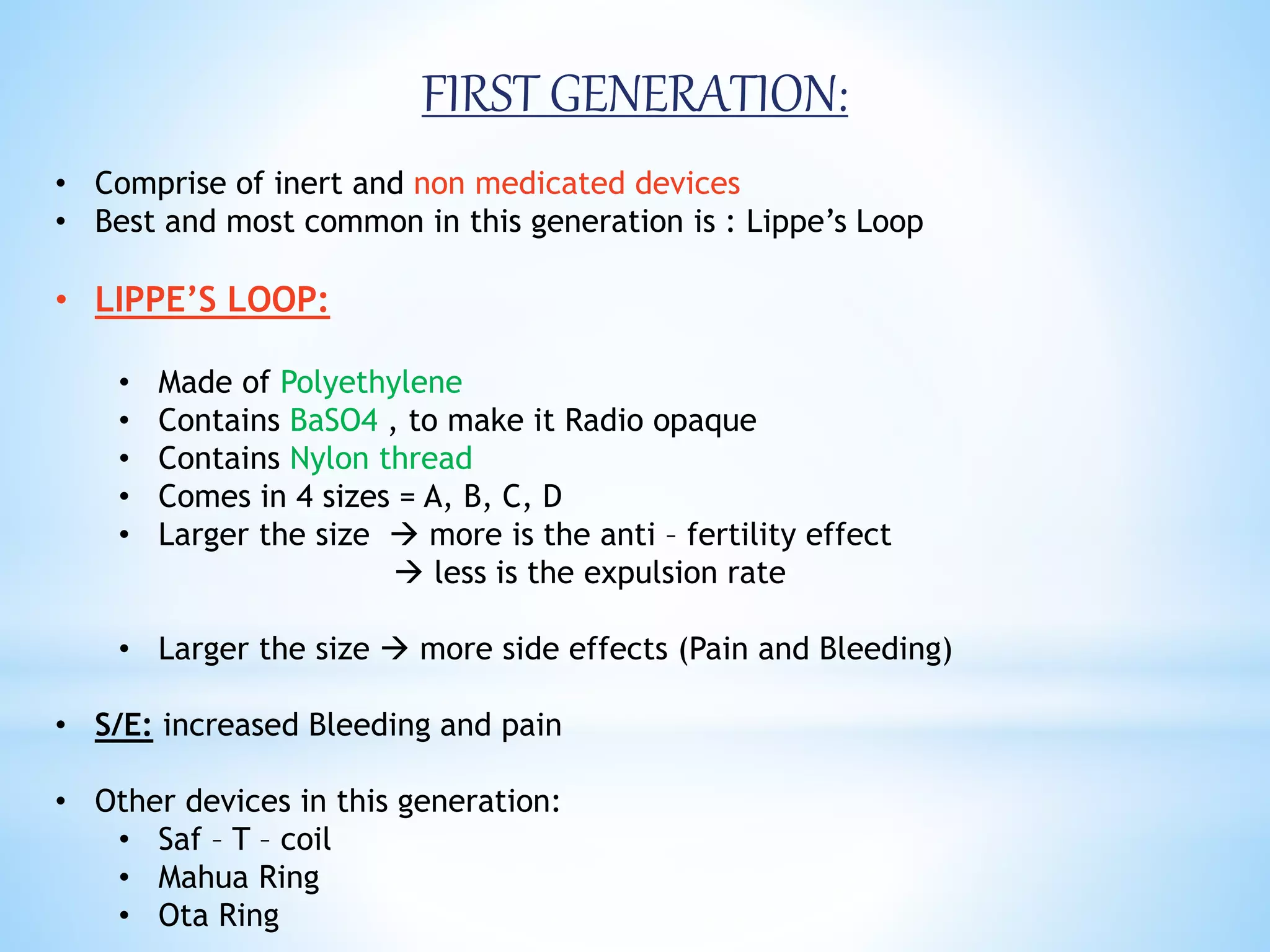
• Best and most common in this generation is : Lippe’s Loop
• LIPPE’S LOOP:
• Made of Polyethylene
• Contains BaSO4 , to make it Radio opaque
• Contains Nylon thread
• Comes in 4 sizes = A, B, C, D
• Larger the size  more is the anti – fertility effect
 less is the expulsion rate
• Larger the size  more side effects (Pain and Bleeding)
• S/E: increased Bleeding and pain
• Other devices in this generation:
• Saf – T – coil
• Mahua Ring
• Ota Ring
LIPPE’S LOOP SAF – T - COIL OTA RING
SECOND GENERATION
• Copper containing devices
• STRUCTURE: Copper wire is wrapped around the polypropylene stem
• EXAMPLES : Copper-T-200, Copper – 7,Multi – Load Copper 250, Nova – T
• ADVANTAGES:
• Low expulsion rates
• Lower side effects
• Easy to fit and better tolerated in nulliparous
• Increased efficacy
• Used as an emergency contraception
• Long acting
• Amount of copper released = 50 mcg
NAME DURATION IMAGES
Earlier Devices • Copper – 7
• Copper T 200
Newer Devices
• Cu-T-220
• Cu-T-380
A(ParaGard)
3 yrs
10 Yrs
• Nova T
(contains Silver
lining)
5 Yrs
• ML – Cu – 250
• ML – Cu - 375 3-5 Yrs
THIRD GENERATION
• Releases hormones
• EXAMPLES: Mirena, Progestasert, Fibroplant (under trial)
• PROGESTASERT:
• T –shaped device
• 38 mg of Progesterone
MIRENA PROGESTASERT
DURATION (Yrs) 5-7 yrs 1 yr
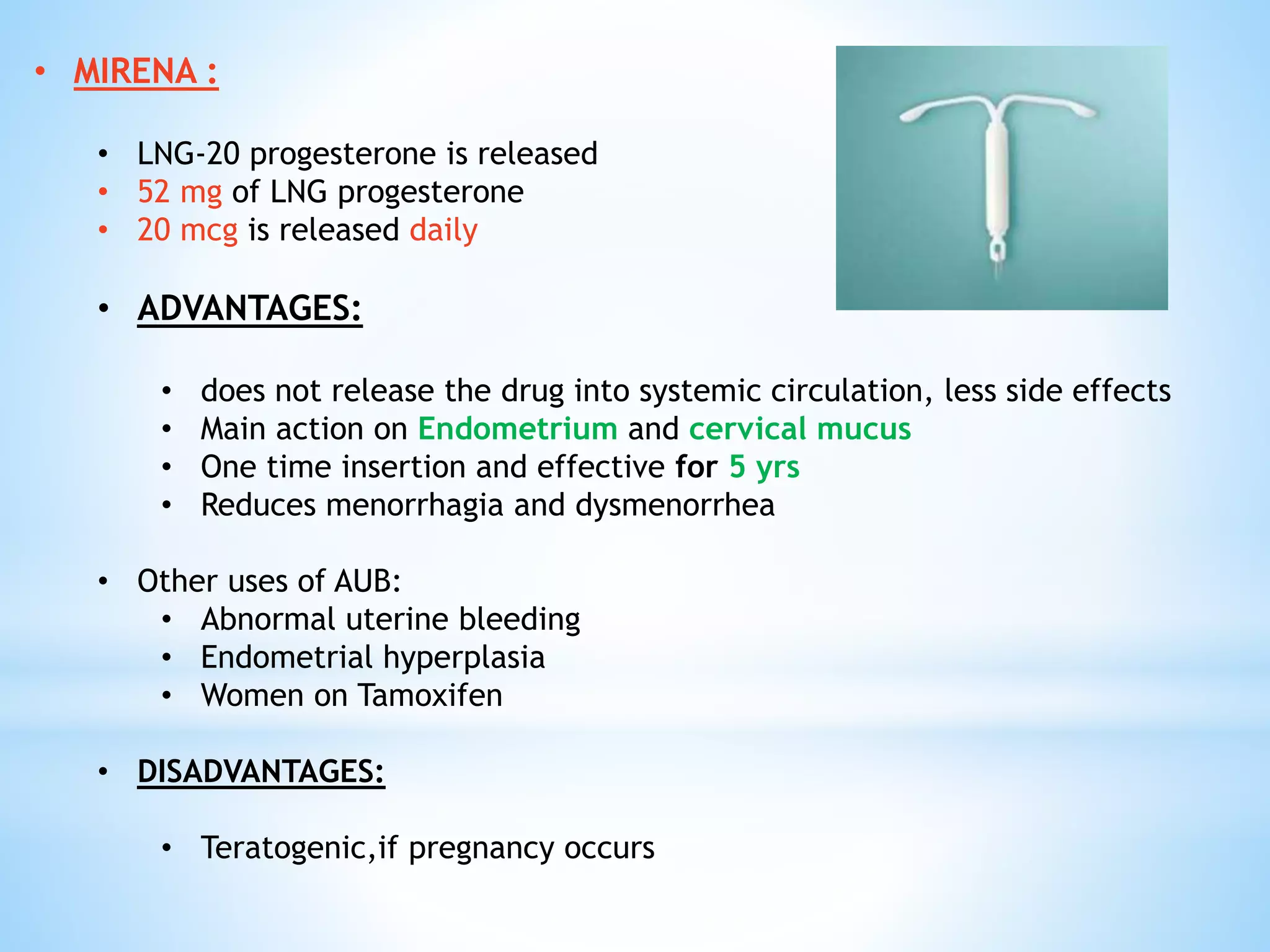
• MIRENA :
• LNG-20 progesterone is released
• 52 mg of LNG progesterone
• 20 mcg is released daily
• ADVANTAGES:
• does not release the drug into systemic circulation, less side effects
• Main action on Endometrium and cervical mucus
• One time insertion and effective for 5 yrs
• Reduces menorrhagia and dysmenorrhea
• Other uses of AUB:
• Abnormal uterine bleeding
• Endometrial hyperplasia
• Women on Tamoxifen
• DISADVANTAGES:
• Teratogenic,if pregnancy occurs
MECHANISM OF ACTION OF IUCD
Non Medicated IUD
• Leads to foreign body reaction
• Sterile inflammatory response, which is spermicidal
Cu Releasing IUD
• Foreign body reaction
• Enzymatic and metabolic changes in Endometrium
• Initiates cytokine release
Hormone Releasing IUD
• Alteration in cervical mucosa making sperm penetration difficult
• Long term progesterone exposure causes endometrial atrophy
IDEAL CANDIDATE FOR IUD
• Borne atleast one child
• No history of pelvic disease
• Normal menstrual cycles
• Willing to check the thread
• Access to follow up and treatment
• Monogamous relationship
• Unhappy or unreliable users of OCP/ Barrier methods
CONTRA INDICATIONS OF IUD
• Suspected pregnancy
• Pelvic inflammatory disease
• Fibroid uterus
• IUD causing menorrhagia and dysmenorrhoea
• Severe anaemia
• Uncontrolled diabetes
• Scarred uterus
• Uterine anomlies
• LNG IUCD in breast Ca
• AVOID in unmarried and nulliparous patients
IUD INSERTION
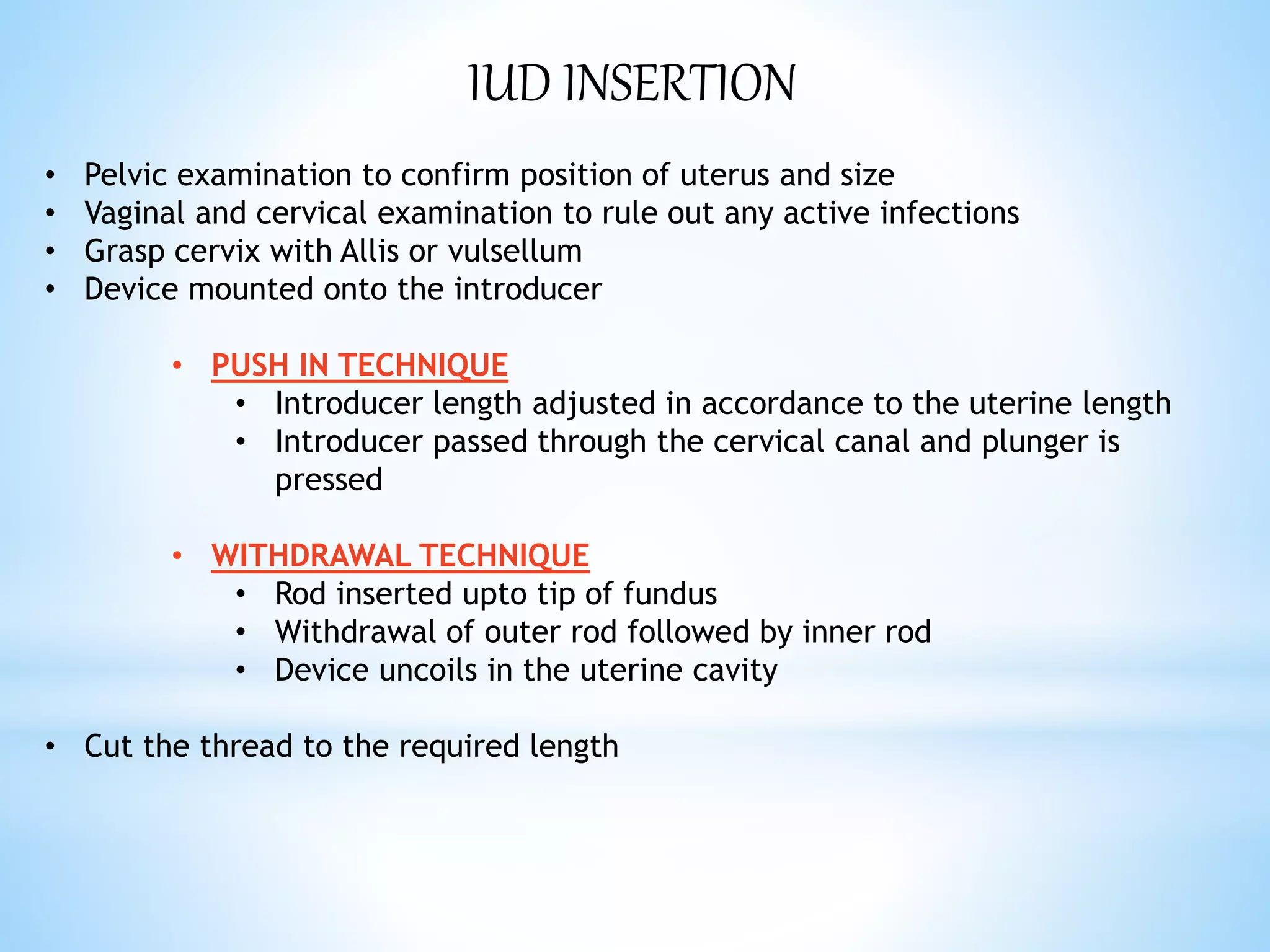
• Pelvic examination to confirm position of uterus and size
• Vaginal and cervical examination to rule out any active infections
• Grasp cervix with Allis or vulsellum
• Device mounted onto the introducer
• PUSH IN TECHNIQUE
• Introducer length adjusted in accordance to the uterine length
• Introducer passed through the cervical canal and plunger is
pressed
• WITHDRAWAL TECHNIQUE
• Rod inserted upto tip of fundus
• Withdrawal of outer rod followed by inner rod
• Device uncoils in the uterine cavity
• Cut the thread to the required length
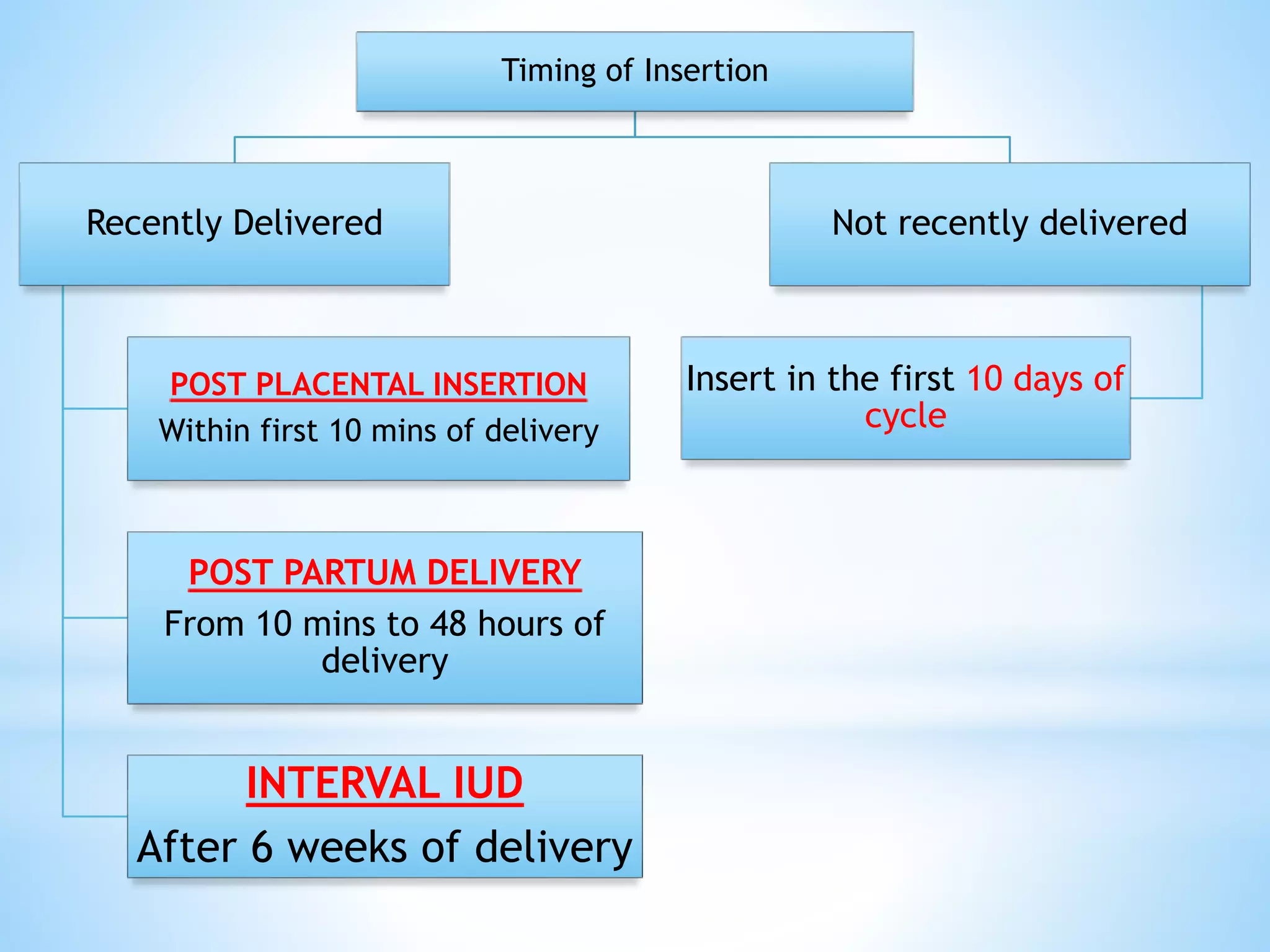
Timing of Insertion
Recently Delivered
POST PLACENTAL INSERTION
Within first 10 mins of delivery
POST PARTUM DELIVERY
From 10 mins to 48 hours of
delivery
INTERVAL IUD
After 6 weeks of delivery
Not recently delivered
Insert in the first 10 days of
cycle
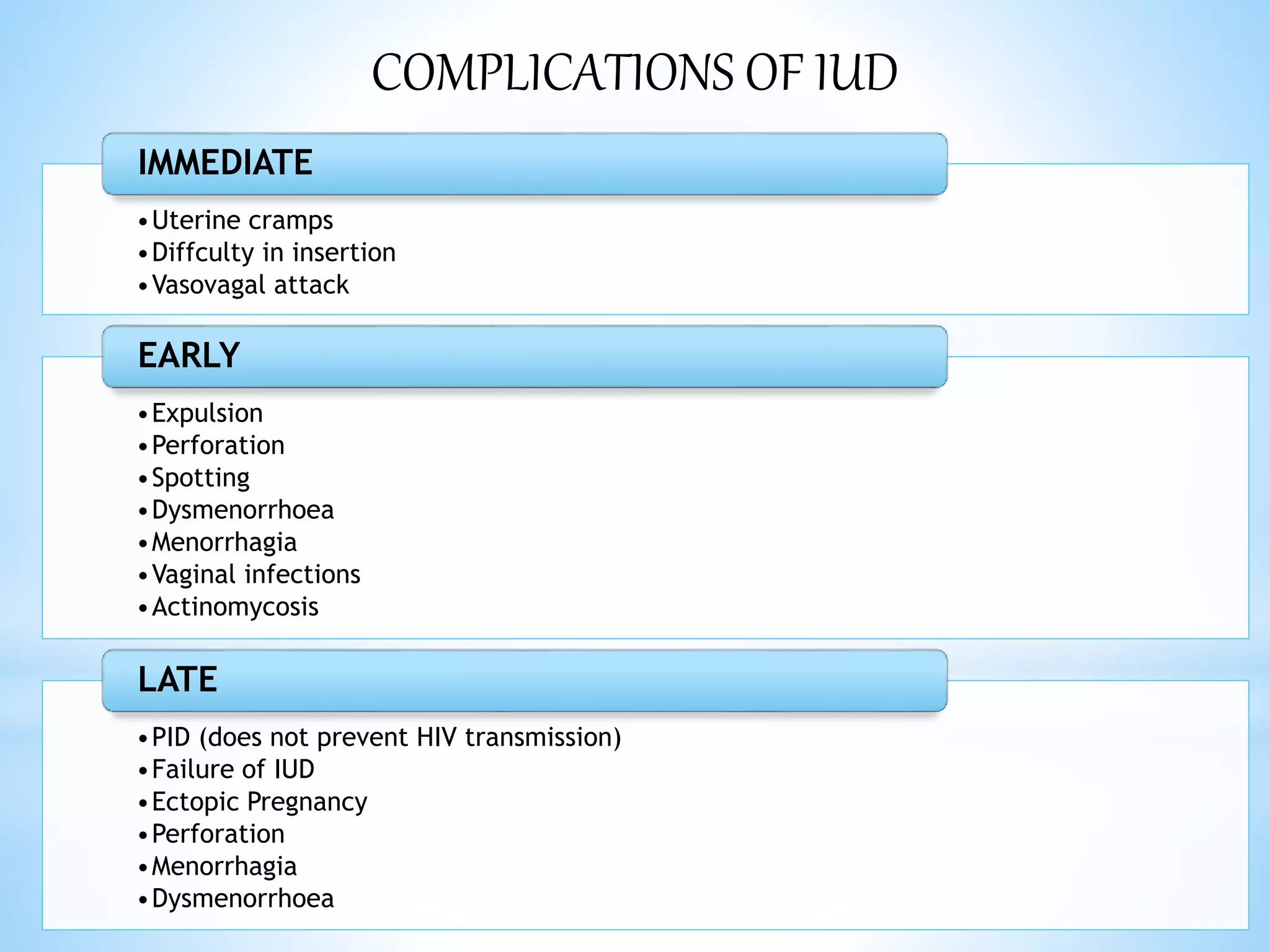
•Uterine cramps
•Diffculty in insertion
•Vasovagal attack
IMMEDIATE
•Expulsion
•Perforation
•Spotting
•Dysmenorrhoea
•Menorrhagia
•Vaginal infections
•Actinomycosis
EARLY
•PID (does not prevent HIV transmission)
•Failure of IUD
•Ectopic Pregnancy
•Perforation
•Menorrhagia
•Dysmenorrhoea
LATE
COMPLICATIONS OF IUD
When patient complains of MISSING THREAD
Missing Thread
Coiled Thread
If she wants to
continue
let her continue
If she wants to
remove
remove under
Hysteroscopic
guidance using
Schroadkar hook/
Artery forceps
Perforation
If IUCD in the
peritoneum
Immediate
Laprotomy/
Laproscopy
Partly in
peritoneum and
partly in uterus 
Hysteroscopy +
Laproscopy
CAUSES:
Coiling of thread
Expulsion of IUD
Pregnancy
Perforation
Do a TVS scan
When patient becomes pregnanant-
Women is
Pregnant
If women does not want
the pregnancy
TERMINATE
If women wants to
continue PREGNANCY
If thread is VISIBLE
Remove the thread
If NOT – VISIBLE
Continue the pregnancy
with IUD
Term as a HIGH RISK
PREGNANCY
Confirm pregnancy by:
UPT
USG ( to rule out
Ectopic)
RISKS OF PREGNANCY WITH IUCD
• Increased risk of infection
• Increased risk of abortion
• Increased risk of Pre – term labour
• Increased risk of Pre Mature Rupture of Membranes
• Increased risk of Intra Uterine Growth Restriction
• IUCD are not teratogenic
• IUCD don’t cause Congenital Malformations in fetus
LATEST DEVELOPMENTS
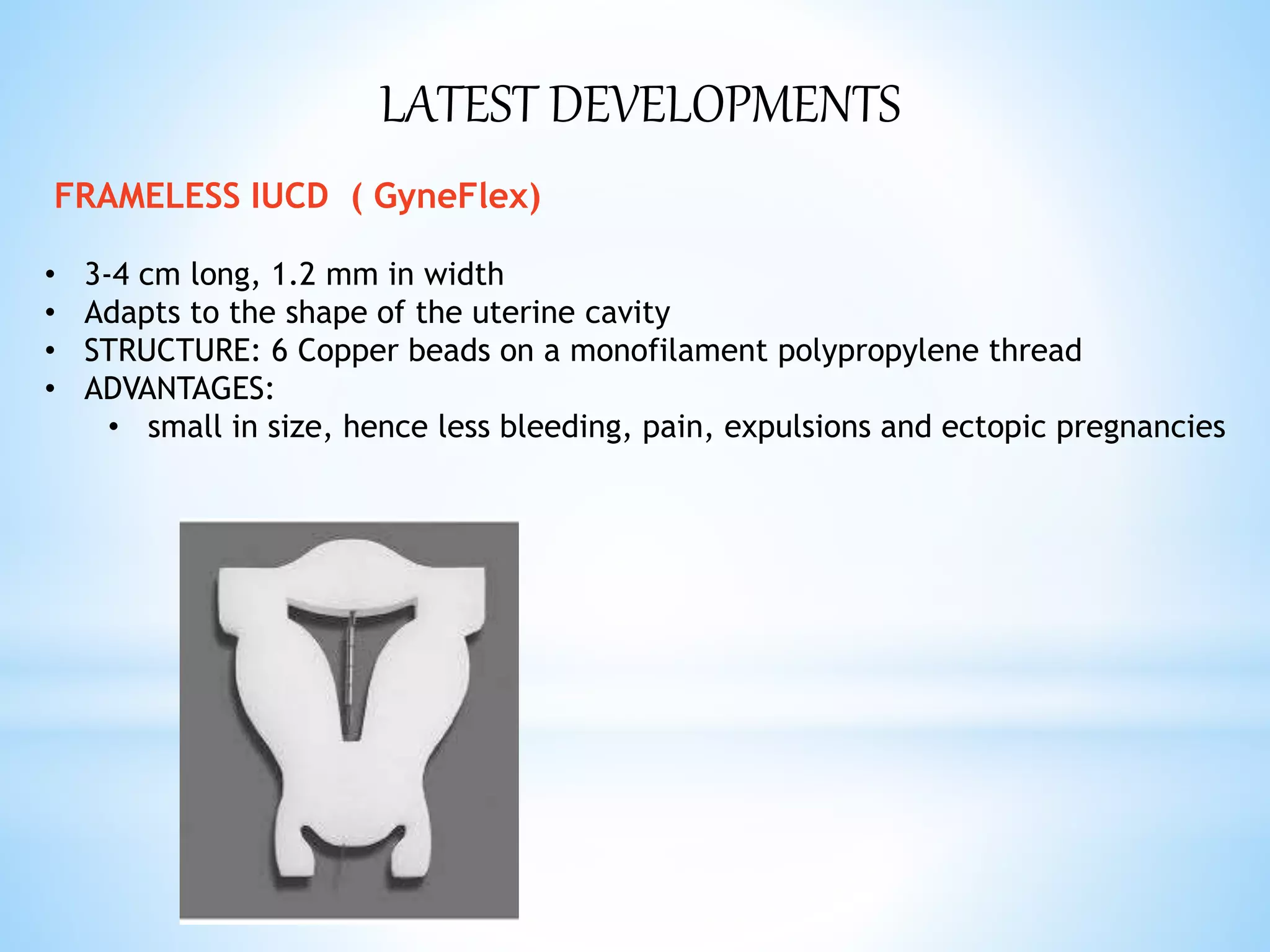
FRAMELESS IUCD ( GyneFlex)
• 3-4 cm long, 1.2 mm in width
• Adapts to the shape of the uterine cavity
• STRUCTURE: 6 Copper beads on a monofilament polypropylene thread
• ADVANTAGES:
• small in size, hence less bleeding, pain, expulsions and ectopic pregnancies
ESSURE Device
• Spring like device that is inserted to the Intra-mural part of fallopian
tube
• STRUCTURE: outer part made of Nickel and Titanium
inner part made of Stainless Steel
Once inserted into the
fallopian tube
inflammation
Fibrosis occurs
Blockage of tubes
MECHANISM
OF ACTION
• Since tissue reaction takes time  females are advised for backup
methods for 3 months
• After 3 months  HSG done to confirm the block
Intra Uterine Contraceptive Devices.pptx

Intra Uterine Contraceptive Devices.pptx

  • 1.
  • 2.
    • IUCD isan effective, reversible and long term method of contraception • Why is IUCD being preferred in the recent times? • No replacement needed for long time • Independent of patient compliance • No interference with sexual activity
  • 3.
    STRUCTURE : • Madeof Polyethylene • Flexible body • Impregnated with Barium sulphate ( makes it Radio – opaque) • Nylon thread is attached to its lower end GENERATIONS OF IUD: FIRST GENERATION • Inert SECOND GENERATION • Copper containing THIRD GENERATION • Hormone containing
  • 4.
    FIRST GENERATION: • Compriseof inert and non medicated devices • Best and most common in this generation is : Lippe’s Loop • LIPPE’S LOOP: • Made of Polyethylene • Contains BaSO4 , to make it Radio opaque • Contains Nylon thread • Comes in 4 sizes = A, B, C, D • Larger the size  more is the anti – fertility effect  less is the expulsion rate • Larger the size  more side effects (Pain and Bleeding) • S/E: increased Bleeding and pain • Other devices in this generation: • Saf – T – coil • Mahua Ring • Ota Ring
  • 5.
    LIPPE’S LOOP SAF– T - COIL OTA RING
  • 6.
    SECOND GENERATION • Coppercontaining devices • STRUCTURE: Copper wire is wrapped around the polypropylene stem • EXAMPLES : Copper-T-200, Copper – 7,Multi – Load Copper 250, Nova – T • ADVANTAGES: • Low expulsion rates • Lower side effects • Easy to fit and better tolerated in nulliparous • Increased efficacy • Used as an emergency contraception • Long acting • Amount of copper released = 50 mcg
  • 7.
    NAME DURATION IMAGES EarlierDevices • Copper – 7 • Copper T 200 Newer Devices • Cu-T-220 • Cu-T-380 A(ParaGard) 3 yrs 10 Yrs • Nova T (contains Silver lining) 5 Yrs • ML – Cu – 250 • ML – Cu - 375 3-5 Yrs
  • 8.
    THIRD GENERATION • Releaseshormones • EXAMPLES: Mirena, Progestasert, Fibroplant (under trial) • PROGESTASERT: • T –shaped device • 38 mg of Progesterone MIRENA PROGESTASERT DURATION (Yrs) 5-7 yrs 1 yr
  • 9.
    • MIRENA : •LNG-20 progesterone is released • 52 mg of LNG progesterone • 20 mcg is released daily • ADVANTAGES: • does not release the drug into systemic circulation, less side effects • Main action on Endometrium and cervical mucus • One time insertion and effective for 5 yrs • Reduces menorrhagia and dysmenorrhea • Other uses of AUB: • Abnormal uterine bleeding • Endometrial hyperplasia • Women on Tamoxifen • DISADVANTAGES: • Teratogenic,if pregnancy occurs
  • 10.
    MECHANISM OF ACTIONOF IUCD Non Medicated IUD • Leads to foreign body reaction • Sterile inflammatory response, which is spermicidal Cu Releasing IUD • Foreign body reaction • Enzymatic and metabolic changes in Endometrium • Initiates cytokine release Hormone Releasing IUD • Alteration in cervical mucosa making sperm penetration difficult • Long term progesterone exposure causes endometrial atrophy
  • 11.
    IDEAL CANDIDATE FORIUD • Borne atleast one child • No history of pelvic disease • Normal menstrual cycles • Willing to check the thread • Access to follow up and treatment • Monogamous relationship • Unhappy or unreliable users of OCP/ Barrier methods
  • 12.
    CONTRA INDICATIONS OFIUD • Suspected pregnancy • Pelvic inflammatory disease • Fibroid uterus • IUD causing menorrhagia and dysmenorrhoea • Severe anaemia • Uncontrolled diabetes • Scarred uterus • Uterine anomlies • LNG IUCD in breast Ca • AVOID in unmarried and nulliparous patients
  • 13.
    IUD INSERTION • Pelvicexamination to confirm position of uterus and size • Vaginal and cervical examination to rule out any active infections • Grasp cervix with Allis or vulsellum • Device mounted onto the introducer • PUSH IN TECHNIQUE • Introducer length adjusted in accordance to the uterine length • Introducer passed through the cervical canal and plunger is pressed • WITHDRAWAL TECHNIQUE • Rod inserted upto tip of fundus • Withdrawal of outer rod followed by inner rod • Device uncoils in the uterine cavity • Cut the thread to the required length
  • 14.
    Timing of Insertion RecentlyDelivered POST PLACENTAL INSERTION Within first 10 mins of delivery POST PARTUM DELIVERY From 10 mins to 48 hours of delivery INTERVAL IUD After 6 weeks of delivery Not recently delivered Insert in the first 10 days of cycle
  • 15.
    •Uterine cramps •Diffculty ininsertion •Vasovagal attack IMMEDIATE •Expulsion •Perforation •Spotting •Dysmenorrhoea •Menorrhagia •Vaginal infections •Actinomycosis EARLY •PID (does not prevent HIV transmission) •Failure of IUD •Ectopic Pregnancy •Perforation •Menorrhagia •Dysmenorrhoea LATE COMPLICATIONS OF IUD
  • 16.
    When patient complainsof MISSING THREAD Missing Thread Coiled Thread If she wants to continue let her continue If she wants to remove remove under Hysteroscopic guidance using Schroadkar hook/ Artery forceps Perforation If IUCD in the peritoneum Immediate Laprotomy/ Laproscopy Partly in peritoneum and partly in uterus  Hysteroscopy + Laproscopy CAUSES: Coiling of thread Expulsion of IUD Pregnancy Perforation Do a TVS scan
  • 17.
    When patient becomespregnanant- Women is Pregnant If women does not want the pregnancy TERMINATE If women wants to continue PREGNANCY If thread is VISIBLE Remove the thread If NOT – VISIBLE Continue the pregnancy with IUD Term as a HIGH RISK PREGNANCY Confirm pregnancy by: UPT USG ( to rule out Ectopic)
  • 18.
    RISKS OF PREGNANCYWITH IUCD • Increased risk of infection • Increased risk of abortion • Increased risk of Pre – term labour • Increased risk of Pre Mature Rupture of Membranes • Increased risk of Intra Uterine Growth Restriction • IUCD are not teratogenic • IUCD don’t cause Congenital Malformations in fetus
  • 19.
    LATEST DEVELOPMENTS FRAMELESS IUCD( GyneFlex) • 3-4 cm long, 1.2 mm in width • Adapts to the shape of the uterine cavity • STRUCTURE: 6 Copper beads on a monofilament polypropylene thread • ADVANTAGES: • small in size, hence less bleeding, pain, expulsions and ectopic pregnancies
  • 20.
    ESSURE Device • Springlike device that is inserted to the Intra-mural part of fallopian tube • STRUCTURE: outer part made of Nickel and Titanium inner part made of Stainless Steel Once inserted into the fallopian tube inflammation Fibrosis occurs Blockage of tubes MECHANISM OF ACTION
  • 21.
    • Since tissuereaction takes time  females are advised for backup methods for 3 months • After 3 months  HSG done to confirm the block