IUCDs INSERTION AND REMOVAL
Classification
• Non-medicated IUCDs: lippes loop
• Medicated copper containing IUCDs: Cu T-380,Cu T-200,
multiload-375,
multiload-250
• Hormone containing IUCDs:levonorgestrel intrauterine
system(LNG-IUS), progestasert
Types of IUCDs
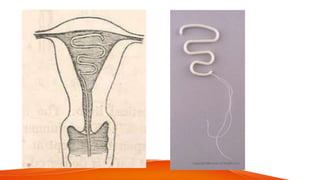
Lippes Loop
• Inert device made of polyethylene or other polymers, appeared
in different shapes and sizes-loops, spirals, coils, rings and bows.
• Types: according to size could be A, B, C and D, D being the largest.
• Larger the size, greater the antifertility effect and a lower expulsion
rate but a lower continuation rate due to side-effects like pain and
bleeding.
First generation IUCD
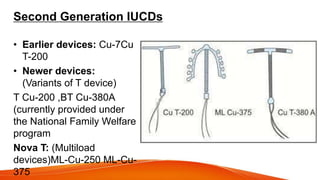
Second Generation IUCDs
• Earlier devices: Cu-7Cu
T-200
• Newer devices:
(Variants of T device)
T Cu-200 ,BT Cu-380A
(currently provided under
the National Family Welfare
program
Nova T: (Multiload
devices)ML-Cu-250 ML-Cu-
375
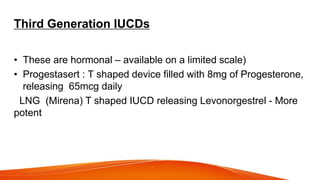
Third Generation IUCDs
• These are hormonal – available on a limited scale)
• Progestasert : T shaped device filled with 8mg of Progesterone,
releasing 65mcg daily
LNG (Mirena) T shaped IUCD releasing Levonorgestrel - More
potent
Mechanism of Action
• Copper-bearing IUCDs, such as the Copper T 380A, act
primarily by preventing fertilization (Rivera et al. 1999).
• Copper ions decrease sperm motility and function by altering
the uterine and tubal fluid environment, thus preventing sperm
from reaching the fallopian tubes and fertilizing the egg.
• The device also stimulates foreign body reaction in the
endometrium that releases macrophages and prevents
implantation.
MEDICAL ELIGIBILITY CRITERIA (MEC):
• WHO system - 4 CATEGORIES
• CATEGORY 1: Can use IUCD with no restriction
1.lactational amenorrhoea
2.post menstrual insertion
3. immediately after 1st trimester abortion
4. more than 6 weeks postpartum provided no
infection
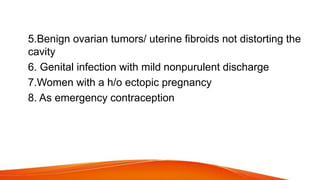
5.Benign ovarian tumors/ uterine fibroids not distorting the
cavity
6. Genital infection with mild nonpurulent discharge
7.Women with a h/o ectopic pregnancy
8. As emergency contraception
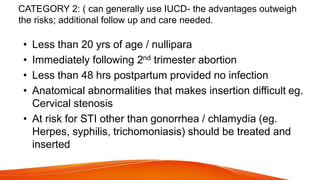
CATEGORY 2: ( can generally use IUCD- the advantages outweigh
the risks; additional follow up and care needed.
• Less than 20 yrs of age / nullipara
• Immediately following 2nd trimester abortion
• Less than 48 hrs postpartum provided no infection
• Anatomical abnormalities that makes insertion difficult eg.
Cervical stenosis
• At risk for STI other than gonorrhea / chlamydia (eg.
Herpes, syphilis, trichomoniasis) should be treated and
inserted
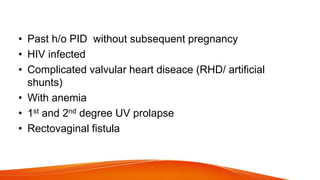
• Past h/o PID without subsequent pregnancy
• HIV infected
• Complicated valvular heart diseace (RHD/ artificial
shunts)
• With anemia
• 1st and 2nd degree UV prolapse
• Rectovaginal fistula
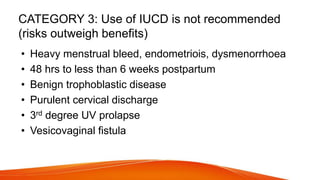
CATEGORY 3: Use of IUCD is not recommended
(risks outweigh benefits)
• Heavy menstrual bleed, endometriois, dysmenorrhoea
• 48 hrs to less than 6 weeks postpartum
• Benign trophoblastic disease
• Purulent cervical discharge
• 3rd degree UV prolapse
• Vesicovaginal fistula
CATEGORY 4: should not use IUCD
• Pregnant women
• h/o puerperal sepsis/ septic abortio
• Malignant trophoblastic disease
• Anatomical abnormalities that distort uterine cavity
• Pelvic TB
Timing of the Insertion
• Within seven days of the beginning of last menstrual period or
anytime during the menstrual cycle provided the service provider is
reasonably sure that woman is not pregnant.
• Immediately or within 48 hours after delivery (by a provider who is
trained in inserting IUCDs during this time) or more than 6 weeks
post partum.
• Concurrently with 1st trimester medical termination of pregnancy.
• After 1st menstrual period following spontaneous/medical/second
trimester abortion
• In a woman with Lactational Amenorrhea provided pregnancy can
be ruled out.
• Within 5 days of unprotected sex as an emergency contraception
Advantages
• No adverse systemic effects
• Long acting
• Reversible Immediate return of fertility
• Reduced chance of intrauterine and ectopic pregnancies with
LNg-IUS
Limitations
• Pelvic examination before IUCD insertion is mandatory as
against other spacing methods.
• Requires a skilled provider for insertion and removal of the
device.
• Does not protect against STIs/ HIV
• Cannot be inserted in the women who currently have active
RTI/STI
• It has chance of expulsion

IUCD- OG.pptx

  • 1.
  • 2.
    Classification • Non-medicated IUCDs:lippes loop • Medicated copper containing IUCDs: Cu T-380,Cu T-200, multiload-375, multiload-250 • Hormone containing IUCDs:levonorgestrel intrauterine system(LNG-IUS), progestasert
  • 3.
  • 4.
    Lippes Loop • Inertdevice made of polyethylene or other polymers, appeared in different shapes and sizes-loops, spirals, coils, rings and bows. • Types: according to size could be A, B, C and D, D being the largest. • Larger the size, greater the antifertility effect and a lower expulsion rate but a lower continuation rate due to side-effects like pain and bleeding. First generation IUCD
  • 6.
    Second Generation IUCDs •Earlier devices: Cu-7Cu T-200 • Newer devices: (Variants of T device) T Cu-200 ,BT Cu-380A (currently provided under the National Family Welfare program Nova T: (Multiload devices)ML-Cu-250 ML-Cu- 375
  • 7.
    Third Generation IUCDs •These are hormonal – available on a limited scale) • Progestasert : T shaped device filled with 8mg of Progesterone, releasing 65mcg daily LNG (Mirena) T shaped IUCD releasing Levonorgestrel - More potent
  • 8.
    Mechanism of Action •Copper-bearing IUCDs, such as the Copper T 380A, act primarily by preventing fertilization (Rivera et al. 1999). • Copper ions decrease sperm motility and function by altering the uterine and tubal fluid environment, thus preventing sperm from reaching the fallopian tubes and fertilizing the egg. • The device also stimulates foreign body reaction in the endometrium that releases macrophages and prevents implantation.
  • 9.
    MEDICAL ELIGIBILITY CRITERIA(MEC): • WHO system - 4 CATEGORIES • CATEGORY 1: Can use IUCD with no restriction 1.lactational amenorrhoea 2.post menstrual insertion 3. immediately after 1st trimester abortion 4. more than 6 weeks postpartum provided no infection
  • 10.
    5.Benign ovarian tumors/uterine fibroids not distorting the cavity 6. Genital infection with mild nonpurulent discharge 7.Women with a h/o ectopic pregnancy 8. As emergency contraception
  • 11.
    CATEGORY 2: (can generally use IUCD- the advantages outweigh the risks; additional follow up and care needed. • Less than 20 yrs of age / nullipara • Immediately following 2nd trimester abortion • Less than 48 hrs postpartum provided no infection • Anatomical abnormalities that makes insertion difficult eg. Cervical stenosis • At risk for STI other than gonorrhea / chlamydia (eg. Herpes, syphilis, trichomoniasis) should be treated and inserted
  • 12.
    • Past h/oPID without subsequent pregnancy • HIV infected • Complicated valvular heart diseace (RHD/ artificial shunts) • With anemia • 1st and 2nd degree UV prolapse • Rectovaginal fistula
  • 13.
    CATEGORY 3: Useof IUCD is not recommended (risks outweigh benefits) • Heavy menstrual bleed, endometriois, dysmenorrhoea • 48 hrs to less than 6 weeks postpartum • Benign trophoblastic disease • Purulent cervical discharge • 3rd degree UV prolapse • Vesicovaginal fistula
  • 14.
    CATEGORY 4: shouldnot use IUCD • Pregnant women • h/o puerperal sepsis/ septic abortio • Malignant trophoblastic disease • Anatomical abnormalities that distort uterine cavity • Pelvic TB
  • 15.
    Timing of theInsertion • Within seven days of the beginning of last menstrual period or anytime during the menstrual cycle provided the service provider is reasonably sure that woman is not pregnant. • Immediately or within 48 hours after delivery (by a provider who is trained in inserting IUCDs during this time) or more than 6 weeks post partum. • Concurrently with 1st trimester medical termination of pregnancy. • After 1st menstrual period following spontaneous/medical/second trimester abortion • In a woman with Lactational Amenorrhea provided pregnancy can be ruled out. • Within 5 days of unprotected sex as an emergency contraception
  • 22.
    Advantages • No adversesystemic effects • Long acting • Reversible Immediate return of fertility • Reduced chance of intrauterine and ectopic pregnancies with LNg-IUS
  • 23.
    Limitations • Pelvic examinationbefore IUCD insertion is mandatory as against other spacing methods. • Requires a skilled provider for insertion and removal of the device. • Does not protect against STIs/ HIV • Cannot be inserted in the women who currently have active RTI/STI • It has chance of expulsion