INTRA UTERINE
CONTRACEPTIVE DEVICE
(IUCD)
Learning points
■ History
■ Introduction
■ Types of IUCD
■ Mechanism of Action
■ Ideal IUD Candidate
■ Contraindications
■ Time of Insertion
■ Advice after Insertion
■ Failure rate & restoration of fertility
■ Advantages & disadvantages
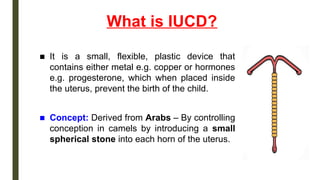
What is IUCD?
■ It is a small, flexible, plastic device that
contains either metal e.g. copper or hormones
e.g. progesterone, which when placed inside
the uterus, prevent the birth of the child.
■ Concept: Derived from Arabs – By controlling
conception in camels by introducing a small
spherical stone into each horn of the uterus.
History
■ 1929 = Grafenberg, German Gynecologist  Used a core of silkworm gut encircled by
German Silver ring successfully in preventing conception.
■ 1934 = Mr. Ota, Japan  Introduced a gold plated silver ring, with a disk in the center,
attached by three spokes (Ota ring)
■ 1959 = Oppenheimer (Israel) & Ishihama (Japan)  Published the excellent results of
IUDs, discovered by Grafenberg & Ota.
■ 1960 = Margulies spiral was launched, a plastic device, impregnated with barium sulfate, a
radioopaque substance.
■ 1960 = Dr Jack Lippe (USA)  Introduced Lippes Loop, very popular for two decades in
India
■ 1970 = It was modified by adding copper, have strong antifertility effect, widely used now a
days under NFWP.
■ 1990 = Further modified and improved by impregnating the IUDs with slow releasing
hormones.
Introduction
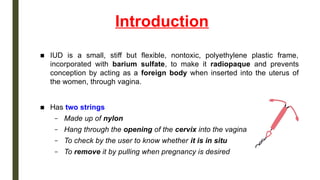
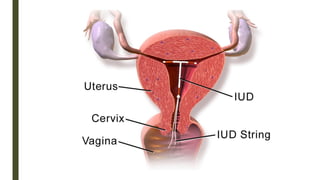
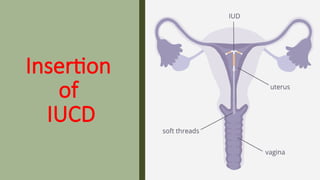
■ IUD is a small, stiff but flexible, nontoxic, polyethylene plastic frame,
incorporated with barium sulfate, to make it radiopaque and prevents
conception by acting as a foreign body when inserted into the uterus of
the women, through vagina.
■ Has two strings
– Made up of nylon
– Hang through the opening of the cervix into the vagina
– To check by the user to know whether it is in situ
– To remove it by pulling when pregnancy is desired
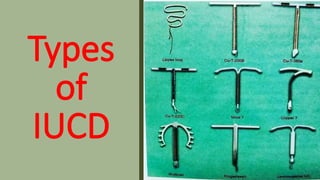
Types
of
IUCD
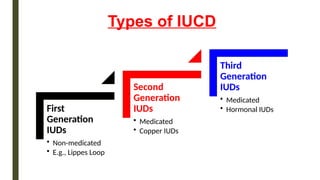
Types of IUCD
First
Generation
IUDs
• Non-medicated
• E.g., Lippes Loop
Second
Generation
IUDs
• Medicated
• Copper IUDs
Third
Generation
IUDs
• Medicated
• Hormonal IUDs
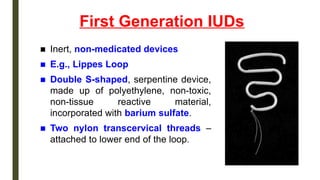
First Generation IUDs
■ Inert, non-medicated devices
■ E.g., Lippes Loop
■ Double S-shaped, serpentine device,
made up of polyethylene, non-toxic,
non-tissue reactive material,
incorporated with barium sulfate.
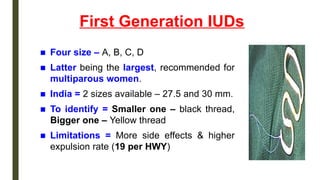
■ Two nylon transcervical threads –
attached to lower end of the loop.
First Generation IUDs
■ Four size – A, B, C, D
■ Latter being the largest, recommended for
multiparous women.
■ India = 2 sizes available – 27.5 and 30 mm.
■ To identify = Smaller one – black thread,
Bigger one – Yellow thread
■ Limitations = More side effects & higher
expulsion rate (19 per HWY)
Second Generation IUDs
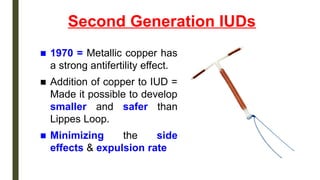
■ 1970 = Metallic copper has
a strong antifertility effect.
■ Addition of copper to IUD =
Made it possible to develop
smaller and safer than
Lippes Loop.
■ Minimizing the side
effects & expulsion rate
Second Generation IUDs
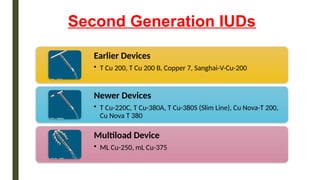
Earlier Devices
• T Cu 200, T Cu 200 B, Copper 7, Sanghai-V-Cu-200
Newer Devices
• T Cu-220C, T Cu-380A, T Cu-380S (Slim Line), Cu Nova-T 200,
Cu Nova T 380
Multiload Device
• ML Cu-250, mL Cu-375
Second Generation IUDs
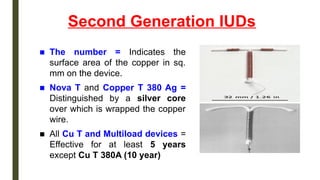
■ The number = Indicates the
surface area of the copper in sq.
mm on the device.
■ Nova T and Copper T 380 Ag =
Distinguished by a silver core
over which is wrapped the copper
wire.
■ All Cu T and Multiload devices =
Effective for at least 5 years
except Cu T 380A (10 year)
Third Generation IUDs
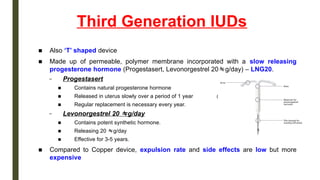
■ Also ‘T’ shaped device
■ Made up of permeable, polymer membrane incorporated with a slow releasing
progesterone hormone (Progestasert, Levonorgestrel 20g/day) – LNG20.
– Progestasert
■ Contains natural progesterone hormone
■ Released in uterus slowly over a period of 1 year @ 65 g daily
■ Regular replacement is necessary every year.
– Levonorgestrel 20 g/day
■ Contains potent synthetic hormone.
■ Releasing 20 g/day
■ Effective for 3-5 years.
■ Compared to Copper device, expulsion rate and side effects are low but more
expensive
Mechanis
m of
Action of
IUCD
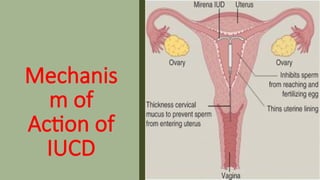
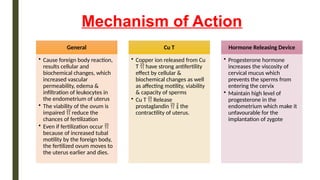
Mechanism of Action
General
• Cause foreign body reaction,
results cellular and
biochemical changes, which
increased vascular
permeability, edema &
infiltration of leukocytes in
the endometrium of uterus
• The viability of the ovum is
impaired  reduce the
chances of fertilization
• Even if fertilization occur 
because of increased tubal
motility by the foreign body,
the fertilized ovum moves to
the uterus earlier and dies.
Cu T
• Copper ion released from Cu
T  have strong antifertility
effect by cellular &
biochemical changes as well
as affecting motility, viability
& capacity of sperms
• Cu T  Release
prostaglandin   the
contractility of uterus.
Hormone Releasing Device
• Progesterone hormone
increases the viscosity of
cervical mucus which
prevents the sperms from
entering the cervix
• Maintain high level of
progesterone in the
endometrium which make it
unfavourable for the
implantation of zygote
Insertion
of
IUCD
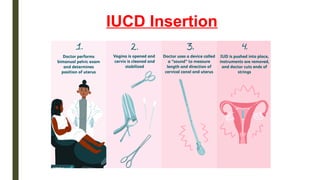
IUCD Insertion
Ideal IUD Candidate
■ Women in the reproductive age
■ Given birth to at least one child
■ Not having multiple sexual partners
■ No history of pelvic disease
■ Normal menstrual period
■ Willing to check IUD tail regularly
■ Has access to follow up
C/I for IUD
Absolute C/I
• STDs
• Previous Ectopic Pregnancy
• Any Pelvic Pathology
• Bleeding disorder
• Congenital defects in the uterus
• Cancer Cervix, Uterus or Adnexa
Relative C/I
• Multiple sexual partner
• Anaemia
• Wilson’s disease (For Cu T only)
Time of Insertion
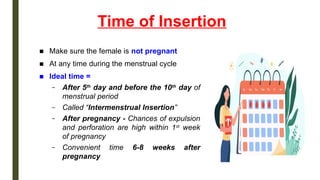
■ Make sure the female is not pregnant
■ At any time during the menstrual cycle
■ Ideal time =
– After 5th
day and before the 10th
day of
menstrual period
– Called “Intermenstrual Insertion”
– After pregnancy - Chances of expulsion
and perforation are high within 1st
week
of pregnancy
– Convenient time 6-8 weeks after
pregnancy
Time of Insertion
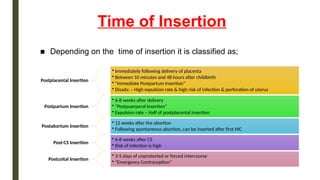
■ Depending on the time of insertion it is classified as;
Postplacental Insertion
• Immediately following delivery of placenta
• Between 10 minutes and 48 hours after childbirth
• “Immediate Postpartum Insertion”
• Disadv. – High expulsion rate & high risk of infection & perforation of uterus
Postpartum Insertion
• 6-8 weeks after delivery
• “Postpuerperal Insertion”
• Expulsion rate – Half of postplacental insertion
Postabortum Insertion
• 12 weeks after the abortion
• Following spontaneous abortion, can be inserted after first MC
Post-CS Insertion
• 6-8 weeks after CS
• Risk of infection is high
Postcoital Insertion
• 3-5 days of unprotected or forced intercourse
• “Emergency Contraception”
Instruction after IUD insertion
■ Must feel for the thread in the vagina – every month
■ Must report if it is not felt or expelled out or cause any
problem
■ Must report for routine examination – 1 & 2 years after
insertion
■ Removal of IUD after its lifespan is over
■ If she became pregnant & if she desires the pregnancy
– Remove the IUD to avoid infection & spontaneous
abortion.
■ If she became pregnant & if she does not want the
pregnancy – MTP is done.
Failure Rate
• 2-3 / HWY
Restoration of Fertility after
Removal
• Fertility is not impaired
• 70% of IUD users conceive within 1 year of
removal
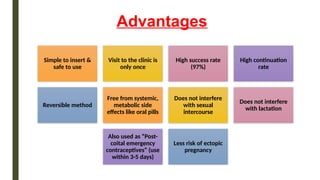
Advantages
Simple to insert &
safe to use
Visit to the clinic is
only once
High success rate
(97%)
High continuation
rate
Reversible method
Free from systemic,
metabolic side
effects like oral pills
Does not interfere
with sexual
intercourse
Does not interfere
with lactation
Also used as “Post-
coital emergency
contraceptives” (use
within 3-5 days)
Less risk of ectopic
pregnancy
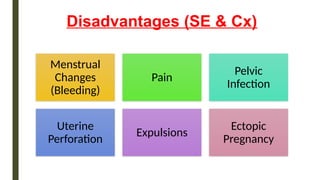
Disadvantages (SE & Cx)
Menstrual
Changes
(Bleeding)
Pain
Pelvic
Infection
Uterine
Perforation
Expulsions
Ectopic
Pregnancy
Intrauterine Contraceptive Device - IUCD

Intrauterine Contraceptive Device - IUCD

  • 1.
  • 2.
    Learning points ■ History ■Introduction ■ Types of IUCD ■ Mechanism of Action ■ Ideal IUD Candidate ■ Contraindications ■ Time of Insertion ■ Advice after Insertion ■ Failure rate & restoration of fertility ■ Advantages & disadvantages
  • 3.
    What is IUCD? ■It is a small, flexible, plastic device that contains either metal e.g. copper or hormones e.g. progesterone, which when placed inside the uterus, prevent the birth of the child. ■ Concept: Derived from Arabs – By controlling conception in camels by introducing a small spherical stone into each horn of the uterus.
  • 4.
    History ■ 1929 =Grafenberg, German Gynecologist  Used a core of silkworm gut encircled by German Silver ring successfully in preventing conception. ■ 1934 = Mr. Ota, Japan  Introduced a gold plated silver ring, with a disk in the center, attached by three spokes (Ota ring) ■ 1959 = Oppenheimer (Israel) & Ishihama (Japan)  Published the excellent results of IUDs, discovered by Grafenberg & Ota. ■ 1960 = Margulies spiral was launched, a plastic device, impregnated with barium sulfate, a radioopaque substance. ■ 1960 = Dr Jack Lippe (USA)  Introduced Lippes Loop, very popular for two decades in India ■ 1970 = It was modified by adding copper, have strong antifertility effect, widely used now a days under NFWP. ■ 1990 = Further modified and improved by impregnating the IUDs with slow releasing hormones.
  • 5.
    Introduction ■ IUD isa small, stiff but flexible, nontoxic, polyethylene plastic frame, incorporated with barium sulfate, to make it radiopaque and prevents conception by acting as a foreign body when inserted into the uterus of the women, through vagina. ■ Has two strings – Made up of nylon – Hang through the opening of the cervix into the vagina – To check by the user to know whether it is in situ – To remove it by pulling when pregnancy is desired
  • 6.
  • 7.
    Types of IUCD First Generation IUDs •Non-medicated • E.g., Lippes Loop Second Generation IUDs • Medicated • Copper IUDs Third Generation IUDs • Medicated • Hormonal IUDs
  • 8.
    First Generation IUDs ■Inert, non-medicated devices ■ E.g., Lippes Loop ■ Double S-shaped, serpentine device, made up of polyethylene, non-toxic, non-tissue reactive material, incorporated with barium sulfate. ■ Two nylon transcervical threads – attached to lower end of the loop.
  • 9.
    First Generation IUDs ■Four size – A, B, C, D ■ Latter being the largest, recommended for multiparous women. ■ India = 2 sizes available – 27.5 and 30 mm. ■ To identify = Smaller one – black thread, Bigger one – Yellow thread ■ Limitations = More side effects & higher expulsion rate (19 per HWY)
  • 10.
    Second Generation IUDs ■1970 = Metallic copper has a strong antifertility effect. ■ Addition of copper to IUD = Made it possible to develop smaller and safer than Lippes Loop. ■ Minimizing the side effects & expulsion rate
  • 11.
    Second Generation IUDs EarlierDevices • T Cu 200, T Cu 200 B, Copper 7, Sanghai-V-Cu-200 Newer Devices • T Cu-220C, T Cu-380A, T Cu-380S (Slim Line), Cu Nova-T 200, Cu Nova T 380 Multiload Device • ML Cu-250, mL Cu-375
  • 12.
    Second Generation IUDs ■The number = Indicates the surface area of the copper in sq. mm on the device. ■ Nova T and Copper T 380 Ag = Distinguished by a silver core over which is wrapped the copper wire. ■ All Cu T and Multiload devices = Effective for at least 5 years except Cu T 380A (10 year)
  • 13.
    Third Generation IUDs ■Also ‘T’ shaped device ■ Made up of permeable, polymer membrane incorporated with a slow releasing progesterone hormone (Progestasert, Levonorgestrel 20g/day) – LNG20. – Progestasert ■ Contains natural progesterone hormone ■ Released in uterus slowly over a period of 1 year @ 65 g daily ■ Regular replacement is necessary every year. – Levonorgestrel 20 g/day ■ Contains potent synthetic hormone. ■ Releasing 20 g/day ■ Effective for 3-5 years. ■ Compared to Copper device, expulsion rate and side effects are low but more expensive
  • 15.
  • 16.
    Mechanism of Action General •Cause foreign body reaction, results cellular and biochemical changes, which increased vascular permeability, edema & infiltration of leukocytes in the endometrium of uterus • The viability of the ovum is impaired  reduce the chances of fertilization • Even if fertilization occur  because of increased tubal motility by the foreign body, the fertilized ovum moves to the uterus earlier and dies. Cu T • Copper ion released from Cu T  have strong antifertility effect by cellular & biochemical changes as well as affecting motility, viability & capacity of sperms • Cu T  Release prostaglandin   the contractility of uterus. Hormone Releasing Device • Progesterone hormone increases the viscosity of cervical mucus which prevents the sperms from entering the cervix • Maintain high level of progesterone in the endometrium which make it unfavourable for the implantation of zygote
  • 17.
  • 18.
  • 19.
    Ideal IUD Candidate ■Women in the reproductive age ■ Given birth to at least one child ■ Not having multiple sexual partners ■ No history of pelvic disease ■ Normal menstrual period ■ Willing to check IUD tail regularly ■ Has access to follow up
  • 20.
    C/I for IUD AbsoluteC/I • STDs • Previous Ectopic Pregnancy • Any Pelvic Pathology • Bleeding disorder • Congenital defects in the uterus • Cancer Cervix, Uterus or Adnexa Relative C/I • Multiple sexual partner • Anaemia • Wilson’s disease (For Cu T only)
  • 21.
    Time of Insertion ■Make sure the female is not pregnant ■ At any time during the menstrual cycle ■ Ideal time = – After 5th day and before the 10th day of menstrual period – Called “Intermenstrual Insertion” – After pregnancy - Chances of expulsion and perforation are high within 1st week of pregnancy – Convenient time 6-8 weeks after pregnancy
  • 22.
    Time of Insertion ■Depending on the time of insertion it is classified as; Postplacental Insertion • Immediately following delivery of placenta • Between 10 minutes and 48 hours after childbirth • “Immediate Postpartum Insertion” • Disadv. – High expulsion rate & high risk of infection & perforation of uterus Postpartum Insertion • 6-8 weeks after delivery • “Postpuerperal Insertion” • Expulsion rate – Half of postplacental insertion Postabortum Insertion • 12 weeks after the abortion • Following spontaneous abortion, can be inserted after first MC Post-CS Insertion • 6-8 weeks after CS • Risk of infection is high Postcoital Insertion • 3-5 days of unprotected or forced intercourse • “Emergency Contraception”
  • 23.
    Instruction after IUDinsertion ■ Must feel for the thread in the vagina – every month ■ Must report if it is not felt or expelled out or cause any problem ■ Must report for routine examination – 1 & 2 years after insertion ■ Removal of IUD after its lifespan is over ■ If she became pregnant & if she desires the pregnancy – Remove the IUD to avoid infection & spontaneous abortion. ■ If she became pregnant & if she does not want the pregnancy – MTP is done.
  • 24.
    Failure Rate • 2-3/ HWY Restoration of Fertility after Removal • Fertility is not impaired • 70% of IUD users conceive within 1 year of removal
  • 25.
    Advantages Simple to insert& safe to use Visit to the clinic is only once High success rate (97%) High continuation rate Reversible method Free from systemic, metabolic side effects like oral pills Does not interfere with sexual intercourse Does not interfere with lactation Also used as “Post- coital emergency contraceptives” (use within 3-5 days) Less risk of ectopic pregnancy
  • 26.
    Disadvantages (SE &Cx) Menstrual Changes (Bleeding) Pain Pelvic Infection Uterine Perforation Expulsions Ectopic Pregnancy

Editor's Notes

  • #19 Multiple sexual partners favors the development of PID which in turn can lead to infertility
  • #20 Multiple sexual partners favors the development of PID which in turn can lead to infertility
  • #21 Most preferred time is during menstruation or within 10 days as during this time diameter of cervical canal is more so insertion is easy
  • #26 Bleeding = Common during first 3 months Occur in any form = Spotting between the periods, longer & heavier menstrual periods. More cramps or pain during periods Removal of IUD restores the normal pattern of MC Pain = 30-40% of users Low back ache, abdominal cramps or pain down the thighs. Usually disappear by third months If intolerable = remove the IUD If pain during insertion = Either IUD is large or incorrectly placed Pelvic Infection = PID = If aseptic precaution is not taken during insertion Nylon thread of IUD = Act as a vehicle (Ascending Infection). Fever, intermenstrual bleeding, leucorrhea, dysuria, pelvic pain, tenderness & palpable painful swelling of adnexa One or two such episodes = Block the tube = Infertility Remove the IUD Uterine Perforation = Rare but serious complication Mostly with Lippes Loop More common in postplacental insertion or inserted by untrained worker Results in migration of device into peritoneal cavity causing obstruction of bowel & peritoneal adhesions. Asymptomatic Diagnose by – Pelvic X-ray or USG Remove IUD by laparotomy Expulsions = Lippes Loop (6-13/HWY) compared to Cu T (1-8/HWY) High in nulliparous women Parous women = More in lactating mother 20% = Unnoticed Mostly within 3 months of insertion & during menstruation Results pregnancy Ectopic Pregnancy = 1 in every 30 pregnancy with IUD = Ectopic Pregnancy H/o of previous ectopic pregnancy = Higher risk Life-threatening & require immediate treatment H/o of amenorrhea, lower abdominal pain, tenderness, scanty or dark vaginal bleeding, anaemia, fainting. Diagnosed by = Pelvic USG May rupture fallopian tubes