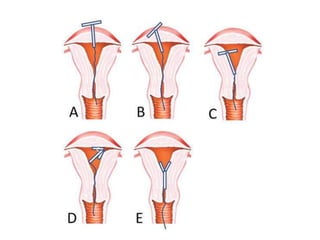

INTRAUTERINE CONTRACEPTIVE
DEVICE
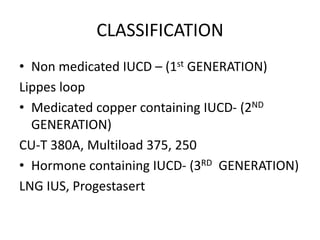
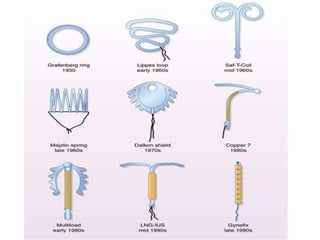
CLASSIFICATION
• Non medicated IUCD – (1st GENERATION)
Lippes loop
• Medicated copper containing IUCD- (2ND
GENERATION)
CU-T 380A, Multiload 375, 250
• Hormone containing IUCD- (3RD GENERATION)
LNG IUS, Progestasert
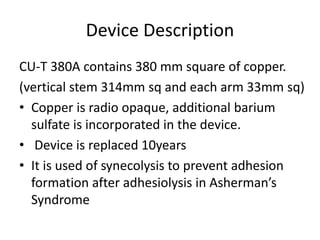
Device Description
CU-T 380A contains 380 mm square of copper.
(vertical stem 314mm sq and each arm 33mm sq)
• Copper is radio opaque, additional barium
sulfate is incorporated in the device.
• Device is replaced 10years
• It is used of synecolysis to prevent adhesion
formation after adhesiolysis in Asherman’s
Syndrome
Multi load CU-375:
• It has 375 mm sq surface area of copper wire
• No introducer and no plunger
• Replaced every 5 years
Multi load CU-250:
• Emits 60-100mcg of copper per day
• Replaced every 3 years
Levonorgestrel Intrauterine system:
• T- shaped with polydimethylsiloxane
membrane around the stem which acts as a
steroid reservoir
• Total amount of LNG is 52mg
• Daily 20mcg is released
• To be replaced every 5 years
• It has many non- contraceptive benefits
Mechanism of action
• Biochemical and histological changes in the
endometrium
• Increased tubal motility
• Endometrial inflammatory response
• Copper initiates release of cytokines which are
cytotoxic. Ionised copper prevents blastocyst
implantation through enzymatic interference
• LNG IUS : Suppression of endometrium, scanty
cervical mucus
Advantages
• Contraception
• Prevents synechiae formation
• Third generation IUCDs – higher efficacy,
longer action, less expulsion, decreased risk of
ectopic pregnancy, decreased risk of PID
• With LNG IUS- decreased menorrhagia,
dysmenorrhoea, premenstrual tension
syndrome, treatment of endometrial
hyperplasia, endometriosis, adenomyosis
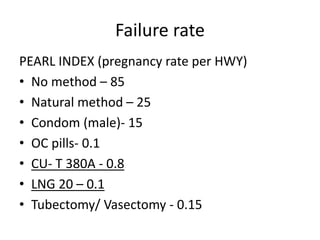
Failure rate
PEARL INDEX (pregnancy rate per HWY)
• No method – 85
• Natural method – 25
• Condom (male)- 15
• OC pills- 0.1
• CU- T 380A - 0.8
• LNG 20 – 0.1
• Tubectomy/ Vasectomy - 0.15
Contraindications
• Pelvic infammatory disease
• Undiagnosed genital tract bleeding
• Suspected pregnancy
• Distorted uterus
• h/o ectopic pregnancy
• For Cu-T – Wilson’s disease , copper allergy
• For LNG IUS: Hepatocellular disease, Breast Ca,
severe arterial disease
• Not advised in nulliparous patients
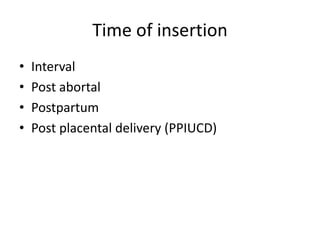
Time of insertion
• Interval
• Post abortal
• Postpartum
• Post placental delivery (PPIUCD)
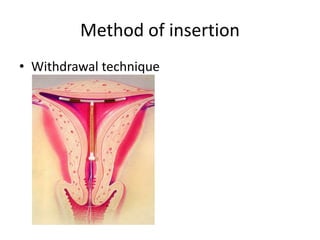
Method of insertion
• Withdrawal technique
Complications
• Immediate: Cramps, syncope, perforation
• Remote: pain, abnormal uterine bleeding,
pelvic inflammatory disease, spontaneous
expulsion, perforation of uterus
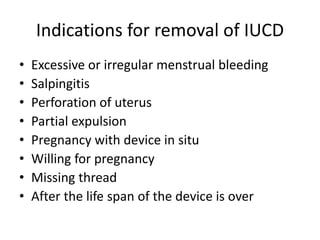
Indications for removal of IUCD
• Excessive or irregular menstrual bleeding
• Salpingitis
• Perforation of uterus
• Partial expulsion
• Pregnancy with device in situ
• Willing for pregnancy
• Missing thread
• After the life span of the device is over
Missing threads
• Causes
• Examination
• USG
• X-ray pelvis AP and lateral view
• Hysteroscopy
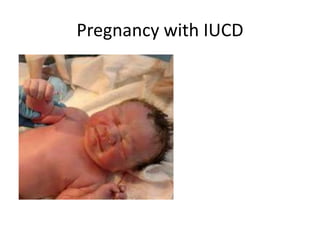
Pregnancy with IUCD
Intrauterine contraceptive device

Intrauterine contraceptive device

  • 1.
  • 2.
    CLASSIFICATION • Non medicatedIUCD – (1st GENERATION) Lippes loop • Medicated copper containing IUCD- (2ND GENERATION) CU-T 380A, Multiload 375, 250 • Hormone containing IUCD- (3RD GENERATION) LNG IUS, Progestasert
  • 4.
    Device Description CU-T 380Acontains 380 mm square of copper. (vertical stem 314mm sq and each arm 33mm sq) • Copper is radio opaque, additional barium sulfate is incorporated in the device. • Device is replaced 10years • It is used of synecolysis to prevent adhesion formation after adhesiolysis in Asherman’s Syndrome
  • 5.
    Multi load CU-375: •It has 375 mm sq surface area of copper wire • No introducer and no plunger • Replaced every 5 years Multi load CU-250: • Emits 60-100mcg of copper per day • Replaced every 3 years
  • 6.
    Levonorgestrel Intrauterine system: •T- shaped with polydimethylsiloxane membrane around the stem which acts as a steroid reservoir • Total amount of LNG is 52mg • Daily 20mcg is released • To be replaced every 5 years • It has many non- contraceptive benefits
  • 7.
    Mechanism of action •Biochemical and histological changes in the endometrium • Increased tubal motility • Endometrial inflammatory response • Copper initiates release of cytokines which are cytotoxic. Ionised copper prevents blastocyst implantation through enzymatic interference • LNG IUS : Suppression of endometrium, scanty cervical mucus
  • 8.
    Advantages • Contraception • Preventssynechiae formation • Third generation IUCDs – higher efficacy, longer action, less expulsion, decreased risk of ectopic pregnancy, decreased risk of PID • With LNG IUS- decreased menorrhagia, dysmenorrhoea, premenstrual tension syndrome, treatment of endometrial hyperplasia, endometriosis, adenomyosis
  • 9.
    Failure rate PEARL INDEX(pregnancy rate per HWY) • No method – 85 • Natural method – 25 • Condom (male)- 15 • OC pills- 0.1 • CU- T 380A - 0.8 • LNG 20 – 0.1 • Tubectomy/ Vasectomy - 0.15
  • 10.
    Contraindications • Pelvic infammatorydisease • Undiagnosed genital tract bleeding • Suspected pregnancy • Distorted uterus • h/o ectopic pregnancy • For Cu-T – Wilson’s disease , copper allergy • For LNG IUS: Hepatocellular disease, Breast Ca, severe arterial disease • Not advised in nulliparous patients
  • 11.
    Time of insertion •Interval • Post abortal • Postpartum • Post placental delivery (PPIUCD)
  • 12.
    Method of insertion •Withdrawal technique
  • 13.
    Complications • Immediate: Cramps,syncope, perforation • Remote: pain, abnormal uterine bleeding, pelvic inflammatory disease, spontaneous expulsion, perforation of uterus
  • 14.
    Indications for removalof IUCD • Excessive or irregular menstrual bleeding • Salpingitis • Perforation of uterus • Partial expulsion • Pregnancy with device in situ • Willing for pregnancy • Missing thread • After the life span of the device is over
  • 15.
    Missing threads • Causes •Examination • USG • X-ray pelvis AP and lateral view • Hysteroscopy
  • 18.