Uterus smaller than date
Oligohydramnios & Intrauterine Growth Restriction (IUGR)
M. Kamil
Amniotic fluid
• Function
• Physical space for fetal movement -> important for normal musculoskeletal
development
• Permits fetal swallowing
• Important for GI tract development
• Permits fetal breathing
• Necessary for lung development
• Prevent umbilical cord compression
• Protect from trauma
Amniotic fluid evaluation
• Component of fetal testing for 2nd and 3rd trimester sonogram.
• Measurements 2 ways:
• Single deepest vertical fluid pocket (nl 2 – 8 cm)
• AFI - The sum of the deepest vertical pockets from each of four equal uterine
quadrants (nl 5 – 24 cm)
Gestational-age-specific nomogram of AFI
Oligohydramnios
• Definition
• AFI ≤ 5 cm (or < 5th percentile)/
• The absence of a fluid pocket 2-3 cm in depth/
• Fluid volume of less than 500 mL at 32 – 36 weeks.
• Anhydramnios – No measurable pocket of amniotic fluid is identified
Clinical manifestation and diagnosis
• Uterine size < expected for gestational age
• Performed ultrasound to assess AF volume
• AFI ≤ 5 cm
• Single deepest pocket of amniotic fluid ≤ 2 cm
• Gestational age specific nomogram: < 2.5th percentile
• A fluid volume of less than 500 mL at 32-36 weeks.
Evaluation
• Thorough maternal history
• Targeted physical examination
• Ultrasound evaluation with fetal biometry and fetal
anomalies
• Fetal growth restriction
• Aneuploidy - ↑ nuchal translucency
• Placental abnormalities (abruption)
Management
• Admission for investigation
• Rule out ROM
• Amniocentesis - > Karyotyping
• Doppler ultrasound for fetal distress
• Evidence of fetal distress- > immediate C-sec
• If no fetal distress, induced and delivered via SVD
• Send placenta for pathological examination
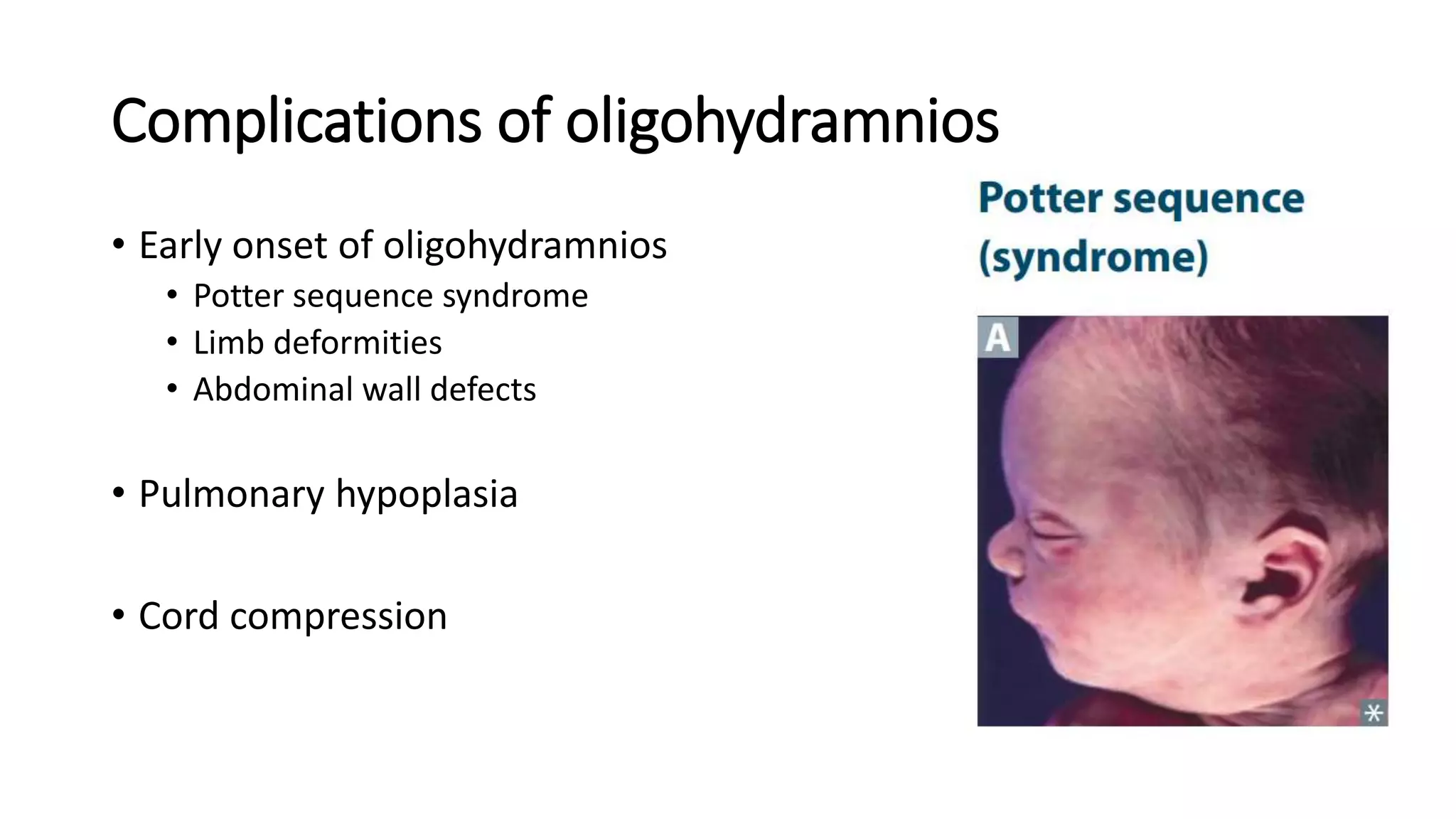
Complications of oligohydramnios
• Early onset of oligohydramnios
• Potter sequence syndrome
• Limb deformities
• Abdominal wall defects
• Pulmonary hypoplasia
• Cord compression
Intrauterine Growth Restriction (IUGR)
• Introduction
• Detection usually on routine U/S
• Important for prenatal care
• Confirming diagnosis
• Determining the cause and severity of fetal growth restriction (FGR)
• Counseling the parents
• Closely monitor fetal growth and well-being
• Determining the optimal time for route of delivery
IUGR VS SGA
• Definition of IUGR:
• A fetus or infant whose weight is less than the 10th percentile at a given GA
as determined by U/S
• Or Infants whose growth velocity < expected
• SGA: An infant with a birth weight at the lower extreme of the
normal birth weight distribution.
• BW <10th %
• BW < 2SD below the mean (3rd %)
FGR VS SGA
http://datab.us/i/smallforgestationalage
Beckmann, C., Herbert, W., Laube, D., Ling, F., Smith, R., & American College of Obstetricians Gynecologists.
(2014). Obstetrics and gynecology (7th ed.).
Uterine fetal growth pattern
Reethiya, L., & Rokeshwar, H.D., Doctrina Perpetua: Guides on Obstetrics. (2015).
Types of IUGR
Reethiya, L., & Rokeshwar, H.D., Doctrina Perpetua: Guides on Obstetrics. (2015).
Pondoral index: Ratio of BW to Length:
𝐵𝑊
𝑙𝑒𝑛𝑔ℎ𝑡3
× 100
Causes and risk factors of FGR
Beckmann, C., Herbert, W., Laube, D., Ling, F., Smith, R., & American College of Obstetricians
Gynecologists. (2014). Obstetrics and gynecology (7th ed.).
Evaluation
• Assess gestational age on early routine
visit.
• History to assess the risk factors.
• Physical examination
• Screening test – serial measurements of
fundal height.
• Fundal height should increase approx.
1cm/week between 20 and 36 weeks
• Significant discrepancy of > 2 cm may indicate
IUGR
Ultrasound
Evaluation (Continued)
• Investigation
• CBC – Hb, WBC (possible infection)
• TORCHES Screening
• Look for dysmorphic features
• Mother urine for substance/ meconium for substance
• Blood sugar
• Calcium
• Bilirubin
• Ultrasound
• To assess fetal size and
growth.
• Fetal biometry
measurements and compare
with standardized table
• Biparietal diameter
• Head circumference
• Abdominal circumference
(AC) – false negative < 10%
• Femur length
Evaluation (Continued)
• Direct studies
• Invasive studies of the fetus.
• Amniocentesis for fetal lung
maturity
• Fetal karyotyping and viral
cultures and PCRs
Evaluation (Continued)
• Doppler velocimetry
• On fetal umbilical artery.
• Measured by Systolic/ Diastolic ratio
• Normal at term: 1.8 to 2.0
Doppler velocimetry (continued)
• IUGR secondary to uteroplacental insufficiency
• Show reversed end- dystolic flow
• May suggest impending fetal demise
Complication
• Fetal
• Hypothermia
• Hypoglycemia
• Hypocalcemia
• Perinatal
• Perinatal asphyxia
• Hypothermia
• Hypoglycemia
• Polycythemia, hyperviscosity
• ↑ meconium aspiration syndrome
• Neurodevelopment
• Lower intelligent
• Learning/behavior disorders
• Neurologic handicap
References
• Beckmann, C., Herbert, W., Laube, D., Ling, F., Smith, R., & American
College of Obstetricians Gynecologists. (2014). Obstetrics and
gynecology (7th ed.).
• http://www.stanfordchildrens.org/en/topic/default?id=amniocentesis
-90-P02429
• Callahan, T., & Caughey, A. (2007). Blueprints obstetrics & gynecology
(4th ed. / Tamara L. Callahan, Aaron B. Caughey. ed., Blueprints).
Philadelphia ; London: Lippincott Williams & Wilkins.
• Cunningham, F., & Williams, J. (2014). Williams obstetrics. (24th ed. /
[edited by] F. Gary Cunningham et al. ed.). New York ; London:
McGraw-Hill Medical.
References
• Beckmann, C., Herbert, W., Laube, D., Ling, F., Smith, R., & American College of
Obstetricians Gynecologists. (2014). Obstetrics and gynecology (7th ed.).
• https://ghr.nlm.nih.gov/condition/vacterl-association
• https://www.uptodate.com/contents/placental-abruption-clinical-features-and-
diagnosis?source=machineLearning&search=abruptio+placenta&selectedTitle=1~
150&sectionRank=1&anchor=H4#H4
• Cunningham, F., & Williams, J. (2014). Williams obstetrics. (24th ed. / [edited by]
F. Gary Cunningham et al. ed.). New York ; London: McGraw-Hill Medical.
• https://www.uptodate.com/contents/oligohydramnios?source=search_result&se
arch=oligohydramnios&selectedTitle=1~150
• Callahan, T., & Caughey, A. (2007). Blueprints obstetrics & gynecology (4th ed. /
Tamara L. Callahan, Aaron B. Caughey. ed., Blueprints). Philadelphia ; London:
Lippincott Williams & Wilkins.
Thank You


Oligohydramnios and IUGR

  • 1.
    Uterus smaller thandate Oligohydramnios & Intrauterine Growth Restriction (IUGR) M. Kamil
  • 3.
    Amniotic fluid • Function •Physical space for fetal movement -> important for normal musculoskeletal development • Permits fetal swallowing • Important for GI tract development • Permits fetal breathing • Necessary for lung development • Prevent umbilical cord compression • Protect from trauma
  • 4.
    Amniotic fluid evaluation •Component of fetal testing for 2nd and 3rd trimester sonogram. • Measurements 2 ways: • Single deepest vertical fluid pocket (nl 2 – 8 cm) • AFI - The sum of the deepest vertical pockets from each of four equal uterine quadrants (nl 5 – 24 cm)
  • 5.
  • 6.
    Oligohydramnios • Definition • AFI≤ 5 cm (or < 5th percentile)/ • The absence of a fluid pocket 2-3 cm in depth/ • Fluid volume of less than 500 mL at 32 – 36 weeks. • Anhydramnios – No measurable pocket of amniotic fluid is identified
  • 8.
    Clinical manifestation anddiagnosis • Uterine size < expected for gestational age • Performed ultrasound to assess AF volume • AFI ≤ 5 cm • Single deepest pocket of amniotic fluid ≤ 2 cm • Gestational age specific nomogram: < 2.5th percentile • A fluid volume of less than 500 mL at 32-36 weeks.
  • 9.
    Evaluation • Thorough maternalhistory • Targeted physical examination • Ultrasound evaluation with fetal biometry and fetal anomalies • Fetal growth restriction • Aneuploidy - ↑ nuchal translucency • Placental abnormalities (abruption)
  • 11.
    Management • Admission forinvestigation • Rule out ROM • Amniocentesis - > Karyotyping • Doppler ultrasound for fetal distress • Evidence of fetal distress- > immediate C-sec • If no fetal distress, induced and delivered via SVD • Send placenta for pathological examination
  • 13.
    Complications of oligohydramnios •Early onset of oligohydramnios • Potter sequence syndrome • Limb deformities • Abdominal wall defects • Pulmonary hypoplasia • Cord compression
  • 14.
  • 15.
    Intrauterine Growth Restriction(IUGR) • Introduction • Detection usually on routine U/S • Important for prenatal care • Confirming diagnosis • Determining the cause and severity of fetal growth restriction (FGR) • Counseling the parents • Closely monitor fetal growth and well-being • Determining the optimal time for route of delivery
  • 16.
    IUGR VS SGA •Definition of IUGR: • A fetus or infant whose weight is less than the 10th percentile at a given GA as determined by U/S • Or Infants whose growth velocity < expected • SGA: An infant with a birth weight at the lower extreme of the normal birth weight distribution. • BW <10th % • BW < 2SD below the mean (3rd %)
  • 17.
  • 18.
    Beckmann, C., Herbert,W., Laube, D., Ling, F., Smith, R., & American College of Obstetricians Gynecologists. (2014). Obstetrics and gynecology (7th ed.).
  • 19.
    Uterine fetal growthpattern Reethiya, L., & Rokeshwar, H.D., Doctrina Perpetua: Guides on Obstetrics. (2015).
  • 20.
    Types of IUGR Reethiya,L., & Rokeshwar, H.D., Doctrina Perpetua: Guides on Obstetrics. (2015). Pondoral index: Ratio of BW to Length: 𝐵𝑊 𝑙𝑒𝑛𝑔ℎ𝑡3 × 100
  • 21.
    Causes and riskfactors of FGR Beckmann, C., Herbert, W., Laube, D., Ling, F., Smith, R., & American College of Obstetricians Gynecologists. (2014). Obstetrics and gynecology (7th ed.).
  • 22.
    Evaluation • Assess gestationalage on early routine visit. • History to assess the risk factors. • Physical examination • Screening test – serial measurements of fundal height. • Fundal height should increase approx. 1cm/week between 20 and 36 weeks • Significant discrepancy of > 2 cm may indicate IUGR Ultrasound
  • 23.
    Evaluation (Continued) • Investigation •CBC – Hb, WBC (possible infection) • TORCHES Screening • Look for dysmorphic features • Mother urine for substance/ meconium for substance • Blood sugar • Calcium • Bilirubin
  • 24.
    • Ultrasound • Toassess fetal size and growth. • Fetal biometry measurements and compare with standardized table • Biparietal diameter • Head circumference • Abdominal circumference (AC) – false negative < 10% • Femur length Evaluation (Continued)
  • 25.
    • Direct studies •Invasive studies of the fetus. • Amniocentesis for fetal lung maturity • Fetal karyotyping and viral cultures and PCRs Evaluation (Continued)
  • 26.
    Evaluation (Continued) • Dopplervelocimetry • On fetal umbilical artery. • Measured by Systolic/ Diastolic ratio • Normal at term: 1.8 to 2.0
  • 27.
    Doppler velocimetry (continued) •IUGR secondary to uteroplacental insufficiency • Show reversed end- dystolic flow • May suggest impending fetal demise
  • 28.
    Complication • Fetal • Hypothermia •Hypoglycemia • Hypocalcemia • Perinatal • Perinatal asphyxia • Hypothermia • Hypoglycemia • Polycythemia, hyperviscosity • ↑ meconium aspiration syndrome • Neurodevelopment • Lower intelligent • Learning/behavior disorders • Neurologic handicap
  • 30.
    References • Beckmann, C.,Herbert, W., Laube, D., Ling, F., Smith, R., & American College of Obstetricians Gynecologists. (2014). Obstetrics and gynecology (7th ed.). • http://www.stanfordchildrens.org/en/topic/default?id=amniocentesis -90-P02429 • Callahan, T., & Caughey, A. (2007). Blueprints obstetrics & gynecology (4th ed. / Tamara L. Callahan, Aaron B. Caughey. ed., Blueprints). Philadelphia ; London: Lippincott Williams & Wilkins. • Cunningham, F., & Williams, J. (2014). Williams obstetrics. (24th ed. / [edited by] F. Gary Cunningham et al. ed.). New York ; London: McGraw-Hill Medical.
  • 31.
    References • Beckmann, C.,Herbert, W., Laube, D., Ling, F., Smith, R., & American College of Obstetricians Gynecologists. (2014). Obstetrics and gynecology (7th ed.). • https://ghr.nlm.nih.gov/condition/vacterl-association • https://www.uptodate.com/contents/placental-abruption-clinical-features-and- diagnosis?source=machineLearning&search=abruptio+placenta&selectedTitle=1~ 150&sectionRank=1&anchor=H4#H4 • Cunningham, F., & Williams, J. (2014). Williams obstetrics. (24th ed. / [edited by] F. Gary Cunningham et al. ed.). New York ; London: McGraw-Hill Medical. • https://www.uptodate.com/contents/oligohydramnios?source=search_result&se arch=oligohydramnios&selectedTitle=1~150 • Callahan, T., & Caughey, A. (2007). Blueprints obstetrics & gynecology (4th ed. / Tamara L. Callahan, Aaron B. Caughey. ed., Blueprints). Philadelphia ; London: Lippincott Williams & Wilkins.
  • 32.

Editor's Notes

  • #3 That is y fetuses with lethal renal abnormalities may no manifest severe oligo until 18 weeks.
  • #6 Williams OB page 233 Nomogram - a diagram representing the relations between three or more variable quantities by means of a number of scales, so arranged that the value of one variable can be found by a simple geometric construction, for example, by drawing a straight line intersecting the other scales at the appropriate values.
  • #7 Cause: Congenital anomalies GU system Growth restriction Nonreassuring fetal testing Nonreactive stress tests FHR decelerations Meconium C-Sec
  • #8 B/L renal agenesis – Potter sequence Renal cystic dysplasia - Meckel- Gruber syndrome Renal anomalies – VACTERL association Urinary tract obstruction Sacral agenesis
  • #10 Meckel- Gruber syndrome - is a rare, lethal, ciliopathic, genetic disorder, characterized by renal cystic dysplasia, central nervous system malformations (occipital encephalocele), polydactyly (post axial), hepatic developmental defects, and pulmonary hypoplasia due to oligohydramnios. VACTERL association - VACTERL stands for vertebral defects, anal atresia, cardiac defects, tracheo-esophageal fistula, renal anomalies, and limb abnormalities Placental insufficiency: Abnormally thin placenta (less than 1 cm)[1] Circumvallate placenta (1% of normal placentas) Amnion cell metaplasia, (amnion nodosum) (present in 65% of normal placentas) Increased syncytial knots Calcifications Infarcts due to focal or diffuse thickening of blood vessels Villi capillaries occupying about 50% of the villi volume or when <40% of capillaries are on the villous periphery Drugs ACE-I PG synthase inhibitors Twin to twin transfusion TRAP (twin reverse arterial perfusion sequence) Fetal demise PIH Pre-eclampsia
  • #12 Between 20 to 36 weeks of gestation -> fundal height should increase approx. 1 cm/week, consistent with gestational age in weeks Decrepancy of more than 2 cm may indicate IUGR
  • #13 Maternal medical disorders often cause a combination of fetal growth restriction and oligohydramnios. Aneuploidy : Abnormal number of chromosome
  • #14 Nitrazine – vaginal pH is 3.5 – 4.5. The nitrazine paper testing will turn to blue in the presence of alkaline amniotic fluid. 93.3% sensitivity. Fern test - visualization of a characteristic “fern-like” pattern on a slide (pre-cleaned, saline free slides are required), viewed under low power on a icroscope. A small amount of cervical mucus is allowed to air-dry on a clean, saline- free glass slide.Procedure. 1. When a slide has completely air dried (at least 5 – 7 minutes), place it on the stage of LM provided for the procedure. 2. Examine the slide under low power (10X). 3. Look for fern-like crystals. If positive for amniotic fluid, this crystal formation will be present in most microscopic fields
  • #15 B/L renal agenesis – Potter sequence Renal cystic dysplasia - Meckel- Gruber syndrome Renal anomalies – VACTERL association Urinary tract obstruction Sacral agenesis
  • #20 EFW: estimated fetal weight Reactive NST= Normal
  • #21 Potter sequence syndrome – limb deformities, low set ears, facial anomalies, retrognathia Compression of the chest and lack of aminiotic fluid aspiration into fetal lungs -> pulmonary hyperplasia Cord compression -> late FHR deceleration -> increase risk of asphyxia. Abnormal fetal development in early onset of oligohydramnios
  • #23 When ultrasound examination suggests fetal growth restriction (FGR), prenatal care involves confirming the suspected diagnosis, determining the cause and severity of FGR, counseling the parents, closely monitoring fetal growth and well-being, and determining the optimal time for and route of delivery. FGR resulting from intrinsic fetal factors such as aneuploidy, congenital malformations, or infection carries a guarded prognosis that often cannot be improved by any intervention. FGR related to uteroplacental insufficiency has a better prognosis, but the risk for adverse outcome remains increased. Growth restriction develop at earlier GA has greater effects on morbidity and mortality. The smaller the fetus with IUGR, the greater its risk for morbidity and mortality
  • #24 The time when the growth restriction is found may be the factor in morbidity and mortality: Growth restriction at earlier GA has greater effects on morbidity and mortality
  • #25 SGA (small for gestational age) & IUGR are not synonymous SGA fetuses - may not necessarily growth restricted as many of these may be just constitutionally small and not at risk of any adverse outcome. Term IUGR should more strictly refer to Small for gestational age and Display other signs of chronic hypoxia or failure to thrive. 
  • #27 If IUGR develop in early in pregnancy -> lead to an irreversible reduction size of organ and also reduce in function. Usually a/w genetic factors, immunologic abnormalities, chronic maternal disease, fetal infection, and multiple pregnancies. If develop later in pregnancy in hyperplasia stage -> result in decrease in the size of cells, which are reversible of fetal size by adequate nutrition. Placenta grows early and rapidly compared with fetus -> and peak at 37 weeks -> after that decline in placental surface area (and hence its function) primarily d/t microinfarctions of its vascular system. Therefore, late onset of IUGR may be related to decrease in function and nutritient transport of the uteroplacental unit (a condition called uteroplacental insufficiency)
  • #28 Using U/S to determine the ratio. Symmetrical: Proportionately small. Usually due to early insult which decrease in overall number and size of the cell. E.g: Chemical exposure, viral infection, or cellular maldevelopment with aneuploidy may cause proportionate reduction of both head and body size. Asymmetrical: Disproportionately lagging abdominal growth. Usually follow late pregnancy insult which primarily affect cell size and not the number. E.g.: Placental insufficiency from HTN, results in diminished glucose transfer and hepatic storage thus fetus have smaller liver which reflect by abdominal circumference. Such somatic – growth restriction is proposed to result from preferential shunting of oxyen and nutrients to the brain -> Allows normal brain and head growth (brain sparring). Because of brain-sparing effects, asymmetrical fetuses were thought to be preferentially protected from the full effects of growth restriction
  • #29 Maternal factors Preeclampsia Diabetes in pregnancy Anemia Chronic hypertension with atherosclerosis Poor nutrition Smoking, Drugs, Alcohol Fetal factors Fetal infection Multiple pregnancy Malformations Chromosomal defects Placental factors Decreased uteroplacental blood flow Placenta previa Thrombosis, infarction (fibrin deposition) Placentitis, vasculitis Placental cysts, chorioangioma
  • #30 1. On routine visit – assessment of gestational age is critically important in early pregnancy, because dating becomes increasingly imprecise as gestational age advances. 2. History to assess the risk factors. 3. Physical examination ->Screening test for IUGR – serial measurements of fundal height. Fundal height should increase approx. 1cm/week between 20 and 36 weeks -> Significant discrepancy of > 2 cm may indicate IUGR -> Need U/S To diagnose 1st – recognition of risk factors 2nd – clinical assessment of uterine size 3rd – followed by biometric measurements
  • #31 Look for dysmorphic features -> if present, conform with karyotyping.
  • #32 - An AC within the normal range reliably excludes growth restriction, with false negative rate of less than 10%. - A small AC or fetal weight estimates below 10th percentile suggests the possibility of growth restriction, with the likelihood increasing as the percentile rank decreases
  • #34 Invasive studies of the fetus. Amniocentesis for fetal lung maturity may assist delivery planning near term or when there is uncertainty regarding GA and concern for growth restriction. Fetal karyotyping and viral cultures and PCRs Rare: Chorionic villus sampling (biopsy of placenta) or direct blood sampling (percutaneous umbilical blood sampling) may be necessary for specific studies.
  • #37 Hypothermia – Decreased SC fat -> increased surface volume ratio -> decrease heat production Hypoglycemia – Decreased glycogen stores/ glycogenolysis/ gluconeogenesis increased metabolic rate deficient catecholamine release Hypocalcemia – a/w perinatal stress, asphyxia, prematurity