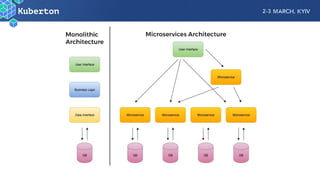
Microservices are solving many architectural problems
that have plagued developers and operations for years. But
while the benefits are now clear, many professionals aren't
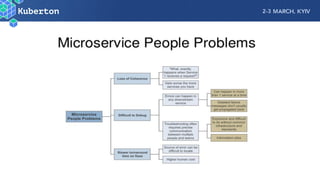
fully aware of the many challenges that come with
microservices. A significant portion of those center around
monitoring and observability.
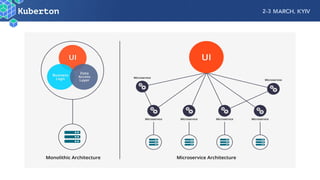
Microservices add complexity to your system,
communication, and network, which makes monitoring more
complicated.
You have a lot more systems
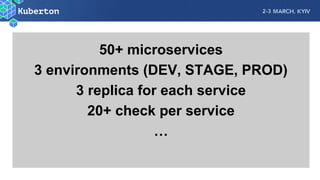
50+ microservices
3 environments (DEV, STAGE, PROD)
3 replica for each service
20+ check per service
…
Think about monitoring from the start
Monitoring
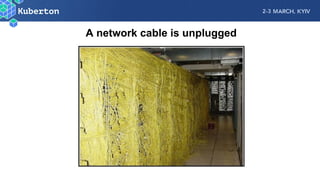
A network cable is unplugged
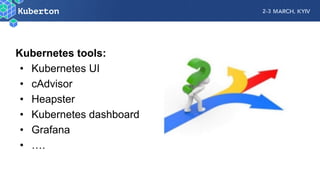
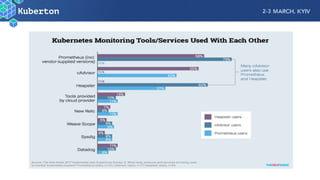
Kubernetes tools:
• Kubernetes UI
• cAdvisor
• Heapster
• Kubernetes dashboard
• Grafana
• ….
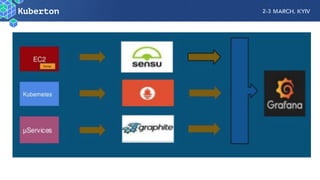
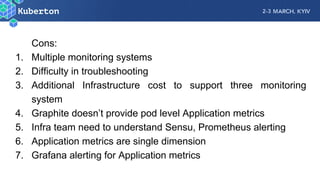
Cons:
1. Multiple monitoring systems
2. Difficulty in troubleshooting
3. Additional Infrastructure cost to support three monitoring
system
4. Graphite doesn’t provide pod level Application metrics
5. Infra team need to understand Sensu, Prometheus alerting
6. Application metrics are single dimension
7. Grafana alerting for Application metrics
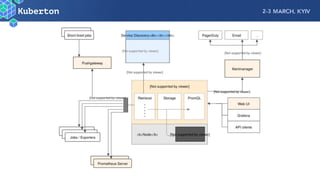
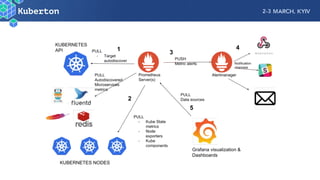
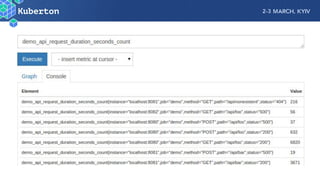
Prometheus:
• It developed as SoundCloud by ex-Googlers
• Prometheus is a close cousin of Kubernetes
• A multi-dimensional data model with time series data
identified by metric name and key/value pairs
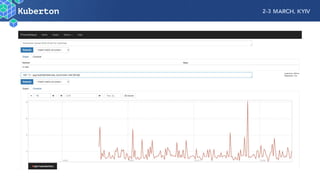
• Alerting and graphing are unified, using the same
language
• Time series collection happens via a pull model over
HTTP
Prometheus:
• Targets are discovered via service discovery or static
configuration
• Provides multiple exporters to send AWS EC2, Kafka,
Redis, RMQ,... metrics
• You can export specific metrics from Prometheus to
Kubernetes and use these metrics in HPA
Metrics:
• CPU (system, user, nice, iowait, idle, irq, softirq, guest)
• Memory (Apps, Buffers, Cached, Free, SwapCached,
Active, Inactive,...)
• Load
• Disk Space Used in percent
• Disk Utilization per Device
• Disk IOPS per device (read, write)
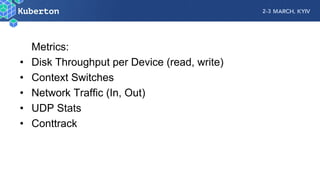
Metrics:
• Disk Throughput per Device (read, write)
• Context Switches
• Network Traffic (In, Out)
• UDP Stats
• Conttrack
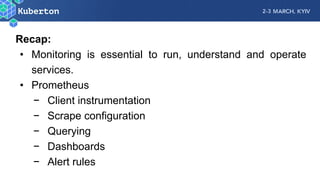
Recap:
• Monitoring is essential to run, understand and operate
services.
• Prometheus
− Client instrumentation
− Scrape configuration
− Querying
− Dashboards
− Alert rules
Logging
Your pods logs exist on the node only as long as the pod
itself exists on the Kubernetes node; this means, when
there’s an eviction event  —  for example, rescheduling pods
from a tainted node-, and the pods are drained, the logs are
taken with it. Persisting this data, however, can be useful,
and doing this requires a little bit of iteration on the logging
architecture. Persistence aside, this also allows you to
leverage more advanced tooling around your log data once
aggregated.
How your cluster ships logs to a logging backend will vary
in small ways, but typically will come down to the following
process; a DaemonSet (meaning a single pod that will run on
as many nodes that exist in the cluster; if you have 4 nodes,
you have 4 instances, and if you remove a node, that 4th
instance is not rescheduled) is used to run a logging agent,
and that agent will ship logs to your logging backend.
Unfortunately, Kubernetes doesn’t provide many
configuration options that pertain to logging. Docker offers
multiple logging drivers, but we can’t configure them via
Kubernetes. Thankfully, there are already several open
source solutions. When it comes to logging, our favorite tools
are Fluentd, Fluent-bit and Filebeat.
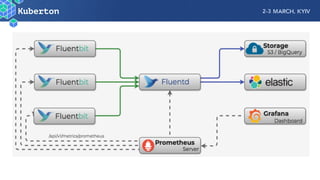
Fluentd is an open source log collector, processor, and
aggregator that was created back in 2011 by the folks at
Treasure Data. Written in Ruby, Fluentd was created to act
as a unified logging layer — a one-stop component that can
aggregate data from multiple sources, unify the differently
formatted data into JSON objects and route it to different
output destinations.
Design wise — performance, scalability, and reliability are
some of Fluentd’s outstanding features. A vanilla Fluentd
deployment will run on ~40MB of memory and is capable of
processing above 10,000 events per second. Adding new
inputs or outputs is relatively simple and has little effect on
performance. Fluentd uses disk or memory for buffering and
queuing to handle transmission failures or data overload and
supports multiple configuration options to ensure a more
resilient data pipeline.
Logstash is not the oldest shipper of this list (that would
be syslog-ng, ironically the only one with “new” in its name),
but it’s certainly the best known. That’s because it has lots
of plugins: inputs, codecs, filters and outputs. Basically, you
can take pretty much any kind of data, enrich it as you wish,
then push it to lots of destinations.
Logstash Advantages:
Logstash’s main strongpoint is flexibility, due to the
number of plugins.
Logstash Disadvantages:
Logstash’s biggest con or “Achille’s heel” has always been
performance and resource consumption (the default heap
size is 1GB).
Fluentd has been around for some time now and has
developed a rich ecosystem consisting of more than 700
different plugins that extend its functionality. Fluentd is the
de-facto standard log aggregator used for logging in
Kubernetes and as mentioned above, is one of the widely
used Docker images.
To serve this purpose, Fluent Bit was designed for high
performance and comes with a super light footprint, running
on ~450KB only. An abstracted I/O handler allows
asynchronous and event-driven read/write operations. For
resiliency and reliability, various configuration option are
available for defining retries and the buffer limit.
Fluent Bit is also extensible, but has a smaller eco-system
compared to Fluentd. Inputs include syslog, tcp,
systemd/journald but also CPU, memory, and disk. Outputs
include Elasticsearch, InfluxDB, file and http. For Kubernetes
deployments, a dedicated filter plugin will add metadata to
log data, such as the pod’s name and namespace, and the
containers name/ID.
Filebeat is a lightweight logshipper for logstash. It can be
installed as agents on your servers to collect operational
data. Since it is lightweight it does not consume system
resources compared to Logstash. It has a number of modules
that can help in parsing, collecting and visualization of logs.
Moreover, it is container ready so in case if you are looking to
build a container based solution you can run Filebeat inside a
container in the same Virtual Machine
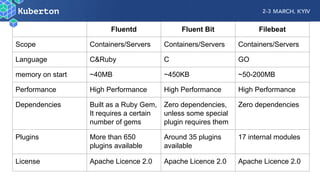
Fluentd Fluent Bit Filebeat
Scope Containers/Servers Containers/Servers Containers/Servers
Language C&Ruby C GO
memory on start ~40MB ~450KB ~50-200MB
Performance High Performance High Performance High Performance
Dependencies Built as a Ruby Gem,
It requires a certain
number of gems
Zero dependencies,
unless some special
plugin requires them
Zero dependencies
Plugins More than 650
plugins available
Around 35 plugins
available
17 internal modules
License Apache Licence 2.0 Apache Licence 2.0 Apache Licence 2.0
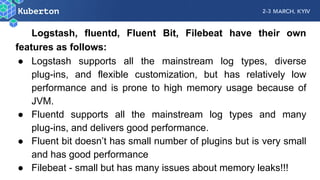
Logstash, fluentd, Fluent Bit, Filebeat have their own
features as follows:
● Logstash supports all the mainstream log types, diverse
plug-ins, and flexible customization, but has relatively low
performance and is prone to high memory usage because of
JVM.
● Fluentd supports all the mainstream log types and many
plug-ins, and delivers good performance.
● Fluent bit doesn’t has small number of plugins but is very small
and has good performance
● Filebeat - small but has many issues about memory leaks!!!
Distributed tracing systems
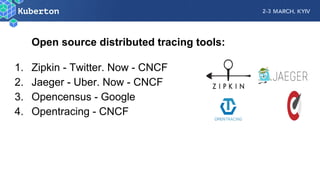
Open source distributed tracing tools:
1. Zipkin - Twitter. Now - CNCF
2. Jaeger - Uber. Now - CNCF
3. Opencensus - Google
4. Opentracing - CNCF
Zipkin and Jaeger are two popular choices for request
tracing. Zipkin was originally inspired by Dapper and
developed by Twitter. It's now maintained by a dedicated
community.
Jaeger was originally built and open sourced by Uber.
Jaeger is a Cloud Native Computing Foundation project.
The overall architecture is similar. Instrumented systems
send events/traces to the trace collector.
OpenTracing is a spec that grew out of Zipkin to provide
cross-platform compatibility. It offers a vendor-neutral API for
adding tracing to applications and delivering that data into
distributed tracing systems. A library written for the OpenTracing
spec can be used with any system that is OpenTracing-compliant.
OpenCensus is a vendor-agnostic (unified framework) single
distribution of libraries to provide metrics collection and tracing for
your services. OpenCensus originates from Google.
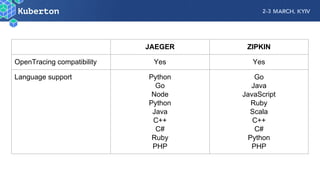
JAEGER ZIPKIN
OpenTracing compatibility Yes Yes
Language support Python
Go
Node
Python
Java
C++
C#
Ruby
PHP
Go
Java
JavaScript
Ruby
Scala
C++
C#
Python
PHP
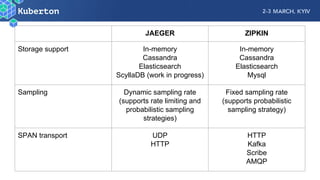
JAEGER ZIPKIN
Storage support In-memory
Cassandra
Elasticsearch
ScyllaDB (work in progress)
In-memory
Cassandra
Elasticsearch
Mysql
Sampling Dynamic sampling rate
(supports rate limiting and
probabilistic sampling
strategies)
Fixed sampling rate
(supports probabilistic
sampling strategy)
SPAN transport UDP
HTTP
HTTP
Kafka
Scribe
AMQP
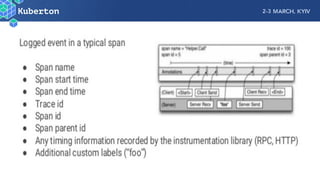
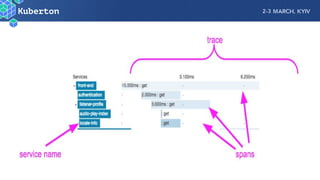
A set of Annotations and BinaryAnnotations that correspond to
a particular RPC. Spans contain identifying information such as
traceId, spanId, parentId, and RPC name.
Spans are usually small. For example, the serialized form is
often measured in KiB or less. When spans grow beyond orders of
KiB, other problems occur, such as hitting limits like Kafka
message size (1MiB). Even if you can raise message limits, large
spans will increase the cost and decrease the usability of the
tracing system. For this reason, be conscious to store data that
helps explain system behavior, and don’t store data that doesn’t.
Error tracking tools
Deploying fast and frequently might introduce a errors,
exceptions and bugs into our application, and it’s best to
identify them before your users do.
Current error tracking tools:
1. Sentry
2. Airbrake
3. BugSnag
4. OverOps
5. StackHunter
6. Rollbar
7. Raygun
Sentry a tiny bit of open source code grew to became a
full-blown error monitoring tool, that identifies and debugs
errors in production. You can use the insights to know
whether you should spend time fixing a certain bug, or if you
should roll back to a previous version.
The dashboard lets you see stack traces, with support for
source maps, along with detecting each error’s URL,
parameters and session information. Each trace can be
filtered with app, framework or raw error views.
Supported languages:
JavaScript, Node.js, Python, Go, PHP, Ruby, C#,
Objective-C and even Swift
Thank you for your attention!
Questions?
Monitoring&Logging - Stanislav Kolenkin

Monitoring&Logging - Stanislav Kolenkin

  • 2.
    Microservices are solvingmany architectural problems that have plagued developers and operations for years. But while the benefits are now clear, many professionals aren't fully aware of the many challenges that come with microservices. A significant portion of those center around monitoring and observability. Microservices add complexity to your system, communication, and network, which makes monitoring more complicated.
  • 4.
    You have alot more systems
  • 5.
    50+ microservices 3 environments(DEV, STAGE, PROD) 3 replica for each service 20+ check per service …
  • 6.
    Think about monitoringfrom the start
  • 7.
  • 8.
    A network cableis unplugged
  • 9.
    Kubernetes tools: • KubernetesUI • cAdvisor • Heapster • Kubernetes dashboard • Grafana • ….
  • 13.
    Cons: 1. Multiple monitoringsystems 2. Difficulty in troubleshooting 3. Additional Infrastructure cost to support three monitoring system 4. Graphite doesn’t provide pod level Application metrics 5. Infra team need to understand Sensu, Prometheus alerting 6. Application metrics are single dimension 7. Grafana alerting for Application metrics
  • 14.
    Prometheus: • It developedas SoundCloud by ex-Googlers • Prometheus is a close cousin of Kubernetes • A multi-dimensional data model with time series data identified by metric name and key/value pairs • Alerting and graphing are unified, using the same language • Time series collection happens via a pull model over HTTP
  • 15.
    Prometheus: • Targets arediscovered via service discovery or static configuration • Provides multiple exporters to send AWS EC2, Kafka, Redis, RMQ,... metrics • You can export specific metrics from Prometheus to Kubernetes and use these metrics in HPA
  • 18.
    Metrics: • CPU (system,user, nice, iowait, idle, irq, softirq, guest) • Memory (Apps, Buffers, Cached, Free, SwapCached, Active, Inactive,...) • Load • Disk Space Used in percent • Disk Utilization per Device • Disk IOPS per device (read, write)
  • 19.
    Metrics: • Disk Throughputper Device (read, write) • Context Switches • Network Traffic (In, Out) • UDP Stats • Conttrack
  • 22.
    Recap: • Monitoring isessential to run, understand and operate services. • Prometheus − Client instrumentation − Scrape configuration − Querying − Dashboards − Alert rules
  • 23.
  • 24.
    Your pods logsexist on the node only as long as the pod itself exists on the Kubernetes node; this means, when there’s an eviction event  —  for example, rescheduling pods from a tainted node-, and the pods are drained, the logs are taken with it. Persisting this data, however, can be useful, and doing this requires a little bit of iteration on the logging architecture. Persistence aside, this also allows you to leverage more advanced tooling around your log data once aggregated.
  • 25.
    How your clusterships logs to a logging backend will vary in small ways, but typically will come down to the following process; a DaemonSet (meaning a single pod that will run on as many nodes that exist in the cluster; if you have 4 nodes, you have 4 instances, and if you remove a node, that 4th instance is not rescheduled) is used to run a logging agent, and that agent will ship logs to your logging backend.
  • 26.
    Unfortunately, Kubernetes doesn’tprovide many configuration options that pertain to logging. Docker offers multiple logging drivers, but we can’t configure them via Kubernetes. Thankfully, there are already several open source solutions. When it comes to logging, our favorite tools are Fluentd, Fluent-bit and Filebeat.
  • 28.
    Fluentd is anopen source log collector, processor, and aggregator that was created back in 2011 by the folks at Treasure Data. Written in Ruby, Fluentd was created to act as a unified logging layer — a one-stop component that can aggregate data from multiple sources, unify the differently formatted data into JSON objects and route it to different output destinations.
  • 29.
    Design wise —performance, scalability, and reliability are some of Fluentd’s outstanding features. A vanilla Fluentd deployment will run on ~40MB of memory and is capable of processing above 10,000 events per second. Adding new inputs or outputs is relatively simple and has little effect on performance. Fluentd uses disk or memory for buffering and queuing to handle transmission failures or data overload and supports multiple configuration options to ensure a more resilient data pipeline.
  • 30.
    Logstash is notthe oldest shipper of this list (that would be syslog-ng, ironically the only one with “new” in its name), but it’s certainly the best known. That’s because it has lots of plugins: inputs, codecs, filters and outputs. Basically, you can take pretty much any kind of data, enrich it as you wish, then push it to lots of destinations.
  • 31.
    Logstash Advantages: Logstash’s mainstrongpoint is flexibility, due to the number of plugins. Logstash Disadvantages: Logstash’s biggest con or “Achille’s heel” has always been performance and resource consumption (the default heap size is 1GB).
  • 32.
    Fluentd has beenaround for some time now and has developed a rich ecosystem consisting of more than 700 different plugins that extend its functionality. Fluentd is the de-facto standard log aggregator used for logging in Kubernetes and as mentioned above, is one of the widely used Docker images.
  • 33.
    To serve thispurpose, Fluent Bit was designed for high performance and comes with a super light footprint, running on ~450KB only. An abstracted I/O handler allows asynchronous and event-driven read/write operations. For resiliency and reliability, various configuration option are available for defining retries and the buffer limit.
  • 34.
    Fluent Bit isalso extensible, but has a smaller eco-system compared to Fluentd. Inputs include syslog, tcp, systemd/journald but also CPU, memory, and disk. Outputs include Elasticsearch, InfluxDB, file and http. For Kubernetes deployments, a dedicated filter plugin will add metadata to log data, such as the pod’s name and namespace, and the containers name/ID.
  • 35.
    Filebeat is alightweight logshipper for logstash. It can be installed as agents on your servers to collect operational data. Since it is lightweight it does not consume system resources compared to Logstash. It has a number of modules that can help in parsing, collecting and visualization of logs. Moreover, it is container ready so in case if you are looking to build a container based solution you can run Filebeat inside a container in the same Virtual Machine
  • 36.
    Fluentd Fluent BitFilebeat Scope Containers/Servers Containers/Servers Containers/Servers Language C&Ruby C GO memory on start ~40MB ~450KB ~50-200MB Performance High Performance High Performance High Performance Dependencies Built as a Ruby Gem, It requires a certain number of gems Zero dependencies, unless some special plugin requires them Zero dependencies Plugins More than 650 plugins available Around 35 plugins available 17 internal modules License Apache Licence 2.0 Apache Licence 2.0 Apache Licence 2.0
  • 37.
    Logstash, fluentd, FluentBit, Filebeat have their own features as follows: ● Logstash supports all the mainstream log types, diverse plug-ins, and flexible customization, but has relatively low performance and is prone to high memory usage because of JVM. ● Fluentd supports all the mainstream log types and many plug-ins, and delivers good performance. ● Fluent bit doesn’t has small number of plugins but is very small and has good performance ● Filebeat - small but has many issues about memory leaks!!!
  • 38.
  • 41.
    Open source distributedtracing tools: 1. Zipkin - Twitter. Now - CNCF 2. Jaeger - Uber. Now - CNCF 3. Opencensus - Google 4. Opentracing - CNCF
  • 42.
    Zipkin and Jaegerare two popular choices for request tracing. Zipkin was originally inspired by Dapper and developed by Twitter. It's now maintained by a dedicated community. Jaeger was originally built and open sourced by Uber. Jaeger is a Cloud Native Computing Foundation project. The overall architecture is similar. Instrumented systems send events/traces to the trace collector.
  • 43.
    OpenTracing is aspec that grew out of Zipkin to provide cross-platform compatibility. It offers a vendor-neutral API for adding tracing to applications and delivering that data into distributed tracing systems. A library written for the OpenTracing spec can be used with any system that is OpenTracing-compliant. OpenCensus is a vendor-agnostic (unified framework) single distribution of libraries to provide metrics collection and tracing for your services. OpenCensus originates from Google.
  • 44.
    JAEGER ZIPKIN OpenTracing compatibilityYes Yes Language support Python Go Node Python Java C++ C# Ruby PHP Go Java JavaScript Ruby Scala C++ C# Python PHP
  • 45.
    JAEGER ZIPKIN Storage supportIn-memory Cassandra Elasticsearch ScyllaDB (work in progress) In-memory Cassandra Elasticsearch Mysql Sampling Dynamic sampling rate (supports rate limiting and probabilistic sampling strategies) Fixed sampling rate (supports probabilistic sampling strategy) SPAN transport UDP HTTP HTTP Kafka Scribe AMQP
  • 46.
    A set ofAnnotations and BinaryAnnotations that correspond to a particular RPC. Spans contain identifying information such as traceId, spanId, parentId, and RPC name. Spans are usually small. For example, the serialized form is often measured in KiB or less. When spans grow beyond orders of KiB, other problems occur, such as hitting limits like Kafka message size (1MiB). Even if you can raise message limits, large spans will increase the cost and decrease the usability of the tracing system. For this reason, be conscious to store data that helps explain system behavior, and don’t store data that doesn’t.
  • 50.
  • 51.
    Deploying fast andfrequently might introduce a errors, exceptions and bugs into our application, and it’s best to identify them before your users do.
  • 52.
    Current error trackingtools: 1. Sentry 2. Airbrake 3. BugSnag 4. OverOps 5. StackHunter 6. Rollbar 7. Raygun
  • 53.
    Sentry a tinybit of open source code grew to became a full-blown error monitoring tool, that identifies and debugs errors in production. You can use the insights to know whether you should spend time fixing a certain bug, or if you should roll back to a previous version.
  • 54.
    The dashboard letsyou see stack traces, with support for source maps, along with detecting each error’s URL, parameters and session information. Each trace can be filtered with app, framework or raw error views. Supported languages: JavaScript, Node.js, Python, Go, PHP, Ruby, C#, Objective-C and even Swift
  • 57.
    Thank you foryour attention! Questions?