May 2016
Raft in details
Ivan Glushkov
ivan.glushkov@gmail.com
@gliush
Raft is a consensus algorithm for managing a
replicated log
Why
❖ Very important topic
❖ [Multi-]Paxos, the key player, is very difficult to
understand
❖ Paxos -> Multi-Paxos -> different approaches
❖ Different optimization, closed-source implementation
Raft goals
❖ Main goal - understandability:
❖ Decomposition: separated leader election, log
replication, safety, membership changes
❖ State space reduction
Replicated state machines
❖ The same state on each server
❖ Compute the state from replicated log
❖ Consensus algorithm: keep the replicated log consistent
Properties of consensus algorithm
❖ Never return an incorrect result: Safety
❖ Functional as long as any majority of the severs are
operational: Availability
❖ Do not depend on timing to ensure consistency (at
worst - unavailable)
Raft in a nutshell
❖ Elect a leader
❖ Give full responsibility for replicated log to leader:
❖ Leader accepts log entries from client
❖ Leader replicates log entries on other servers
❖ Tell servers when it is safe to apply changes on their
state
Raft basics: States
❖ Follower
❖ Candidate
❖ Leader
RequestVote RPC
❖ Become a candidate, if no communication from leader over
a timeout (random election timeout: e.g. 150-300ms)
❖ Spec: (term, candidateId, lastLogIndex, lastLogTerm) 

-> (term, voteGranted)
❖ Receiver:
❖ false if term < currentTerm
❖ true if not voted yet and term and log are Up-To-Date
❖ false
Leader Election
❖ Heartbeats from leader
❖ Election timeout
❖ Candidate results:
❖ It wins
❖ Another server wins
❖ No winner for a period of time -> new election
Leader Election Property
❖ Election Safety: at most one leader can be elected in a
given term
Log Replication
❖ log index
❖ log term
❖ log command
Log Replication
❖ Leader appends command from client to its log
❖ Leader issues AppendEntries RPC to replicate the entry
❖ Leader replicates entry to majority -> apply entry to
state -> “committed entry”
❖ Follower checks if entry is committed by server ->
commit it locally
Log Replication Properties
❖ Leader Append-Only: a leader never overwrites or
deletes entries in its log; it only appends new entries
❖ Log Matching: If two entries in different logs have the
same index and term, then they store the same
command.
❖ Log Matching: If two entries in different logs have the
same index and term, then the logs are identical in all
preceding entries.
Inconsistency
Solving Inconsistency
❖ Leader forces the followers’ logs to duplicate its own
❖ Conflicting entries in the follower logs will be
overwritten with entries from the Leader’s log:
❖ Find latest log where two servers agree
❖ Remove everything after this point
❖ Write new logs
Safety Property
❖ Leader Completeness: if a log entry is committed in a
given term, then that entry will be present in the logs of
the leaders for all higher-numbered terms
❖ State Machine Safety: if a server has applied a log entry
at a given index to its state machine, no other server will
ever apply a different log entry for the same index.
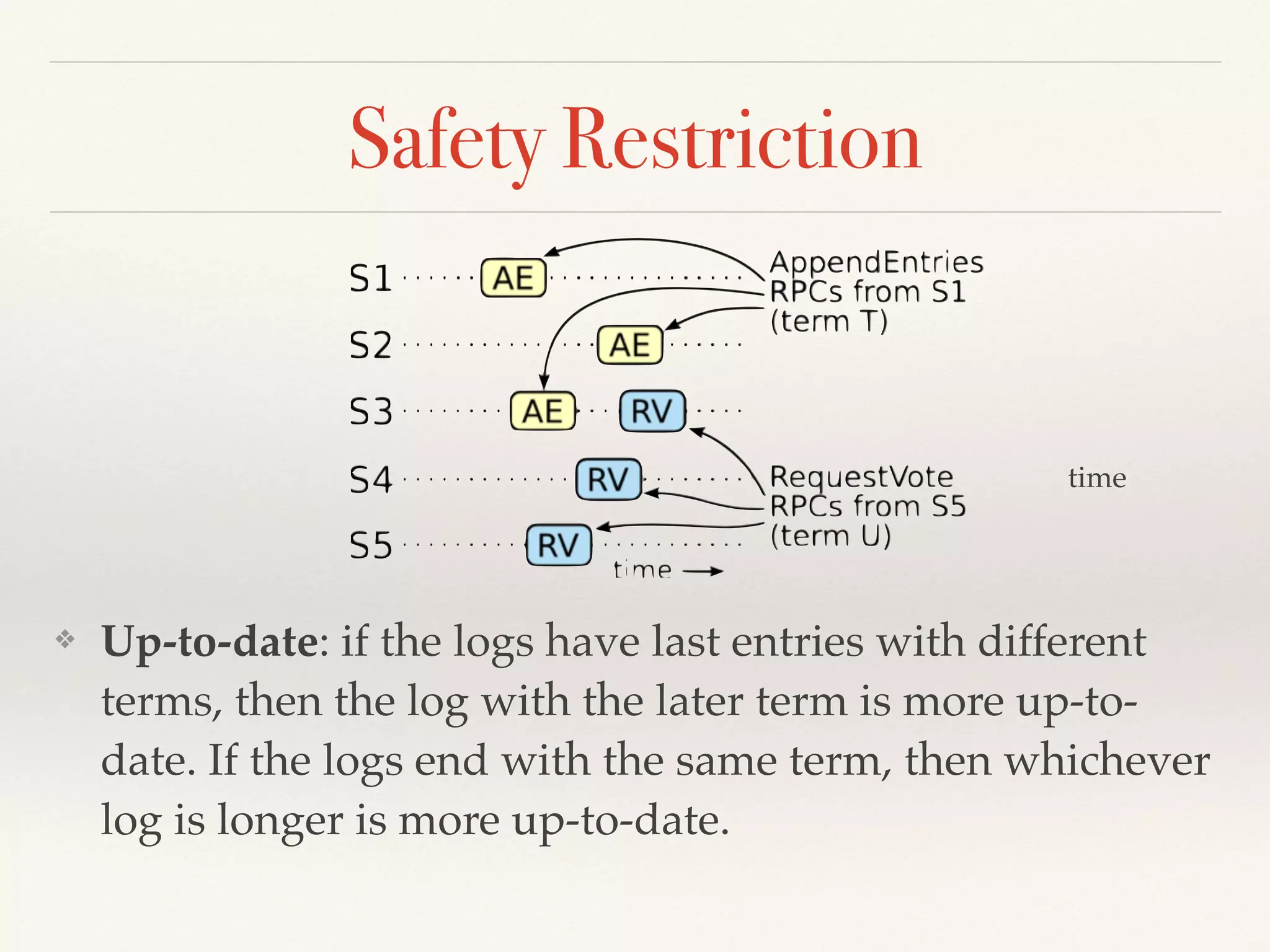
Safety Restriction
❖ Up-to-date: if the logs have last entries with different
terms, then the log with the later term is more up-to-
date. If the logs end with the same term, then whichever
log is longer is more up-to-date.
time
Follower and Candidate Crashes
❖ Retry indefinitely
❖ Raft RPC are idempotent
Raft Joint Consensus
❖ Two phase to change membership configuration
❖ In Joint Consensus state:
❖ replicate log entries to both configuration
❖ any server from either configuration may be a leader
❖ agreement (for election and commitment) requires
separate majorities from both configuration
Log compaction
❖ Independent

snapshotting
❖ Snapshot metadata
❖ InstallSnapshot RPC
Client Interaction
❖ Works with leader
❖ Leader respond to a request when it commits an entry
❖ Assign uniqueID to every command, leader stores latest
ID with response.
❖ Read-only - could be without writing to a log, possible
stale data. Or write “no-op” entry at start
Correctness
❖ TLA+ formal specification for consensus alg (400 LOC)
❖ Proof of linearizability in Raft using Coq (community)
Questions?

Raft in details

  • 1.
    May 2016 Raft indetails Ivan Glushkov ivan.glushkov@gmail.com @gliush
  • 2.
    Raft is aconsensus algorithm for managing a replicated log
  • 3.
    Why ❖ Very importanttopic ❖ [Multi-]Paxos, the key player, is very difficult to understand ❖ Paxos -> Multi-Paxos -> different approaches ❖ Different optimization, closed-source implementation
  • 4.
    Raft goals ❖ Maingoal - understandability: ❖ Decomposition: separated leader election, log replication, safety, membership changes ❖ State space reduction
  • 5.
    Replicated state machines ❖The same state on each server ❖ Compute the state from replicated log ❖ Consensus algorithm: keep the replicated log consistent
  • 6.
    Properties of consensusalgorithm ❖ Never return an incorrect result: Safety ❖ Functional as long as any majority of the severs are operational: Availability ❖ Do not depend on timing to ensure consistency (at worst - unavailable)
  • 7.
    Raft in anutshell ❖ Elect a leader ❖ Give full responsibility for replicated log to leader: ❖ Leader accepts log entries from client ❖ Leader replicates log entries on other servers ❖ Tell servers when it is safe to apply changes on their state
  • 8.
    Raft basics: States ❖Follower ❖ Candidate ❖ Leader
  • 9.
    RequestVote RPC ❖ Becomea candidate, if no communication from leader over a timeout (random election timeout: e.g. 150-300ms) ❖ Spec: (term, candidateId, lastLogIndex, lastLogTerm) 
 -> (term, voteGranted) ❖ Receiver: ❖ false if term < currentTerm ❖ true if not voted yet and term and log are Up-To-Date ❖ false
  • 10.
    Leader Election ❖ Heartbeatsfrom leader ❖ Election timeout ❖ Candidate results: ❖ It wins ❖ Another server wins ❖ No winner for a period of time -> new election
  • 11.
    Leader Election Property ❖Election Safety: at most one leader can be elected in a given term
  • 12.
    Log Replication ❖ logindex ❖ log term ❖ log command
  • 13.
    Log Replication ❖ Leaderappends command from client to its log ❖ Leader issues AppendEntries RPC to replicate the entry ❖ Leader replicates entry to majority -> apply entry to state -> “committed entry” ❖ Follower checks if entry is committed by server -> commit it locally
  • 14.
    Log Replication Properties ❖Leader Append-Only: a leader never overwrites or deletes entries in its log; it only appends new entries ❖ Log Matching: If two entries in different logs have the same index and term, then they store the same command. ❖ Log Matching: If two entries in different logs have the same index and term, then the logs are identical in all preceding entries.
  • 15.
  • 16.
    Solving Inconsistency ❖ Leaderforces the followers’ logs to duplicate its own ❖ Conflicting entries in the follower logs will be overwritten with entries from the Leader’s log: ❖ Find latest log where two servers agree ❖ Remove everything after this point ❖ Write new logs
  • 17.
    Safety Property ❖ LeaderCompleteness: if a log entry is committed in a given term, then that entry will be present in the logs of the leaders for all higher-numbered terms ❖ State Machine Safety: if a server has applied a log entry at a given index to its state machine, no other server will ever apply a different log entry for the same index.
  • 18.
    Safety Restriction ❖ Up-to-date:if the logs have last entries with different terms, then the log with the later term is more up-to- date. If the logs end with the same term, then whichever log is longer is more up-to-date. time
  • 19.
    Follower and CandidateCrashes ❖ Retry indefinitely ❖ Raft RPC are idempotent
  • 20.
    Raft Joint Consensus ❖Two phase to change membership configuration ❖ In Joint Consensus state: ❖ replicate log entries to both configuration ❖ any server from either configuration may be a leader ❖ agreement (for election and commitment) requires separate majorities from both configuration
  • 21.
    Log compaction ❖ Independent
 snapshotting ❖Snapshot metadata ❖ InstallSnapshot RPC
  • 22.
    Client Interaction ❖ Workswith leader ❖ Leader respond to a request when it commits an entry ❖ Assign uniqueID to every command, leader stores latest ID with response. ❖ Read-only - could be without writing to a log, possible stale data. Or write “no-op” entry at start
  • 23.
    Correctness ❖ TLA+ formalspecification for consensus alg (400 LOC) ❖ Proof of linearizability in Raft using Coq (community)
  • 24.