Conducting interview
 Talking to somebody is a very easy task yet conducting an
interview require a skill.
 An interview is a social interaction and therefore the
interviewer has to create an atmosphere of friendship with
the informant.
 As a interviewer, you must begin by making an appointment
at a date and time convienient to respondent so that she/he
can give you honest open answers.
 Sometimes speaking to an informant before the actual
interview may help create an atmosphere of friendship.
Conducting interview cont.
 While carrying out the interview, avoid being
judgmental, giving clues and showing expressions of
approval or disapproval.
 The interviewer must not direct the respondent answers
through his/her tone of voice or through the way he/she
phrases a question, e.g. 'You agree with us that this is
right, don't you?
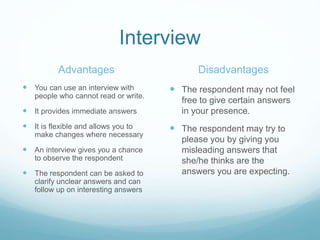
Interview
Advantages
 You can use an interview with
people who cannot read or write.
 It provides immediate answers
 It is flexible and allows you to
make changes where necessary
 An interview gives you a chance
to observe the respondent
 The respondent can be asked to
clarify unclear answers and can
follow up on interesting answers
Disadvantages
 The respondent may not feel
free to give certain answers
in your presence.
 The respondent may try to
please you by giving you
misleading answers that
she/he thinks are the
answers you are expecting.
Questionnaire
 A questionnaire is a list of questions each with a range
of answers from which the respondent can choose.
 The questionnaire can either be structure or
unstructured.
 However, most of the questionnaire are designed in a
structured manner, where the respondent is given
alternatives from which to choose.
Questionnaire
 Usually, using Likert scale which allows the respondent to
evaluate idea or attitude statements along four or five point
scale.
 For example Strongly
agree_____ Agree_____disagree_____ Strongly
agree_____
 The open ended questions allow the respondent to answer
the questions in their own way.
 For example, Foreign Aid always has strings attached.
 The respondent will freely express his opinion about the
assertion made.
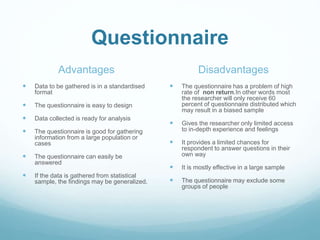
Questionnaire
Advantages
 Data to be gathered is in a standardised
format
 The questionnaire is easy to design
 Data collected is ready for analysis
 The questionnaire is good for gathering
information from a large population or
cases
 The questionnaire can easily be
answered
 If the data is gathered from statistical
sample, the findings may be generalized.
Disadvantages
 The questionnaire has a problem of high
rate of non return.In other words most
the researcher will only receive 60
percent of questionnaire distributed which
may result in a biased sample
 Gives the researcher only limited access
to in-depth experience and feelings
 It provides a limited chances for
respondent to answer questions in their
own way
 It is mostly effective in a large sample
 The questionnaire may exclude some
groups of people
Observation sheet
 Observation is the collection of data by watching somethings
happen in real life situation and do the recording as the events
unfold.
 The use tally marks is very important and one should make a tally
whenever the observed behaviour occurs.
 The observation can be divided into simple
observation and participant observation.
 In simple observation, the observer is not part of the process that
is being researched, but an objective outsider.
 Simple observation collects data as it unfolds, while in participant
observation the observer is involved in a group of people who are
subject of research.
Observation
Advantages
 Takes place in the real world
 Can provide a clear picture of the
social phenomena observed
 Information collected through
observation is reliable and
accurate
 Data collected through participant
is loaded and detailed
 Observation does not need the
skill of communication
Disadvantages
 It can be difficult to decide
what to observe and record
 Observation is time-
consuming
 Researcher can become
bored and lose objectivity
 It is difficult to observe
everything
 In participant observation
people may pretentious in
their actions

Instruments of data collection

  • 1.
    Conducting interview  Talkingto somebody is a very easy task yet conducting an interview require a skill.  An interview is a social interaction and therefore the interviewer has to create an atmosphere of friendship with the informant.  As a interviewer, you must begin by making an appointment at a date and time convienient to respondent so that she/he can give you honest open answers.  Sometimes speaking to an informant before the actual interview may help create an atmosphere of friendship.
  • 2.
    Conducting interview cont. While carrying out the interview, avoid being judgmental, giving clues and showing expressions of approval or disapproval.  The interviewer must not direct the respondent answers through his/her tone of voice or through the way he/she phrases a question, e.g. 'You agree with us that this is right, don't you?
  • 3.
    Interview Advantages  You canuse an interview with people who cannot read or write.  It provides immediate answers  It is flexible and allows you to make changes where necessary  An interview gives you a chance to observe the respondent  The respondent can be asked to clarify unclear answers and can follow up on interesting answers Disadvantages  The respondent may not feel free to give certain answers in your presence.  The respondent may try to please you by giving you misleading answers that she/he thinks are the answers you are expecting.
  • 4.
    Questionnaire  A questionnaireis a list of questions each with a range of answers from which the respondent can choose.  The questionnaire can either be structure or unstructured.  However, most of the questionnaire are designed in a structured manner, where the respondent is given alternatives from which to choose.
  • 5.
    Questionnaire  Usually, usingLikert scale which allows the respondent to evaluate idea or attitude statements along four or five point scale.  For example Strongly agree_____ Agree_____disagree_____ Strongly agree_____  The open ended questions allow the respondent to answer the questions in their own way.  For example, Foreign Aid always has strings attached.  The respondent will freely express his opinion about the assertion made.
  • 6.
    Questionnaire Advantages  Data tobe gathered is in a standardised format  The questionnaire is easy to design  Data collected is ready for analysis  The questionnaire is good for gathering information from a large population or cases  The questionnaire can easily be answered  If the data is gathered from statistical sample, the findings may be generalized. Disadvantages  The questionnaire has a problem of high rate of non return.In other words most the researcher will only receive 60 percent of questionnaire distributed which may result in a biased sample  Gives the researcher only limited access to in-depth experience and feelings  It provides a limited chances for respondent to answer questions in their own way  It is mostly effective in a large sample  The questionnaire may exclude some groups of people
  • 7.
    Observation sheet  Observationis the collection of data by watching somethings happen in real life situation and do the recording as the events unfold.  The use tally marks is very important and one should make a tally whenever the observed behaviour occurs.  The observation can be divided into simple observation and participant observation.  In simple observation, the observer is not part of the process that is being researched, but an objective outsider.  Simple observation collects data as it unfolds, while in participant observation the observer is involved in a group of people who are subject of research.
  • 8.
    Observation Advantages  Takes placein the real world  Can provide a clear picture of the social phenomena observed  Information collected through observation is reliable and accurate  Data collected through participant is loaded and detailed  Observation does not need the skill of communication Disadvantages  It can be difficult to decide what to observe and record  Observation is time- consuming  Researcher can become bored and lose objectivity  It is difficult to observe everything  In participant observation people may pretentious in their actions