By- Deepika Dubey
A polygraph Test, popularly known as a lie detector
test, is used to prove truthfulness of a subject &
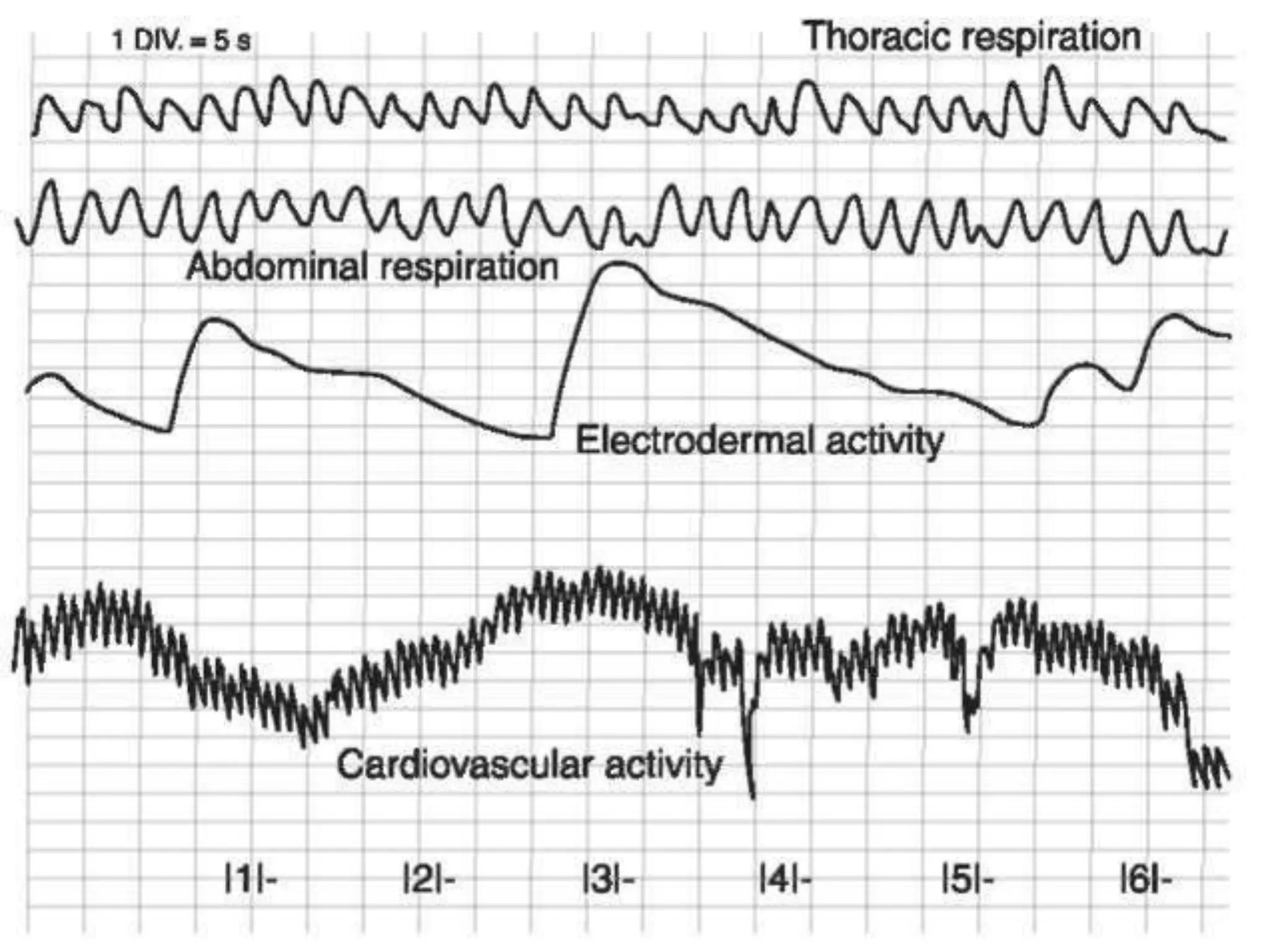
measures and records several physiological indices
such as:-
 Blood pressure
 Pulse
 Respiration,&
 Skin conductivity.
while the subject is asked a series of questions.
Lie detection is also known as deception detection.
 To verify the veracity of the statement of suspect,
witness & complainant in all types of crime.
 To replace the third degree method of interrogation in
a scientific manner.
 To examine white collar criminals, economic offenders,
cyber criminals & other offenders.
 To corroborate or to refute the findings of the
investigation.
The study of physiological methods for deception tests
measuring emotional disturbances began in the early
19th century.
 Benussi was the first to work on practical deception
tests based on physiological changes.
 And the first attempt to develop a scientific instrument
to detect truth was made by Lombroso in 1895.
 Later, Larsen & Keelar independently designed
instruments with new features to make it more
versatile.
 John Reid, in 1947 further improved the instrument as
well as the technique of administering the test.
 The polygraph is based on the principle of
psychosomatic interaction of an individual.This means,
a change takes place in person who consciously holds
feelings, which manifest into physiological changes in
his blood pressure, pulse rate, respiration and
electrodermal response. Hence it is the fear of
detection & not the guilt which produces measurable
physiological responses.
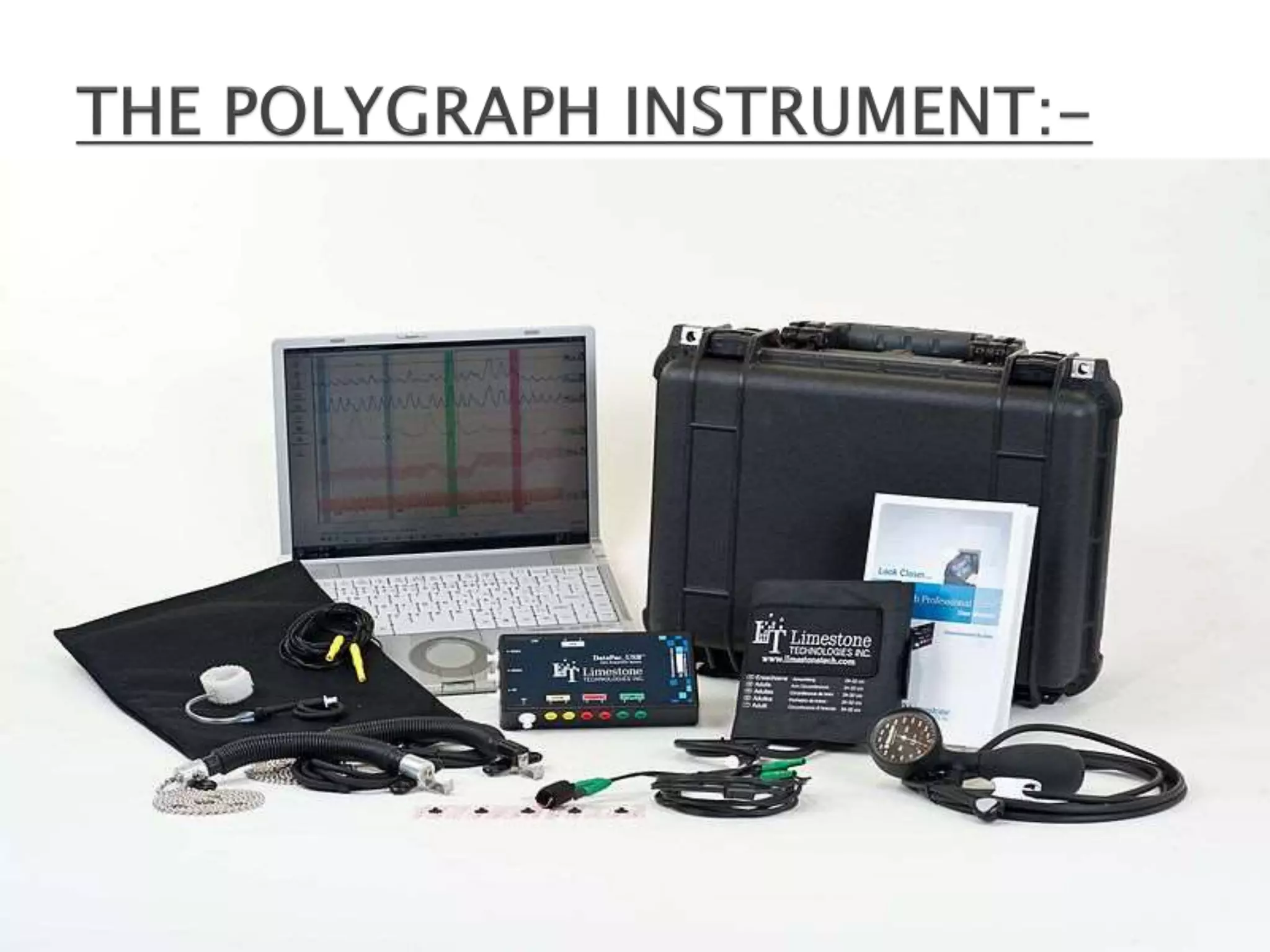
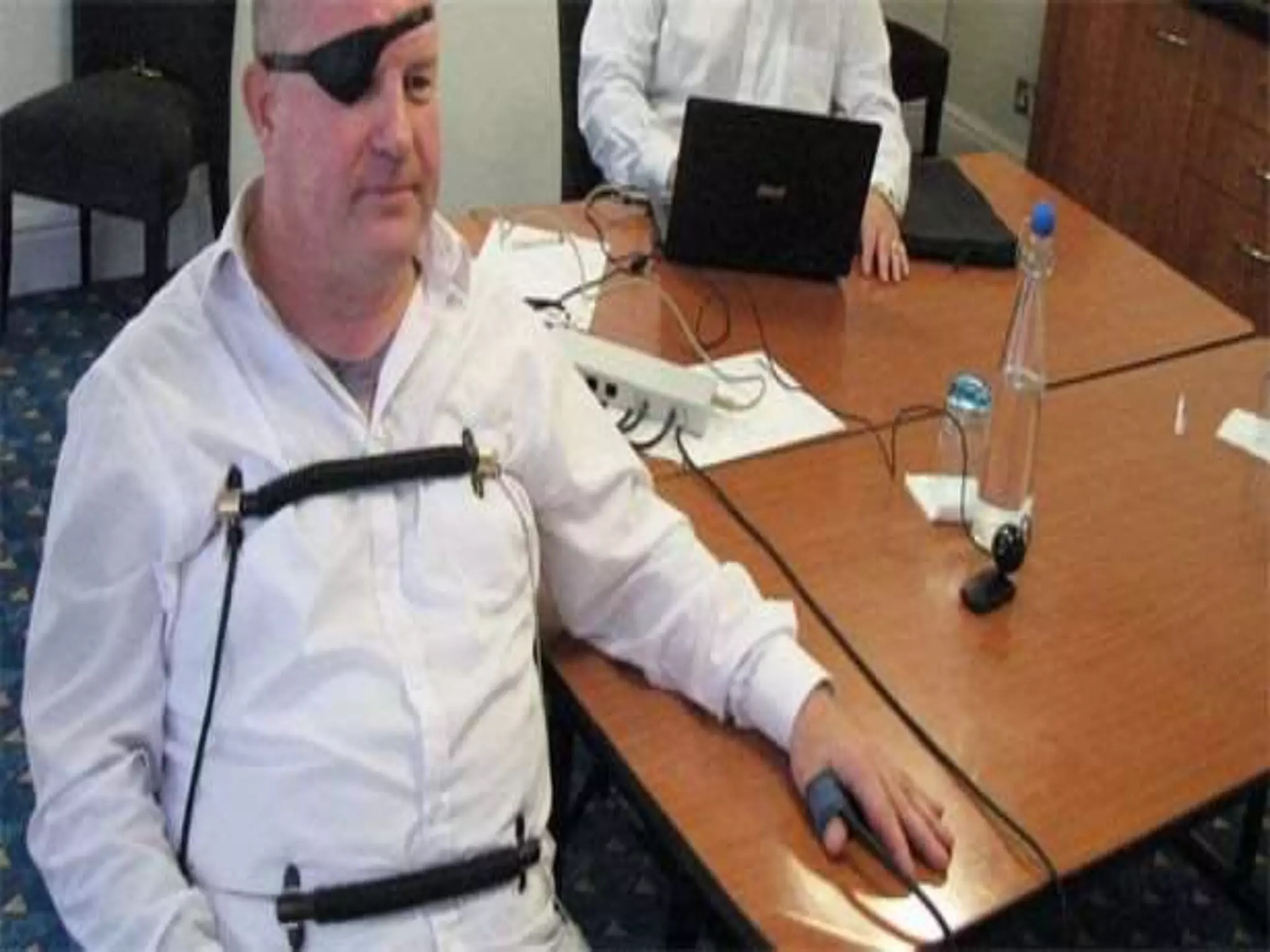
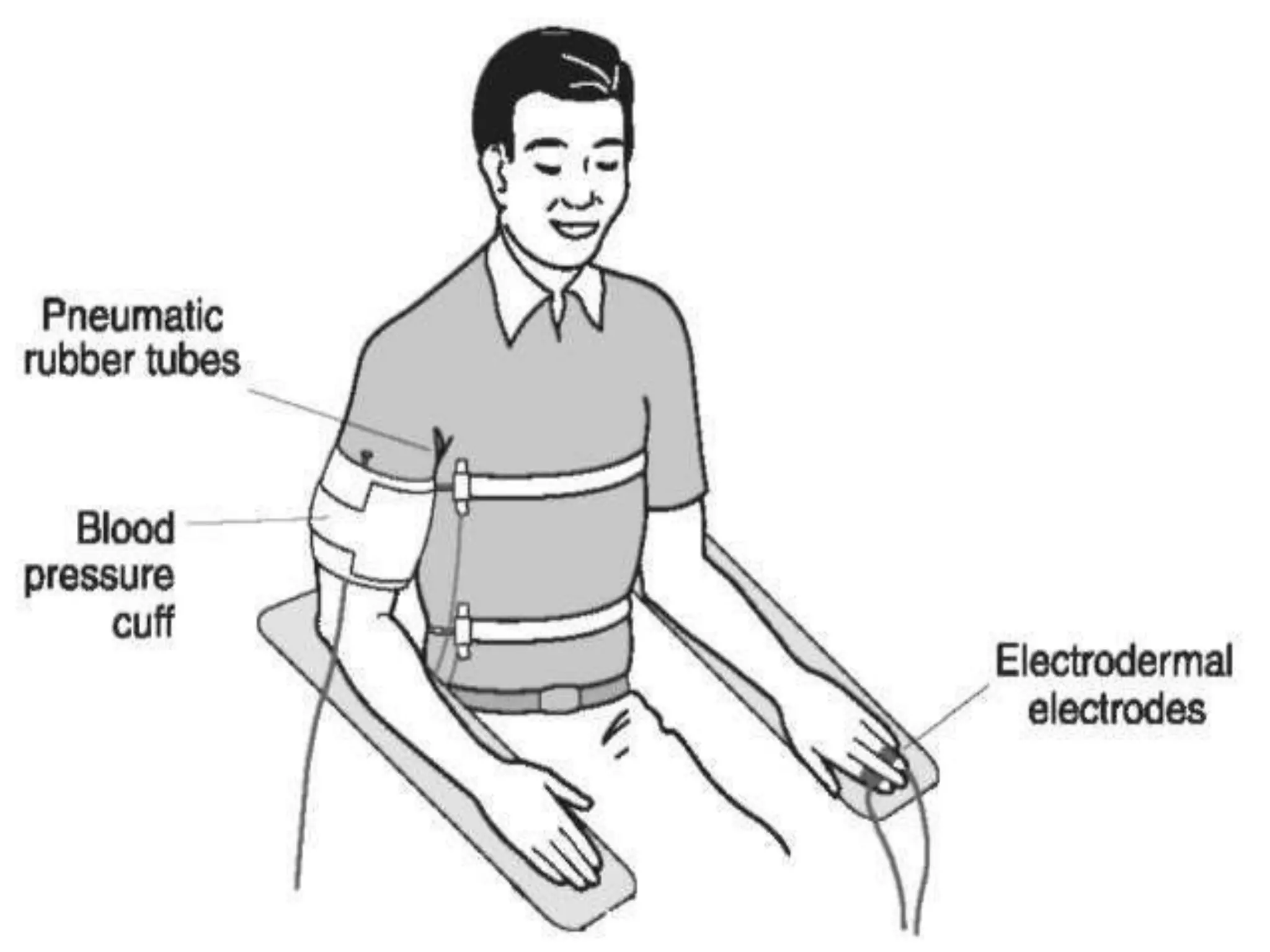
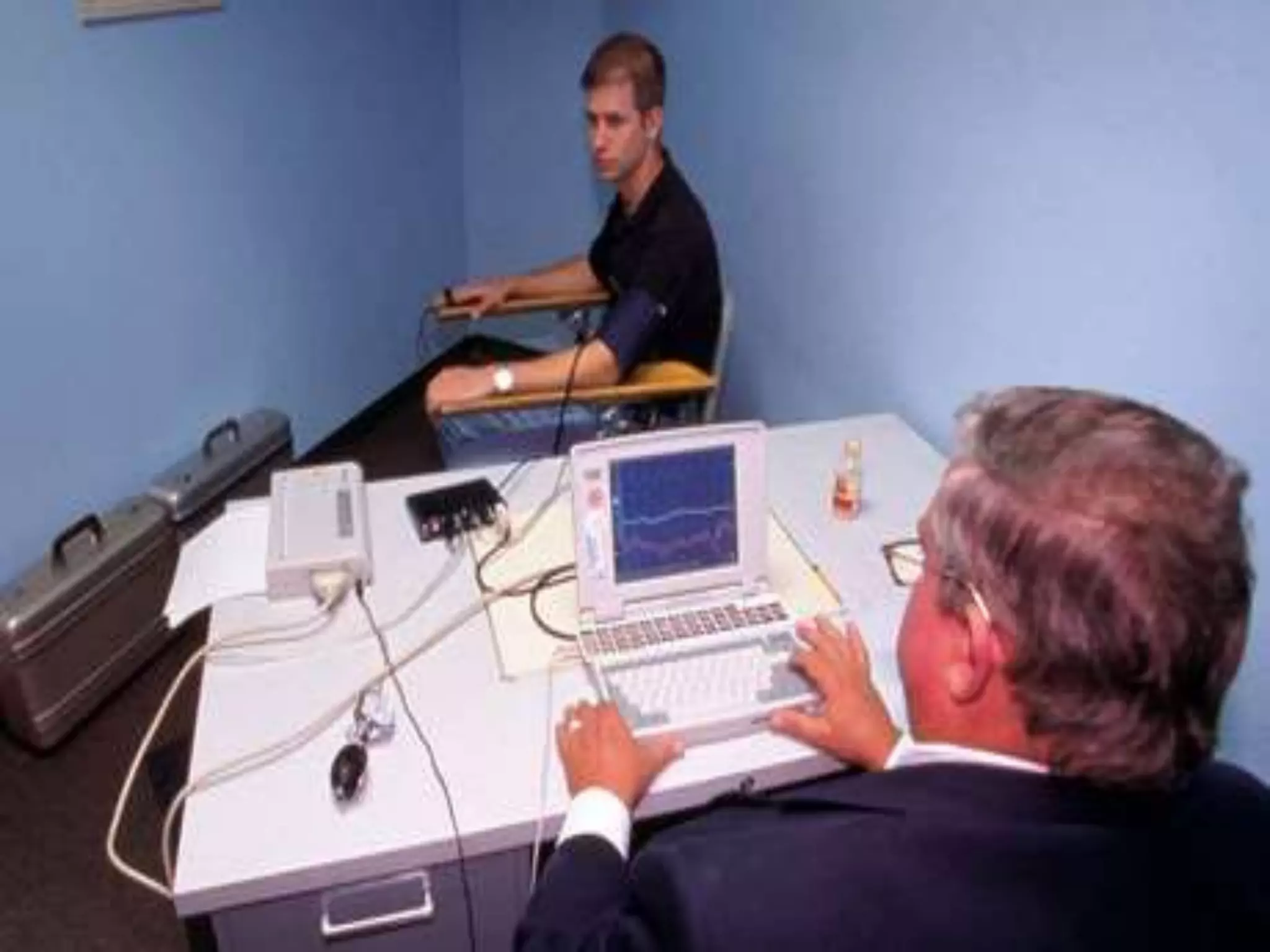
A polygraph instrument is basically a combination of
medical devices that are used to monitor changes
occurring in the body. It includes:-
 One pneumograph tube is fastened around chest &
another around abdomen to measure the variation in
respiratory pattern.
 A blood pressure cuff or a sphygmomanometer, similar to
the one used by physicians, is attached to the subjects
upper arm.
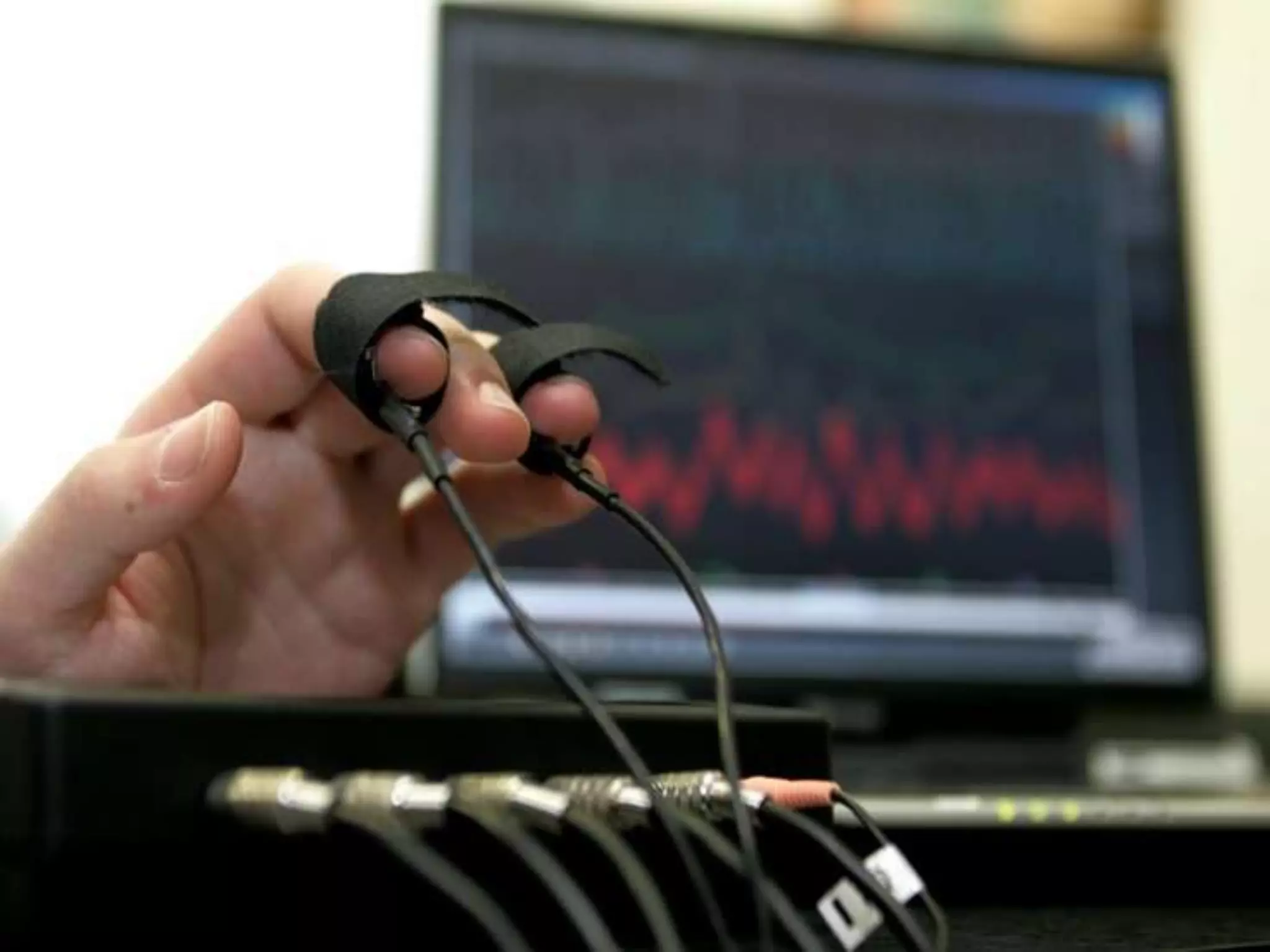
 Electrodes or galvanograph are attached to the hand or
index & ring fingers, through which a weak electric current
is passed to measure the galvanic skin response (GSR).
 Plethysmograph is a transducer. It is attached to the
thumb. It measures blood volume reflecting the pulse rate.
In questioning the subject , generally the basic approaches
are followed:-
 Relevant/Irrelevant Question Technique- Both relevant &
irrelevant questions, pertaining to the case in hand are
asked.
 Control Questions- These are interspread among the
relevant & irrelevant questions. They do not directly relate
to the crime under investigation, but to a similar situation
in which the answers may have a feeling of concern with
respect to either its truthfulness or its accuracy.
 Peak of tension questions- It is framed when some of
the important details of the offence in question are not
made known to the subject. The test questions in this
case are framed in such a way that only one question
will have bearing upon the matter under investigation
& all others coming close to the guilty knowledge. The
series of questions framed are first read to the subject
& later they are administered with the instrument
attached.
The polygraph examiner considers the following
aspects while analyzing the results of the test-
 Simultaneous occurrence in respiration & increase in
blood pressure immediately after the subject’s reply.
 Heavier breathing immediately after reply to a relevant
question.
 Decrease in blood pressure several seconds after the
subject’s reply.
 Slowing up pulse rate after the questioning session &
after the subject is informed that there will be no more
questions.
 Variation in the blood pressure curve during the test
e.g. downward trend indicate release of tension i.e. the
subject feels at ease, horizontal trend indicates no
change in the emotional state, upward trend indicate
increase in tension, suggesting deception or guilty.
The working process briefly involves following aspects-
 The subject is asked about the crime he has
committed. He knows that if he answers the question
truthfully ,he would be punished for the same.
 He wants to tell lies to avoid punishment.
 His mental faculties set in to find lies to substitute
truth. This shielding process is called Defence
Mechanism.
 The Defence Mechanism interacts with the body &
creates physiological changes in the form of increased
blood pressure, increased respiration rate, increased
heart beat & lower GSR.
 Evaluations of these responses are done by the
psychologists personally or he uses the computer to
evaluate the results.
 The main provision regarding crime investigation &
trial in the Indian constitution is Article 20(3).
 It deals the privilege against self incrimination. The
privilege against self incrimination is a fundamental
canon of common law of criminal jurisprudence.
 Article 20(3) which embody this privilege reads-
“No person accused of any offence shall be compelled
to be a witness against himself”.
The result of polygraph examination is not accepted in
Indian courts.

The polygraph test

  • 1.
  • 2.
    A polygraph Test,popularly known as a lie detector test, is used to prove truthfulness of a subject & measures and records several physiological indices such as:-  Blood pressure  Pulse  Respiration,&  Skin conductivity. while the subject is asked a series of questions. Lie detection is also known as deception detection.
  • 3.
     To verifythe veracity of the statement of suspect, witness & complainant in all types of crime.  To replace the third degree method of interrogation in a scientific manner.  To examine white collar criminals, economic offenders, cyber criminals & other offenders.  To corroborate or to refute the findings of the investigation.
  • 4.
    The study ofphysiological methods for deception tests measuring emotional disturbances began in the early 19th century.  Benussi was the first to work on practical deception tests based on physiological changes.  And the first attempt to develop a scientific instrument to detect truth was made by Lombroso in 1895.
  • 5.
     Later, Larsen& Keelar independently designed instruments with new features to make it more versatile.  John Reid, in 1947 further improved the instrument as well as the technique of administering the test.
  • 7.
     The polygraphis based on the principle of psychosomatic interaction of an individual.This means, a change takes place in person who consciously holds feelings, which manifest into physiological changes in his blood pressure, pulse rate, respiration and electrodermal response. Hence it is the fear of detection & not the guilt which produces measurable physiological responses.
  • 8.
    A polygraph instrumentis basically a combination of medical devices that are used to monitor changes occurring in the body. It includes:-  One pneumograph tube is fastened around chest & another around abdomen to measure the variation in respiratory pattern.
  • 10.
     A bloodpressure cuff or a sphygmomanometer, similar to the one used by physicians, is attached to the subjects upper arm.  Electrodes or galvanograph are attached to the hand or index & ring fingers, through which a weak electric current is passed to measure the galvanic skin response (GSR).  Plethysmograph is a transducer. It is attached to the thumb. It measures blood volume reflecting the pulse rate.
  • 13.
    In questioning thesubject , generally the basic approaches are followed:-  Relevant/Irrelevant Question Technique- Both relevant & irrelevant questions, pertaining to the case in hand are asked.  Control Questions- These are interspread among the relevant & irrelevant questions. They do not directly relate to the crime under investigation, but to a similar situation in which the answers may have a feeling of concern with respect to either its truthfulness or its accuracy.
  • 14.
     Peak oftension questions- It is framed when some of the important details of the offence in question are not made known to the subject. The test questions in this case are framed in such a way that only one question will have bearing upon the matter under investigation & all others coming close to the guilty knowledge. The series of questions framed are first read to the subject & later they are administered with the instrument attached.
  • 16.
    The polygraph examinerconsiders the following aspects while analyzing the results of the test-  Simultaneous occurrence in respiration & increase in blood pressure immediately after the subject’s reply.  Heavier breathing immediately after reply to a relevant question.  Decrease in blood pressure several seconds after the subject’s reply.
  • 17.
     Slowing uppulse rate after the questioning session & after the subject is informed that there will be no more questions.  Variation in the blood pressure curve during the test e.g. downward trend indicate release of tension i.e. the subject feels at ease, horizontal trend indicates no change in the emotional state, upward trend indicate increase in tension, suggesting deception or guilty.
  • 19.
    The working processbriefly involves following aspects-  The subject is asked about the crime he has committed. He knows that if he answers the question truthfully ,he would be punished for the same.  He wants to tell lies to avoid punishment.  His mental faculties set in to find lies to substitute truth. This shielding process is called Defence Mechanism.
  • 20.
     The DefenceMechanism interacts with the body & creates physiological changes in the form of increased blood pressure, increased respiration rate, increased heart beat & lower GSR.  Evaluations of these responses are done by the psychologists personally or he uses the computer to evaluate the results.
  • 21.
     The mainprovision regarding crime investigation & trial in the Indian constitution is Article 20(3).  It deals the privilege against self incrimination. The privilege against self incrimination is a fundamental canon of common law of criminal jurisprudence.  Article 20(3) which embody this privilege reads- “No person accused of any offence shall be compelled to be a witness against himself”. The result of polygraph examination is not accepted in Indian courts.