Crime Scene
Investigation
   To document and process a crime scene
    through photography, sketching and note-
    taking.


OBJECTIVE
 Camera
 Computer
 Paper
 Writing utensils


MATERIALS
   Do not contaminate the crime scene!


SAFETY
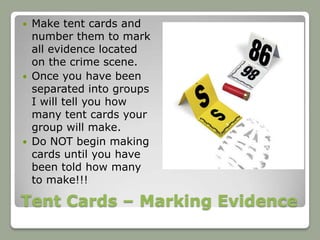
 Make tent cards and
  number them to mark
  all evidence located
  on the crime scene.
 Once you have been
  separated into groups
  I will tell you how
  many tent cards your
  group will make.
 Do NOT begin making
  cards until you have
  been told how many
  to make!!!

Tent Cards – Marking Evidence
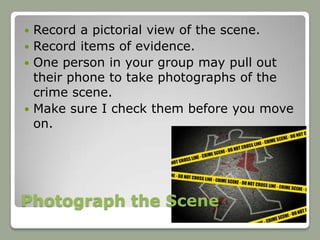
 Record a pictorial view of the scene.
 Record items of evidence.
 One person in your group may pull out
  their phone to take photographs of the
  crime scene.
 Make sure I check them before you move
  on.


Photograph the Scene
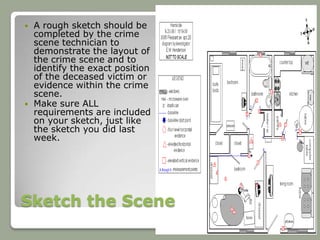
   A rough sketch should be
    completed by the crime
    scene technician to
    demonstrate the layout of
    the crime scene and to
    identify the exact position
    of the deceased victim or
    evidence within the crime
    scene.
   Make sure ALL
    requirements are included
    on your sketch, just like
    the sketch you did last
    week.


Sketch the Scene
   Must provide all the details necessary to
    complete a finished drawing
   Must identify every object in the room
   Need to be to scale
   Needs to have measurements (have someone in
    your group verify this).
   Needs to be marked “N” for North to orient the
    drawing
   Needs a legend to explain any symbols that are
    used to identify various objects (In small
    areas, various objects may be lettered or
    numbered and keyed in the legend)


Sketch the Scene
   In this case and at this crime scene, the note taker has two jobs.
     ◦ The first job is taking notes over crime scene. Make
       notations over placement of objects, the position of the
       body, blood spatters, bugs or insects that are on the
       body, etc. Anything and everything is note-worthy.
     ◦ The more detailed your notes are, the better off you are.
     ◦ The notes taken will help to reconstruct the crime scene
       after it is longer available to you.
     ◦ Notes should contain any of your own thoughts and any
       “memory joggers” that will help you remember the
       specifics about the case.
     ◦ Be sure to work closely with the crime scene sketcher
       and the photographer so that nothing is missed.
     ◦ Notes need to be typed up and placed in the file so that
       they do not get lost. They are a very important
       permanent record about the crime scene.


Note-taking
   The second job is that you will do is provide
    leadership for your team. You will be the
    one who assists the sketcher on double-
    checking measurements. You will be the
    one to question the photographer to make
    sure that all the evidence, strange marks, or
    footprints were photographed. Once the
    POE has been established, photographs
    have been taken, and notes have been
    written, it will be your responsibility to
    make sure that your evidence collector does
    a thorough and proper job. If asked, you
    will be the one who holds the envelope
    while the evidence is placed into it.
Note-taking
   Name – Deaundre Jackson
   D.O.B – 11.21.64
   Race – Black and Hispanic
   Height – 5’10”
   Weight – 182 lbs.
   Occupation – Teacher


Victim’s Information
   Blood spatter on the east wall belonged
    to the victim.
    ◦ It is reported to be the initial blow.
   Blood found on the floor near the yellow
    student desk belonged to the victim.


Bodily Fluids
 It is the victim’s blood on the hole-
  puncher.
 Blood smear near the hole-puncher is the
  victim’s.


Bodily fluids (Victim)
   Hair belonged to the victim on the hole-
    puncher.


Trace Evidence
 Fingerprints found on the hole puncher
  did NOT belong to the victim.
 Fingerprint found on the paper towel
  dispenser did not belong to the victim or
  the f.p. found on the hole puncher


Fingerprints
 Victim died of blunt force trauma to the
  head.
 Hole-puncher was determined to be the
  murder weapon due to the impression left
  on the posterior side of the skull.
 T.O.D. – estimated at 11:00pm (which
  suggested watch was broken during the
  struggle)


Injury Report
   Blood spatter (puddle) near the victim
    was the victim’s blood
   Trail of blood near the victim did NOT
    belong to him.
   Blood and skin was found under the
    victim’s nails on his right hand.
   Saliva was discovered on the cell phone.
   DNA from the saliva, blood trail, and skin
    found under the nails ALL came from the
    same person.


Bodily Fluids (Suspect)
 Note: “Have interesting new info. See
  you tonight. Dion”
 Handwriting does not match that of
  signatures from the victim.


Questioned Document Analysis
   Dion Jackson – step brother of Deaundre.
   D.O.B. – 5.13.79
   Race – Black American
   Height – 5’11”
   Weight – 200 lbs

   Unknown bodily fluids and skin (found
    under the nails of victim) matched this
    suspect’s DNA


Suspect #1 Information
   Dion Carter– co-worker of Deaundre
   D.O.B. – 10.12.77
   Race – Black American
   Height – 5’10.5”
   Weight – 210 lbs

   Fingerprint on the paper towel dispenser
    matched this suspect’s prints


Suspect #2 Information
   Crime scene reconstruction is the use of
    scientific methods, physical
    evidence, deductive reasoning, and their
    interrelationships to gain explicit knowledge
    of the series of events that surround the
    commission of a crime.
   It is a disciplined and principled approach
    towards objectively understanding a crime
    scene.
   Using evidence found at a crime scene the
    incident can be reconstructed to determine
    what happened, and possibly find more clues.


Crime Scene Reconstruction
 Specific Incident Reconstruction (Traffic
  Accident, Homicide, Bombing, etc.).
 Specific Event Reconstruction
  (Sequence, Direction, Condition, Relation,
  Identity).
 Specific Physical Evidence Reconstruction
  (Firearms, Blood, Glass etc.).


Types of Crime Scene
Reconstruction
   The pattern selected will normally depend
    on the size and locale of the scene and
    the number of collectors participating in
    the search.


Crime Scene Search Patterns
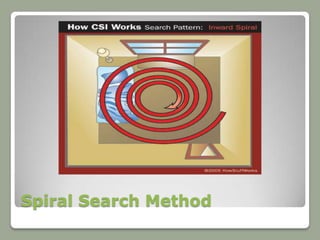
Spiral Search Method
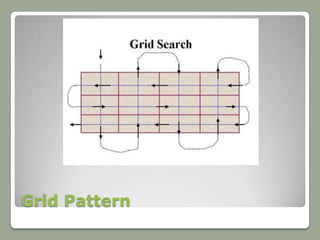
Grid Pattern
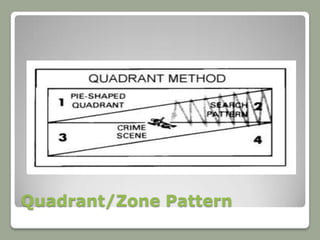
Quadrant/Zone Pattern
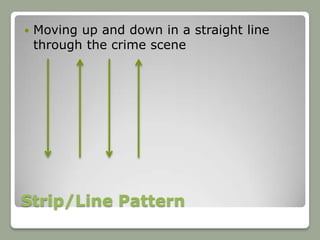
   Moving up and down in a straight line
    through the crime scene


Strip/Line Pattern

Crime Scene Investigation

  • 1.
  • 2.
    To document and process a crime scene through photography, sketching and note- taking. OBJECTIVE
  • 3.
     Camera  Computer Paper  Writing utensils MATERIALS
  • 4.
    Do not contaminate the crime scene! SAFETY
  • 5.
     Make tentcards and number them to mark all evidence located on the crime scene.  Once you have been separated into groups I will tell you how many tent cards your group will make.  Do NOT begin making cards until you have been told how many to make!!! Tent Cards – Marking Evidence
  • 6.
     Record apictorial view of the scene.  Record items of evidence.  One person in your group may pull out their phone to take photographs of the crime scene.  Make sure I check them before you move on. Photograph the Scene
  • 7.
    A rough sketch should be completed by the crime scene technician to demonstrate the layout of the crime scene and to identify the exact position of the deceased victim or evidence within the crime scene.  Make sure ALL requirements are included on your sketch, just like the sketch you did last week. Sketch the Scene
  • 8.
    Must provide all the details necessary to complete a finished drawing  Must identify every object in the room  Need to be to scale  Needs to have measurements (have someone in your group verify this).  Needs to be marked “N” for North to orient the drawing  Needs a legend to explain any symbols that are used to identify various objects (In small areas, various objects may be lettered or numbered and keyed in the legend) Sketch the Scene
  • 9.
    In this case and at this crime scene, the note taker has two jobs. ◦ The first job is taking notes over crime scene. Make notations over placement of objects, the position of the body, blood spatters, bugs or insects that are on the body, etc. Anything and everything is note-worthy. ◦ The more detailed your notes are, the better off you are. ◦ The notes taken will help to reconstruct the crime scene after it is longer available to you. ◦ Notes should contain any of your own thoughts and any “memory joggers” that will help you remember the specifics about the case. ◦ Be sure to work closely with the crime scene sketcher and the photographer so that nothing is missed. ◦ Notes need to be typed up and placed in the file so that they do not get lost. They are a very important permanent record about the crime scene. Note-taking
  • 10.
    The second job is that you will do is provide leadership for your team. You will be the one who assists the sketcher on double- checking measurements. You will be the one to question the photographer to make sure that all the evidence, strange marks, or footprints were photographed. Once the POE has been established, photographs have been taken, and notes have been written, it will be your responsibility to make sure that your evidence collector does a thorough and proper job. If asked, you will be the one who holds the envelope while the evidence is placed into it. Note-taking
  • 11.
    Name – Deaundre Jackson  D.O.B – 11.21.64  Race – Black and Hispanic  Height – 5’10”  Weight – 182 lbs.  Occupation – Teacher Victim’s Information
  • 12.
    Blood spatter on the east wall belonged to the victim. ◦ It is reported to be the initial blow.  Blood found on the floor near the yellow student desk belonged to the victim. Bodily Fluids
  • 13.
     It isthe victim’s blood on the hole- puncher.  Blood smear near the hole-puncher is the victim’s. Bodily fluids (Victim)
  • 14.
    Hair belonged to the victim on the hole- puncher. Trace Evidence
  • 15.
     Fingerprints foundon the hole puncher did NOT belong to the victim.  Fingerprint found on the paper towel dispenser did not belong to the victim or the f.p. found on the hole puncher Fingerprints
  • 16.
     Victim diedof blunt force trauma to the head.  Hole-puncher was determined to be the murder weapon due to the impression left on the posterior side of the skull.  T.O.D. – estimated at 11:00pm (which suggested watch was broken during the struggle) Injury Report
  • 17.
    Blood spatter (puddle) near the victim was the victim’s blood  Trail of blood near the victim did NOT belong to him.  Blood and skin was found under the victim’s nails on his right hand.  Saliva was discovered on the cell phone.  DNA from the saliva, blood trail, and skin found under the nails ALL came from the same person. Bodily Fluids (Suspect)
  • 18.
     Note: “Haveinteresting new info. See you tonight. Dion”  Handwriting does not match that of signatures from the victim. Questioned Document Analysis
  • 19.
    Dion Jackson – step brother of Deaundre.  D.O.B. – 5.13.79  Race – Black American  Height – 5’11”  Weight – 200 lbs  Unknown bodily fluids and skin (found under the nails of victim) matched this suspect’s DNA Suspect #1 Information
  • 20.
    Dion Carter– co-worker of Deaundre  D.O.B. – 10.12.77  Race – Black American  Height – 5’10.5”  Weight – 210 lbs  Fingerprint on the paper towel dispenser matched this suspect’s prints Suspect #2 Information
  • 21.
    Crime scene reconstruction is the use of scientific methods, physical evidence, deductive reasoning, and their interrelationships to gain explicit knowledge of the series of events that surround the commission of a crime.  It is a disciplined and principled approach towards objectively understanding a crime scene.  Using evidence found at a crime scene the incident can be reconstructed to determine what happened, and possibly find more clues. Crime Scene Reconstruction
  • 22.
     Specific IncidentReconstruction (Traffic Accident, Homicide, Bombing, etc.).  Specific Event Reconstruction (Sequence, Direction, Condition, Relation, Identity).  Specific Physical Evidence Reconstruction (Firearms, Blood, Glass etc.). Types of Crime Scene Reconstruction
  • 23.
    The pattern selected will normally depend on the size and locale of the scene and the number of collectors participating in the search. Crime Scene Search Patterns
  • 24.
  • 25.
  • 26.
  • 27.
    Moving up and down in a straight line through the crime scene Strip/Line Pattern