LIVER FUNCTIONTESTS
Liver Functions
• Metabolism
 CHO, Protein & amino acids, Fat Metabolism
• Excretion & Detoxification
 Bile pigments, bile salts and cholesterol (Excreted in bile into
intestine);Ammonia(detoxification)
• Synthetic Function
 Plasma proteins/Clotting Factors
• Storage Function
 Glycogen, vitamins A, D and B12,and trace element iron
• Protective functions and detoxification
Kupffer cells perform phagocytosis
Classification Of LFTs
• No single biochemical test can detect the global
functions of liver
• ? Based on individual Liver Functions
• ‘True’ tests of liver function
• Tests indicative of liver injury or biliary tract disease.
• Many of the tests reflecting the health of the liver are
not direct measures of its function.
Lab Evaluation of hepato-biliary disease
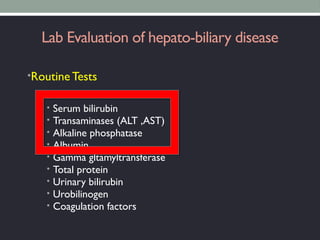
•Routine Tests
• Serum bilirubin
• Transaminases (ALT ,AST)
• Alkaline phosphatase
• Albumin
• Gamma gltamyltransferase
• Total protein
• Urinary bilirubin
• Urobilinogen
• Coagulation factors
Lab Evaluation of hepato-biliary disease
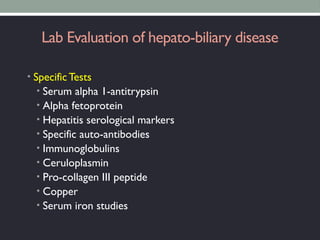
• Specific Tests
• Serum alpha 1-antitrypsin
• Alpha fetoprotein
• Hepatitis serological markers
• Specific auto-antibodies
• Immunoglobulins
• Ceruloplasmin
• Pro-collagen III peptide
• Copper
• Serum iron studies
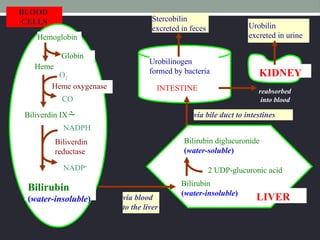
via bile duct to intestines
Stercobilin
excreted in feces
Urobilinogen
formed by bacteria KIDNEY
Urobilin
excreted in urine
BLOOD
CELLS
CO
Biliverdin IX
Heme oxygenase
O2
Bilirubin
(water-insoluble)
NADP+
NADPH
Biliverdin
reductase
Heme
Globin
Hemoglobin
reabsorbed
into blood
LIVER
Bilirubin diglucuronide
(water-soluble)
2 UDP-glucuronic acid
Bilirubin
(water-insoluble)
via blood
to the liver
INTESTINE
Serum Bilirubin
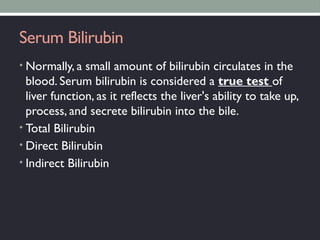
• Normally, a small amount of bilirubin circulates in the
blood. Serum bilirubin is considered a true test of
liver function, as it reflects the liver's ability to take up,
process, and secrete bilirubin into the bile.
• Total Bilirubin
• Direct Bilirubin
• Indirect Bilirubin
HPLC Based Fractions of Bilirubin
• Alpha ( -bilirubin)
α
• Beta bilirubin ( -bilirubin)
β
• Gamma ( -bilirubin)
ϒ
• (delta) -bilirubin
δ
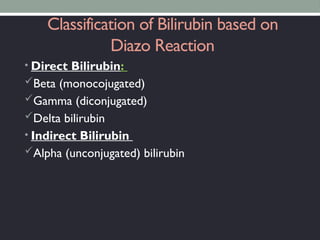
Classification of Bilirubin based on
Diazo Reaction
• Direct Bilirubin:
Beta (monocojugated)
Gamma (diconjugated)
Delta bilirubin
• Indirect Bilirubin
Alpha (unconjugated) bilirubin
Disorders of The Liver
• Congenital
 Gilbert’s Disease
 Crigglar-Najjar
 Dubin-Johnson syndrome
 Rotor’s syndrome
• Hepatitis
 Acute
 Chronic
• Cholestasis
 Extrahepatic
 Intrahepatic
• Cirrhosis
• Anoxia
• Infiltrations
• Drug Toxicity
Congenital Causes of Hyperbilirubinaemia
Unconjugated Bilirubinaemia
Gilbert syndrome:
Crigler-Najjar
Conjugated Bilirubinaemia
Dubin-johnson syndrome:
Rotar Syndrome
Gilbert's Syndrome
• The most common inherited disorder of bilirubin
glucuronidation (9-10% of the adult population)
• Also called "constitutional hepatic dysfunction" and
"familial non-hemolytic jaundice"
• Enzyme Defect: Uridinediphosphoglucuronate
glucuronosyltransferases (UGTs) which is a family of
enzymes that mediate glucuronidation of various
endogenous and exogenous compounds
• Genetic Defect: The mutation is in the promoter
region, upstream to exon 1 of the gene encoding bilirubin-
UGT
Haemolytic Disease of the Newborn (HDN)
• RBCs of the fetus or newborn are destroyed
by maternally-derived alloantibodies.
• These antibodies arise in the mother as the
direct result of a blood group incompatibility
between the mother and fetus (Mother Rh-D
negative , Fetus Rh-D Positive )
• In developed world very high incidence has
been reduced due to immunization of Anti D.
Neonatal (Physiological) Jaundice
• FullTerm infants Jaundice lasts for about 10 days
with a rapid rise of serum bilirubin up to 204
µmol/L (12 mg/dL).
• Preterm infants Jaundice lasts for about two weeks,
with a rapid rise of serum bilirubin up to 255
µmol/L (15 mg/dL).
Pathological Neonatal Jaundice
• Any of the following features
characterizes pathological jaundice:
• Clinical jaundice appearing in the first 24 hours
• Jaundice lasting more than 14 days of life.
• Increases in the level of total bilirubin by more than
8.5 µmol/L (0.5 mg/dL) per hour or (85 µmol/L)
5 mg/dL per 24 hours.
• Total bilirubin more than 331 µmol/L (19.5 mg/dL)
• Direct bilirubin more than 34 µmol/L (2.0 mg/dL).
Urine Bilirubin
• The presence of urine bilirubin indicates hepatobiliary
disease.
• Conjugated bilirubin may be found in urine when the
serum bilirubin levels are normal (Early AVH)
• Tests strips impregnated with diazo reagent are used to
detect bilirubin in urine
Hepatic Transaminases
• ALT is mainly a cytoplasmic enzyme
• AST has two fractions :
• Cytoplasmic AST
• Organellar AST
• In Acute Hepatitis, only cell membrane is damaged
while organelles remain intact
• So in Acute Hepatitis ALT is markedly increased as
compared to AST
HepaticTransaminases (Cont)
• ALT may be the first or only liver marker to rise
• In Chronic Hepatitis AST is a better marker
• AST lacks specificity
• So for diagnosis and monitoring of Chronic Hepatitis
(Hep B and C),ALT can be used.
AlanineAminotransferse
• Also known as Alanine transaminase,L-alanine:2-
oxoglutarate aminotransferase
• Formerly glutamic pyruvic transaminase (GPT)
• Groups of ezyme catalyze the interconversion of
amino acids to 2-oxo-acids
• Tissue sources of enzyme are liver,
kidney,heart,skeletal muscles,spleen and lungs.
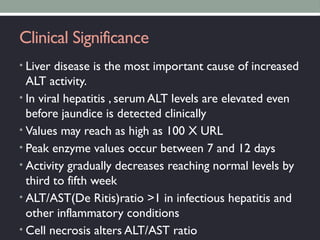
Clinical Significance
• Liver disease is the most important cause of increased
ALT activity.
• In viral hepatitis , serum ALT levels are elevated even
before jaundice is detected clinically
• Values may reach as high as 100 X URL
• Peak enzyme values occur between 7 and 12 days
• Activity gradually decreases reaching normal levels by
third to fifth week
• ALT/AST(De Ritis)ratio >1 in infectious hepatitis and
other inflammatory conditions
• Cell necrosis alters ALT/AST ratio
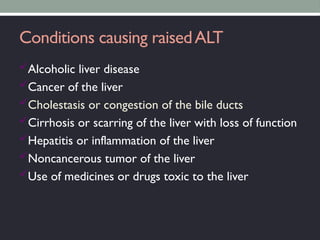
Conditions causing raisedALT
Alcoholic liver disease
Cancer of the liver
Cholestasis or congestion of the bile ducts
Cirrhosis or scarring of the liver with loss of function
Hepatitis or inflammation of the liver
Noncancerous tumor of the liver
Use of medicines or drugs toxic to the liver
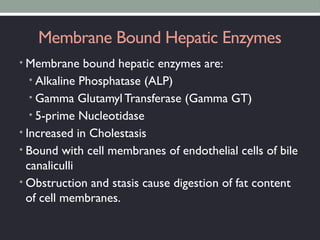
Membrane Bound Hepatic Enzymes
• Membrane bound hepatic enzymes are:
• Alkaline Phosphatase (ALP)
• Gamma GlutamylTransferase (Gamma GT)
• 5-prime Nucleotidase
• Increased in Cholestasis
• Bound with cell membranes of endothelial cells of bile
canaliculli
• Obstruction and stasis cause digestion of fat content
of cell membranes.
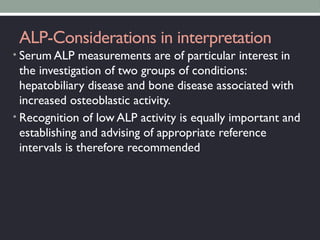
ALP-Considerations in interpretation
• Serum ALP measurements are of particular interest in
the investigation of two groups of conditions:
hepatobiliary disease and bone disease associated with
increased osteoblastic activity.
• Recognition of low ALP activity is equally important and
establishing and advising of appropriate reference
intervals is therefore recommended
Considerations in interpretation(Contd)
• The form present in the sera of normal adults probably
originates mainly in the liver, with up to half the total
activity coming from the skeleton.
• Normal ALP levels are age-dependent and levels are
elevated during periods of active bone growth.
• In humans, alkaline phosphatase is particularly
concentrated in liver, bile duct, kidney, bone, intestinal
epithelium and the placenta.
Considerations in Interpretation(Contd)
• Levels are significantly higher in children and pregnant
women.
• ALP levels are affected by many drugs, physical
conditions, herbal medicines, food intake, smoking,
alcohol intake, and pregnancy
Gamma GlutamylTransferase
• Found in hepatocytes and biliary epithelial cells
• Levels rise in hepatobilirary disease
• Lacks specificity
• Other causes for : Pancreatic disease, myocardial
infarction, renal failure, chronic obstructive pulmonary
disease, diabetes, and alcoholism
• Identification of patients with occult alcohol use
• Used in evaluation of liver origin of other raised
enzymes like AP
Albumin
• Major protein of human plasma(35-50g/l)
• Approx 60% of the total plasma protein
• t1/2 is approx 19 days
• Migrates fastest in the electrophoresis at
alkaline pH
• Synthesized in liver, and synthesis reduced
in acute phase
• Distributed mainly in ECF , with abt 40%
located intracellular compartment
Albumin
• Albumin level is not a reliable indicator of hepatic
protein synthesis in acute liver disease.
• Decreased levels in CLD and cirrhosis
• Hypoalbuminemia: not specific for liver (protein
malnutrition, nephrotic syndrome and chronic protein
losing enteropathies.)
ProthrombinTime
• Prothrombin is formed in the liver from inactive
“preprothrombin” in presence of vitamin K.
• PT is used to assess the activity of extrinsic blood clotting
pathway .
• A useful test of liver function as well.
• Elevated PT indicates either vitamin K deficiency due to
prolonged jaundice and malabsorption of vitamin K or
significant hepatocellular dysfunction.
• Failure of PT to correct with parenteral administration of
vitamin K indicates severe hepatocellular injury.
Liver function tests interpretation bilirubin metabolism

Liver function tests interpretation bilirubin metabolism

  • 1.
  • 2.
    Liver Functions • Metabolism CHO, Protein & amino acids, Fat Metabolism • Excretion & Detoxification  Bile pigments, bile salts and cholesterol (Excreted in bile into intestine);Ammonia(detoxification) • Synthetic Function  Plasma proteins/Clotting Factors • Storage Function  Glycogen, vitamins A, D and B12,and trace element iron • Protective functions and detoxification Kupffer cells perform phagocytosis
  • 3.
    Classification Of LFTs •No single biochemical test can detect the global functions of liver • ? Based on individual Liver Functions • ‘True’ tests of liver function • Tests indicative of liver injury or biliary tract disease. • Many of the tests reflecting the health of the liver are not direct measures of its function.

  • 4.
    Lab Evaluation ofhepato-biliary disease •Routine Tests • Serum bilirubin • Transaminases (ALT ,AST) • Alkaline phosphatase • Albumin • Gamma gltamyltransferase • Total protein • Urinary bilirubin • Urobilinogen • Coagulation factors
  • 5.
    Lab Evaluation ofhepato-biliary disease • Specific Tests • Serum alpha 1-antitrypsin • Alpha fetoprotein • Hepatitis serological markers • Specific auto-antibodies • Immunoglobulins • Ceruloplasmin • Pro-collagen III peptide • Copper • Serum iron studies
  • 6.
    via bile ductto intestines Stercobilin excreted in feces Urobilinogen formed by bacteria KIDNEY Urobilin excreted in urine BLOOD CELLS CO Biliverdin IX Heme oxygenase O2 Bilirubin (water-insoluble) NADP+ NADPH Biliverdin reductase Heme Globin Hemoglobin reabsorbed into blood LIVER Bilirubin diglucuronide (water-soluble) 2 UDP-glucuronic acid Bilirubin (water-insoluble) via blood to the liver INTESTINE
  • 7.
    Serum Bilirubin • Normally,a small amount of bilirubin circulates in the blood. Serum bilirubin is considered a true test of liver function, as it reflects the liver's ability to take up, process, and secrete bilirubin into the bile. • Total Bilirubin • Direct Bilirubin • Indirect Bilirubin
  • 8.
    HPLC Based Fractionsof Bilirubin • Alpha ( -bilirubin) α • Beta bilirubin ( -bilirubin) β • Gamma ( -bilirubin) ϒ • (delta) -bilirubin δ
  • 9.
    Classification of Bilirubinbased on Diazo Reaction • Direct Bilirubin: Beta (monocojugated) Gamma (diconjugated) Delta bilirubin • Indirect Bilirubin Alpha (unconjugated) bilirubin
  • 10.
    Disorders of TheLiver • Congenital  Gilbert’s Disease  Crigglar-Najjar  Dubin-Johnson syndrome  Rotor’s syndrome • Hepatitis  Acute  Chronic • Cholestasis  Extrahepatic  Intrahepatic • Cirrhosis • Anoxia • Infiltrations • Drug Toxicity
  • 11.
    Congenital Causes ofHyperbilirubinaemia Unconjugated Bilirubinaemia Gilbert syndrome: Crigler-Najjar Conjugated Bilirubinaemia Dubin-johnson syndrome: Rotar Syndrome
  • 12.
    Gilbert's Syndrome • Themost common inherited disorder of bilirubin glucuronidation (9-10% of the adult population) • Also called "constitutional hepatic dysfunction" and "familial non-hemolytic jaundice" • Enzyme Defect: Uridinediphosphoglucuronate glucuronosyltransferases (UGTs) which is a family of enzymes that mediate glucuronidation of various endogenous and exogenous compounds • Genetic Defect: The mutation is in the promoter region, upstream to exon 1 of the gene encoding bilirubin- UGT
  • 13.
    Haemolytic Disease ofthe Newborn (HDN) • RBCs of the fetus or newborn are destroyed by maternally-derived alloantibodies. • These antibodies arise in the mother as the direct result of a blood group incompatibility between the mother and fetus (Mother Rh-D negative , Fetus Rh-D Positive ) • In developed world very high incidence has been reduced due to immunization of Anti D.
  • 14.
    Neonatal (Physiological) Jaundice •FullTerm infants Jaundice lasts for about 10 days with a rapid rise of serum bilirubin up to 204 µmol/L (12 mg/dL). • Preterm infants Jaundice lasts for about two weeks, with a rapid rise of serum bilirubin up to 255 µmol/L (15 mg/dL).
  • 15.
    Pathological Neonatal Jaundice •Any of the following features characterizes pathological jaundice: • Clinical jaundice appearing in the first 24 hours • Jaundice lasting more than 14 days of life. • Increases in the level of total bilirubin by more than 8.5 µmol/L (0.5 mg/dL) per hour or (85 µmol/L) 5 mg/dL per 24 hours. • Total bilirubin more than 331 µmol/L (19.5 mg/dL) • Direct bilirubin more than 34 µmol/L (2.0 mg/dL).
  • 16.
    Urine Bilirubin • Thepresence of urine bilirubin indicates hepatobiliary disease. • Conjugated bilirubin may be found in urine when the serum bilirubin levels are normal (Early AVH) • Tests strips impregnated with diazo reagent are used to detect bilirubin in urine
  • 17.
    Hepatic Transaminases • ALTis mainly a cytoplasmic enzyme • AST has two fractions : • Cytoplasmic AST • Organellar AST • In Acute Hepatitis, only cell membrane is damaged while organelles remain intact • So in Acute Hepatitis ALT is markedly increased as compared to AST
  • 18.
    HepaticTransaminases (Cont) • ALTmay be the first or only liver marker to rise • In Chronic Hepatitis AST is a better marker • AST lacks specificity • So for diagnosis and monitoring of Chronic Hepatitis (Hep B and C),ALT can be used.
  • 19.
    AlanineAminotransferse • Also knownas Alanine transaminase,L-alanine:2- oxoglutarate aminotransferase • Formerly glutamic pyruvic transaminase (GPT) • Groups of ezyme catalyze the interconversion of amino acids to 2-oxo-acids • Tissue sources of enzyme are liver, kidney,heart,skeletal muscles,spleen and lungs.
  • 20.
    Clinical Significance • Liverdisease is the most important cause of increased ALT activity. • In viral hepatitis , serum ALT levels are elevated even before jaundice is detected clinically • Values may reach as high as 100 X URL • Peak enzyme values occur between 7 and 12 days • Activity gradually decreases reaching normal levels by third to fifth week • ALT/AST(De Ritis)ratio >1 in infectious hepatitis and other inflammatory conditions • Cell necrosis alters ALT/AST ratio
  • 21.
    Conditions causing raisedALT Alcoholicliver disease Cancer of the liver Cholestasis or congestion of the bile ducts Cirrhosis or scarring of the liver with loss of function Hepatitis or inflammation of the liver Noncancerous tumor of the liver Use of medicines or drugs toxic to the liver
  • 22.
    Membrane Bound HepaticEnzymes • Membrane bound hepatic enzymes are: • Alkaline Phosphatase (ALP) • Gamma GlutamylTransferase (Gamma GT) • 5-prime Nucleotidase • Increased in Cholestasis • Bound with cell membranes of endothelial cells of bile canaliculli • Obstruction and stasis cause digestion of fat content of cell membranes.
  • 23.
    ALP-Considerations in interpretation •Serum ALP measurements are of particular interest in the investigation of two groups of conditions: hepatobiliary disease and bone disease associated with increased osteoblastic activity. • Recognition of low ALP activity is equally important and establishing and advising of appropriate reference intervals is therefore recommended
  • 24.
    Considerations in interpretation(Contd) •The form present in the sera of normal adults probably originates mainly in the liver, with up to half the total activity coming from the skeleton. • Normal ALP levels are age-dependent and levels are elevated during periods of active bone growth. • In humans, alkaline phosphatase is particularly concentrated in liver, bile duct, kidney, bone, intestinal epithelium and the placenta.
  • 25.
    Considerations in Interpretation(Contd) •Levels are significantly higher in children and pregnant women. • ALP levels are affected by many drugs, physical conditions, herbal medicines, food intake, smoking, alcohol intake, and pregnancy
  • 26.
    Gamma GlutamylTransferase • Foundin hepatocytes and biliary epithelial cells • Levels rise in hepatobilirary disease • Lacks specificity • Other causes for : Pancreatic disease, myocardial infarction, renal failure, chronic obstructive pulmonary disease, diabetes, and alcoholism • Identification of patients with occult alcohol use • Used in evaluation of liver origin of other raised enzymes like AP
  • 28.
    Albumin • Major proteinof human plasma(35-50g/l) • Approx 60% of the total plasma protein • t1/2 is approx 19 days • Migrates fastest in the electrophoresis at alkaline pH • Synthesized in liver, and synthesis reduced in acute phase • Distributed mainly in ECF , with abt 40% located intracellular compartment
  • 29.
    Albumin • Albumin levelis not a reliable indicator of hepatic protein synthesis in acute liver disease. • Decreased levels in CLD and cirrhosis • Hypoalbuminemia: not specific for liver (protein malnutrition, nephrotic syndrome and chronic protein losing enteropathies.)
  • 30.
    ProthrombinTime • Prothrombin isformed in the liver from inactive “preprothrombin” in presence of vitamin K. • PT is used to assess the activity of extrinsic blood clotting pathway . • A useful test of liver function as well. • Elevated PT indicates either vitamin K deficiency due to prolonged jaundice and malabsorption of vitamin K or significant hepatocellular dysfunction. • Failure of PT to correct with parenteral administration of vitamin K indicates severe hepatocellular injury.

Editor's Notes

  • #2 Ammonia to urea Detox func - biliubin
  • #5 Pro collagen increased in fibrosis Autoimmjune profile AMA , ASMA,anti SLA, anti LKM. Serum protein electrophoresis Transferrin Saturation/Ferritin/HFE Genotyping USG,CT,MRI Biopsy
  • #6 Haem into iron and protoporphyrin which is converted to biliverdin
  • #7 Only disturbed in acute fulminant infections.
  • #10 06 months duration for acute n chronic Drug most imp is acetaminophen Gilbert – fluctuating rise- triggered by stress-range 70-90
  • #16 Unconj not found in urine as it is not conjug and so is albumin bound which is not filtered by kidneys normally.
  • #19 Glutamic-amino acid Pyruvic acid- oxoacid
  • #20 Normal ratio is 0.4-0.5 Acute x 100 Paracet tox x 85 Chronic hep x 7 Cirrrhosis x 4-5 tumour = 2-5 URL of ALT
  • #21 NAFLD
  • #23 Low value imp in hypoposphotasia and wilsons disease ALP is metalloenzyme ie it requires metal eg Zn.In wilson disease Cu replaces Zn so ALP decreases.
  • #24 ALP isoenzymes found in liver bone kidneys etc
  • #26  Increased in enzyme inducers n alcoholics Drugs like alcohol phenytoin barbiturates statins