Downloaded 340 times
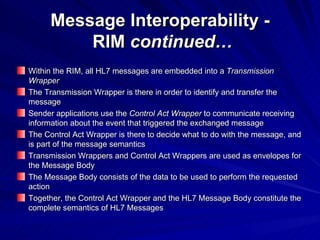
![Message Interoperability - Reference Information Model (RIM) HL7’s RIM is a “static model of healthcare information representing the aspects of the healthcare domain undertaken so far by HL7 standards development activities” The HL7 v3 standard development process defines rules used to implement and derive domain-specific information models from the RIM, finally generating XML schema definitions (XSD) associated with a particular message type The HL7 RIM standard “provides a substantial level of message functionality between applications by structuring envelopes which support message exchange between applications HL7 message envelopes are called wrappers , initially modeled by defining classes and relationships in the RIM These specifications are then used to create the XML schema for the message wrappers, following a process outlined in the HL7 Message Development Framework” [4]](https://image.slidesharecdn.com/interoperabilitybetweenhealthcareapplications-1264109893651-phpapp02/85/Interoperability-Between-Healthcare-Applications-5-320.jpg)
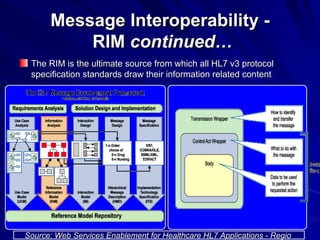
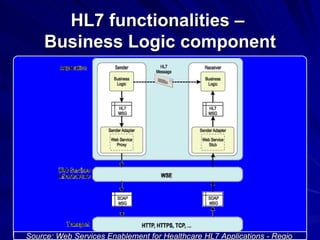
![HL7 functionalities – Business Logic component SENDER “ Create an XML representation of a specific HL7 Message Type that includes Body, Control Wrapper, and Transmission Wrapper Pass that message to the Web Service Adapter for its transmission to the Receiver Application” [4] RECEIVER “ Retrieve the HL7 Message received by the Web Service Adapter, and unfold the Transmission Wrapper, Control Wrapper, and Message Body from the received XML Message Verify the HL7 Message satisfies the business rules and constraints for that Interaction Check if the Sender Application required an Application Level Acknowledge (HL7 Message Type MCI) and – in that case – send that message” [4]](https://image.slidesharecdn.com/interoperabilitybetweenhealthcareapplications-1264109893651-phpapp02/85/Interoperability-Between-Healthcare-Applications-8-320.jpg)
![HL7 functionalities – Web Service Adapter component SENDER “ Read the Transmission Wrapper of received HL7 Messages to determine how to reach the ultimate recipient (for example Receiver Application) on the Web Services Infrastructure, configuring the SOAP Envelope accordingly Based on HL7 Message Type, application configuration and policies (for example, security) prepare a SOAP message, containing the HL7 XML message as a SOAP body part to be sent over the Web Services Infrastructure Pass the SOAP Message to the Web service proxy for transmission on the wire Get ready to receive and – optionally – store related Accept or Application Level acknowledgement messages from the Receiver, whenever requested by the Sender” [4] RECEIVER “ Receive the SOAP message from the Web Service stub Verify the received SOAP message satisfies application configuration and policies constraints (for example, security) Possibly store the received message in a a persistent form of memory Optionally unfold the HL7 XML message from the SOAP message and check schema compliance for the received HL7 Message with the expected HL7 Message Type Verify if any communication (Accept) level acknowledgement needs to be performed, and in that case prepare an appropriate message to be sent to the original Message Sender. Pass the HL7 Message to the Receiver Application” [4]](https://image.slidesharecdn.com/interoperabilitybetweenhealthcareapplications-1264109893651-phpapp02/85/Interoperability-Between-Healthcare-Applications-10-320.jpg)
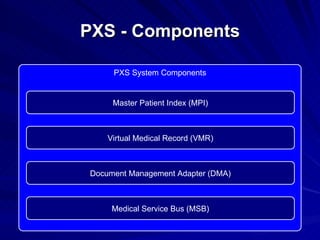
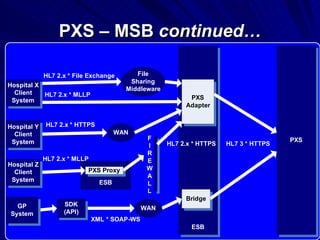
![References [1] Key Issues of Technical Interoperability Solutions in eHealth and the RIDE Project; Dogac, Namli, Okcan, Laleci, Kabak and Eichelberg; pg. 1; http://www.ehealthnews.eu/images/stories/pdf/ride.pdf [2] Towards Interoperable Healthcare Information Systems: The HL7 Conformance Profile Approach; Snelick, Rontey, Gebase, Carnahan; p. 2; http://www.itl.nist.gov/div897/ctg/messagemaker/papers/IESA2007.rsnelick.pdf [3] Key Issues of Technical Interoperability Solutions in eHealth and the RIDE Project; Dogac, Namli, Okcan, Laleci, Kabak and Eichelberg; pg. 2; http://www.ehealthnews.eu/images/stories/pdf/ride.pdf](https://image.slidesharecdn.com/interoperabilitybetweenhealthcareapplications-1264109893651-phpapp02/85/Interoperability-Between-Healthcare-Applications-48-320.jpg)
![References continued… [4] Web Services Enablement for Healthcare HL7 Applications – Web Services Basic Profile Reference Implementation; Mauro Regio, Microsoft Corporation; http://msdn.microsoft.com/en-us/library/ms954603.aspx [5] Aims of the openEHR Architecture http://www.openehr.org/releases/1.0.1/html/architecture/overview/Output/aims.html [6] HL7 Clinical Document Architecture, Release 2.0 http://xml.coverpages.org/CDA-Release2-Unofficial.html [7] Electronic Business using eXtensible Markup Language http://en.wikipedia.org/wiki/EbXML [8] WS/PIDS: Standard Interoperable PIDS in Web Services Environments; Vasilescu, Dorobantu, Govoni, Padh, Ki Mun http://ieeexplore.ieee.org/stamp/stamp.jsp?arnumber=04358877](https://image.slidesharecdn.com/interoperabilitybetweenhealthcareapplications-1264109893651-phpapp02/85/Interoperability-Between-Healthcare-Applications-49-320.jpg)
![References continued… [9] SNOMED CT http://en.wikipedia.org/wiki/SNOMED_CT [10] LOINC http://en.wikipedia.org/wiki/LOINC [11] Key Issues of Technical Interoperability Solutions in eHealth (IST-027065 RIDE Project); Dogac http://www.ehealthconference2006.org/pdf/DOGAC.pdf [12] ICW Developer Network – PXS Technical Whitepaper (must be a registered member of the ICW Developer Network to view the documents) http://idn.icw-global.com/fileadmin/downloads/PRG/TechnicalWhitepaper_en_US_PRG_PXS__2.0_DE_en_US_2.0.pdf [13] ICW Developer Network – New to ICW Professional Exchange Server http://idn.icw-global.com/solutions/icw-professional-suite/professional-exchange-server/new-to-pxs.html](https://image.slidesharecdn.com/interoperabilitybetweenhealthcareapplications-1264109893651-phpapp02/85/Interoperability-Between-Healthcare-Applications-50-320.jpg)
![References continued… [14] ICW Professional Suite – Professional Exchange Server http://www.icw-global.com/fileadmin/user_upload/pdf/brochures/icw-professional-suite/stuffer/icw-pxs-en.pdf](https://image.slidesharecdn.com/interoperabilitybetweenhealthcareapplications-1264109893651-phpapp02/85/Interoperability-Between-Healthcare-Applications-51-320.jpg)

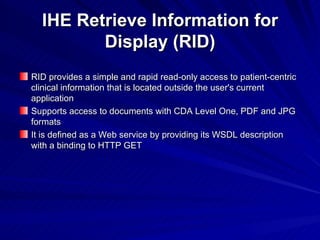
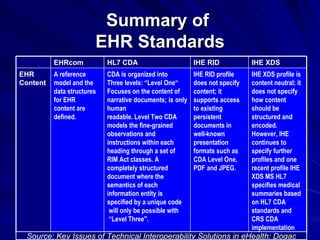
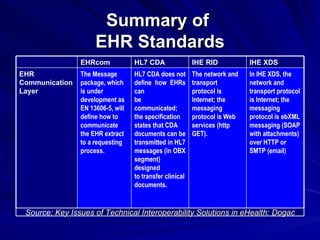
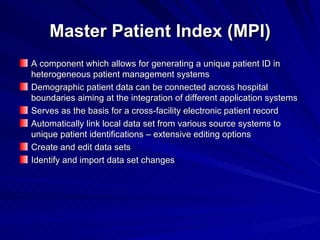
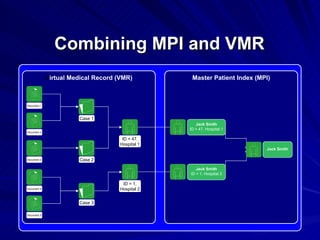
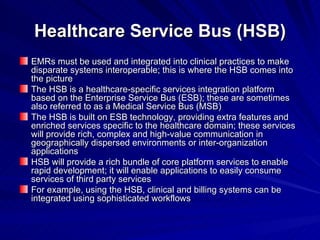
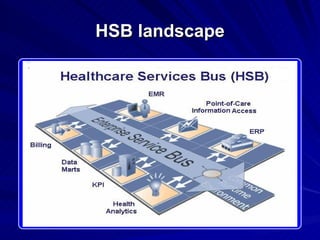
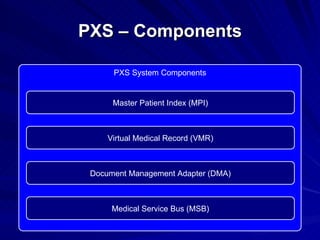
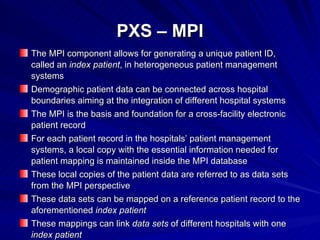
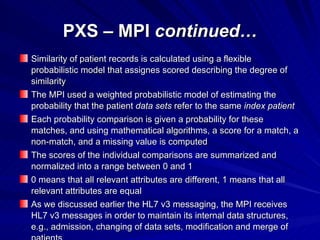
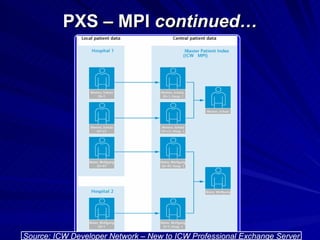
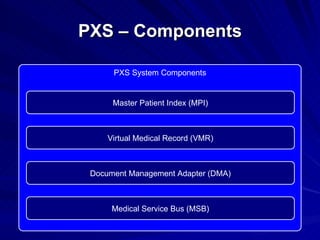
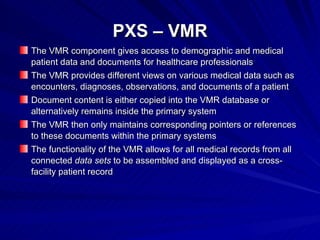
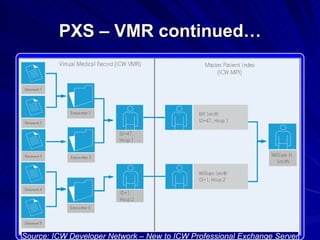
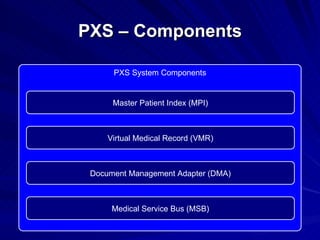
The document discusses interoperability between heterogeneous healthcare information systems. It describes standards for achieving interoperability, including HL7 versions 2 and 3 for message exchange, the Reference Information Model (RIM), Clinical Document Architecture (CDA), and Integrating the Healthcare Enterprise (IHE) profiles like Cross-Enterprise Document Sharing (XDS). It also discusses electronic health records (EHRs), master patient indexes (MPIs), virtual medical records (VMRs), and how the Professional Exchange Server (PXS) can bridge gaps between disparate healthcare systems through its various components.


