EHR models, standards and
semantic interoperability
David Moner
damoca@veratech.es
ELECTRONIC HEALTH RECORDS: A VIEW AT THE CURRENT DEVELOPMENTS OF HEALTHCARE DELIVERY MODELS
IN POLAND AND THE EU / ELEKTRONICZNA DOKUMENTACJA MEDYCZNA W POLSCE I EUROPIE
THE NATIONAL E-HEALTH CLUSTER CONFERENCE
ZAMEK TOPACZ, 6-7 AUGUST 2015
An interoperable world
• Technology allows us to be connected and to
have access to our data everywhere at every
time.
Why is this not true with health information?
EHR models, standards and semantic interoperability 2
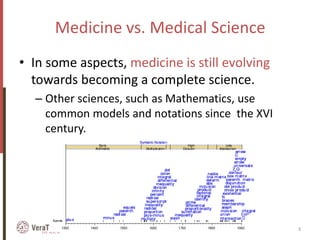
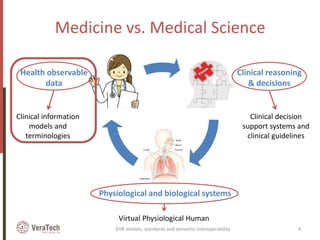
Medicine vs. Medical Science
• In some aspects, medicine is still evolving
towards becoming a complete science.
– Other sciences, such as Mathematics, use
common models and notations since the XVI
century.
EHR models, standards and semantic interoperability 3
Medicine vs. Medical Science
Physiological and biological systems
Clinical reasoning
& decisions
Health observable
data
Virtual Physiological Human
Clinical information
models and
terminologies
Clinical decision
support systems and
clinical guidelines
EHR models, standards and semantic interoperability 4
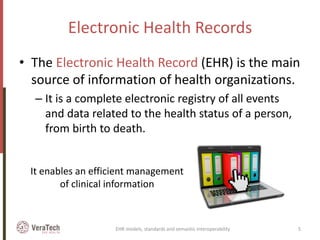
Electronic Health Records
• The Electronic Health Record (EHR) is the main
source of information of health organizations.
– It is a complete electronic registry of all events
and data related to the health status of a person,
from birth to death.
It enables an efficient management
of clinical information
EHR models, standards and semantic interoperability 5
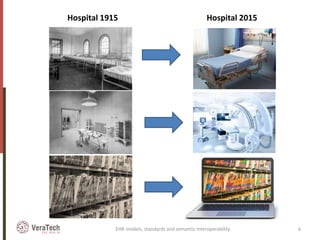
Hospital 1915 Hospital 2015
EHR models, standards and semantic interoperability 6
Electronic Health Records
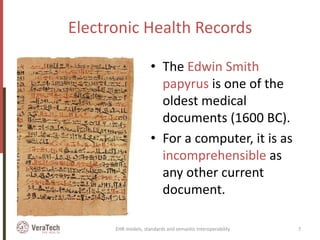
• The Edwin Smith
papyrus is one of the
oldest medical
documents (1600 BC).
• For a computer, it is as
incomprehensible as
any other current
document.
EHR models, standards and semantic interoperability 7
Electronic Health Records
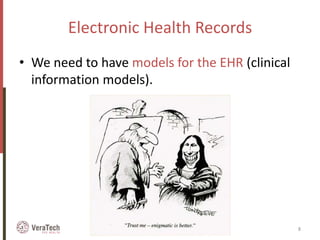
• We need to have models for the EHR (clinical
information models).
EHR models, standards and semantic interoperability 8
Modeling the EHR
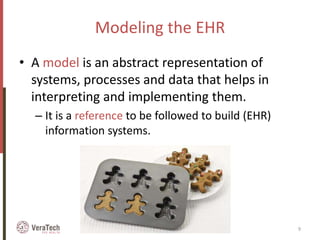
• A model is an abstract representation of
systems, processes and data that helps in
interpreting and implementing them.
– It is a reference to be followed to build (EHR)
information systems.
EHR models, standards and semantic interoperability 9
Modeling the EHR
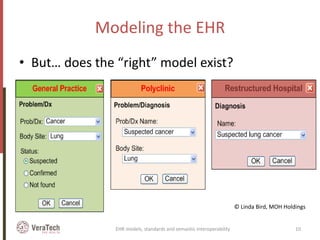
• But… does the “right” model exist?
© Linda Bird, MOH Holdings
EHR models, standards and semantic interoperability 10
Modeling the EHR
• The problems we are facing are:
– Health data is complex.
– Health data is variable.
– Health data has specific semantics.
How can we agree on common
formats and models?
How can we share our data
and reuse other’s data?
EHR models, standards and semantic interoperability 11
Modeling the EHR
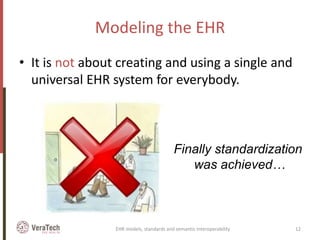
• It is not about creating and using a single and
universal EHR system for everybody.
EHR models, standards and semantic interoperability 12
Finally standardization
was achieved…
Modeling the EHR
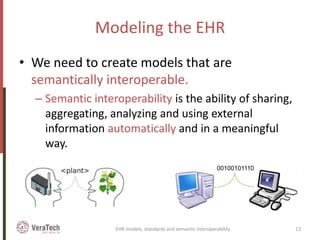
• We need to create models that are
semantically interoperable.
– Semantic interoperability is the ability of sharing,
aggregating, analyzing and using external
information automatically and in a meaningful
way.
00100101110
EHR models, standards and semantic interoperability 13
EHR models, standards and semantic interoperability 14
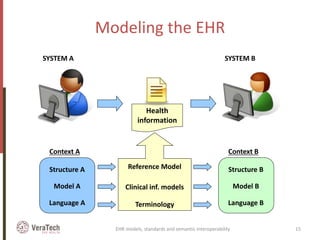
Modeling the EHR
SYSTEM A SYSTEM B
Health
information
Structure A
Model A
Language A
Structure B
Model B
Language B
Context A Context B
?
Reference Model
Clinical inf. models
Terminology
EHR models, standards and semantic interoperability 15
Modeling the EHR
• A Reference Model provides the syntax (basic
data structure and data types) to represent
any kind of health information in the EHR.
EHR models, standards and semantic interoperability 16
Modeling the EHR
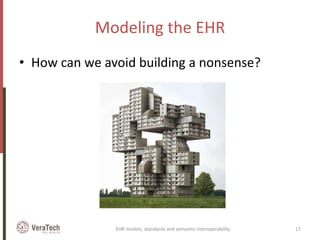
• How can we avoid building a nonsense?
EHR models, standards and semantic interoperability 17
Modeling the EHR
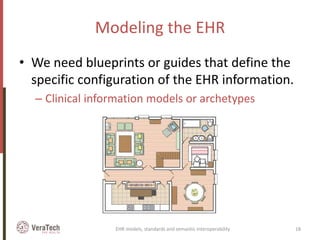
• We need blueprints or guides that define the
specific configuration of the EHR information.
– Clinical information models or archetypes
EHR models, standards and semantic interoperability 18
Modeling the EHR
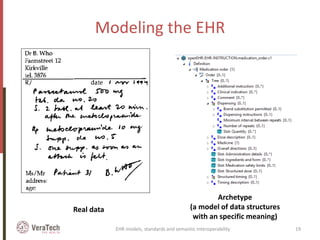
Real data
Archetype
(a model of data structures
with an specific meaning)
EHR models, standards and semantic interoperability 19
Modeling the EHR
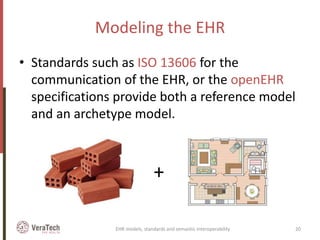
• Standards such as ISO 13606 for the
communication of the EHR, or the openEHR
specifications provide both a reference model
and an archetype model.
+
EHR models, standards and semantic interoperability 20
Modeling the EHR
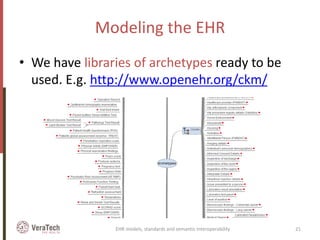
• We have libraries of archetypes ready to be
used. E.g. http://www.openehr.org/ckm/
EHR models, standards and semantic interoperability 21
Modeling the EHR
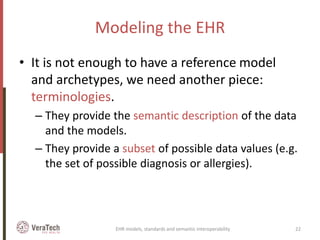
• It is not enough to have a reference model
and archetypes, we need another piece:
terminologies.
– They provide the semantic description of the data
and the models.
– They provide a subset of possible data values (e.g.
the set of possible diagnosis or allergies).
EHR models, standards and semantic interoperability 22
Modeling the EHR
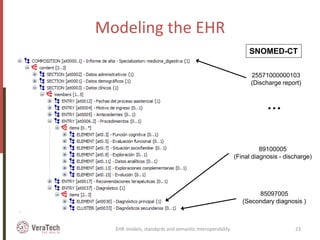
25571000000103
(Discharge report)
SNOMED-CT
85097005
(Secondary diagnosis )
…
89100005
(Final diagnosis - discharge)
EHR models, standards and semantic interoperability 23
Modeling the EHR
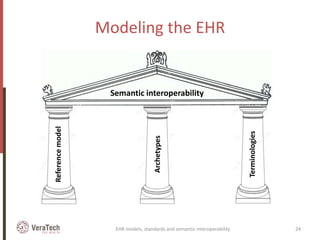
EHR models, standards and semantic interoperability 24
Referencemodel
Archetypes
Terminologies
Semantic interoperability
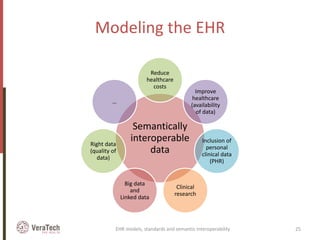
Modeling the EHR
Semantically
interoperable
data
Reduce
healthcare
costs
Improve
healthcare
(availability
of data)
Inclusion of
personal
clinical data
(PHR)
Clinical
research
Big data
and
Linked data
Right data
(quality of
data)
…
EHR models, standards and semantic interoperability 25
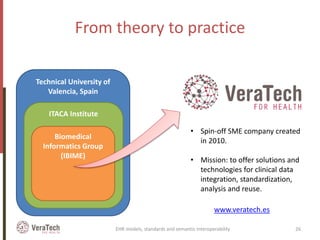
From theory to practice
Technical University of
Valencia, Spain
ITACA Institute
Biomedical
Informatics Group
(IBIME)
• Spin-off SME company created
in 2010.
• Mission: to offer solutions and
technologies for clinical data
integration, standardization,
analysis and reuse.
www.veratech.es
EHR models, standards and semantic interoperability 26
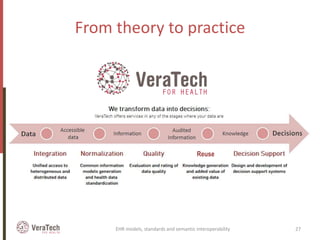
From theory to practice
EHR models, standards and semantic interoperability 27
Reuse
• LinkEHR Normalization Platform
– A set of tools that facilitates the adoption of EHR
standards based on the use of archetypes.
– It works over existing EHR systems and data.
EHR models, standards and semantic interoperability 28
www.linkehr.com
Reuse
• Four main modules:
– LinkEHR Integration: distributed data integration
engine.
– LinkEHR Editor: reference model independent
archetype editor.
– LinkEHR Studio: transformation of existing legacy
data into archetype-compliant standardized data.
– Clinical Information Model Manager: management
and government of clinical models and
archetypes.
EHR models, standards and semantic interoperability 29
Reuse
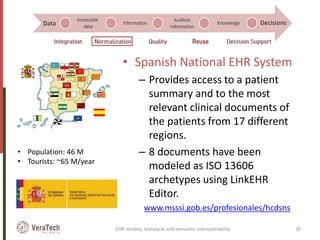
• Spanish National EHR System
– Provides access to a patient
summary and to the most
relevant clinical documents of
the patients from 17 different
regions.
– 8 documents have been
modeled as ISO 13606
archetypes using LinkEHR
Editor.
EHR models, standards and semantic interoperability 30
www.msssi.gob.es/profesionales/hcdsns
• Population: 46 M
• Tourists: ~65 M/year
Reuse
EHR models, standards and semantic interoperability 31
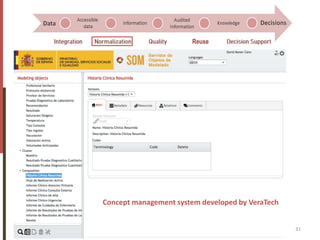
Concept management system developed by VeraTech
Reuse
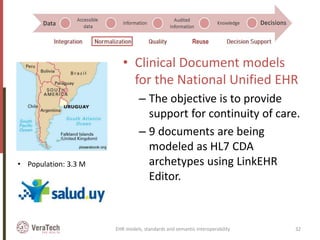
• Clinical Document models
for the National Unified EHR
– The objective is to provide
support for continuity of care.
– 9 documents are being
modeled as HL7 CDA
archetypes using LinkEHR
Editor.
EHR models, standards and semantic interoperability 32
• Population: 3.3 M
Reuse
• Shared EHR system (Madrid region, Spain)
– Objective: to build an EHR system based on ISO
13606 and archetypes for 5.5 million people.
– Fed by existing primary and specialized care EHR
systems. Data will be transformed using LinkEHR
Studio.
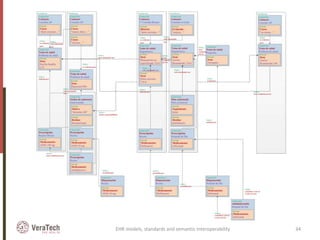
– The challenge is to maintain the relationships
between all the information.
EHR models, standards and semantic interoperability 33
Reuse
EHR models, standards and semantic interoperability 34
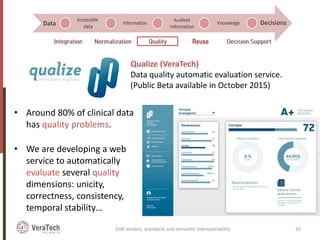
• Around 80% of clinical data
has quality problems.
• We are developing a web
service to automatically
evaluate several quality
dimensions: unicity,
correctness, consistency,
temporal stability…
Qualize (VeraTech)
Data quality automatic evaluation service.
(Public Beta available in October 2015)
EHR models, standards and semantic interoperability 35
Reuse
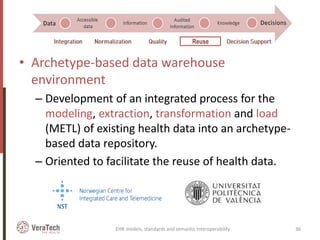
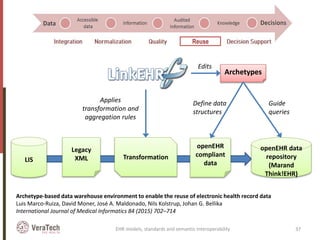
• Archetype-based data warehouse
environment
– Development of an integrated process for the
modeling, extraction, transformation and load
(METL) of existing health data into an archetype-
based data repository.
– Oriented to facilitate the reuse of health data.
EHR models, standards and semantic interoperability 36
Reuse
EHR models, standards and semantic interoperability 37
LIS Transformation
Legacy
XML
openEHR
compliant
data
openEHR data
repository
(Marand
Think!EHR)
Guide
queries
Applies
transformation and
aggregation rules
Archetypes
Define data
structures
Edits
Archetype-based data warehouse environment to enable the reuse of electronic health record data
Luis Marco-Ruiza, David Moner, José A. Maldonado, Nils Kolstrup, Johan G. Bellika
International Journal of Medical Informatics 84 (2015) 702–714
Reuse
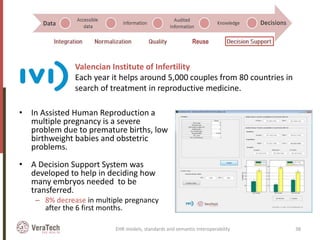
• In Assisted Human Reproduction a
multiple pregnancy is a severe
problem due to premature births, low
birthweight babies and obstetric
problems.
• A Decision Support System was
developed to help in deciding how
many embryos needed to be
transferred.
– 8% decrease in multiple pregnancy
after the 6 first months.
Valencian Institute of Infertility
Each year it helps around 5,000 couples from 80 countries in
search of treatment in reproductive medicine.
EHR models, standards and semantic interoperability 38
Reuse
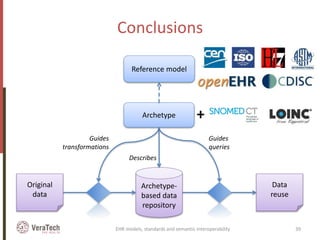
Conclusions
EHR models, standards and semantic interoperability 39
Reference model
Archetype
Archetype-
based data
repository
Original
data
Data
reuse
Describes
Guides
transformations
Guides
queries
+
Conclusions
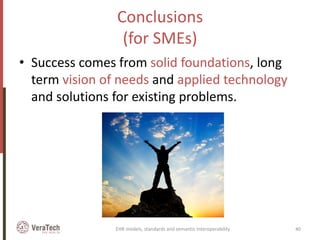
(for SMEs)
• Success comes from solid foundations, long
term vision of needs and applied technology
and solutions for existing problems.
EHR models, standards and semantic interoperability 40
Thank you!
Questions?
David Moner
damoca@veratech.es
Ehr models, standards and semantic interoperability
  • 1.
    EHR models, standardsand semantic interoperability David Moner damoca@veratech.es ELECTRONIC HEALTH RECORDS: A VIEW AT THE CURRENT DEVELOPMENTS OF HEALTHCARE DELIVERY MODELS IN POLAND AND THE EU / ELEKTRONICZNA DOKUMENTACJA MEDYCZNA W POLSCE I EUROPIE THE NATIONAL E-HEALTH CLUSTER CONFERENCE ZAMEK TOPACZ, 6-7 AUGUST 2015
  • 2.
    An interoperable world •Technology allows us to be connected and to have access to our data everywhere at every time. Why is this not true with health information? EHR models, standards and semantic interoperability 2
  • 3.
    Medicine vs. MedicalScience • In some aspects, medicine is still evolving towards becoming a complete science. – Other sciences, such as Mathematics, use common models and notations since the XVI century. EHR models, standards and semantic interoperability 3
  • 4.
    Medicine vs. MedicalScience Physiological and biological systems Clinical reasoning & decisions Health observable data Virtual Physiological Human Clinical information models and terminologies Clinical decision support systems and clinical guidelines EHR models, standards and semantic interoperability 4
  • 5.
    Electronic Health Records •The Electronic Health Record (EHR) is the main source of information of health organizations. – It is a complete electronic registry of all events and data related to the health status of a person, from birth to death. It enables an efficient management of clinical information EHR models, standards and semantic interoperability 5
  • 6.
    Hospital 1915 Hospital2015 EHR models, standards and semantic interoperability 6
  • 7.
    Electronic Health Records •The Edwin Smith papyrus is one of the oldest medical documents (1600 BC). • For a computer, it is as incomprehensible as any other current document. EHR models, standards and semantic interoperability 7
  • 8.
    Electronic Health Records •We need to have models for the EHR (clinical information models). EHR models, standards and semantic interoperability 8
  • 9.
    Modeling the EHR •A model is an abstract representation of systems, processes and data that helps in interpreting and implementing them. – It is a reference to be followed to build (EHR) information systems. EHR models, standards and semantic interoperability 9
  • 10.
    Modeling the EHR •But… does the “right” model exist? © Linda Bird, MOH Holdings EHR models, standards and semantic interoperability 10
  • 11.
    Modeling the EHR •The problems we are facing are: – Health data is complex. – Health data is variable. – Health data has specific semantics. How can we agree on common formats and models? How can we share our data and reuse other’s data? EHR models, standards and semantic interoperability 11
  • 12.
    Modeling the EHR •It is not about creating and using a single and universal EHR system for everybody. EHR models, standards and semantic interoperability 12 Finally standardization was achieved…
  • 13.
    Modeling the EHR •We need to create models that are semantically interoperable. – Semantic interoperability is the ability of sharing, aggregating, analyzing and using external information automatically and in a meaningful way. 00100101110 EHR models, standards and semantic interoperability 13
  • 14.
    EHR models, standardsand semantic interoperability 14
  • 15.
    Modeling the EHR SYSTEMA SYSTEM B Health information Structure A Model A Language A Structure B Model B Language B Context A Context B ? Reference Model Clinical inf. models Terminology EHR models, standards and semantic interoperability 15
  • 16.
    Modeling the EHR •A Reference Model provides the syntax (basic data structure and data types) to represent any kind of health information in the EHR. EHR models, standards and semantic interoperability 16
  • 17.
    Modeling the EHR •How can we avoid building a nonsense? EHR models, standards and semantic interoperability 17
  • 18.
    Modeling the EHR •We need blueprints or guides that define the specific configuration of the EHR information. – Clinical information models or archetypes EHR models, standards and semantic interoperability 18
  • 19.
    Modeling the EHR Realdata Archetype (a model of data structures with an specific meaning) EHR models, standards and semantic interoperability 19
  • 20.
    Modeling the EHR •Standards such as ISO 13606 for the communication of the EHR, or the openEHR specifications provide both a reference model and an archetype model. + EHR models, standards and semantic interoperability 20
  • 21.
    Modeling the EHR •We have libraries of archetypes ready to be used. E.g. http://www.openehr.org/ckm/ EHR models, standards and semantic interoperability 21
  • 22.
    Modeling the EHR •It is not enough to have a reference model and archetypes, we need another piece: terminologies. – They provide the semantic description of the data and the models. – They provide a subset of possible data values (e.g. the set of possible diagnosis or allergies). EHR models, standards and semantic interoperability 22
  • 23.
    Modeling the EHR 25571000000103 (Dischargereport) SNOMED-CT 85097005 (Secondary diagnosis ) … 89100005 (Final diagnosis - discharge) EHR models, standards and semantic interoperability 23
  • 24.
    Modeling the EHR EHRmodels, standards and semantic interoperability 24 Referencemodel Archetypes Terminologies Semantic interoperability
  • 25.
    Modeling the EHR Semantically interoperable data Reduce healthcare costs Improve healthcare (availability ofdata) Inclusion of personal clinical data (PHR) Clinical research Big data and Linked data Right data (quality of data) … EHR models, standards and semantic interoperability 25
  • 26.
    From theory topractice Technical University of Valencia, Spain ITACA Institute Biomedical Informatics Group (IBIME) • Spin-off SME company created in 2010. • Mission: to offer solutions and technologies for clinical data integration, standardization, analysis and reuse. www.veratech.es EHR models, standards and semantic interoperability 26
  • 27.
    From theory topractice EHR models, standards and semantic interoperability 27 Reuse
  • 28.
    • LinkEHR NormalizationPlatform – A set of tools that facilitates the adoption of EHR standards based on the use of archetypes. – It works over existing EHR systems and data. EHR models, standards and semantic interoperability 28 www.linkehr.com Reuse
  • 29.
    • Four mainmodules: – LinkEHR Integration: distributed data integration engine. – LinkEHR Editor: reference model independent archetype editor. – LinkEHR Studio: transformation of existing legacy data into archetype-compliant standardized data. – Clinical Information Model Manager: management and government of clinical models and archetypes. EHR models, standards and semantic interoperability 29 Reuse
  • 30.
    • Spanish NationalEHR System – Provides access to a patient summary and to the most relevant clinical documents of the patients from 17 different regions. – 8 documents have been modeled as ISO 13606 archetypes using LinkEHR Editor. EHR models, standards and semantic interoperability 30 www.msssi.gob.es/profesionales/hcdsns • Population: 46 M • Tourists: ~65 M/year Reuse
  • 31.
    EHR models, standardsand semantic interoperability 31 Concept management system developed by VeraTech Reuse
  • 32.
    • Clinical Documentmodels for the National Unified EHR – The objective is to provide support for continuity of care. – 9 documents are being modeled as HL7 CDA archetypes using LinkEHR Editor. EHR models, standards and semantic interoperability 32 • Population: 3.3 M Reuse
  • 33.
    • Shared EHRsystem (Madrid region, Spain) – Objective: to build an EHR system based on ISO 13606 and archetypes for 5.5 million people. – Fed by existing primary and specialized care EHR systems. Data will be transformed using LinkEHR Studio. – The challenge is to maintain the relationships between all the information. EHR models, standards and semantic interoperability 33 Reuse
  • 34.
    EHR models, standardsand semantic interoperability 34
  • 35.
    • Around 80%of clinical data has quality problems. • We are developing a web service to automatically evaluate several quality dimensions: unicity, correctness, consistency, temporal stability… Qualize (VeraTech) Data quality automatic evaluation service. (Public Beta available in October 2015) EHR models, standards and semantic interoperability 35 Reuse
  • 36.
    • Archetype-based datawarehouse environment – Development of an integrated process for the modeling, extraction, transformation and load (METL) of existing health data into an archetype- based data repository. – Oriented to facilitate the reuse of health data. EHR models, standards and semantic interoperability 36 Reuse
  • 37.
    EHR models, standardsand semantic interoperability 37 LIS Transformation Legacy XML openEHR compliant data openEHR data repository (Marand Think!EHR) Guide queries Applies transformation and aggregation rules Archetypes Define data structures Edits Archetype-based data warehouse environment to enable the reuse of electronic health record data Luis Marco-Ruiza, David Moner, José A. Maldonado, Nils Kolstrup, Johan G. Bellika International Journal of Medical Informatics 84 (2015) 702–714 Reuse
  • 38.
    • In AssistedHuman Reproduction a multiple pregnancy is a severe problem due to premature births, low birthweight babies and obstetric problems. • A Decision Support System was developed to help in deciding how many embryos needed to be transferred. – 8% decrease in multiple pregnancy after the 6 first months. Valencian Institute of Infertility Each year it helps around 5,000 couples from 80 countries in search of treatment in reproductive medicine. EHR models, standards and semantic interoperability 38 Reuse
  • 39.
    Conclusions EHR models, standardsand semantic interoperability 39 Reference model Archetype Archetype- based data repository Original data Data reuse Describes Guides transformations Guides queries +
  • 40.
    Conclusions (for SMEs) • Successcomes from solid foundations, long term vision of needs and applied technology and solutions for existing problems. EHR models, standards and semantic interoperability 40
  • 41.