Employee Training
and Development
Learning is a relatively permanent change in
behaviour that results from direct or indirect
experience.
Learning Organisation: A learning organisation is
one whose employees continously learn new
things and to use what they learn to improve
product or service quality.
Organisation learning is a process of detecting and
correcting errors.
(Chris Argyris)
Organisations where people continually expand their
capacity to create the results they truly desire, where
new patterns of thinking are nurtured, where collective
aspiration is set free, and where people are continually
learning.
(Peter Senge)
 737 and 747 plane programs resulted in much fanfare and poblems.
 Comparison between development processes of 737 and 747 with
707 and 727.
 An employee group was commissioned to compare the
development processes of 737 and 747 to 707 and 727, two of
company’s most successful aircraft.
 After working three years, they produced booklet.
 Several members of the team transferred to 757 and 767 startups.
They produced the most successful, error-free launches in Boeings
history.
Training is a planned attempted by an organisation
to facilitate employee learning of job-related,
knowledge, skills and behaviours.
Development refers to enhance the skills needed for
both present and future jobs.
NEED FOR TRAINING
The need for training arises because of the following reasons:-
CHANGING TECHNOLOGY: Technology is changing at a fast
place. The workers must learn new techniques to make use of
advanced technology. Thus, training should be treated as a
continuous process to update the employees in new methods &
practices.
QUALITY CONSCIOUS CUSTOMERS: The customers have
become quality conscious & their requirements keep on changing .
To satisfy the customers, quality of products must be improved
through training of workers.
GREATER PRODUCTIVITY: It is essential to increase
productivity &reduce cost of production for meeting competition in
the market. Effective training can help increase productivity of the
workers.
STABLE WORKFORCE: Training creates a feeling of
confidence in the minds of the workers. It gives them at
the work place. As a result, labour turnover &
absenteeism rates are reduced.
INCREASED SAFETY: Trained workers handle the
machines safely. They also know the use of various
safety devices in the factory. Thus, they are less prone to
industrial accidents.
BETTER MANAGEMENT: Training can be used as an
effective tool of planning and control. It develops skills
among workers for the future and also prepares them for
promotion. It also helps to increase productivity and
quality.
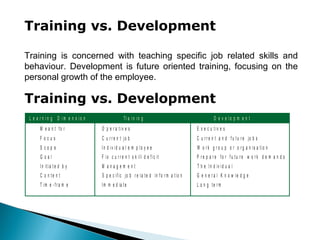
Training vs. Development
Training is concerned with teaching specific job related skills and
behaviour. Development is future oriented training, focusing on the
personal growth of the employee.
Training vs. Development
L e a r n i n g D i m e n s i o n Tr a i n in g D e v e l o p m e n t
M e a n t fo r O p e r a t iv e s E x e c u t iv e s
F o c u s C u r r e n t jo b C u r r e n t a n d f u t u r e jo b s
S c o p e I n d iv id u a l e m p lo y e e W o r k g r o u p o r o r g a n is a t io n
G o a l F ix c u r r e n t s k ill d e f ic it P r e p a r e fo r f u tu r e w o r k d e m a n d s
In itia t e d b y M a n a g e m e n t T h e In d iv id u a l
C o n te n t S p e c ific jo b r e la te d in fo r m a tio n G e n e r a l K n o w le d g e
T im e - fr a m e Im m e d ia te L o n g te r m
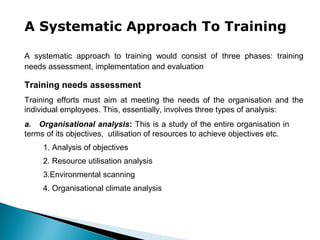
A Systematic Approach To Training
A systematic approach to training would consist of three phases: training
needs assessment, implementation and evaluation
Training needs assessment
Training efforts must aim at meeting the needs of the organisation and the
individual employees. This, essentially, involves three types of analysis:
a. Organisational analysis: This is a study of the entire organisation in
terms of its objectives, utilisation of resources to achieve objectives etc.
1. Analysis of objectives
2. Resource utilisation analysis
3.Environmental scanning
4. Organisational climate analysis
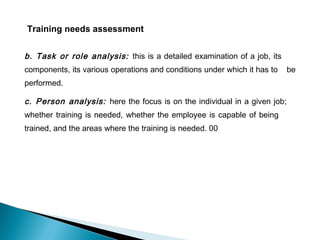
b. Task or role analysis: this is a detailed examination of a job, its
components, its various operations and conditions under which it has to be
performed.
c. Person analysis: here the focus is on the individual in a given job;
whether training is needed, whether the employee is capable of being
trained, and the areas where the training is needed. 00
Training needs assessment
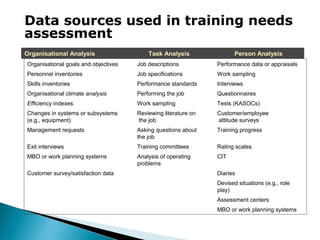
Data sources used in training needs
assessment
Organisational Analysis Task Analysis Person Analysis
Organisational goals and objectives Job descriptions Performance data or appraisals
Personnel inventories Job specifications Work sampling
Skills inventories Performance standards Interviews
Organisational climate analysis Performing the job Questionnaires
Efficiency indexes Work sampling Tests (KASOCs)
Changes in systems or subsystems Reviewing literature on Customer/employee
(e.g., equipment) the job attitude surveys
Management requests Asking questions about Training progress
the job
Exit interviews Training committees Rating scales
MBO or work planning systems Analysis of operating CIT
problems
Customer survey/satisfaction data Diaries
Devised situations (e.g., role
play)
Assessment centers
MBO or work planning systems
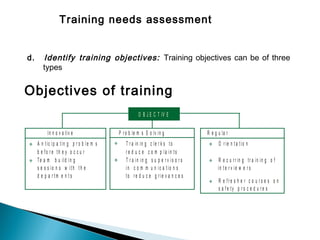
d. Identify training objectives: Training objectives can be of three
types
Objectives of training
O B J E C T IV E
In n o v a tiv e P r o b le m s S o lv in g R e g u la r
  
  

A n t ic ip a t in g p r o b le m s T r a in in g c le r k s to O r ie n t a t io n
b e fo r e t h e y o c c u r r e d u c e c o m p la in t s
Te a m b u ild in g T r a in in g s u p e r v is o r s R e c u r r in g tr a in in g o f
s e s s io n s w it h t h e in c o m m u n ic a t io n s in t e r v ie w e r s
d e p a r t m e n t s to r e d u c e g r ie v a n c e s
R e fr e s h e r c o u r s e s o n
s a f e ty p r o c e d u r e s
Training needs assessment
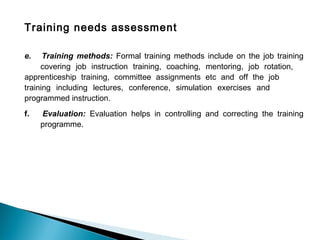
e. Training methods: Formal training methods include on the job training
covering job instruction training, coaching, mentoring, job rotation,
apprenticeship training, committee assignments etc and off the job
training including lectures, conference, simulation exercises and
programmed instruction.
f. Evaluation: Evaluation helps in controlling and correcting the training
programme.
Training needs assessment
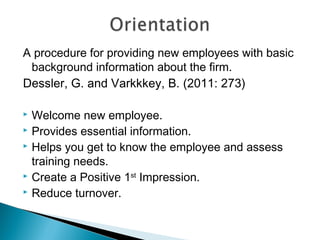
A procedure for providing new employees with basic
background information about the firm.
Dessler, G. and Varkkkey, B. (2011: 273)
 Welcome new employee.
 Provides essential information.
 Helps you get to know the employee and assess
training needs.
 Create a Positive 1st
Impression.
 Reduce turnover.
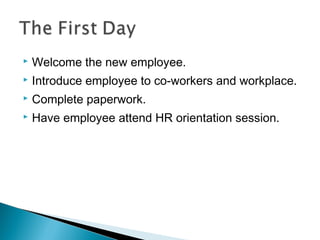
 Welcome the new employee.
 Introduce employee to co-workers and workplace.
 Complete paperwork.
 Have employee attend HR orientation session.
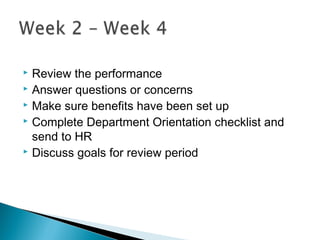
 Review the performance
 Answer questions or concerns
 Make sure benefits have been set up
 Complete Department Orientation checklist and
send to HR
 Discuss goals for review period
1.INDUCTION OR ORIENTATION TRAINING:- Induction
is concerned with introducing & its procedure s,rules
&regulations. Employee orientation or induction training is
nothing but introduction of the organisation to the newly
employed person. The purpose is to give a ‘bird’s eye view’ of
the organisation where he has to work. It is a very short
informative training given immediately after recruitment. It
creates a feeling of involvement in the minds of newly
appointed employees.
2.JOB TRAINING: Job training relates to a specific job which
the worker has to handle about machines, process of
production, and so on. It develop skills & confidence among
workers &enables them to perform the job efficiently.
3.APPRENTICESHIP TRAINING:- It tends more towards
education them merely on the vocational training. Under this
both knowledge &skills in doing a job or a series of related jobs
are involved.
This training is desirable in industries which require a
constant flow of new employees expected to become all round
craftsmen. It is very prevalent in printing trades, building
&construction and crafts like mechanics, electricians, welders
etc.
4.INTERNSHIP TRAINING:- Under this method ,the
educational or vocational institute enters into arrangement with
an industrial enterprise for providing practical knowledge to its
students. Internship training is usually meant for such
vocations where advanced theoretical knowledge is to be
backed up by practical experience on the job.

Chapter 5

  • 1.
  • 2.
    Learning is arelatively permanent change in behaviour that results from direct or indirect experience. Learning Organisation: A learning organisation is one whose employees continously learn new things and to use what they learn to improve product or service quality.
  • 3.
    Organisation learning isa process of detecting and correcting errors. (Chris Argyris) Organisations where people continually expand their capacity to create the results they truly desire, where new patterns of thinking are nurtured, where collective aspiration is set free, and where people are continually learning. (Peter Senge)
  • 4.
     737 and747 plane programs resulted in much fanfare and poblems.  Comparison between development processes of 737 and 747 with 707 and 727.  An employee group was commissioned to compare the development processes of 737 and 747 to 707 and 727, two of company’s most successful aircraft.  After working three years, they produced booklet.  Several members of the team transferred to 757 and 767 startups. They produced the most successful, error-free launches in Boeings history.
  • 5.
    Training is aplanned attempted by an organisation to facilitate employee learning of job-related, knowledge, skills and behaviours. Development refers to enhance the skills needed for both present and future jobs.
  • 6.
    NEED FOR TRAINING Theneed for training arises because of the following reasons:- CHANGING TECHNOLOGY: Technology is changing at a fast place. The workers must learn new techniques to make use of advanced technology. Thus, training should be treated as a continuous process to update the employees in new methods & practices. QUALITY CONSCIOUS CUSTOMERS: The customers have become quality conscious & their requirements keep on changing . To satisfy the customers, quality of products must be improved through training of workers. GREATER PRODUCTIVITY: It is essential to increase productivity &reduce cost of production for meeting competition in the market. Effective training can help increase productivity of the workers.
  • 7.
    STABLE WORKFORCE: Trainingcreates a feeling of confidence in the minds of the workers. It gives them at the work place. As a result, labour turnover & absenteeism rates are reduced. INCREASED SAFETY: Trained workers handle the machines safely. They also know the use of various safety devices in the factory. Thus, they are less prone to industrial accidents. BETTER MANAGEMENT: Training can be used as an effective tool of planning and control. It develops skills among workers for the future and also prepares them for promotion. It also helps to increase productivity and quality.
  • 8.
    Training vs. Development Trainingis concerned with teaching specific job related skills and behaviour. Development is future oriented training, focusing on the personal growth of the employee. Training vs. Development L e a r n i n g D i m e n s i o n Tr a i n in g D e v e l o p m e n t M e a n t fo r O p e r a t iv e s E x e c u t iv e s F o c u s C u r r e n t jo b C u r r e n t a n d f u t u r e jo b s S c o p e I n d iv id u a l e m p lo y e e W o r k g r o u p o r o r g a n is a t io n G o a l F ix c u r r e n t s k ill d e f ic it P r e p a r e fo r f u tu r e w o r k d e m a n d s In itia t e d b y M a n a g e m e n t T h e In d iv id u a l C o n te n t S p e c ific jo b r e la te d in fo r m a tio n G e n e r a l K n o w le d g e T im e - fr a m e Im m e d ia te L o n g te r m
  • 9.
    A Systematic ApproachTo Training A systematic approach to training would consist of three phases: training needs assessment, implementation and evaluation Training needs assessment Training efforts must aim at meeting the needs of the organisation and the individual employees. This, essentially, involves three types of analysis: a. Organisational analysis: This is a study of the entire organisation in terms of its objectives, utilisation of resources to achieve objectives etc. 1. Analysis of objectives 2. Resource utilisation analysis 3.Environmental scanning 4. Organisational climate analysis
  • 10.
    b. Task orrole analysis: this is a detailed examination of a job, its components, its various operations and conditions under which it has to be performed. c. Person analysis: here the focus is on the individual in a given job; whether training is needed, whether the employee is capable of being trained, and the areas where the training is needed. 00 Training needs assessment
  • 11.
    Data sources usedin training needs assessment Organisational Analysis Task Analysis Person Analysis Organisational goals and objectives Job descriptions Performance data or appraisals Personnel inventories Job specifications Work sampling Skills inventories Performance standards Interviews Organisational climate analysis Performing the job Questionnaires Efficiency indexes Work sampling Tests (KASOCs) Changes in systems or subsystems Reviewing literature on Customer/employee (e.g., equipment) the job attitude surveys Management requests Asking questions about Training progress the job Exit interviews Training committees Rating scales MBO or work planning systems Analysis of operating CIT problems Customer survey/satisfaction data Diaries Devised situations (e.g., role play) Assessment centers MBO or work planning systems
  • 12.
    d. Identify trainingobjectives: Training objectives can be of three types Objectives of training O B J E C T IV E In n o v a tiv e P r o b le m s S o lv in g R e g u la r        A n t ic ip a t in g p r o b le m s T r a in in g c le r k s to O r ie n t a t io n b e fo r e t h e y o c c u r r e d u c e c o m p la in t s Te a m b u ild in g T r a in in g s u p e r v is o r s R e c u r r in g tr a in in g o f s e s s io n s w it h t h e in c o m m u n ic a t io n s in t e r v ie w e r s d e p a r t m e n t s to r e d u c e g r ie v a n c e s R e fr e s h e r c o u r s e s o n s a f e ty p r o c e d u r e s Training needs assessment
  • 13.
    e. Training methods:Formal training methods include on the job training covering job instruction training, coaching, mentoring, job rotation, apprenticeship training, committee assignments etc and off the job training including lectures, conference, simulation exercises and programmed instruction. f. Evaluation: Evaluation helps in controlling and correcting the training programme. Training needs assessment
  • 14.
    A procedure forproviding new employees with basic background information about the firm. Dessler, G. and Varkkkey, B. (2011: 273)  Welcome new employee.  Provides essential information.  Helps you get to know the employee and assess training needs.  Create a Positive 1st Impression.  Reduce turnover.
  • 15.
     Welcome thenew employee.  Introduce employee to co-workers and workplace.  Complete paperwork.  Have employee attend HR orientation session.
  • 16.
     Review theperformance  Answer questions or concerns  Make sure benefits have been set up  Complete Department Orientation checklist and send to HR  Discuss goals for review period
  • 17.
    1.INDUCTION OR ORIENTATIONTRAINING:- Induction is concerned with introducing & its procedure s,rules &regulations. Employee orientation or induction training is nothing but introduction of the organisation to the newly employed person. The purpose is to give a ‘bird’s eye view’ of the organisation where he has to work. It is a very short informative training given immediately after recruitment. It creates a feeling of involvement in the minds of newly appointed employees. 2.JOB TRAINING: Job training relates to a specific job which the worker has to handle about machines, process of production, and so on. It develop skills & confidence among workers &enables them to perform the job efficiently.
  • 18.
    3.APPRENTICESHIP TRAINING:- Ittends more towards education them merely on the vocational training. Under this both knowledge &skills in doing a job or a series of related jobs are involved. This training is desirable in industries which require a constant flow of new employees expected to become all round craftsmen. It is very prevalent in printing trades, building &construction and crafts like mechanics, electricians, welders etc. 4.INTERNSHIP TRAINING:- Under this method ,the educational or vocational institute enters into arrangement with an industrial enterprise for providing practical knowledge to its students. Internship training is usually meant for such vocations where advanced theoretical knowledge is to be backed up by practical experience on the job.

Editor's Notes

  • #15 Slide Show Notes What are the benefits of new hire orientation? First of all, orientation welcomes the new employee and provides them with all the information and tools necessary to excel in their work. Orientation helps you to get to know your new employee and be better able to understand the issues he or she may need more training on. Orientation creates a positive first impression for the new employee of UNC. A good orientation program can reduce turnover. If we think back to the time we were new employees, it’s easier to understand why orientation is important. You may be able to improve the experience of your new employee based on past experiences of your own.
  • #16 Slide Show Notes The first day you should: Welcoming new employees personally and introducing them to your orientation assistant. Later, you can turn them over to your assistant to continue with other parts of the first-day orientation. You can also make introductions in the department and accompany the new employee on a tour of the workplace yourself, or you can leave this task to your orientation assistant. Either way, show the new employee around the facility, including the break rooms, cafeteria, vending machines, rest rooms, and locker rooms. Have the new employee attend HR orientation session. Give the new employee time to complete any paperwork that must be turned in to HR that day or the next morning. Page 5 of New Employee Orientation Guide.
  • #17 Slide Show Notes Review any questions, problems, or concerns from the first week. After 2 weeks, meet formally with the employee again to discuss his or her progress and to answer questions. Check on how well the employee is doing with job training, and discuss any problems concerning training or other aspects of the job. Make sure benefits have been set up. Complete department orientation check list Schedule a time to discuss goals for their review period. Page 5 and 6 of New Employee Orientation Guide for Supervisors.