International Human Resource Management
Definition Of Human Resources Management
“ Human” represents the dimension of HRM  which relates to the soft aspects such as commitment of employees through participation and the most important assets being the employees.  “ Resource” represents the hard aspects such as the strategy link of HRM and the importance of efficient utilization of employees.  “ Management” represents the role of HRM as part of management that implies that it is not only an administrative function that carries out the formulated policies and strategies but also a managerial function that contributes to strategy formulation.
Responsibilities of Human Resource Management   To ensure that the employees of an organization are used in such a way that  t he employer obtains the greatest possible benefit from their abilities and that the employees obtain both material and psychological rewards from their work.
Staffing : identifying the job requirements within an organization  determining the numbers of people and the skills mix necessary to do these jobs and recruiting  selecting and promoting qualified candidates.  Retention : rewarding employees for performing their jobs effectively  insuring harmonious working relations between employees and managers and maintaining a safe  healthy work environment.
Development : preserving and enhancing employees’ competence in their jobs through improving their knowledge  skills  abilities and other characteristics. Adjustment : maintain compliance with the organization’s personnel policies and business strategies.
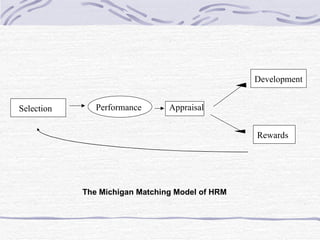
Performance Selection Appraisal Rewards Development The Michigan Matching Model of HRM
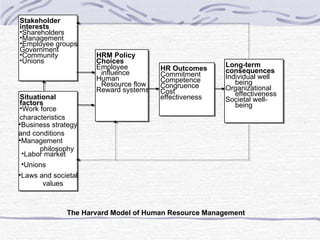
Stakeholder interests Shareholders Management Employee groups Government Community Unions HRM Policy Choices Employee influence Human Resource flow Reward systems HR Outcomes Commitment Competence Congruence Cost effectiveness Long-term consequences Individual well being Organizational effectiveness Societal well- being Situational factors Work force  characteristics Business strategy and conditions Management philosophy Labor market Unions Laws and societal values The Harvard Model of Human Resource Management
International Human  Resource Management
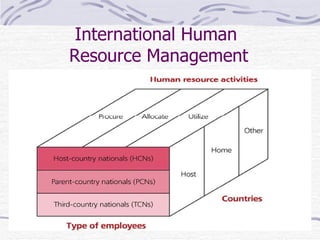
IHRM is interplay among three dimensions:  HR Functions Country of Operations Types of Employees
HR Functions Recruitment & Selection  Training & Development  Performance Appraisal Compensation Industrial & Labor Relations
Types Of Employees Parent country nationals (PCNs) are residents of the international business’s home country who are transferred to one of its foreign operations Host country nationals (HCNs) are residents of the host country, and are the most common choice for mid-level and lower-level jobs.  Employing HCNs is popular because they are already familiar with local laws, culture, and economic conditions Third country nationals (TCNs) are citizens of neither the firm’s home country nor of the host country.  TCNs are most likely to employed in upper-level or technical positions
Who is an expatriate? An employee who is working and temporarily residing in a foreign country or people working and residing in countries other than their native country Some firms prefer to use the term ‘international assignees’ Expatriates are PCNs from the parent country operations, TCNs transferred to either HQ or another subsidiary, and HCNs transferred into the parent country.
International Vs Domestic HRM More functions to perform (taxation  culture orientation  relocation  admin services for expats)  Broader perspective (cater to needs of PCNs,  HCNs & TCNs)  Greater involvement in the personal lives of employees  Greater risk exposure (expat failure,  family problems & terrorism)  More external influences (government regulations,  local ways of doing business,  code of conduct)
 
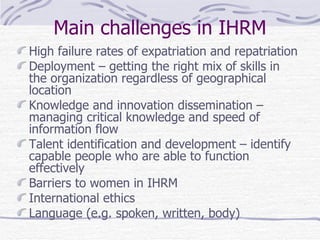
Main challenges in IHRM High failure rates of expatriation and repatriation Deployment – getting the right mix of skills in the organization regardless of geographical location Knowledge and innovation dissemination – managing critical knowledge and speed of information flow Talent identification and development – identify capable people who are able to function effectively Barriers to women in IHRM International ethics Language (e.g. spoken, written, body)
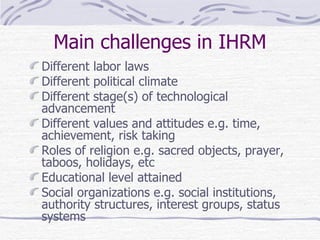
Main challenges in IHRM Different labor laws Different political climate Different stage(s) of technological advancement Different values and attitudes e.g. time, achievement, risk taking Roles of religion e.g. sacred objects, prayer, taboos, holidays, etc Educational level attained Social organizations e.g. social institutions, authority structures, interest groups, status systems
International Recruitment and Selection A selection program for international assignments involves assessing prospective candidates on certain criteria thought to be associated with assignment effectiveness.  In order to have a successful selection program there needs to be a broad range of prospective candidates from which to choose  criteria of effectiveness  and valid procedures for assessing candidates on them.
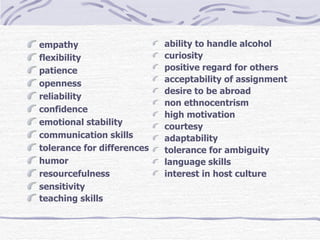
empathy  flexibility  patience  openness  reliability  confidence  emotional stability  communication skills  tolerance for differences  humor  resourcefulness  sensitivity  teaching skills ability to handle alcohol curiosity positive regard for others acceptability of assignment desire to be abroad non ethnocentrism high motivation courtesy adaptability tolerance for ambiguity language skills interest in host culture
International Training and Development   Empirical literature give guarded support to the proposition that cross cultural training has a positive impact on cross cultural effectiveness. Cultural awareness training is not just for the employee going overseas. It has numerous applications domestically that will increase organizational effectiveness. Findings indicate that it should be a regular part of personnel training  especially management development. The realities of a more pluralistic society and international business make this a necessity.
Area studies programs  Culture assimilator programs  Language training programs  Sensitivity training programs  Field experience programs International Training and Development
International Compensation If compensation  is  high  then problems may be encountered on return to head office .  If compensation  is not  adequate  then there may be no incentive to go for the international assignment  given the hardships that are usually involved in doing so.
International Compensation  Expatriation Premium Cost of Living Allowance   Shelter Allowance Home Leave Benefits – Medical, Educational Allowance for children, Flights to Home etc
Repatriation Virtually all repatriated personnel experienced some personal difficulty in reintegrating on return home. The main complaints were loss of status  loss of autonomy  lack of recognition of the value of the experience and lack of career direction.

international mktg1st lec

  • 1.
  • 2.
    Definition Of HumanResources Management
  • 3.
    “ Human” representsthe dimension of HRM which relates to the soft aspects such as commitment of employees through participation and the most important assets being the employees. “ Resource” represents the hard aspects such as the strategy link of HRM and the importance of efficient utilization of employees. “ Management” represents the role of HRM as part of management that implies that it is not only an administrative function that carries out the formulated policies and strategies but also a managerial function that contributes to strategy formulation.
  • 4.
    Responsibilities of HumanResource Management To ensure that the employees of an organization are used in such a way that t he employer obtains the greatest possible benefit from their abilities and that the employees obtain both material and psychological rewards from their work.
  • 5.
    Staffing : identifyingthe job requirements within an organization determining the numbers of people and the skills mix necessary to do these jobs and recruiting selecting and promoting qualified candidates. Retention : rewarding employees for performing their jobs effectively insuring harmonious working relations between employees and managers and maintaining a safe healthy work environment.
  • 6.
    Development : preservingand enhancing employees’ competence in their jobs through improving their knowledge skills abilities and other characteristics. Adjustment : maintain compliance with the organization’s personnel policies and business strategies.
  • 7.
    Performance Selection AppraisalRewards Development The Michigan Matching Model of HRM
  • 8.
    Stakeholder interests ShareholdersManagement Employee groups Government Community Unions HRM Policy Choices Employee influence Human Resource flow Reward systems HR Outcomes Commitment Competence Congruence Cost effectiveness Long-term consequences Individual well being Organizational effectiveness Societal well- being Situational factors Work force characteristics Business strategy and conditions Management philosophy Labor market Unions Laws and societal values The Harvard Model of Human Resource Management
  • 9.
    International Human Resource Management
  • 10.
    IHRM is interplayamong three dimensions: HR Functions Country of Operations Types of Employees
  • 11.
    HR Functions Recruitment& Selection Training & Development Performance Appraisal Compensation Industrial & Labor Relations
  • 12.
    Types Of EmployeesParent country nationals (PCNs) are residents of the international business’s home country who are transferred to one of its foreign operations Host country nationals (HCNs) are residents of the host country, and are the most common choice for mid-level and lower-level jobs. Employing HCNs is popular because they are already familiar with local laws, culture, and economic conditions Third country nationals (TCNs) are citizens of neither the firm’s home country nor of the host country. TCNs are most likely to employed in upper-level or technical positions
  • 13.
    Who is anexpatriate? An employee who is working and temporarily residing in a foreign country or people working and residing in countries other than their native country Some firms prefer to use the term ‘international assignees’ Expatriates are PCNs from the parent country operations, TCNs transferred to either HQ or another subsidiary, and HCNs transferred into the parent country.
  • 14.
    International Vs DomesticHRM More functions to perform (taxation culture orientation relocation admin services for expats) Broader perspective (cater to needs of PCNs, HCNs & TCNs) Greater involvement in the personal lives of employees Greater risk exposure (expat failure, family problems & terrorism) More external influences (government regulations, local ways of doing business, code of conduct)
  • 15.
  • 16.
    Main challenges inIHRM High failure rates of expatriation and repatriation Deployment – getting the right mix of skills in the organization regardless of geographical location Knowledge and innovation dissemination – managing critical knowledge and speed of information flow Talent identification and development – identify capable people who are able to function effectively Barriers to women in IHRM International ethics Language (e.g. spoken, written, body)
  • 17.
    Main challenges inIHRM Different labor laws Different political climate Different stage(s) of technological advancement Different values and attitudes e.g. time, achievement, risk taking Roles of religion e.g. sacred objects, prayer, taboos, holidays, etc Educational level attained Social organizations e.g. social institutions, authority structures, interest groups, status systems
  • 18.
    International Recruitment andSelection A selection program for international assignments involves assessing prospective candidates on certain criteria thought to be associated with assignment effectiveness. In order to have a successful selection program there needs to be a broad range of prospective candidates from which to choose criteria of effectiveness and valid procedures for assessing candidates on them.
  • 19.
    empathy flexibility patience openness reliability confidence emotional stability communication skills tolerance for differences humor resourcefulness sensitivity teaching skills ability to handle alcohol curiosity positive regard for others acceptability of assignment desire to be abroad non ethnocentrism high motivation courtesy adaptability tolerance for ambiguity language skills interest in host culture
  • 20.
    International Training andDevelopment Empirical literature give guarded support to the proposition that cross cultural training has a positive impact on cross cultural effectiveness. Cultural awareness training is not just for the employee going overseas. It has numerous applications domestically that will increase organizational effectiveness. Findings indicate that it should be a regular part of personnel training especially management development. The realities of a more pluralistic society and international business make this a necessity.
  • 21.
    Area studies programs Culture assimilator programs  Language training programs  Sensitivity training programs Field experience programs International Training and Development
  • 22.
    International Compensation Ifcompensation is high then problems may be encountered on return to head office . If compensation is not adequate then there may be no incentive to go for the international assignment given the hardships that are usually involved in doing so.
  • 23.
    International Compensation Expatriation Premium Cost of Living Allowance   Shelter Allowance Home Leave Benefits – Medical, Educational Allowance for children, Flights to Home etc
  • 24.
    Repatriation Virtually allrepatriated personnel experienced some personal difficulty in reintegrating on return home. The main complaints were loss of status loss of autonomy lack of recognition of the value of the experience and lack of career direction.

Editor's Notes

  • #8 Emphasis is placed on how to best match and develop appropriate HRM systems to business strategies. The systems that Formrun et al . (1984) felt to be the most important in achieving this match were selection performance appraisal rewards and development
  • #24 The local managers are aware that their career prospects are limited therefore they are only concerned with the security and stability of only the local operation disregarding the broader goals of the global firm. When the expatriate receives many rewards to convince them to go abroad the local employees feel discriminated against.