































International
HRM
Caleb Joshua
MSW(HR)
Bishop Heber
College, Trichy
Definition
International human resource management
is concerned with the human resource
problems of multi-national firms in foreign
subsidiaries with the unfolding of HR issues
that are associated with the various stages
of the internationalization process


Boxall 1995
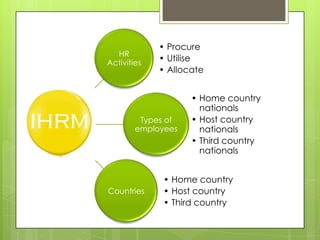
HR
Activities

• Procure
• Utilise
• Allocate

Types of
employees

Countries

• Home country
nationals
• Host country
nationals
• Third country
nationals

• Home country
• Host country
• Third country
IHRM COMPARED WITH DHRM
However the differences between IHRM and
DHRM are more striking than their similarities.
The main difference stems from the
complexity of operating countries, having
different employees.
Factors that Differentiate
 More

HR functions and activities
 Need for broader perspective
 More involvement in employee’s personal
lives
 Changes in emphasis as the work force mix
of expatriates and locals vary
 Risk exposure
 Broader external influences
More HR Activities
 Human

resource planning
 Employee hiring
 Training and development
 Compensation
 Performance management
 Industrial relations
Human Resource Planning
 Difficulty

in implanting HR procedures in
host countries.
 Difficulty in tying strategic business planning
to HR planning and vice versa.
 Providing developmental opportunities for
international managers.
Employee Hiring
 Ascertain

cultural-fit with that of the global
organization.
 Ethnocentric, polycentric or geocentric
approaches to staffing.
 Selection of expatriates.
 Coping with expatriate failure.
 Managing repatriation processes.
 Managing female expatriates.
Training and Development
 Emphasis

on cultural training
 Language training
 Training in
global etiquette and the
nuances of the virtual workplace culture
Compensation
 In

Devising an appropriate strategy to
compensate expatriates
 Minimizing discrepancies in pay between
parent, host and third country nationals
Performance Management
 Constraints

while operating in host countries
need to be considered
 Physical distance, time differences and cost
of reporting system add to the complexity
 Identification
of
raters
to
evaluate
subsidiary performance
Industrial Relations
 Who

should handle industrial relation
problems in a subsidiary ?
 What should be the attitude of a parent
company towards the unions in a
subsidiary ?
 What
should be union tactics in
Subsidiaries ?
Need for Broader Perspective
 While

dealing with pay issues
 Family
 Constitutional policies
 culture
Involvement in Employee’s
personal lives
Its necessary for selection, training and
effective management of both parentcountry and third-country nationals. The HR
departments needs to ensure that the
expatriate employee understands housing
arrangements, health care, and all aspects of
remuneration provided for the foreign
assignments. In most companies there are
separate ‘International Human Resource
Service’ for this purpose to handle
banking,
investments,
rentals
and
repatriation.
Risk Exposure
In IHRM there are many risks that are
terrorism, kidnapping and murders.
 There is the risk of expatriate failure.
 The failure of an expatriate can have
disastrous results.
 There are also personal setbacks for
employees who fail even though they had
been viewed as competent managers
within the domestic organizations.

External Influences
Policy
actions
of
national
governments, such as expropriation and
changes in exchange rated.
 Responses of competitors in the host
market, and
 Host country stipulations on staff selection.

Growing interest in IHRM
 Globalization

of business leading to
mobilization of resources.
 Effective
management
of
human
resources.
 To minimize the risk of underperformance or
failure in overseas assignments.
 Implementation of international strategies
by competent managerial personnel to
man overseas assignments.
 Movement

from traditional hierarchical
organizational structures towards the
network organization.
 Plays significant role in implementing and
control of strategies in an international
business.
Managing
International Human Resource
Activities
Basic Steps in IHRM
Human Resource Planning
Recruitment and selection
Training and Development
Performance Management
Remuneration
Repatriation
Employee Relations
Multi-Cultural Management
HRP







Identifying top-management potential early.
Identifying critical success factors for future
international managers.
Providing developmental opportunities.
Tracking and maintaining commitment to
individuals in international career paths.
Tying strategic business planning to HRP and
vice-versa.
Dealing with multiple business units while
attempting to achieve globally and regionally
focused strategies.
Recruitment and Selection
 Right

number of people for right type.
 Must not select people just with skills but
also employees who can mix with the
organization's culture.
 Should hire employees whose styles, beliefs
and value systems are consistent with those
of the firm.
Approaches to Staffing
Ethnocentric policy
 Key

management positions filled by parent
country nationals

 Advantages:
 Overcomes lack of qualified managers in
host nation
 Unified culture
 Helps transfer core competencies
 Disadvantages:
 Produces resentment in host country
 Can lead to cultural myopia
Polycentric policy




Host-country nationals manage subsidiaries
Parent company nationals hold key headquarter
positions
Best suited to multi-domestic businesses

 Advantages:




Alleviates cultural myopia.
Inexpensive to implement
Helps transfer core competencies

 Disadvantages:



Limits opportunity to gain experience of hostcountry nationals outside their own country.
Can create gap between home-and host-country
operations
Geocentric policy


Seek best people, regardless of nationality





Best suited to Global and trans-national
businesses
Advantages:







not always possible

Enables the firm to make best use of its human
resources
Equips executives to work in a number of cultures
Helps build strong unifying culture and informal
management network

Disadvantages:





National immigration policies may limit implementation
Expensive to implement due to training and relocation
Compensation structure can be a problem.
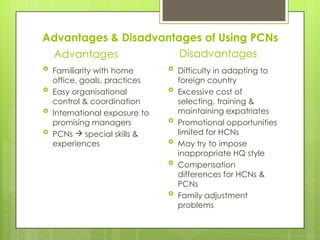
Advantages & Disadvantages of Using PCNs
Disadvantages
Advantages





Familiarity with home
office, goals, practices
Easy organisational
control & coordination
International exposure to
promising managers
PCNs  special skills &
experiences










Difficulty in adapting to
foreign country
Excessive cost of
selecting, training &
maintaining expatriates
Promotional opportunities
limited for HCNs
May try to impose
inappropriate HQ style
Compensation
differences for HCNs &
PCNs
Family adjustment
problems
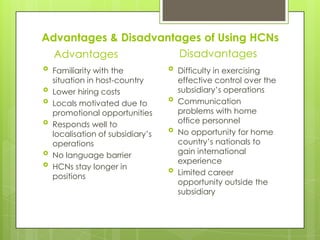
Advantages & Disadvantages of Using HCNs
Disadvantages
Advantages








Familiarity with the
situation in host-country
Lower hiring costs
Locals motivated due to
promotional opportunities
Responds well to
localisation of subsidiary’s
operations
No language barrier
HCNs stay longer in
positions









Difficulty in exercising
effective control over the
subsidiary’s operations
Communication
problems with home
office personnel
No opportunity for home
country’s nationals to
gain international
experience
Limited career
opportunity outside the
subsidiary
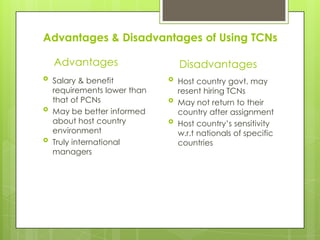
Advantages & Disadvantages of Using TCNs
Advantages






Salary & benefit
requirements lower than
that of PCNs
May be better informed
about host country
environment
Truly international
managers

Disadvantages




Host country govt. may
resent hiring TCNs
May not return to their
country after assignment
Host country’s sensitivity
w.r.t nationals of specific
countries
Expatriate Assignment Life Cycle
Determining the
need for an
expatriate

Crisis &
Adjustment

Reassignment
Abroad
Repatriation
& Adjustment

Departure

Selection
Process

Pre-assignment
training

Post-arrival
Orientation &
Training

Crisis &
Failure
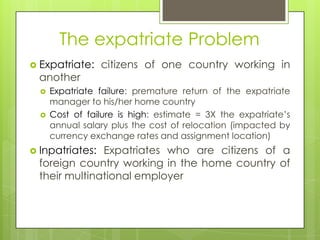
The expatriate Problem
 Expatriate:

another



citizens of one country working in

Expatriate failure: premature return of the expatriate
manager to his/her home country
Cost of failure is high: estimate = 3X the expatriate’s
annual salary plus the cost of relocation (impacted by
currency exchange rates and assignment location)

 Inpatriates:

Expatriates who are citizens of a
foreign country working in the home country of
their multinational employer
Expatriate Failure
Premature return of expatriates to their home
country
 Reasons






Inability to adjust to host country culture leads
to culture shock
Personal & emotional problems
Difficulties with the environment
Inability to cope with larger international
responsibilities
Other family reasons
Expatriate selection





Reduce expatriate failure rates by improving
selection procedures
An executive’s domestic performance does not
(necessarily) equate his/her overseas performance
potential
Employees need to be selected not solely on
technical expertise but also on cross-cultural
fluency
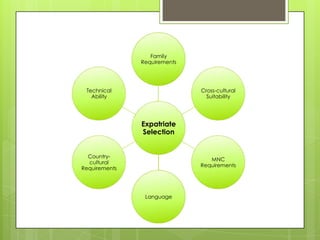
Family
Requirements

Technical
Ability

Cross-cultural
Suitability

Expatriate
Selection
Countrycultural
Requirements

MNC
Requirements

Language
Training & Development
Cross Cultural
Training

Language
Training

Practical
Training

Management
Development
& Strategy

35
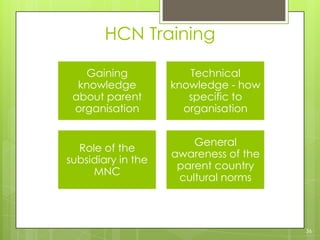
HCN Training
Gaining
knowledge
about parent
organisation

Technical
knowledge - how
specific to
organisation

Role of the
subsidiary in the
MNC

General
awareness of the
parent country
cultural norms

36
Expatriate Performance Management
Linkage to
organisational
strategy

Setting individual
performance
goals

Identifying
variables
impacting
performance

Providing
opportunities for
improvement

Providing regular
feedback on
progress towards
goals

Appraising the
performance

Linking results
with rewards

37
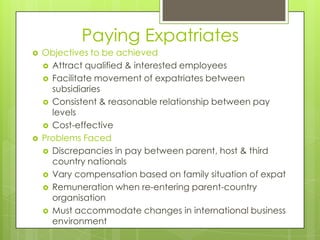
Paying Expatriates




Objectives to be achieved
 Attract qualified & interested employees
 Facilitate movement of expatriates between
subsidiaries
 Consistent & reasonable relationship between pay
levels
 Cost-effective
Problems Faced
 Discrepancies in pay between parent, host & third
country nationals
 Vary compensation based on family situation of expat
 Remuneration when re-entering parent-country
organisation
 Must accommodate changes in international business
environment
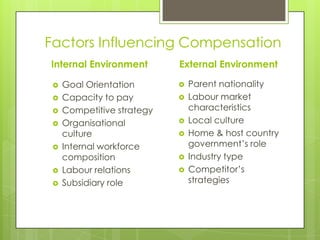
Factors Influencing Compensation
Internal Environment








Goal Orientation
Capacity to pay
Competitive strategy
Organisational
culture
Internal workforce
composition
Labour relations
Subsidiary role

External Environment








Parent nationality
Labour market
characteristics
Local culture
Home & host country
government’s role
Industry type
Competitor’s
strategies
Repatriation
 The

activity of bringing the expat back to
the home country
 Can cause re-entry shock or reverse culture
shock
 Reasons





Posting period over
Children’s education
Not happy with overseas assignment
Failure to do a good job
Repatriation Process
Preparation

Physical
Relocation

Transition

Re-adjustment
Employee Relations
 Delegated

to foreign subsidiaries
 Labour relations centralised when intersubsidiary production integration is present
 Depends on nationality of ownership of
subsidiary – compare US and Europeans
 When
a
well
established
firm
is
acquired, the autonomy is given to the Host
 Parent country has more control during
initial stage
 More intervention when subsidiary is of
strategic importance
Multiculturalism





Culture – customs, beliefs, norms & values that
guide behaviour of people in a society or
passed on from one generation to the next
Multiculturalism – people from many cultures
(countries) interact regularly
Benefits






Greater creativity & innovation
Sensitivity in dealing with foreign customers
Possibilities of hiring best talent
‘Super organisational culture’
Universally acceptable HR policies & practices
Power Distance

Uncertainty
avoidance

Hofstede’s Cultural
Dimensions

Individualism

Masculinity

44
Books and lectures
gives u a start,
experience and
endurance gives u
wisdom
but
how u act is what u
have
Understood
- Caleb Joshua

THANK YOU

International HRM by Caleb Joshua, MSW(HR), Bishop Heber College, Trichy.

  • 1.
  • 2.
    Definition International human resourcemanagement is concerned with the human resource problems of multi-national firms in foreign subsidiaries with the unfolding of HR issues that are associated with the various stages of the internationalization process  Boxall 1995
  • 3.
    HR Activities • Procure • Utilise •Allocate Types of employees Countries • Home country nationals • Host country nationals • Third country nationals • Home country • Host country • Third country
  • 4.
    IHRM COMPARED WITHDHRM However the differences between IHRM and DHRM are more striking than their similarities. The main difference stems from the complexity of operating countries, having different employees.
  • 5.
    Factors that Differentiate More HR functions and activities  Need for broader perspective  More involvement in employee’s personal lives  Changes in emphasis as the work force mix of expatriates and locals vary  Risk exposure  Broader external influences
  • 6.
    More HR Activities Human resource planning  Employee hiring  Training and development  Compensation  Performance management  Industrial relations
  • 7.
    Human Resource Planning Difficulty in implanting HR procedures in host countries.  Difficulty in tying strategic business planning to HR planning and vice versa.  Providing developmental opportunities for international managers.
  • 8.
    Employee Hiring  Ascertain cultural-fitwith that of the global organization.  Ethnocentric, polycentric or geocentric approaches to staffing.  Selection of expatriates.  Coping with expatriate failure.  Managing repatriation processes.  Managing female expatriates.
  • 9.
    Training and Development Emphasis on cultural training  Language training  Training in global etiquette and the nuances of the virtual workplace culture
  • 10.
    Compensation  In Devising anappropriate strategy to compensate expatriates  Minimizing discrepancies in pay between parent, host and third country nationals
  • 11.
    Performance Management  Constraints whileoperating in host countries need to be considered  Physical distance, time differences and cost of reporting system add to the complexity  Identification of raters to evaluate subsidiary performance
  • 12.
    Industrial Relations  Who shouldhandle industrial relation problems in a subsidiary ?  What should be the attitude of a parent company towards the unions in a subsidiary ?  What should be union tactics in Subsidiaries ?
  • 13.
    Need for BroaderPerspective  While dealing with pay issues  Family  Constitutional policies  culture
  • 14.
    Involvement in Employee’s personallives Its necessary for selection, training and effective management of both parentcountry and third-country nationals. The HR departments needs to ensure that the expatriate employee understands housing arrangements, health care, and all aspects of remuneration provided for the foreign assignments. In most companies there are separate ‘International Human Resource Service’ for this purpose to handle banking, investments, rentals and repatriation.
  • 15.
    Risk Exposure In IHRMthere are many risks that are terrorism, kidnapping and murders.  There is the risk of expatriate failure.  The failure of an expatriate can have disastrous results.  There are also personal setbacks for employees who fail even though they had been viewed as competent managers within the domestic organizations. 
  • 16.
    External Influences Policy actions of national governments, suchas expropriation and changes in exchange rated.  Responses of competitors in the host market, and  Host country stipulations on staff selection. 
  • 17.
    Growing interest inIHRM  Globalization of business leading to mobilization of resources.  Effective management of human resources.  To minimize the risk of underperformance or failure in overseas assignments.  Implementation of international strategies by competent managerial personnel to man overseas assignments.
  • 18.
     Movement from traditionalhierarchical organizational structures towards the network organization.  Plays significant role in implementing and control of strategies in an international business.
  • 19.
  • 20.
    Basic Steps inIHRM Human Resource Planning Recruitment and selection Training and Development Performance Management Remuneration Repatriation Employee Relations Multi-Cultural Management
  • 21.
    HRP       Identifying top-management potentialearly. Identifying critical success factors for future international managers. Providing developmental opportunities. Tracking and maintaining commitment to individuals in international career paths. Tying strategic business planning to HRP and vice-versa. Dealing with multiple business units while attempting to achieve globally and regionally focused strategies.
  • 22.
    Recruitment and Selection Right number of people for right type.  Must not select people just with skills but also employees who can mix with the organization's culture.  Should hire employees whose styles, beliefs and value systems are consistent with those of the firm.
  • 23.
  • 24.
    Ethnocentric policy  Key managementpositions filled by parent country nationals  Advantages:  Overcomes lack of qualified managers in host nation  Unified culture  Helps transfer core competencies  Disadvantages:  Produces resentment in host country  Can lead to cultural myopia
  • 25.
    Polycentric policy    Host-country nationalsmanage subsidiaries Parent company nationals hold key headquarter positions Best suited to multi-domestic businesses  Advantages:    Alleviates cultural myopia. Inexpensive to implement Helps transfer core competencies  Disadvantages:   Limits opportunity to gain experience of hostcountry nationals outside their own country. Can create gap between home-and host-country operations
  • 26.
    Geocentric policy  Seek bestpeople, regardless of nationality    Best suited to Global and trans-national businesses Advantages:     not always possible Enables the firm to make best use of its human resources Equips executives to work in a number of cultures Helps build strong unifying culture and informal management network Disadvantages:    National immigration policies may limit implementation Expensive to implement due to training and relocation Compensation structure can be a problem.
  • 27.
    Advantages & Disadvantagesof Using PCNs Disadvantages Advantages     Familiarity with home office, goals, practices Easy organisational control & coordination International exposure to promising managers PCNs  special skills & experiences       Difficulty in adapting to foreign country Excessive cost of selecting, training & maintaining expatriates Promotional opportunities limited for HCNs May try to impose inappropriate HQ style Compensation differences for HCNs & PCNs Family adjustment problems
  • 28.
    Advantages & Disadvantagesof Using HCNs Disadvantages Advantages       Familiarity with the situation in host-country Lower hiring costs Locals motivated due to promotional opportunities Responds well to localisation of subsidiary’s operations No language barrier HCNs stay longer in positions     Difficulty in exercising effective control over the subsidiary’s operations Communication problems with home office personnel No opportunity for home country’s nationals to gain international experience Limited career opportunity outside the subsidiary
  • 29.
    Advantages & Disadvantagesof Using TCNs Advantages    Salary & benefit requirements lower than that of PCNs May be better informed about host country environment Truly international managers Disadvantages    Host country govt. may resent hiring TCNs May not return to their country after assignment Host country’s sensitivity w.r.t nationals of specific countries
  • 30.
    Expatriate Assignment LifeCycle Determining the need for an expatriate Crisis & Adjustment Reassignment Abroad Repatriation & Adjustment Departure Selection Process Pre-assignment training Post-arrival Orientation & Training Crisis & Failure
  • 31.
    The expatriate Problem Expatriate: another   citizens of one country working in Expatriate failure: premature return of the expatriate manager to his/her home country Cost of failure is high: estimate = 3X the expatriate’s annual salary plus the cost of relocation (impacted by currency exchange rates and assignment location)  Inpatriates: Expatriates who are citizens of a foreign country working in the home country of their multinational employer
  • 32.
    Expatriate Failure Premature returnof expatriates to their home country  Reasons      Inability to adjust to host country culture leads to culture shock Personal & emotional problems Difficulties with the environment Inability to cope with larger international responsibilities Other family reasons
  • 33.
    Expatriate selection    Reduce expatriatefailure rates by improving selection procedures An executive’s domestic performance does not (necessarily) equate his/her overseas performance potential Employees need to be selected not solely on technical expertise but also on cross-cultural fluency
  • 34.
  • 35.
    Training & Development CrossCultural Training Language Training Practical Training Management Development & Strategy 35
  • 36.
    HCN Training Gaining knowledge about parent organisation Technical knowledge- how specific to organisation Role of the subsidiary in the MNC General awareness of the parent country cultural norms 36
  • 37.
    Expatriate Performance Management Linkageto organisational strategy Setting individual performance goals Identifying variables impacting performance Providing opportunities for improvement Providing regular feedback on progress towards goals Appraising the performance Linking results with rewards 37
  • 38.
    Paying Expatriates   Objectives tobe achieved  Attract qualified & interested employees  Facilitate movement of expatriates between subsidiaries  Consistent & reasonable relationship between pay levels  Cost-effective Problems Faced  Discrepancies in pay between parent, host & third country nationals  Vary compensation based on family situation of expat  Remuneration when re-entering parent-country organisation  Must accommodate changes in international business environment
  • 39.
    Factors Influencing Compensation InternalEnvironment        Goal Orientation Capacity to pay Competitive strategy Organisational culture Internal workforce composition Labour relations Subsidiary role External Environment       Parent nationality Labour market characteristics Local culture Home & host country government’s role Industry type Competitor’s strategies
  • 40.
    Repatriation  The activity ofbringing the expat back to the home country  Can cause re-entry shock or reverse culture shock  Reasons     Posting period over Children’s education Not happy with overseas assignment Failure to do a good job
  • 41.
  • 42.
    Employee Relations  Delegated toforeign subsidiaries  Labour relations centralised when intersubsidiary production integration is present  Depends on nationality of ownership of subsidiary – compare US and Europeans  When a well established firm is acquired, the autonomy is given to the Host  Parent country has more control during initial stage  More intervention when subsidiary is of strategic importance
  • 43.
    Multiculturalism    Culture – customs,beliefs, norms & values that guide behaviour of people in a society or passed on from one generation to the next Multiculturalism – people from many cultures (countries) interact regularly Benefits      Greater creativity & innovation Sensitivity in dealing with foreign customers Possibilities of hiring best talent ‘Super organisational culture’ Universally acceptable HR policies & practices
  • 44.
  • 45.
    Books and lectures givesu a start, experience and endurance gives u wisdom but how u act is what u have Understood - Caleb Joshua THANK YOU