



Module 4
Evaluation of Innovation
Effectiveness Evaluation
 Is Measuring the extent to which
targets are being met, and detecting
the factors that hinder r facilitate their
realization
 Involves establishing cause-effect
relationship about the extent to which
a particular policy produces desired
outcome.
Integration Of risks
 Combining different departments of
any organisation to analyse the risks
involved and eliminate the risk at the
initial stage
 Ex., If Raw material used is found to
be toxic, then keeping purchase and
R&D team in loop to find an alternative
raw material will help, even the
marketing team might help.
Integration Of risks
 Companies have to integrate customers into the
innovation process to improve overall innovation
capabilities and reduce discontinuous innovation's
market risk
 Customer integration into NPD process helps to
identify customer needs better and also manage the
risks better
 Once customer needs are identified, information
dissemination across the functional disciplines
becomes a very important task for the organisation
 Discontinuous innovations pose more risk because
they involve more uncertainty
Issues in Innovation
 Benefits and risks from innovation
 Public perception of benefits and
risks
 Public opinion, prejudice and new
technologies
 Communication and education
 Science and Scientific uncertainty
Issues in Innovation
 Risk-based vs. Hazard based policy
and legislation
 Risk assessment
 Precautionary principle
 Proportionality principle
 Integration of risk and benefit
Conceptual approaches for
risk
 Risk is part of any human effort.
 The word Risk is derived from Italian
word “RISICARE”, which means “to
dare”.
 The risk is not an option, but we are
permanently exposed to risk in
everyday life, what is really important
is that each time, to gain control over it
Features of Risk
 Possibility of obtaining favourable or unfavourable results in a future
action expressed in terms of probabilities
 Possible future event whose production could cause some losses
 It is threat that an event or action to affect in a negative manner the
capacity of an organization to achieve its planned goals
 Some concepts about risk are focussed only on negative events,
while others take into account all variables, both threats and
opportunities
 Achieving the expected result of an activity is under the influence of
random factors that accompany it in all stages of its development
Features of Risk
 It is a problem which has not yet occurred but can
occur in the future, threatening the achievement of
agreed outcomes.
 It is uncertainty in obtaining expected results and
should be treated as a combination of probability and
impact
 The probability of risk occurrence and its impact on
the results contribute to establish the risk value
 It is permanent reality, an inherent phenomenon that
accomplishes all activities and actions of an
organization
Integrated Approach to risk
 Integrated risk management process is designed and
set by managment and implemented by staff within the
organization
 The process is not linear
 COSO – Committee of Sponsoring Organization of the
Treadway Commission (COSO) is a joint initiative of
the five private sector organizations listed on the left
and is dedicated to providing thought leadership
through the development of frameworks and guidance
on enterprise risk management, internal control and
fraud deterrence
Factors influencing economic
effectiveness
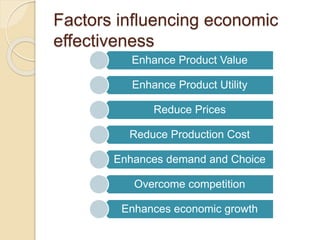
Enhance Product Value
Enhance Product Utility
Reduce Prices
Reduce Production Cost
Enhances demand and Choice
Overcome competition
Enhances economic growth
Post Implementation Analysis Of
Innovation Projects
 PIR – Post Implementation Review
◦ Analysis of Projects post implementation
and simulation.
 Important Questions to Answer in PIR
◦ Did the project fully solve the problem that
it was designed to address?
◦ Can we take things further and deliver
even bigger benefits
◦ What lessons did we learn that we can
apply to bigger future projects?
PIR
When to review
◦ When the members of the project team
remember the most.
◦ shortly after the project has been delivered
◦ when most of the problems have been ironed-
out.
Tips to conduct PIR
◦ Ask for openness
◦ Be objective
◦ Document Success
◦ Look for hindsight
◦ Be future-focussed
◦ Look at both positives and negatives
PIR - What to review
 Gap Analysis
◦ Review the project charter to evaluate how
closely the project results match the original
objectives
◦ Review the expected deliverables and ensure
either that these have been delivered to an
acceptable level of quality or that an
acceptable substitute is in place
◦ If there are any gaps, how can those be
closed
PIR - What to review
 Project Goals
◦ Is deliverable functioning as expected
◦ Are error rates low enough, and is it fit for
purpose
◦ Is it functioning well, n in a way that will
adjust to future operating demands
◦ Are users adequate trained, Skilled and
supported
◦ Are necessary controls and systems in place.
◦ Routine activities needed to support the
project’s success
◦ How does end result compare with the
original project plan, in terms of quality,
schedule and budget?
PIR - What to review
 Stakeholders
◦ Were the end users met
◦ Is the project sponsor satisfied
◦ What are the effects on the clients or end
user
◦ How can dissatisfaction be addressed?
PIR - What to review
 Project’s Costs and Benefits
◦ Final costs
◦ Cost to operate the solution
◦ Cost to support the solution
◦ Compare costs with the benefits
 Report Findings and Suggestions
◦ What have you learned from this review
◦ Do you need corrective activity to get benefits you
want
◦ What lessons have you learned that need to be
carried forward to future projects
◦ Does this project naturally lead on to future projects,
which will build on the success and benefits already
achieved
PIR – How to review
 Define the scope of the review
beforehand
 Review key documents
 Consider using independent reviewers
 Use appropriate data collections
 Deliver appropriate reports
 Present recommendations
Phases of Project
Management
 Project strategy and Business case
 Preparation
 Design
 Development and testing
 Training and Business readiness
 Support and Benefits realization
 Project close
 Preparation Phase:
◦ Complete high level WBS – Work
Breakdown Structure
◦ Determine the project’s high level plan at
the milestone level
◦ Identify and recruit project members
◦ Produce the Project Initiation Document
◦ Select third parties to use in the early
project phases
◦ Put actions in place to secure key
resources
 Training and Business readiness
Phase
◦ Train users
◦ Put in place ongoing project
◦ Transfer data to new systems
◦ Identify what’s required for the project to
be effective from the launch date and
ensure that you adequately address this.
 Project Close Phase
◦ Complete and store documentation
◦ Carry out a PIR
◦ Use your business connections to
reassign project team members to
appropriate roles in the organization
Project Management
Processes
 Phase Management
 Planning
 Control
 Team Management
 Communication
 Procurement
 Integration
Intellectual Property in
Innovation
 IPR
◦ Are the rights given to persons over the
creations of their minds
 Importance of IPR
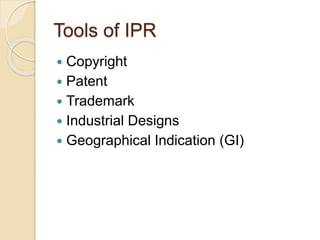
Tools of IPR
 Copyright
 Patent
 Trademark
 Industrial Designs
 Geographical Indication (GI)
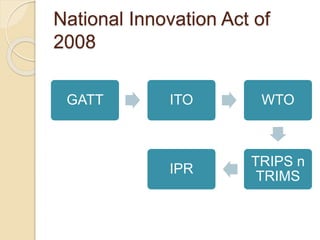
National Innovation Act of
2008
GATT ITO WTO
TRIPS n
TRIMS
IPR
Innovation Management for BU syllabus

Innovation Management for BU syllabus

  • 1.
  • 2.
    Effectiveness Evaluation  IsMeasuring the extent to which targets are being met, and detecting the factors that hinder r facilitate their realization  Involves establishing cause-effect relationship about the extent to which a particular policy produces desired outcome.
  • 3.
    Integration Of risks Combining different departments of any organisation to analyse the risks involved and eliminate the risk at the initial stage  Ex., If Raw material used is found to be toxic, then keeping purchase and R&D team in loop to find an alternative raw material will help, even the marketing team might help.
  • 4.
    Integration Of risks Companies have to integrate customers into the innovation process to improve overall innovation capabilities and reduce discontinuous innovation's market risk  Customer integration into NPD process helps to identify customer needs better and also manage the risks better  Once customer needs are identified, information dissemination across the functional disciplines becomes a very important task for the organisation  Discontinuous innovations pose more risk because they involve more uncertainty
  • 5.
    Issues in Innovation Benefits and risks from innovation  Public perception of benefits and risks  Public opinion, prejudice and new technologies  Communication and education  Science and Scientific uncertainty
  • 6.
    Issues in Innovation Risk-based vs. Hazard based policy and legislation  Risk assessment  Precautionary principle  Proportionality principle  Integration of risk and benefit
  • 7.
    Conceptual approaches for risk Risk is part of any human effort.  The word Risk is derived from Italian word “RISICARE”, which means “to dare”.  The risk is not an option, but we are permanently exposed to risk in everyday life, what is really important is that each time, to gain control over it
  • 8.
    Features of Risk Possibility of obtaining favourable or unfavourable results in a future action expressed in terms of probabilities  Possible future event whose production could cause some losses  It is threat that an event or action to affect in a negative manner the capacity of an organization to achieve its planned goals  Some concepts about risk are focussed only on negative events, while others take into account all variables, both threats and opportunities  Achieving the expected result of an activity is under the influence of random factors that accompany it in all stages of its development
  • 9.
    Features of Risk It is a problem which has not yet occurred but can occur in the future, threatening the achievement of agreed outcomes.  It is uncertainty in obtaining expected results and should be treated as a combination of probability and impact  The probability of risk occurrence and its impact on the results contribute to establish the risk value  It is permanent reality, an inherent phenomenon that accomplishes all activities and actions of an organization
  • 10.
    Integrated Approach torisk  Integrated risk management process is designed and set by managment and implemented by staff within the organization  The process is not linear  COSO – Committee of Sponsoring Organization of the Treadway Commission (COSO) is a joint initiative of the five private sector organizations listed on the left and is dedicated to providing thought leadership through the development of frameworks and guidance on enterprise risk management, internal control and fraud deterrence
  • 11.
    Factors influencing economic effectiveness EnhanceProduct Value Enhance Product Utility Reduce Prices Reduce Production Cost Enhances demand and Choice Overcome competition Enhances economic growth
  • 12.
    Post Implementation AnalysisOf Innovation Projects  PIR – Post Implementation Review ◦ Analysis of Projects post implementation and simulation.  Important Questions to Answer in PIR ◦ Did the project fully solve the problem that it was designed to address? ◦ Can we take things further and deliver even bigger benefits ◦ What lessons did we learn that we can apply to bigger future projects?
  • 13.
    PIR When to review ◦When the members of the project team remember the most. ◦ shortly after the project has been delivered ◦ when most of the problems have been ironed- out. Tips to conduct PIR ◦ Ask for openness ◦ Be objective ◦ Document Success ◦ Look for hindsight ◦ Be future-focussed ◦ Look at both positives and negatives
  • 14.
    PIR - Whatto review  Gap Analysis ◦ Review the project charter to evaluate how closely the project results match the original objectives ◦ Review the expected deliverables and ensure either that these have been delivered to an acceptable level of quality or that an acceptable substitute is in place ◦ If there are any gaps, how can those be closed
  • 15.
    PIR - Whatto review  Project Goals ◦ Is deliverable functioning as expected ◦ Are error rates low enough, and is it fit for purpose ◦ Is it functioning well, n in a way that will adjust to future operating demands ◦ Are users adequate trained, Skilled and supported ◦ Are necessary controls and systems in place. ◦ Routine activities needed to support the project’s success ◦ How does end result compare with the original project plan, in terms of quality, schedule and budget?
  • 16.
    PIR - Whatto review  Stakeholders ◦ Were the end users met ◦ Is the project sponsor satisfied ◦ What are the effects on the clients or end user ◦ How can dissatisfaction be addressed?
  • 17.
    PIR - Whatto review  Project’s Costs and Benefits ◦ Final costs ◦ Cost to operate the solution ◦ Cost to support the solution ◦ Compare costs with the benefits  Report Findings and Suggestions ◦ What have you learned from this review ◦ Do you need corrective activity to get benefits you want ◦ What lessons have you learned that need to be carried forward to future projects ◦ Does this project naturally lead on to future projects, which will build on the success and benefits already achieved
  • 18.
    PIR – Howto review  Define the scope of the review beforehand  Review key documents  Consider using independent reviewers  Use appropriate data collections  Deliver appropriate reports  Present recommendations
  • 19.
    Phases of Project Management Project strategy and Business case  Preparation  Design  Development and testing  Training and Business readiness  Support and Benefits realization  Project close
  • 20.
     Preparation Phase: ◦Complete high level WBS – Work Breakdown Structure ◦ Determine the project’s high level plan at the milestone level ◦ Identify and recruit project members ◦ Produce the Project Initiation Document ◦ Select third parties to use in the early project phases ◦ Put actions in place to secure key resources
  • 21.
     Training andBusiness readiness Phase ◦ Train users ◦ Put in place ongoing project ◦ Transfer data to new systems ◦ Identify what’s required for the project to be effective from the launch date and ensure that you adequately address this.
  • 22.
     Project ClosePhase ◦ Complete and store documentation ◦ Carry out a PIR ◦ Use your business connections to reassign project team members to appropriate roles in the organization
  • 23.
    Project Management Processes  PhaseManagement  Planning  Control  Team Management  Communication  Procurement  Integration
  • 24.
    Intellectual Property in Innovation IPR ◦ Are the rights given to persons over the creations of their minds  Importance of IPR
  • 25.
    Tools of IPR Copyright  Patent  Trademark  Industrial Designs  Geographical Indication (GI)
  • 26.
    National Innovation Actof 2008 GATT ITO WTO TRIPS n TRIMS IPR