Global Human Resource
Management
Dr. G C Mohanta, BE(Mech), MSc(Engg), MBA, PhD(Mgt)
Professor
Al-Qurmoshi Institute of Business Management,
Hyderabad - 500005
1
Global Human Resource Management
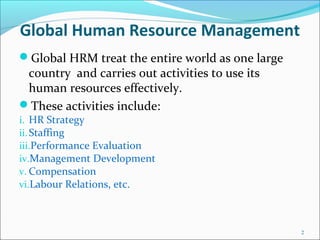
Global HRM treat the entire world as one large
country and carries out activities to use its
human resources effectively.
These activities include:
i. HR Strategy
ii.Staffing
iii.Performance Evaluation
iv.Management Development
v. Compensation
vi.Labour Relations, etc.
2
Ch 1 3
Staffing Policy
Staffing policy is concerned with the selection of
employees for particular jobs.
i. Selecting individuals who have the skill to do a
particular job.
ii. Tool for developing and promoting the desired
corporate culture of the firm.
Ch 1 4
Types of staffing policies
There are three types of staffing policies:
i. Ethnocentric approach
ii. Polycentric approach
iii. Geocentric approach
Ch 1 5
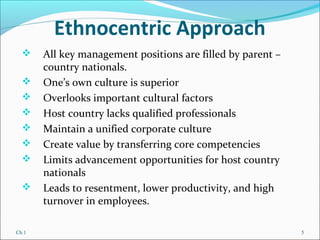
Ethnocentric Approach
 All key management positions are filled by parent –
country nationals.
 One’s own culture is superior
 Overlooks important cultural factors
 Host country lacks qualified professionals
 Maintain a unified corporate culture
 Create value by transferring core competencies
 Limits advancement opportunities for host country
nationals
 Leads to resentment, lower productivity, and high
turnover in employees.
Ch 1 6
Polycentric Approach
 Decentralized control
 Business Units in different countries have autonomy
from home office, like a local Co.
 No standard forms or procedures
 Recruits host country nationals to manage subsidiaries,
while parent country nationals occupy key positions at
corporate HQ.
 Firm is less likely to suffer from cultural myopia.
 Less expensive to implement
 Host country nationals have limited opportunities to
gain experience outside their own countries
 Gap due to language barriers, cultural differences may
isolate corporate HQ from foreign subsidieries.
Ch 1 7
Geocentric Approach
 It seeks the best people for key jobs, throughout the
organization, regardless of nationality.
 Hybrid of Ethnocentric and Polycentric approach
 Based on informed knowledge of home and host
countries.
 Enables firms to make best use of its HR
 Helps the firm to build a cadre of international
executives, who feel at home working in no. of
countries.
 Helps building a strong unifying corporate culture and
informal management network.
 Reduces cultural myopia
 Enhance local responsiveness
Ch 1 8
Expatriate & Inpatriate Managers
 Expatriates are citizens of one country, who are
working in another country.
 Inpatriates are citizens of a foreign country,
working in the home country of the multinational
employer. (e.g., Citizen of India, who moves to U.S
to work for Microsoft)
Ch 1 9
Expatriate selection
Four dimensions that predict success in a foreign
posting:
 Self orientation – self esteem, self confidence, mental well
being, adapt their interest in food, sports, music and
hobbies.
 Others orientation – ability to interact with host country’s
nationals, relationship development and willingness to
communicate by learning local language.
 Perceptual ability – to understand the particular
behaviour of people in host countries, empathise.
 Cultural toughness – relationship between country of
assignment and how well an expatriate adjusts
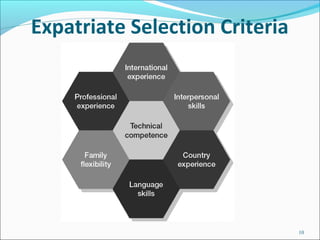
Expatriate Selection Criteria
10
Ch 1 11
Training & Management Development
After selection, the next step is training the manager to do
the specific job.
 MDP is a broader concept, it is intended to develop a
manager’s skills over his career in the firm, e.g., sending
managers on various foreign postings over years to build
his cross cultural sensitivity and experience.
To enhance management and leadership skills of
executives.
MDP has a strategic purpose, and helps reinforce desired
culture of the firm by creating an informal network.
Ch 1 12
Types of Training
i. Cultural training – understanding the culture of
host country, enhancing effectiveness,
familiarization trip before formal transfer.
ii. Language training – manager’s ability to
interact, help build rapport and improve
manager’s effectiveness.
iii. Practical training – adjust to day to day life in
host country, establish a routine, successful
adaptation, support network of friends
Management Development &
Strategy
Development programs designed to increase the
overall skill levels of managers through:
On going management education
Rotation of managers through a number of jobs within
the firm to give broad range of experiences
Used as a strategic tool to build a strong unifying
culture and informal management network
13
Ch 1 14
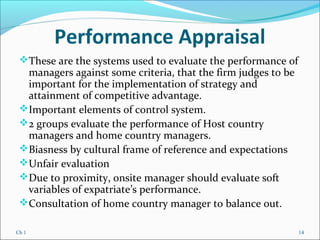
Performance Appraisal
These are the systems used to evaluate the performance of
managers against some criteria, that the firm judges to be
important for the implementation of strategy and
attainment of competitive advantage.
Important elements of control system.
2 groups evaluate the performance of Host country
managers and home country managers.
Biasness by cultural frame of reference and expectations
Unfair evaluation
Due to proximity, onsite manager should evaluate soft
variables of expatriate’s performance.
Consultation of home country manager to balance out.
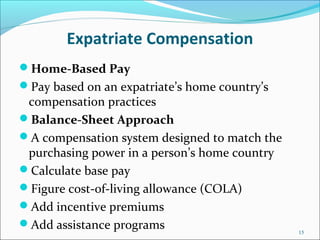
Expatriate Compensation
Home-Based Pay
Pay based on an expatriate’s home country’s
compensation practices
Balance-Sheet Approach
A compensation system designed to match the
purchasing power in a person’s home country
Calculate base pay
Figure cost-of-living allowance (COLA)
Add incentive premiums
Add assistance programs 15
Ch 1 16
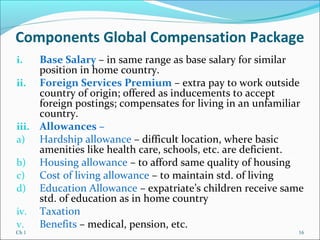
Components Global Compensation Package
i. Base Salary – in same range as base salary for similar
position in home country.
ii. Foreign Services Premium – extra pay to work outside
country of origin; offered as inducements to accept
foreign postings; compensates for living in an unfamiliar
country.
iii. Allowances –
a) Hardship allowance – difficult location, where basic
amenities like health care, schools, etc. are deficient.
b) Housing allowance – to afford same quality of housing
c) Cost of living allowance – to maintain std. of living
d) Education Allowance – expatriate’s children receive same
std. of education as in home country
iv. Taxation
v. Benefits – medical, pension, etc.

Global human resource management gcm

  • 1.
    Global Human Resource Management Dr.G C Mohanta, BE(Mech), MSc(Engg), MBA, PhD(Mgt) Professor Al-Qurmoshi Institute of Business Management, Hyderabad - 500005 1
  • 2.
    Global Human ResourceManagement Global HRM treat the entire world as one large country and carries out activities to use its human resources effectively. These activities include: i. HR Strategy ii.Staffing iii.Performance Evaluation iv.Management Development v. Compensation vi.Labour Relations, etc. 2
  • 3.
    Ch 1 3 StaffingPolicy Staffing policy is concerned with the selection of employees for particular jobs. i. Selecting individuals who have the skill to do a particular job. ii. Tool for developing and promoting the desired corporate culture of the firm.
  • 4.
    Ch 1 4 Typesof staffing policies There are three types of staffing policies: i. Ethnocentric approach ii. Polycentric approach iii. Geocentric approach
  • 5.
    Ch 1 5 EthnocentricApproach  All key management positions are filled by parent – country nationals.  One’s own culture is superior  Overlooks important cultural factors  Host country lacks qualified professionals  Maintain a unified corporate culture  Create value by transferring core competencies  Limits advancement opportunities for host country nationals  Leads to resentment, lower productivity, and high turnover in employees.
  • 6.
    Ch 1 6 PolycentricApproach  Decentralized control  Business Units in different countries have autonomy from home office, like a local Co.  No standard forms or procedures  Recruits host country nationals to manage subsidiaries, while parent country nationals occupy key positions at corporate HQ.  Firm is less likely to suffer from cultural myopia.  Less expensive to implement  Host country nationals have limited opportunities to gain experience outside their own countries  Gap due to language barriers, cultural differences may isolate corporate HQ from foreign subsidieries.
  • 7.
    Ch 1 7 GeocentricApproach  It seeks the best people for key jobs, throughout the organization, regardless of nationality.  Hybrid of Ethnocentric and Polycentric approach  Based on informed knowledge of home and host countries.  Enables firms to make best use of its HR  Helps the firm to build a cadre of international executives, who feel at home working in no. of countries.  Helps building a strong unifying corporate culture and informal management network.  Reduces cultural myopia  Enhance local responsiveness
  • 8.
    Ch 1 8 Expatriate& Inpatriate Managers  Expatriates are citizens of one country, who are working in another country.  Inpatriates are citizens of a foreign country, working in the home country of the multinational employer. (e.g., Citizen of India, who moves to U.S to work for Microsoft)
  • 9.
    Ch 1 9 Expatriateselection Four dimensions that predict success in a foreign posting:  Self orientation – self esteem, self confidence, mental well being, adapt their interest in food, sports, music and hobbies.  Others orientation – ability to interact with host country’s nationals, relationship development and willingness to communicate by learning local language.  Perceptual ability – to understand the particular behaviour of people in host countries, empathise.  Cultural toughness – relationship between country of assignment and how well an expatriate adjusts
  • 10.
  • 11.
    Ch 1 11 Training& Management Development After selection, the next step is training the manager to do the specific job.  MDP is a broader concept, it is intended to develop a manager’s skills over his career in the firm, e.g., sending managers on various foreign postings over years to build his cross cultural sensitivity and experience. To enhance management and leadership skills of executives. MDP has a strategic purpose, and helps reinforce desired culture of the firm by creating an informal network.
  • 12.
    Ch 1 12 Typesof Training i. Cultural training – understanding the culture of host country, enhancing effectiveness, familiarization trip before formal transfer. ii. Language training – manager’s ability to interact, help build rapport and improve manager’s effectiveness. iii. Practical training – adjust to day to day life in host country, establish a routine, successful adaptation, support network of friends
  • 13.
    Management Development & Strategy Developmentprograms designed to increase the overall skill levels of managers through: On going management education Rotation of managers through a number of jobs within the firm to give broad range of experiences Used as a strategic tool to build a strong unifying culture and informal management network 13
  • 14.
    Ch 1 14 PerformanceAppraisal These are the systems used to evaluate the performance of managers against some criteria, that the firm judges to be important for the implementation of strategy and attainment of competitive advantage. Important elements of control system. 2 groups evaluate the performance of Host country managers and home country managers. Biasness by cultural frame of reference and expectations Unfair evaluation Due to proximity, onsite manager should evaluate soft variables of expatriate’s performance. Consultation of home country manager to balance out.
  • 15.
    Expatriate Compensation Home-Based Pay Paybased on an expatriate’s home country’s compensation practices Balance-Sheet Approach A compensation system designed to match the purchasing power in a person’s home country Calculate base pay Figure cost-of-living allowance (COLA) Add incentive premiums Add assistance programs 15
  • 16.
    Ch 1 16 ComponentsGlobal Compensation Package i. Base Salary – in same range as base salary for similar position in home country. ii. Foreign Services Premium – extra pay to work outside country of origin; offered as inducements to accept foreign postings; compensates for living in an unfamiliar country. iii. Allowances – a) Hardship allowance – difficult location, where basic amenities like health care, schools, etc. are deficient. b) Housing allowance – to afford same quality of housing c) Cost of living allowance – to maintain std. of living d) Education Allowance – expatriate’s children receive same std. of education as in home country iv. Taxation v. Benefits – medical, pension, etc.