Differentiate between host-country nationals, parent- country nationals, and third-country nationals Define the four dominant human resources management approaches. FOUNDATIONS OF HUMAN RESOURCES MANAGEMENT LESSON 11-1 GOALS
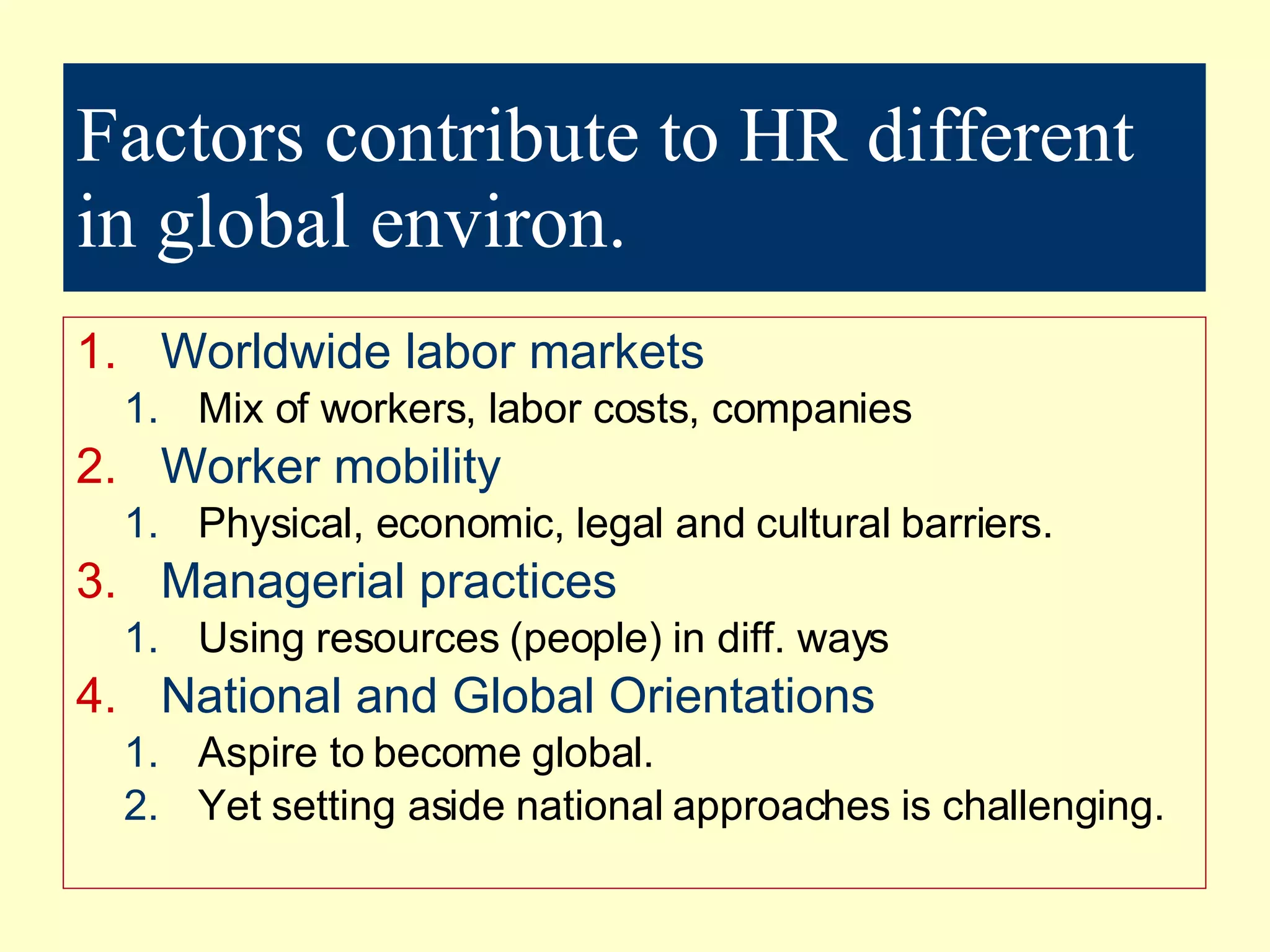
Factors contribute to HR different in global environ. Worldwide labor markets Mix of workers, labor costs, companies Worker mobility Physical, economic, legal and cultural barriers. Managerial practices Using resources (people) in diff. ways National and Global Orientations Aspire to become global. Yet setting aside national approaches is challenging.
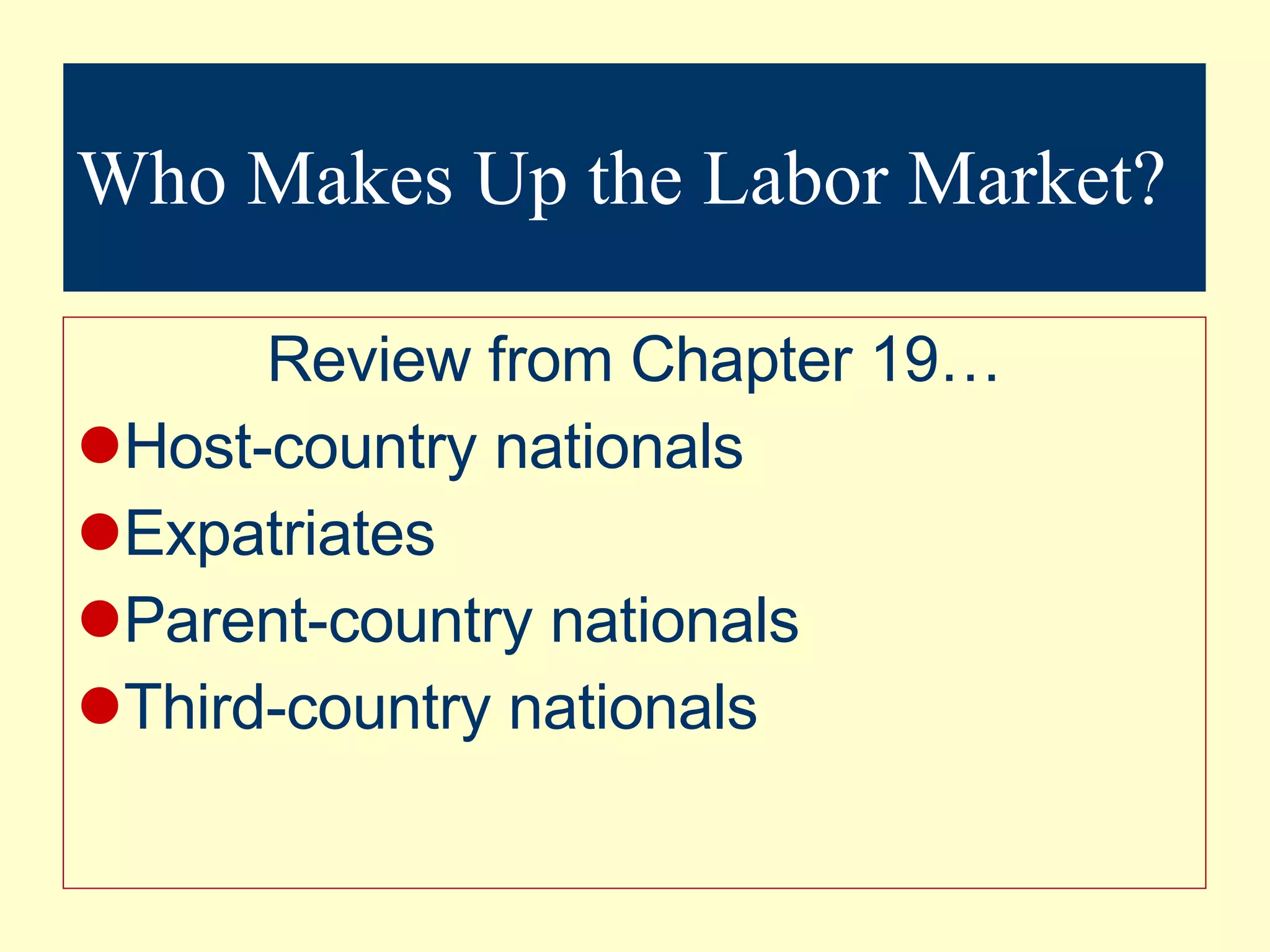
Who Makes Up the Labor Market? Review from Chapter 19… Host-country nationals Expatriates Parent-country nationals Third-country nationals
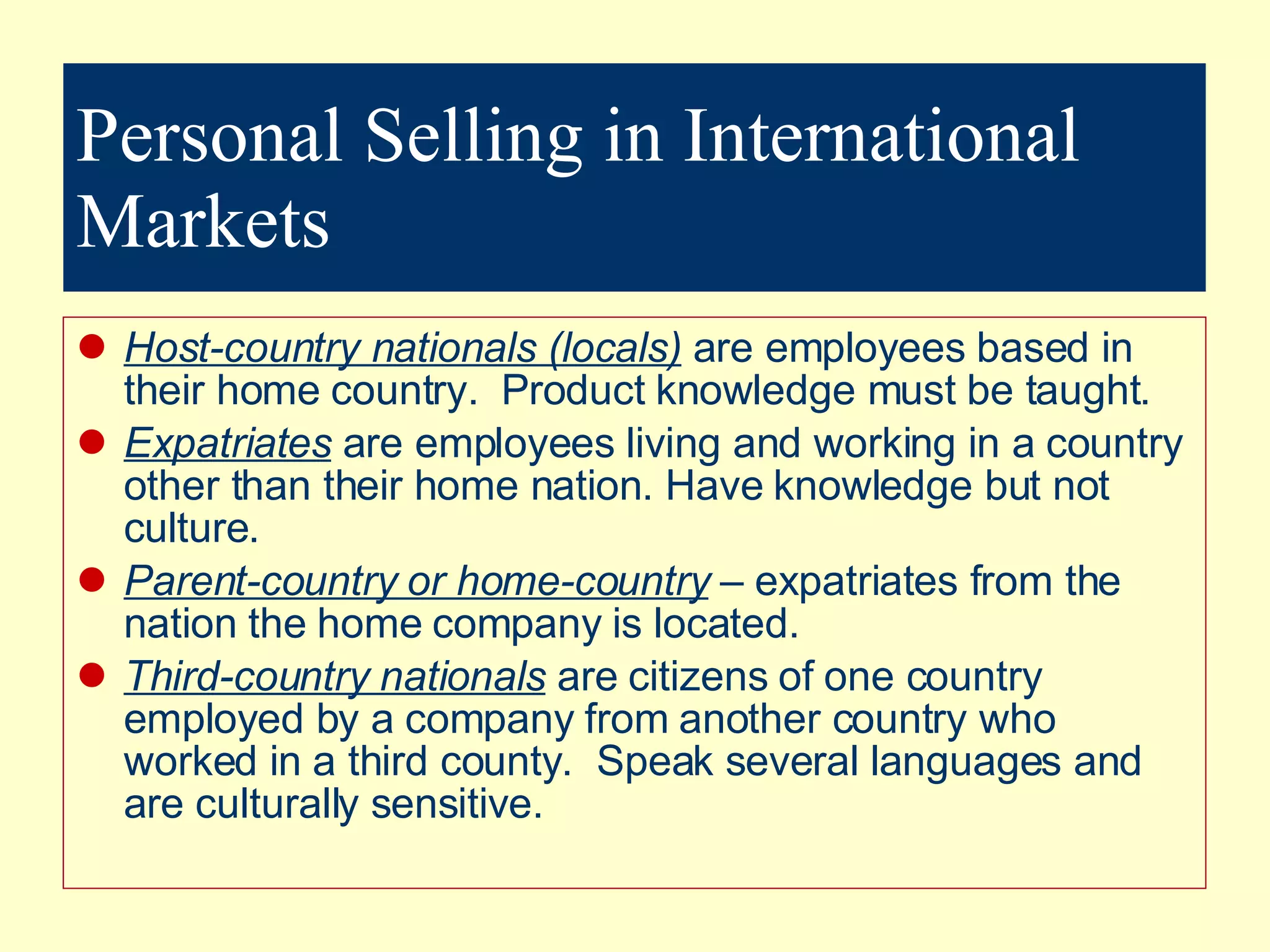
Personal Selling in International Markets Host-country nationals (locals)  are employees based in their home country.  Product knowledge must be taught. Expatriates  are employees living and working in a country other than their home nation. Have knowledge but not culture. Parent-country or home-country  – expatriates from the nation the home company is located. Third-country nationals  are citizens of one country employed by a company from another country who worked in a third county.  Speak several languages and are culturally sensitive.
Balance advantages and disadvantages of each. Locals  Adv. - usually culturally sensitive and easy to find. Dis. – may not have knowledge and skills Parent-country Adv. – have needed knowledge and skills. Dis. – lack appropriate local language and cultural skills.  And more costly.  Gov’t may also restrict hiring. Third-country Adv. – more adaptable to local conditions.  Speak languages and are more culturally sensitive. May be unqualified and may lack desired company orientation.
Four Human Resources Management Approaches Ethnocentric approach Polycentric approach Regiocentric approach Geocentric approach Decision depends on: Gov’t regulations and the size, structure, strategy, attitudes, and staffing of the company.
Ethnocentric Approach Uses natives of the parent country of a business to fill key positions at home and abroad. Usefulness New Technology in another country Prior experience is important. Goal is to prepare the host country employees to manage the business. Drawbacks Deprives the locals of jobs, lowers morale of workers, may not be culturally sensitive to locals.
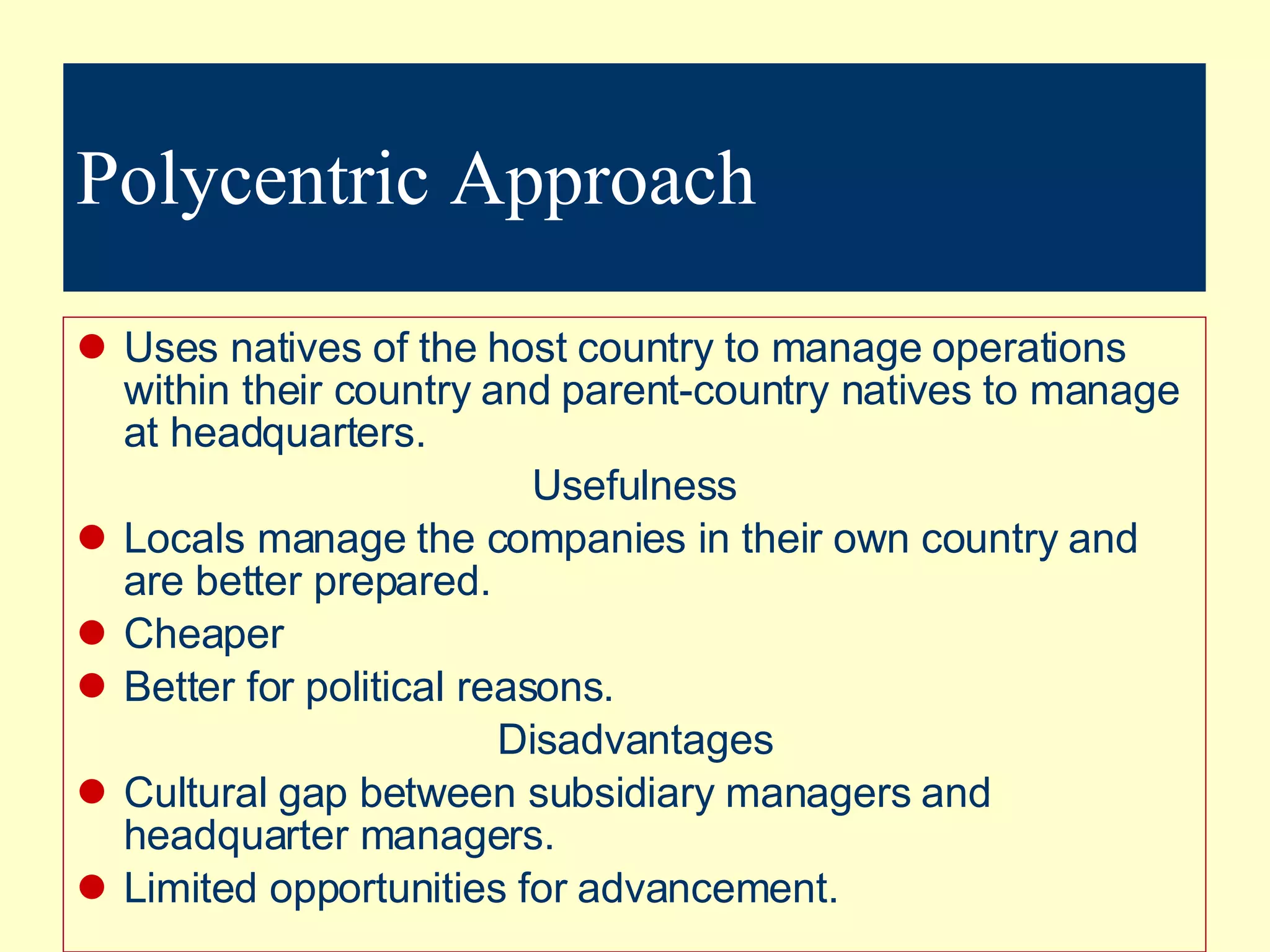
Polycentric Approach Uses natives of the host country to manage operations within their country and parent-country natives to manage at headquarters. Usefulness Locals manage the companies in their own country and are better prepared. Cheaper Better for political reasons. Disadvantages Cultural gap between subsidiary managers and headquarter managers. Limited opportunities for advancement.
Regioncentric Approach Uses managers from various countries within the geographic regions of a business. Usefulness When regional expertise is needed. Disadvantages Communication – diversity of employees may not understand corporate headquarter’s views. International experience of managers may not be considered
Geocentric Approach Uses the best available managers without regard for their countries of origin. Usefulness Should have a worldwide strategy of business integration in place. Develops international managers and reduces national bias. Disadvantages Government regulations Expensive Slow to get all employees trained and located
Explain how staffing needs are determined. Describe how potential employees are recruited. Describe three factors to consider when hiring job applicants. SELECTING AND TRAINING STAFF LESSON 11-2 GOALS
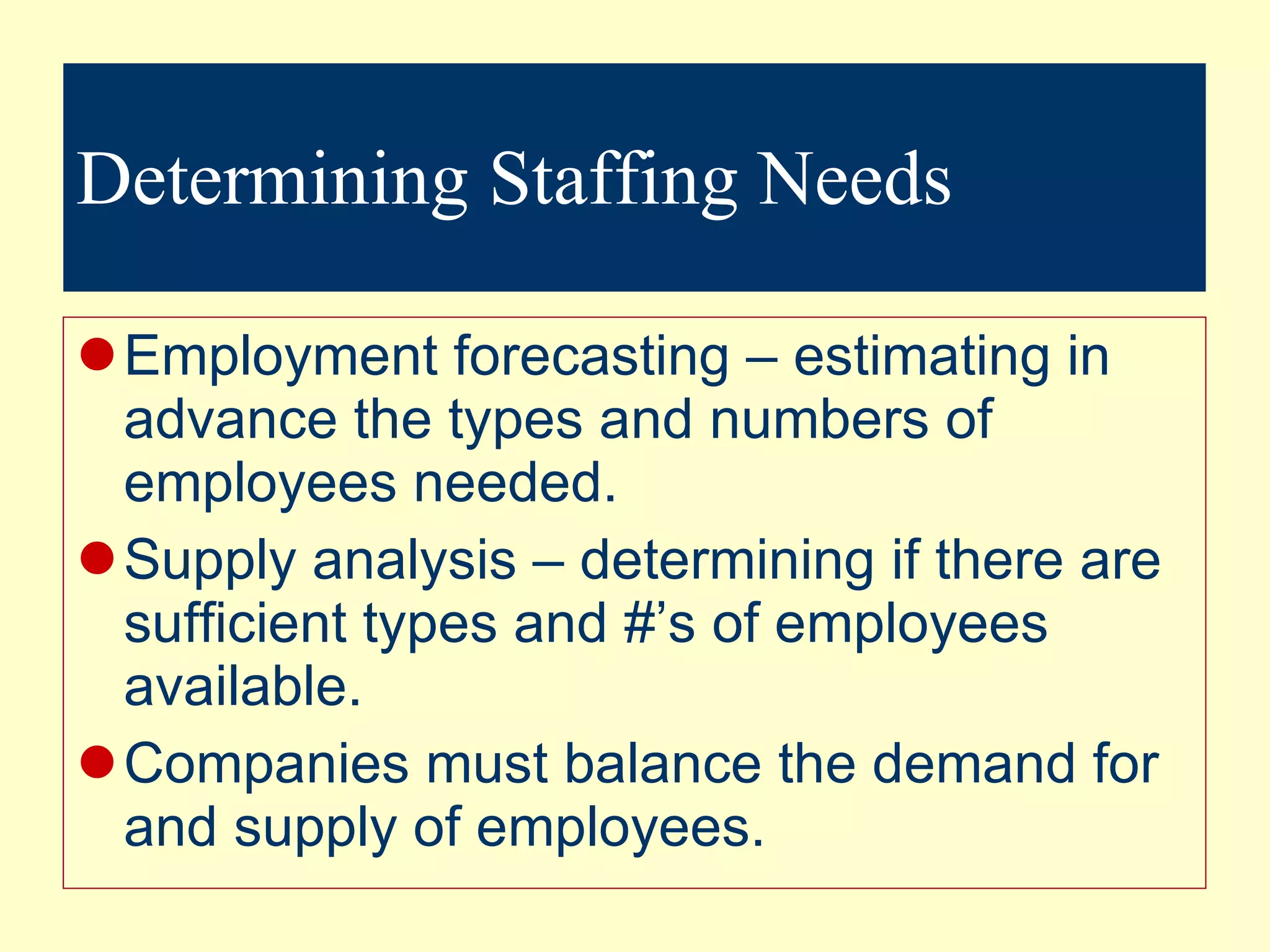
Determining Staffing Needs Employment forecasting – estimating in advance the types and numbers of employees needed. Supply analysis – determining if there are sufficient types and #’s of employees available. Companies must balance the demand for and supply of employees.
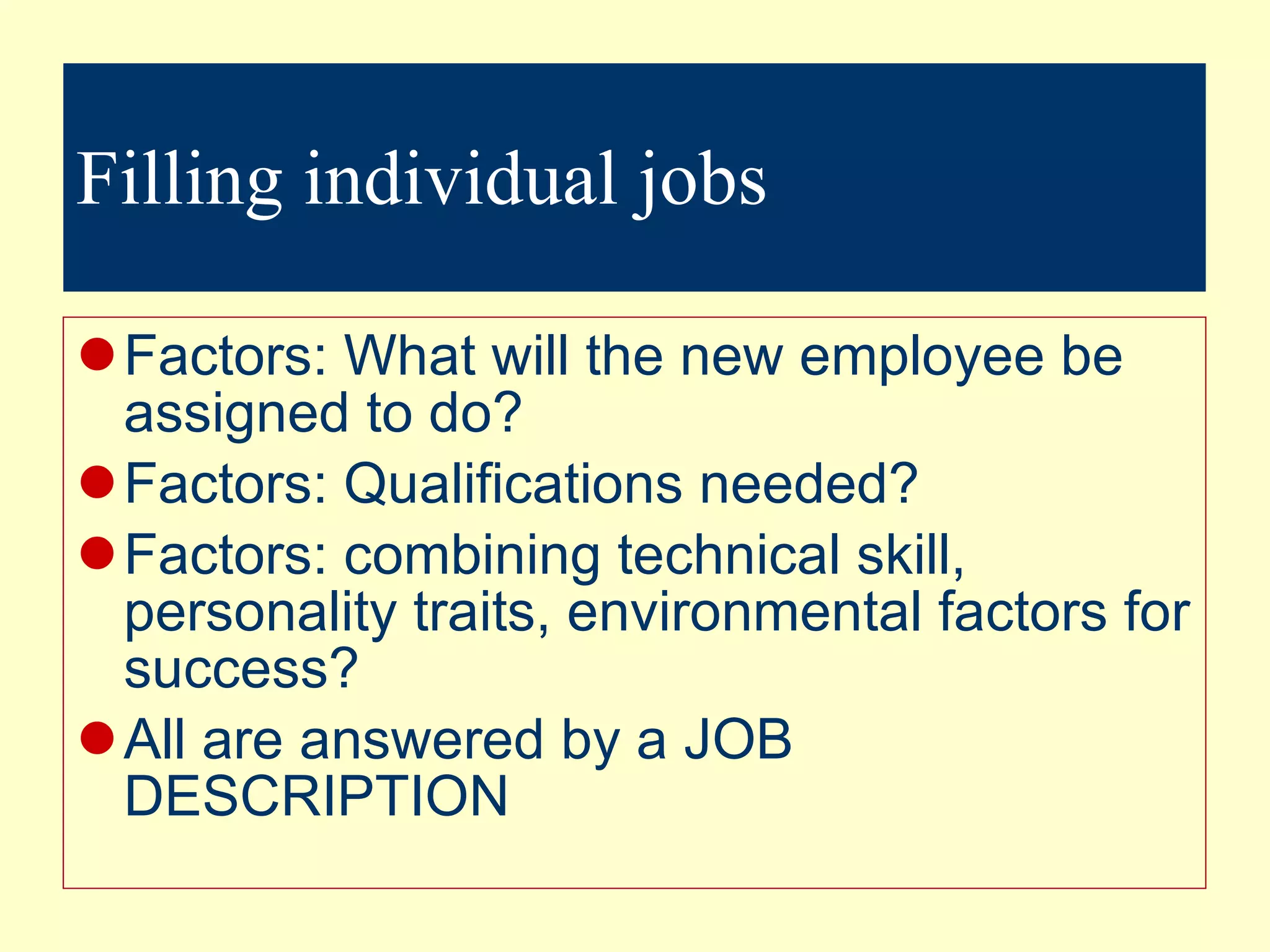
Filling individual jobs Factors: What will the new employee be assigned to do? Factors: Qualifications needed? Factors: combining technical skill, personality traits, environmental factors for success? All are answered by a JOB DESCRIPTION
Job description A document that includes the job identification, job statement, duties and responsibilities, and job specifications and requirements.
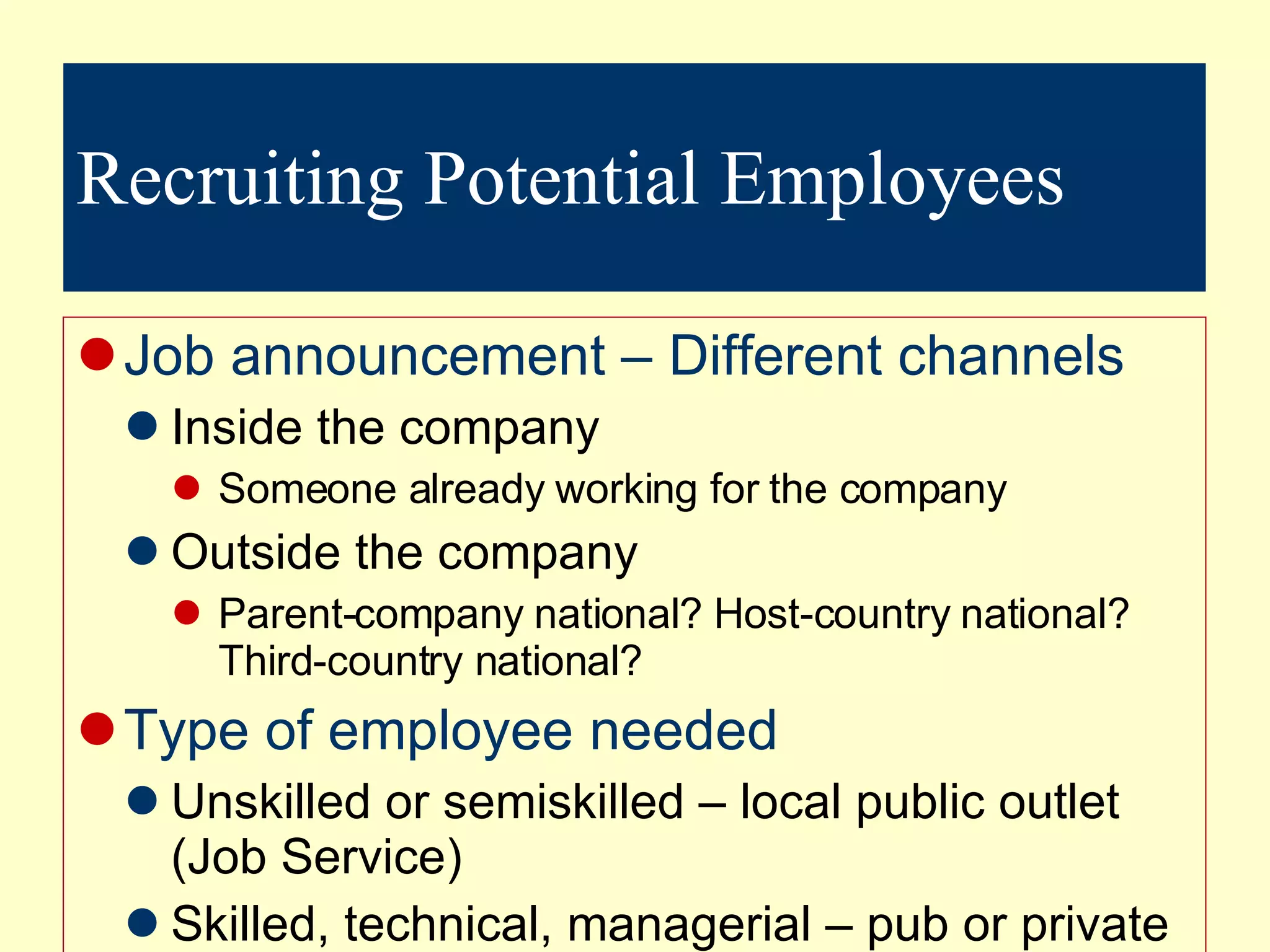
Recruiting Potential Employees Job announcement – Different channels Inside the company Someone already working for the company Outside the company Parent-company national? Host-country national? Third-country national? Type of employee needed Unskilled or semiskilled – local public outlet (Job Service) Skilled, technical, managerial – pub or private outlet used High ranking man pos (recruitment firm –  headhunters)
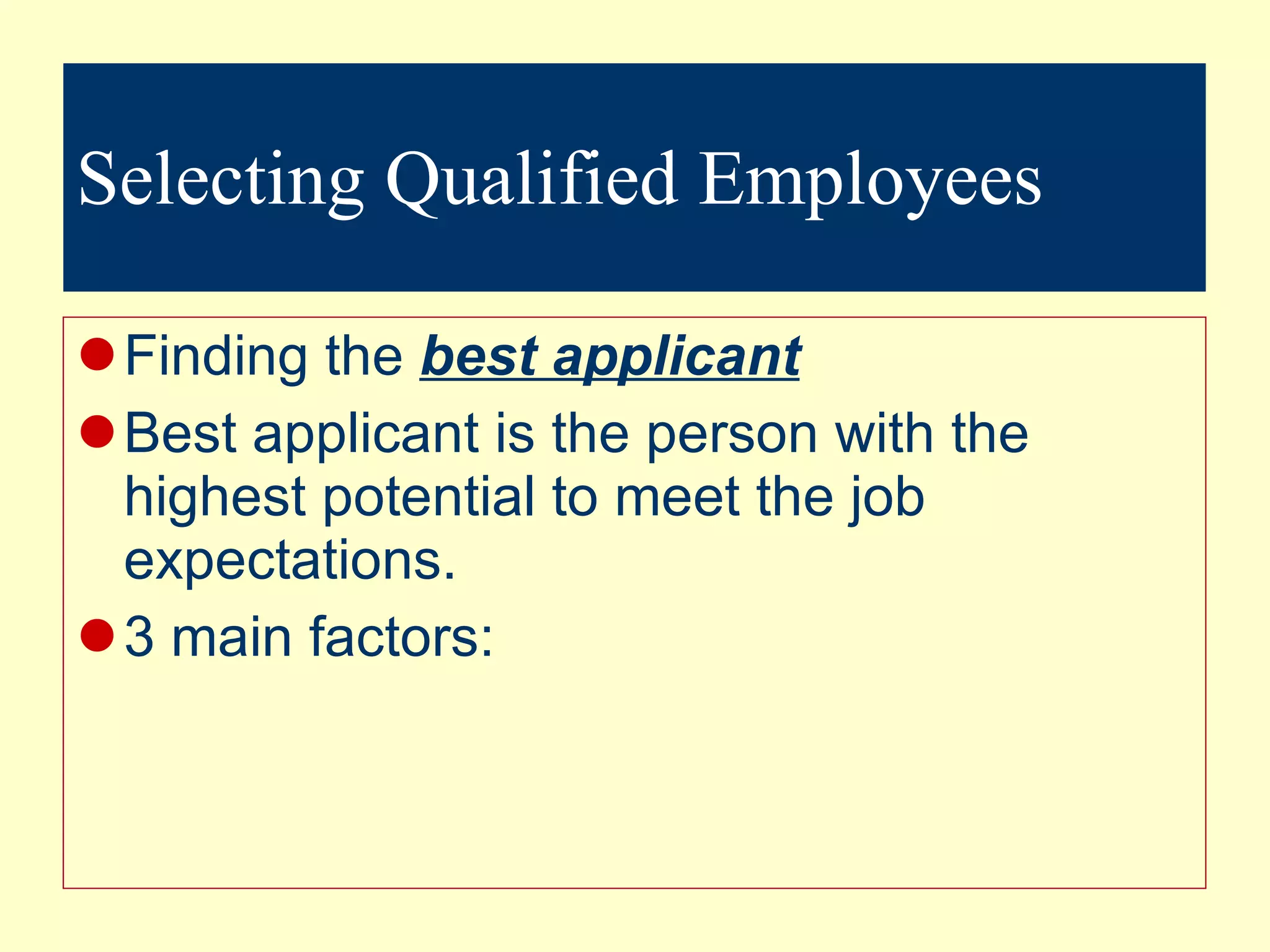
Selecting Qualified Employees Finding the  best applicant Best applicant is the person with the highest potential to meet the job expectations. 3 main factors:
Competence- Factor that relates to the ability to perform. Ex: Technical Knowledge,  Specialty Areas,  Experience,  leadership skills,  Cultural awareness and language skills,  Communication Skills
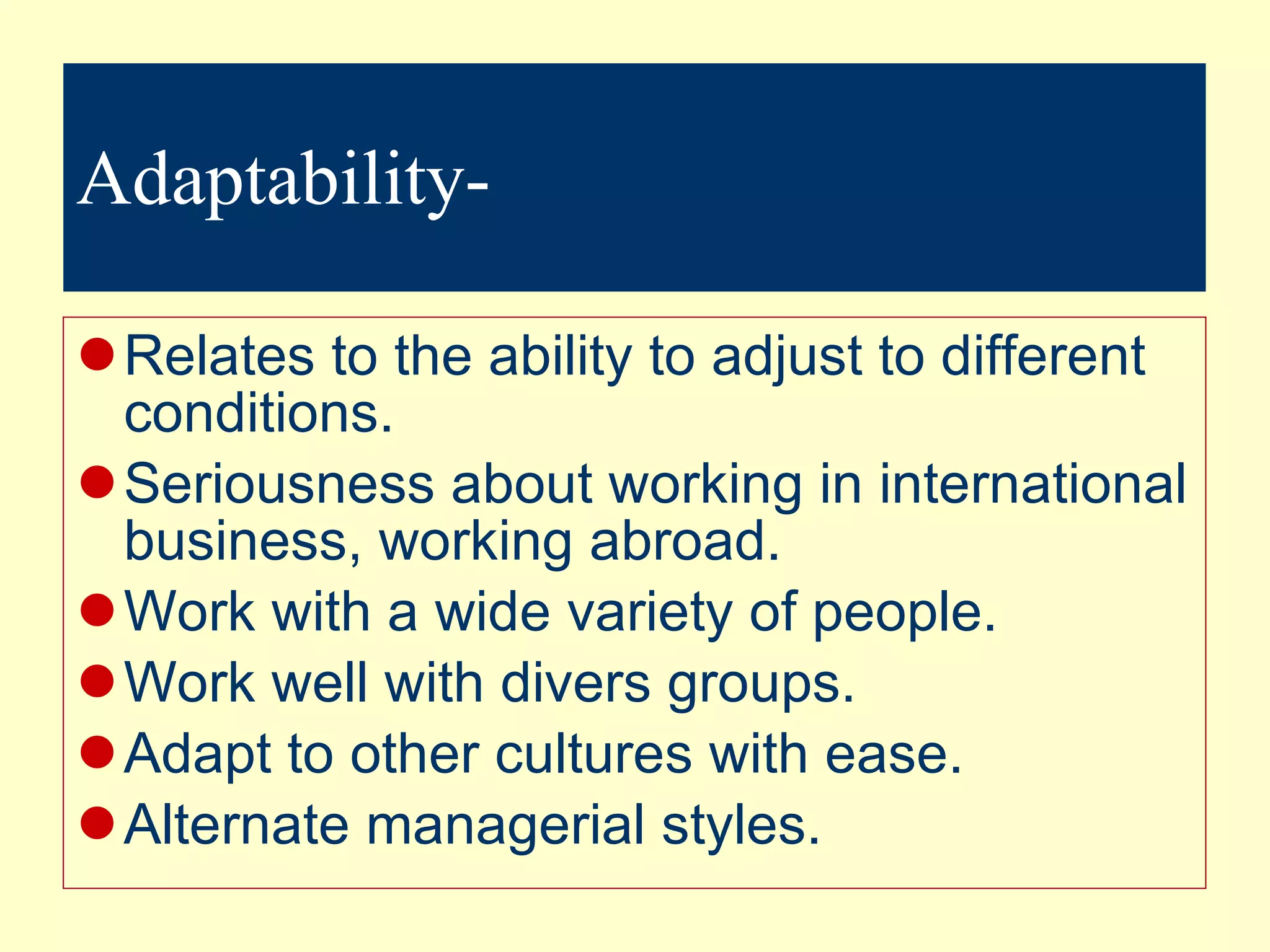
Adaptability- Relates to the ability to adjust to different conditions. Seriousness about working in international business, working abroad. Work with a wide variety of people. Work well with divers groups. Adapt to other cultures with ease. Alternate managerial styles.
Personal characteristics- Maturity of the employee. Education Gender Social Acceptability Diplomacy General Health Stability of Family*
Understand the importance of training and development for global employees. Identify the common types of training and develop-ment for international employees. Explain how training and development programs reduce the chance of employee failure. MAXIMIZATION OF HUMAN RESOURCES LESSON 11-3 GOALS
Training and Development are Critical
Major Expense
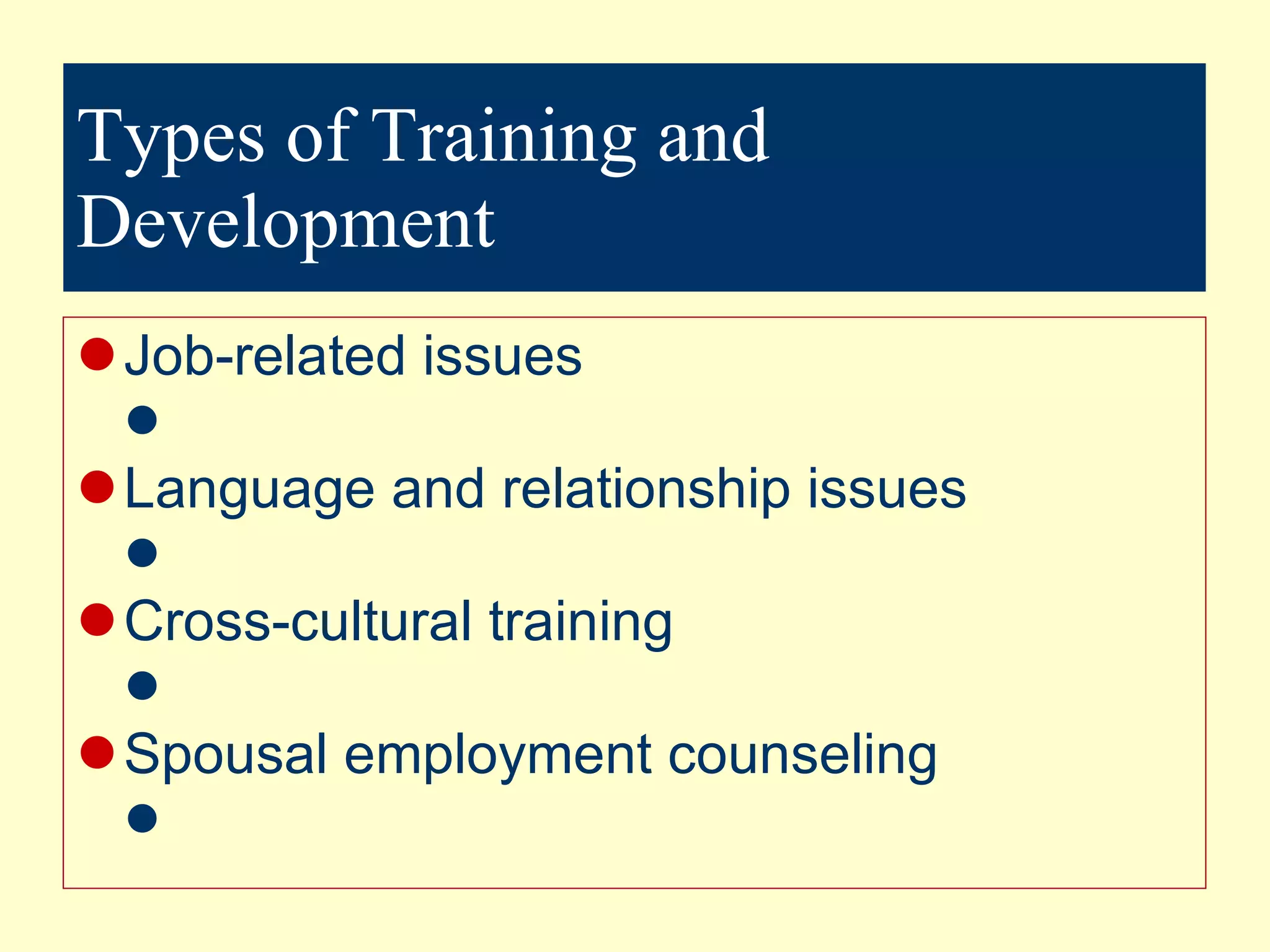
Types of Training and Development Job-related issues Language and relationship issues Cross-cultural training Spousal employment counseling
Table on Page 298 Make one relevant to  Your Business Plan
Training and Development Help Prevent Failure Why global employees fail
Training and Development Help Prevent Failure Reducing the chance of employee failure
Understand that employee motivation is culturally based. Explain the common components of compensation packages for parent-country nationals. Appreciate the complexities of evaluating employee perform-ance in an international setting. List strategies that help to minimize repatriation problems. RETAINING HUMAN RESOURCES LESSON 11-4 GOALS
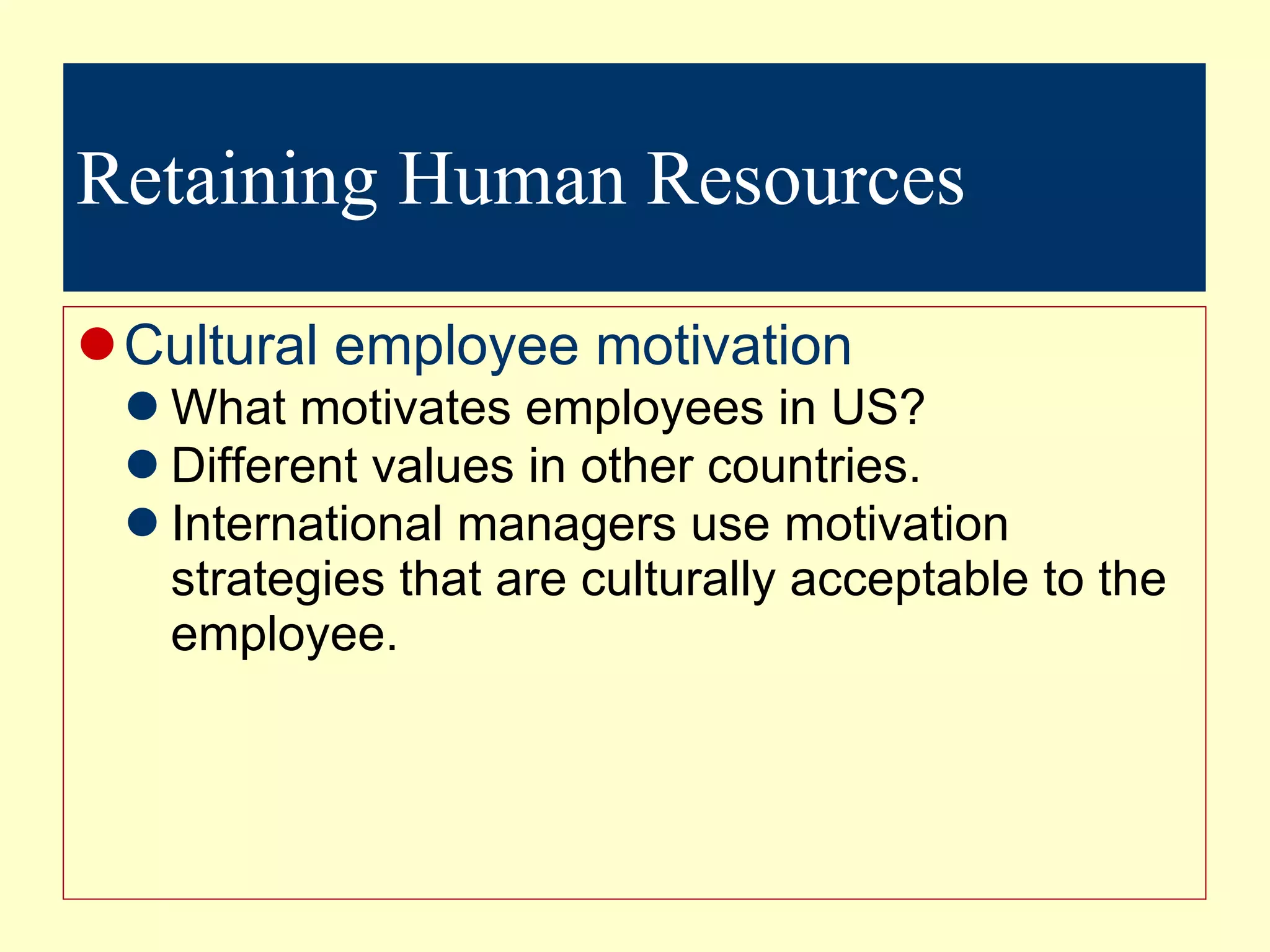
Retaining Human Resources Cultural employee motivation What motivates employees in US? Different values in other countries. International managers use motivation strategies that are culturally acceptable to the employee.
Compensating employees Cultural sensitivity Cash and noncash items Base salary Salary is in line with living expenses in this country Expatriate bonus Compensation for moving and adjustment problems. Cost-of-living adjustment Adjusted pay for different cost of living Employee benefits Relocation, insurance, and extras
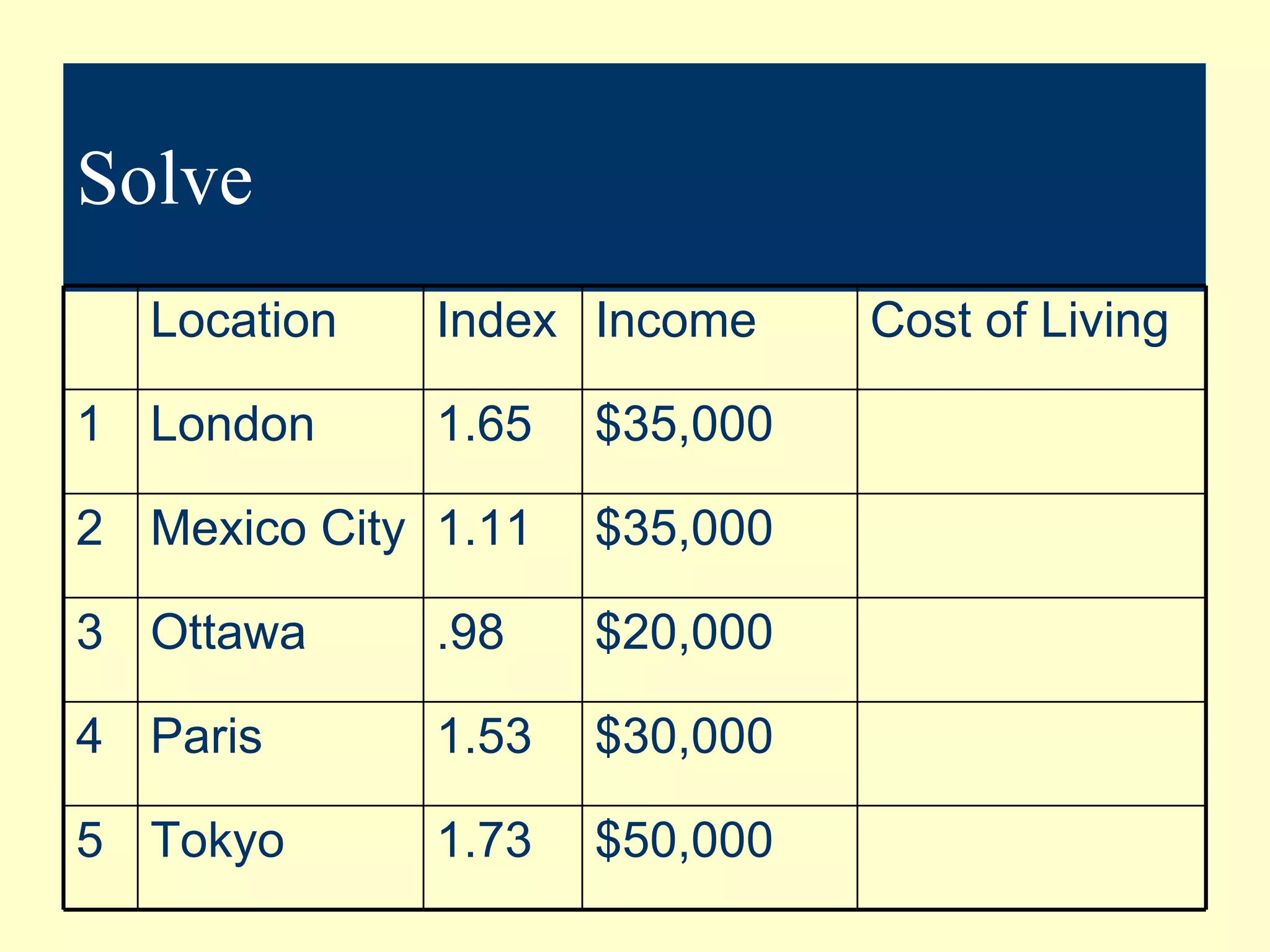
Solve $30,000 1.53 Paris 4 $50,000 1.73 Tokyo 5 $20,000 .98 Ottawa 3 $35,000 1.11 Mexico City 2 $35,000 1.65 London 1 Cost of Living Income Index Location
Evaluating employee performance Employee performance  is  influenced  by 3 factors: Environment The Task The Individual’s Personality Why is evaluating the performance of international employees so challenging?
Anticipating repatriation REPATRIATION – the process a person goes through when returning home and settling after having worked abroad. Adjustments: Reverse Culture Shock Work, finances, and social relationships Sense of Isolation Others have not experience the same things you have. Smooth the transition by…

Chap11

  • 1.
    Differentiate between host-countrynationals, parent- country nationals, and third-country nationals Define the four dominant human resources management approaches. FOUNDATIONS OF HUMAN RESOURCES MANAGEMENT LESSON 11-1 GOALS
  • 2.
    Factors contribute toHR different in global environ. Worldwide labor markets Mix of workers, labor costs, companies Worker mobility Physical, economic, legal and cultural barriers. Managerial practices Using resources (people) in diff. ways National and Global Orientations Aspire to become global. Yet setting aside national approaches is challenging.
  • 3.
    Who Makes Upthe Labor Market? Review from Chapter 19… Host-country nationals Expatriates Parent-country nationals Third-country nationals
  • 4.
    Personal Selling inInternational Markets Host-country nationals (locals) are employees based in their home country. Product knowledge must be taught. Expatriates are employees living and working in a country other than their home nation. Have knowledge but not culture. Parent-country or home-country – expatriates from the nation the home company is located. Third-country nationals are citizens of one country employed by a company from another country who worked in a third county. Speak several languages and are culturally sensitive.
  • 5.
    Balance advantages anddisadvantages of each. Locals Adv. - usually culturally sensitive and easy to find. Dis. – may not have knowledge and skills Parent-country Adv. – have needed knowledge and skills. Dis. – lack appropriate local language and cultural skills. And more costly. Gov’t may also restrict hiring. Third-country Adv. – more adaptable to local conditions. Speak languages and are more culturally sensitive. May be unqualified and may lack desired company orientation.
  • 6.
    Four Human ResourcesManagement Approaches Ethnocentric approach Polycentric approach Regiocentric approach Geocentric approach Decision depends on: Gov’t regulations and the size, structure, strategy, attitudes, and staffing of the company.
  • 7.
    Ethnocentric Approach Usesnatives of the parent country of a business to fill key positions at home and abroad. Usefulness New Technology in another country Prior experience is important. Goal is to prepare the host country employees to manage the business. Drawbacks Deprives the locals of jobs, lowers morale of workers, may not be culturally sensitive to locals.
  • 8.
    Polycentric Approach Usesnatives of the host country to manage operations within their country and parent-country natives to manage at headquarters. Usefulness Locals manage the companies in their own country and are better prepared. Cheaper Better for political reasons. Disadvantages Cultural gap between subsidiary managers and headquarter managers. Limited opportunities for advancement.
  • 9.
    Regioncentric Approach Usesmanagers from various countries within the geographic regions of a business. Usefulness When regional expertise is needed. Disadvantages Communication – diversity of employees may not understand corporate headquarter’s views. International experience of managers may not be considered
  • 10.
    Geocentric Approach Usesthe best available managers without regard for their countries of origin. Usefulness Should have a worldwide strategy of business integration in place. Develops international managers and reduces national bias. Disadvantages Government regulations Expensive Slow to get all employees trained and located
  • 11.
    Explain how staffingneeds are determined. Describe how potential employees are recruited. Describe three factors to consider when hiring job applicants. SELECTING AND TRAINING STAFF LESSON 11-2 GOALS
  • 12.
    Determining Staffing NeedsEmployment forecasting – estimating in advance the types and numbers of employees needed. Supply analysis – determining if there are sufficient types and #’s of employees available. Companies must balance the demand for and supply of employees.
  • 13.
    Filling individual jobsFactors: What will the new employee be assigned to do? Factors: Qualifications needed? Factors: combining technical skill, personality traits, environmental factors for success? All are answered by a JOB DESCRIPTION
  • 14.
    Job description Adocument that includes the job identification, job statement, duties and responsibilities, and job specifications and requirements.
  • 15.
    Recruiting Potential EmployeesJob announcement – Different channels Inside the company Someone already working for the company Outside the company Parent-company national? Host-country national? Third-country national? Type of employee needed Unskilled or semiskilled – local public outlet (Job Service) Skilled, technical, managerial – pub or private outlet used High ranking man pos (recruitment firm – headhunters)
  • 16.
    Selecting Qualified EmployeesFinding the best applicant Best applicant is the person with the highest potential to meet the job expectations. 3 main factors:
  • 17.
    Competence- Factor thatrelates to the ability to perform. Ex: Technical Knowledge, Specialty Areas, Experience, leadership skills, Cultural awareness and language skills, Communication Skills
  • 18.
    Adaptability- Relates tothe ability to adjust to different conditions. Seriousness about working in international business, working abroad. Work with a wide variety of people. Work well with divers groups. Adapt to other cultures with ease. Alternate managerial styles.
  • 19.
    Personal characteristics- Maturityof the employee. Education Gender Social Acceptability Diplomacy General Health Stability of Family*
  • 20.
    Understand the importanceof training and development for global employees. Identify the common types of training and develop-ment for international employees. Explain how training and development programs reduce the chance of employee failure. MAXIMIZATION OF HUMAN RESOURCES LESSON 11-3 GOALS
  • 21.
  • 22.
  • 23.
    Types of Trainingand Development Job-related issues Language and relationship issues Cross-cultural training Spousal employment counseling
  • 24.
    Table on Page298 Make one relevant to Your Business Plan
  • 25.
    Training and DevelopmentHelp Prevent Failure Why global employees fail
  • 26.
    Training and DevelopmentHelp Prevent Failure Reducing the chance of employee failure
  • 27.
    Understand that employeemotivation is culturally based. Explain the common components of compensation packages for parent-country nationals. Appreciate the complexities of evaluating employee perform-ance in an international setting. List strategies that help to minimize repatriation problems. RETAINING HUMAN RESOURCES LESSON 11-4 GOALS
  • 28.
    Retaining Human ResourcesCultural employee motivation What motivates employees in US? Different values in other countries. International managers use motivation strategies that are culturally acceptable to the employee.
  • 29.
    Compensating employees Culturalsensitivity Cash and noncash items Base salary Salary is in line with living expenses in this country Expatriate bonus Compensation for moving and adjustment problems. Cost-of-living adjustment Adjusted pay for different cost of living Employee benefits Relocation, insurance, and extras
  • 30.
    Solve $30,000 1.53Paris 4 $50,000 1.73 Tokyo 5 $20,000 .98 Ottawa 3 $35,000 1.11 Mexico City 2 $35,000 1.65 London 1 Cost of Living Income Index Location
  • 31.
    Evaluating employee performanceEmployee performance is influenced by 3 factors: Environment The Task The Individual’s Personality Why is evaluating the performance of international employees so challenging?
  • 32.
    Anticipating repatriation REPATRIATION– the process a person goes through when returning home and settling after having worked abroad. Adjustments: Reverse Culture Shock Work, finances, and social relationships Sense of Isolation Others have not experience the same things you have. Smooth the transition by…