









Recruitment & Selection for
International Assignments
Objectives

• To identify factors predictive of success for
  a global manager
• To identify barriers to effective recruitment
  and selection
• To describe staffing issues in an MNE
Recruitment:
 The process of generating a pool of
 capable candidates to apply for your job
 vacancy
Selection:
 The process of choosing from the pool of
 applicants the person most likely to
 succeed in the job
Underlying key principles.

• Individual differences

• Prediction
Selection criteria

• Reliability
• Validity
Discrimination:

• Direct

• Indirect
Two approaches
• Person specification
  based on asking yourself – how can I describe
  the person who can fulfil this job description ie
  description of duties/responsibilities


• Job competencies
   identify knowledge skills and knowledge a
  person needs to adequately do a job

(Rees & Porter)
Example of JD format
• JOB DESCRIPTION
 Job title
 Department
 Responsible to:
 Relationships
 Purpose of job/overall objectives
 Specific duties and responsibilities
 Physical/economic conditions
Alec Rodger’s 7 point plan (1970)

• PERSONNEL SPECIFICATION
 Physical characteristics
 Attainments
 General intelligence
 Specific aptitudes
 Interests
 Disposition
 Circumstances
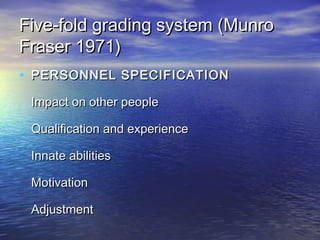
Five-fold grading system (Munro
Fraser 1971)
• PERSONNEL SPECIFICATION
 Impact on other people

 Qualification and experience

 Innate abilities

 Motivation

 Adjustment
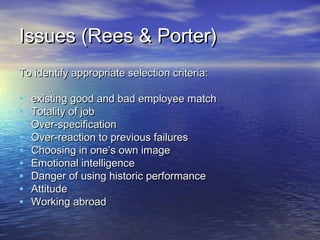
Issues (Rees & Porter)
To identify appropriate selection criteria:

•   existing good and bad employee match
•   Totality of job
•   Over-specification
•   Over-reaction to previous failures
•   Choosing in one’s own image
•   Emotional intelligence
•   Danger of using historic performance
•   Attitude
•   Working abroad
Information to collect

•   References
•   Testimonials
•   CVs/application forms
•   Assessment centres
•   Psychometric test
•   interview
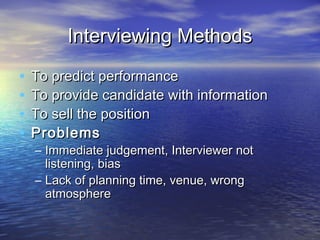
Interviewing Methods

•   To predict performance
•   To provide candidate with information
•   To sell the position
•   Problems
    – Immediate judgement, Interviewer not
      listening, bias
    – Lack of planning time, venue, wrong
      atmosphere
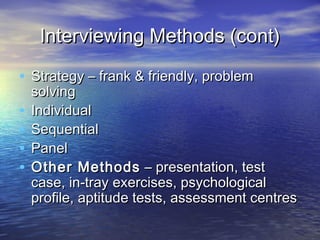
Interviewing Methods (cont)

• Strategy – frank & friendly, problem
    solving
•   Individual
•   Sequential
•   Panel
•   Other Methods – presentation, test
    case, in-tray exercises, psychological
    profile, aptitude tests, assessment centres
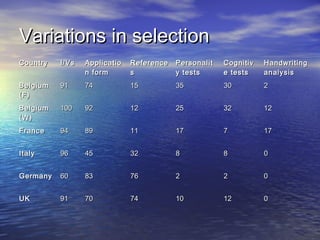
Variations in selection
Country   I/Vs   Applicatio   Reference   Personalit   Cognitiv   Handwriting
                 n form       s           y tests      e tests    analysis
Belgium   91     74           15          35           30         2
(F)
Belgium   100    92           12          25           32         12
(W)
France    94     89           11          17           7          17


Italy     96     45           32          8            8          0


Germany   60     83           76          2            2          0


UK        91     70           74          10           12         0
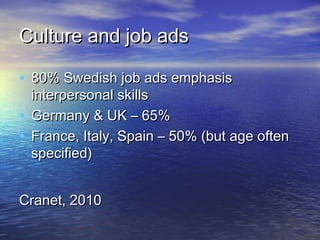
Culture and job ads

• 80% Swedish job ads emphasis
  interpersonal skills
• Germany & UK – 65%
• France, Italy, Spain – 50% (but age often
  specified)


Cranet, 2010
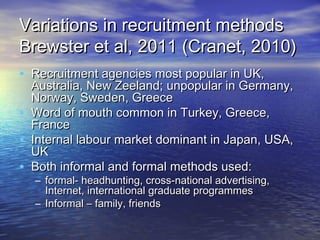
Variations in recruitment methods
Brewster et al, 2011 (Cranet, 2010)
• Recruitment agencies most popular in UK,
    Australia, New Zeeland; unpopular in Germany,
    Norway, Sweden, Greece
•   Word of mouth common in Turkey, Greece,
    France
•   Internal labour market dominant in Japan, USA,
    UK
•   Both informal and formal methods used:
    – formal- headhunting, cross-national advertising,
      Internet, international graduate programmes
    – Informal – family, friends
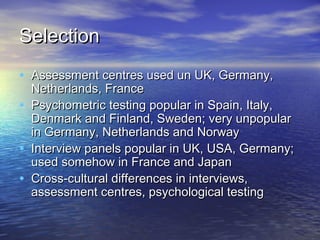
Selection
• Assessment centres used un UK, Germany,
    Netherlands, France
•   Psychometric testing popular in Spain, Italy,
    Denmark and Finland, Sweden; very unpopular
    in Germany, Netherlands and Norway
•   Interview panels popular in UK, USA, Germany;
    used somehow in France and Japan
•   Cross-cultural differences in interviews,
    assessment centres, psychological testing
Influence of culture on R&S
 Brewster et al, 2011
• Anglo-Saxon tradition – individual factors used to predict
    performance; competencies frameworks
•   Australia – fir between the person and the organisation’s
    values and ways of doing things
•   France – personal values not considered appropriate;
    assessment of risk rather than predicted outcomes
•   Latin America, Mexico, Peru – who the person is,
    relationships, connections
•   Regional challenges: India – employee referrals,
    succession planning and internal recruitment; ethnicity
    important in Malaysia; Islamic principles – experience,
    decency etc
Black & Stephens

• “Our research has found that the
 successful completion of a global
 assignment is linked more closely to the
 expat’s and the spouse’s adjustment to
 the new culture than to the expat’s
 adjustment to the new work role.”
Selection Strategy

• Ethnocentric – Home Country bias
• Geocentric – Best candidate on worldwide
  basis, no country bias
• Polycentric – Host country bias
• Regiocentric – Best candidate on regional
  basis
International Transfers

• For staffing needs
• Management Development – eg foreign
  management, technical skills
• Organizational Development
• Problems eg repatriation
Failure (in using expatriates)

• Costs – Cauldron: $250K-$1 million
  depending on salary, location, dependents
• Black: 16-40% US ex-pats failed
• Tung: found European and Japanese
  failures lower. Are companies judging by
  the same standards? Japanese
  placements longer than US
Reasons for failure

• Mead says less than 1/3 work related
• Tung ranks ex-pat failure in US in
 descending order: managers’ inability to
 adapt to different physical/cultural
 environment; other family problems;
 overseas work; lack of technical
 competence; lack of motivation
Culture Shock

• “ a sense of psychological disorientation that
  most people suffer when they move into a
  culture that is different from their own.”
• Can’t recognise cues ; perceptions different
• Symptoms – tension & frustration,
  alienation, need to be alone, depression
• Study by Black adjustment < 50 months
Reverse Culture Shock

•   Reduced financial benefits
•   Less power, status
•   Change in jobs & personnel
•   Poorer housing, loss of domestic help
•   Solutions – mentor, training, brief
    managers on changes, debrief manager
Selection Factors Predictive of
           Expat Success
• Strategic Factors – Control of subsidiary,
  stage of development for MNE, long term
  strategy vs reaction
• Exchange of critical information including
  technical data
• Management development
Selection Factors (cont.)
• Professional Skills – technical and
    interpersonal
•   Management Skills – able to manage conflict,
    collaboration, trust
•   Communication – language proficiency, 2-way
    conversation, cross-cultural ability
•   Individual characteristics – flexibility, open
    minds, ability to cope with stress
•   Spouse & Family – language skills, spouse’s
    career, education facilities
Some Other Solutions
(based on Black, J.S. et al – “Global Assignments”)

•   Involve family early in process
•   Most successful ex-pats are geo-centric
•   Candidate should be non-judgemental, mature,
    willing to learn
•   Experience in similar environment may help but
    Black found little relationship between previous
    ex-pat work & ability to adapt
•   Ethnic affinity
Other Solutions (cont.)

• Professional & technical support at
    subsidiary and head office
•   Clarify duration to reduce uncertainty
•   Guaranteed career security on repatriation
•   Career planning, promotion opportunities
•   Support for living eg medical, housing,
    insurance, social events, job for spouse
Summary

•   Is recruitment necessary?
•   Source of best not easiest placement
•   Concentrate on personal qualities
•   Focus on families
•   Consider cost & allow adequate time
•   Communicate, clarify progress

Recruitment & selection 2012

  • 1.
    Recruitment & Selectionfor International Assignments
  • 2.
    Objectives • To identifyfactors predictive of success for a global manager • To identify barriers to effective recruitment and selection • To describe staffing issues in an MNE
  • 3.
    Recruitment: The processof generating a pool of capable candidates to apply for your job vacancy Selection: The process of choosing from the pool of applicants the person most likely to succeed in the job
  • 4.
    Underlying key principles. •Individual differences • Prediction
  • 5.
  • 6.
  • 7.
    Two approaches • Personspecification based on asking yourself – how can I describe the person who can fulfil this job description ie description of duties/responsibilities • Job competencies identify knowledge skills and knowledge a person needs to adequately do a job (Rees & Porter)
  • 8.
    Example of JDformat • JOB DESCRIPTION Job title Department Responsible to: Relationships Purpose of job/overall objectives Specific duties and responsibilities Physical/economic conditions
  • 9.
    Alec Rodger’s 7point plan (1970) • PERSONNEL SPECIFICATION Physical characteristics Attainments General intelligence Specific aptitudes Interests Disposition Circumstances
  • 10.
    Five-fold grading system(Munro Fraser 1971) • PERSONNEL SPECIFICATION Impact on other people Qualification and experience Innate abilities Motivation Adjustment
  • 11.
    Issues (Rees &Porter) To identify appropriate selection criteria: • existing good and bad employee match • Totality of job • Over-specification • Over-reaction to previous failures • Choosing in one’s own image • Emotional intelligence • Danger of using historic performance • Attitude • Working abroad
  • 12.
    Information to collect • References • Testimonials • CVs/application forms • Assessment centres • Psychometric test • interview
  • 13.
    Interviewing Methods • To predict performance • To provide candidate with information • To sell the position • Problems – Immediate judgement, Interviewer not listening, bias – Lack of planning time, venue, wrong atmosphere
  • 14.
    Interviewing Methods (cont) •Strategy – frank & friendly, problem solving • Individual • Sequential • Panel • Other Methods – presentation, test case, in-tray exercises, psychological profile, aptitude tests, assessment centres
  • 15.
    Variations in selection Country I/Vs Applicatio Reference Personalit Cognitiv Handwriting n form s y tests e tests analysis Belgium 91 74 15 35 30 2 (F) Belgium 100 92 12 25 32 12 (W) France 94 89 11 17 7 17 Italy 96 45 32 8 8 0 Germany 60 83 76 2 2 0 UK 91 70 74 10 12 0
  • 16.
    Culture and jobads • 80% Swedish job ads emphasis interpersonal skills • Germany & UK – 65% • France, Italy, Spain – 50% (but age often specified) Cranet, 2010
  • 17.
    Variations in recruitmentmethods Brewster et al, 2011 (Cranet, 2010) • Recruitment agencies most popular in UK, Australia, New Zeeland; unpopular in Germany, Norway, Sweden, Greece • Word of mouth common in Turkey, Greece, France • Internal labour market dominant in Japan, USA, UK • Both informal and formal methods used: – formal- headhunting, cross-national advertising, Internet, international graduate programmes – Informal – family, friends
  • 18.
    Selection • Assessment centresused un UK, Germany, Netherlands, France • Psychometric testing popular in Spain, Italy, Denmark and Finland, Sweden; very unpopular in Germany, Netherlands and Norway • Interview panels popular in UK, USA, Germany; used somehow in France and Japan • Cross-cultural differences in interviews, assessment centres, psychological testing
  • 19.
    Influence of cultureon R&S Brewster et al, 2011 • Anglo-Saxon tradition – individual factors used to predict performance; competencies frameworks • Australia – fir between the person and the organisation’s values and ways of doing things • France – personal values not considered appropriate; assessment of risk rather than predicted outcomes • Latin America, Mexico, Peru – who the person is, relationships, connections • Regional challenges: India – employee referrals, succession planning and internal recruitment; ethnicity important in Malaysia; Islamic principles – experience, decency etc
  • 20.
    Black & Stephens •“Our research has found that the successful completion of a global assignment is linked more closely to the expat’s and the spouse’s adjustment to the new culture than to the expat’s adjustment to the new work role.”
  • 21.
    Selection Strategy • Ethnocentric– Home Country bias • Geocentric – Best candidate on worldwide basis, no country bias • Polycentric – Host country bias • Regiocentric – Best candidate on regional basis
  • 22.
    International Transfers • Forstaffing needs • Management Development – eg foreign management, technical skills • Organizational Development • Problems eg repatriation
  • 23.
    Failure (in usingexpatriates) • Costs – Cauldron: $250K-$1 million depending on salary, location, dependents • Black: 16-40% US ex-pats failed • Tung: found European and Japanese failures lower. Are companies judging by the same standards? Japanese placements longer than US
  • 24.
    Reasons for failure •Mead says less than 1/3 work related • Tung ranks ex-pat failure in US in descending order: managers’ inability to adapt to different physical/cultural environment; other family problems; overseas work; lack of technical competence; lack of motivation
  • 25.
    Culture Shock • “a sense of psychological disorientation that most people suffer when they move into a culture that is different from their own.” • Can’t recognise cues ; perceptions different • Symptoms – tension & frustration, alienation, need to be alone, depression • Study by Black adjustment < 50 months
  • 26.
    Reverse Culture Shock • Reduced financial benefits • Less power, status • Change in jobs & personnel • Poorer housing, loss of domestic help • Solutions – mentor, training, brief managers on changes, debrief manager
  • 27.
    Selection Factors Predictiveof Expat Success • Strategic Factors – Control of subsidiary, stage of development for MNE, long term strategy vs reaction • Exchange of critical information including technical data • Management development
  • 28.
    Selection Factors (cont.) •Professional Skills – technical and interpersonal • Management Skills – able to manage conflict, collaboration, trust • Communication – language proficiency, 2-way conversation, cross-cultural ability • Individual characteristics – flexibility, open minds, ability to cope with stress • Spouse & Family – language skills, spouse’s career, education facilities
  • 29.
    Some Other Solutions (basedon Black, J.S. et al – “Global Assignments”) • Involve family early in process • Most successful ex-pats are geo-centric • Candidate should be non-judgemental, mature, willing to learn • Experience in similar environment may help but Black found little relationship between previous ex-pat work & ability to adapt • Ethnic affinity
  • 30.
    Other Solutions (cont.) •Professional & technical support at subsidiary and head office • Clarify duration to reduce uncertainty • Guaranteed career security on repatriation • Career planning, promotion opportunities • Support for living eg medical, housing, insurance, social events, job for spouse
  • 31.
    Summary • Is recruitment necessary? • Source of best not easiest placement • Concentrate on personal qualities • Focus on families • Consider cost & allow adequate time • Communicate, clarify progress