WELCOME
TO
THE PRESENTATION
Presented by
Rabeya Bosri-1832049
Laxmy Rani Bosue-1832050
Mathia Mim Oishi-1832051
Suraya Jahan-1832064
Tania Sultana-1832065
Farjana Sabnur-1832068
Tanjila Akter-1832070
Joyeta Bosu-1832071
IHRM can be defined as set of activities aimed managing organizational
human resources at international level to achieve organizational objectives
& achieve competitive advantage over competitors at national and
international level.
IHRM
 Create a local appeal without compromising upon the global identity
 Generating awareness cross-cultural sensitivities among managers
globally and hiring of staff across geographic boundaries.
 Training upon cultures and sensitivities of the host country.
OBJECTIVES
Functions of international human resource
management:
1.Procurement: HR planning, Staffing (recruitment, selection, placement)
2. Allocation: Compensation (remuneration) and benefits.
3. Utilization: Performance Management ,Training and development,
Industrial Relations.
 Business activities e.g. taxation, international relocation expatriate remuneration
,performance appraisal ,cross-culture training and repatriation.
 Increased complexities e.g. currency fluctuations, foreign HR policies and practices,
different labor laws.
 Increased involvement in employee’s personal life e.g. Personal taxation ,voter
registration,housing,children’s education ,health ,recreation n and spouse employment.
 Complex employee mix- Culture,Political,Religious, Ethical,educational and legal
background .
 Increased risks e.g. emergency exists for serious illness, personal security, kidnapping and
terrorism.
Major differences between Domestic HRM and IHRM
 Emphasis on core competency to generate competitive advantage.
 Reorganization as flat structure due to the essential additional skills that can be met by
appointing new managerial talents or by developing the existing human resources.
 Competition for human resources in various sectors such as consultancy, merchant banking etc.
for acquiring managerial talents.
 Technological changes can remove restrictions on technology import and acquisition. Through
these can be obtained newer technology.
 Different skills and mindsets involved in workforce can be changed due to workforce
empowerment.
Importance of IHRM
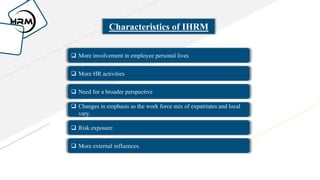
Characteristics of IHRM
 More involvement in employee personal lives
 More HR activities
 Need for a broader perspective
 Changes in emphasis as the work force mix of expatriates and local
vary.
 Risk exposure
 More external influences.
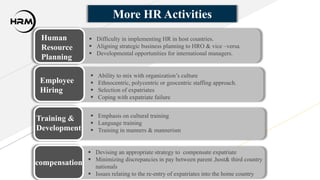
More HR Activities
Human
Resource
Planning
Employee
Hiring
Training &
Development
 Difficulty in implementing HR in host countries.
 Aligning strategic business planning to HRO & vice –versa.
 Developmental opportunities for international managers.
 Ability to mix with organization’s culture
 Ethnocentric, polycentric or geocentric staffing approach.
 Selection of expatriates
 Coping with expatriate failure
 Emphasis on cultural training
 Language training
 Training in manners & mannerism
compensation
 Devising an appropriate strategy to compensate expatriate
 Minimizing discrepancies in pay between parent ,host& third country
nationals
 Issues relating to the re-entry of expatriates into the home country
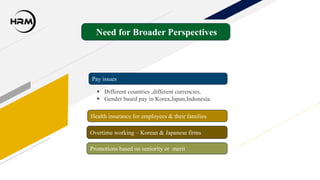
Pay issues
Health insurance for employees & their families
Overtime working – Korean & Japanese firms
Need for Broader Perspectives
Promotions based on seniority or merit
 Different countries ,different currencies.
 Gender based pay in Korea,Japan,Indonesia.
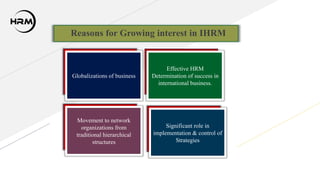
Globalizations of business
Effective HRM
Determination of success in
international business.
Movement to network
organizations from
traditional hierarchical
structures
Significant role in
implementation & control of
Strategies
Reasons for Growing interest in IHRM
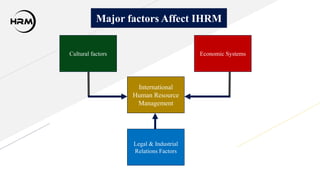
Cultural factors Economic Systems
International
Human Resource
Management
Legal & Industrial
Relations Factors
Major factors Affect IHRM
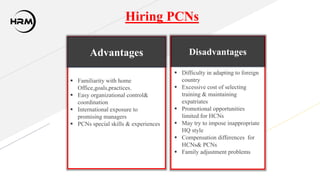
Hiring PCNs
Advantages
 Familiarity with home
Office,goals,practices.
 Easy organizational control&
coordination
 International exposure to
promising managers
 PCNs special skills & experiences
Disadvantages
 Difficulty in adapting to foreign
country
 Excessive cost of selecting
training & maintaining
expatriates
 Promotional opportunities
limited for HCNs
 May try to impose inappropriate
HQ style
 Compensation differences for
HCNs& PCNs
 Family adjustment problems
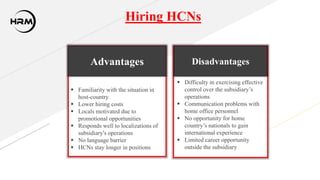
Hiring HCNs
Advantages
 Familiarity with the situation in
host-country
 Lower hiring costs
 Locals motivated due to
promotional opportunities
 Responds well to localizations of
subsidiary's operations
 No language barrier
 HCNs stay longer in positions
Disadvantages
 Difficulty in exercising effective
control over the subsidiary’s
operations
 Communication problems with
home office personnel
 No opportunity for home
country’s nationals to gain
international experience
 Limited career opportunity
outside the subsidiary
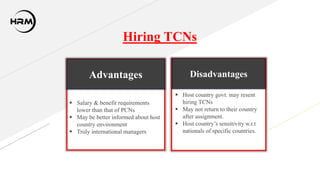
Hiring TCNs
Advantages
 Salary & benefit requirements
lower than that of PCNs
 May be better informed about host
country environment
 Truly international managers
Disadvantages
 Host country govt. may resent
hiring TCNs
 May not return to their country
after assignment.
 Host country’s sensitivity w.r.t
nationals of specific countries.
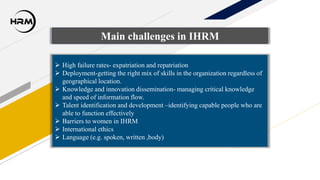
 High failure rates- expatriation and repatriation
 Deployment-getting the right mix of skills in the organization regardless of
geographical location.
 Knowledge and innovation dissemination- managing critical knowledge
and speed of information flow.
 Talent identification and development –identifying capable people who are
able to function effectively
 Barriers to women in IHRM
 International ethics
 Language (e.g. spoken, written ,body)
Main challenges in IHRM
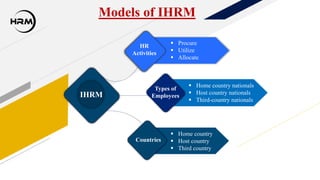
IHRM
 Procure
 Utilize
 Allocate
 Home country nationals
 Host country nationals
 Third-country nationals
 Home country
 Host country
 Third country
HR
Activities
Types of
Employees
Countries
Models of IHRM
IHRM-Presentation.pptx

IHRM-Presentation.pptx

  • 1.
  • 2.
    Presented by Rabeya Bosri-1832049 LaxmyRani Bosue-1832050 Mathia Mim Oishi-1832051 Suraya Jahan-1832064 Tania Sultana-1832065 Farjana Sabnur-1832068 Tanjila Akter-1832070 Joyeta Bosu-1832071
  • 3.
    IHRM can bedefined as set of activities aimed managing organizational human resources at international level to achieve organizational objectives & achieve competitive advantage over competitors at national and international level. IHRM
  • 4.
     Create alocal appeal without compromising upon the global identity  Generating awareness cross-cultural sensitivities among managers globally and hiring of staff across geographic boundaries.  Training upon cultures and sensitivities of the host country. OBJECTIVES
  • 5.
    Functions of internationalhuman resource management: 1.Procurement: HR planning, Staffing (recruitment, selection, placement) 2. Allocation: Compensation (remuneration) and benefits. 3. Utilization: Performance Management ,Training and development, Industrial Relations.
  • 6.
     Business activitiese.g. taxation, international relocation expatriate remuneration ,performance appraisal ,cross-culture training and repatriation.  Increased complexities e.g. currency fluctuations, foreign HR policies and practices, different labor laws.  Increased involvement in employee’s personal life e.g. Personal taxation ,voter registration,housing,children’s education ,health ,recreation n and spouse employment.  Complex employee mix- Culture,Political,Religious, Ethical,educational and legal background .  Increased risks e.g. emergency exists for serious illness, personal security, kidnapping and terrorism. Major differences between Domestic HRM and IHRM
  • 7.
     Emphasis oncore competency to generate competitive advantage.  Reorganization as flat structure due to the essential additional skills that can be met by appointing new managerial talents or by developing the existing human resources.  Competition for human resources in various sectors such as consultancy, merchant banking etc. for acquiring managerial talents.  Technological changes can remove restrictions on technology import and acquisition. Through these can be obtained newer technology.  Different skills and mindsets involved in workforce can be changed due to workforce empowerment. Importance of IHRM
  • 8.
    Characteristics of IHRM More involvement in employee personal lives  More HR activities  Need for a broader perspective  Changes in emphasis as the work force mix of expatriates and local vary.  Risk exposure  More external influences.
  • 9.
    More HR Activities Human Resource Planning Employee Hiring Training& Development  Difficulty in implementing HR in host countries.  Aligning strategic business planning to HRO & vice –versa.  Developmental opportunities for international managers.  Ability to mix with organization’s culture  Ethnocentric, polycentric or geocentric staffing approach.  Selection of expatriates  Coping with expatriate failure  Emphasis on cultural training  Language training  Training in manners & mannerism compensation  Devising an appropriate strategy to compensate expatriate  Minimizing discrepancies in pay between parent ,host& third country nationals  Issues relating to the re-entry of expatriates into the home country
  • 10.
    Pay issues Health insurancefor employees & their families Overtime working – Korean & Japanese firms Need for Broader Perspectives Promotions based on seniority or merit  Different countries ,different currencies.  Gender based pay in Korea,Japan,Indonesia.
  • 11.
    Globalizations of business EffectiveHRM Determination of success in international business. Movement to network organizations from traditional hierarchical structures Significant role in implementation & control of Strategies Reasons for Growing interest in IHRM
  • 12.
    Cultural factors EconomicSystems International Human Resource Management Legal & Industrial Relations Factors Major factors Affect IHRM
  • 13.
    Hiring PCNs Advantages  Familiaritywith home Office,goals,practices.  Easy organizational control& coordination  International exposure to promising managers  PCNs special skills & experiences Disadvantages  Difficulty in adapting to foreign country  Excessive cost of selecting training & maintaining expatriates  Promotional opportunities limited for HCNs  May try to impose inappropriate HQ style  Compensation differences for HCNs& PCNs  Family adjustment problems
  • 14.
    Hiring HCNs Advantages  Familiaritywith the situation in host-country  Lower hiring costs  Locals motivated due to promotional opportunities  Responds well to localizations of subsidiary's operations  No language barrier  HCNs stay longer in positions Disadvantages  Difficulty in exercising effective control over the subsidiary’s operations  Communication problems with home office personnel  No opportunity for home country’s nationals to gain international experience  Limited career opportunity outside the subsidiary
  • 15.
    Hiring TCNs Advantages  Salary& benefit requirements lower than that of PCNs  May be better informed about host country environment  Truly international managers Disadvantages  Host country govt. may resent hiring TCNs  May not return to their country after assignment.  Host country’s sensitivity w.r.t nationals of specific countries.
  • 16.
     High failurerates- expatriation and repatriation  Deployment-getting the right mix of skills in the organization regardless of geographical location.  Knowledge and innovation dissemination- managing critical knowledge and speed of information flow.  Talent identification and development –identifying capable people who are able to function effectively  Barriers to women in IHRM  International ethics  Language (e.g. spoken, written ,body) Main challenges in IHRM
  • 17.
    IHRM  Procure  Utilize Allocate  Home country nationals  Host country nationals  Third-country nationals  Home country  Host country  Third country HR Activities Types of Employees Countries Models of IHRM