Presented By
Jyoti Verma
Strategic Role In Global
Environment
We are living in a vastly altered world where societal expectations of
businesses have changed dramatically. At the cornerstone of the discourses
dealing with human resources (HR), corporate social responsibility, corporate
governance, and sustainability, are humans—their rights, their aspirations, and
advancement. Humans are pivotal to both global corporations‟ survival and
the wealth of nations. Never before has the pressure on organizations, to
ensure that the basic rights of humans are protected and respected both within
them and the communities they operate in, been greater. The purpose of this
paper will be to review current worldwide trends and practices of leading
corporations (profit and non-profit) in their management of human resources
and social responsibility. An examination of the responsibilities of these
global corporations will be made, and recommendations for reconciling these
dual responsibilities and reshaping global HR practices will be presented.
 International trade is growing at a more rapid
rate than world output
 Foreign direct investment (FDI) flows have set
record levels in recent years
 Cross-border inter-firm agreements have risen
dramatically during the last 20 years
 Social, economic, and political developments
throughout the world have changed the way
global business is conducted.
Global strategic HRM augments the
 Importance of resource flexibility,
 Strategic leadership,
 Human capital,
 Technological and manufacturing advances
 Cooperative synergies between organizational
culture and structure
The report examines the changing roles the human
resource (HR) function plays in a globally
competitive marketplace and identifies the
challenges of:
 Investigate how domestic and international
companies conduct HR practices around the
world.
 Determine the top HR priorities for each
organization type.
 Determine the challenges that organizations
face when trying to globalize their HR
function, practices and policies to service
staffing need abroad.
 Determine what organizations are doing to
institute a consistent corporate culture
across all locations/offices.
 Creating organization structures capable of
balancing centralized home office control wit
adequate autonomy.
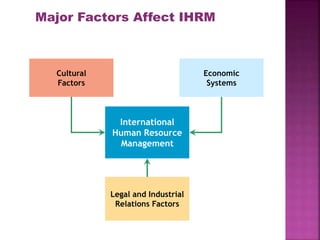
International
Human Resource
Management
Cultural
Factors
Legal and Industrial
Relations Factors
Economic
Systems
Major Factors Affect IHRM
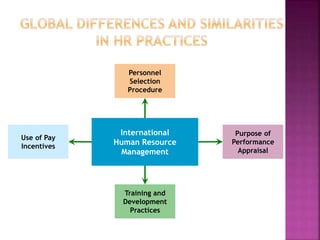
International
Human Resource
Management
Training and
Development
Practices
Use of Pay
Incentives
Purpose of
Performance
Appraisal
Personnel
Selection
Procedure
International companies face
many challenges when try to
make HR Practices consistent
across all the locations/offices.
Top Three challenges included:
 Variations in social, political and economic
circumstances.
 Different locations/offices have their own
way of doing things are resistant to change.
 The perceived value of the HR function
varies across locations/offices.
 Relational competence to navigate the global
network knowledge base through consensus
building, accountability charting, conflict
management, performance contracting and
innovation management.
 Managerial competence to design creative
human resource allocations, negotiate
concerted strategies, and structure
multiparty relationships.
 Motivational leadership in incentivizing units
to demonstrate and share skills at joint human
resource management problem solving.
 Cross-functional competence in auditing
managerial loss of control and difficulties in
assessing network accountability in terms of
human resource management adaptations.
Developed a long –
term HR plan to ensure
alignment of HR
strategies/objectives
with corporate
objectives.
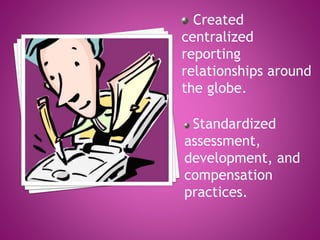
Created centralized
reporting relationships
around the globe.
Created
centralized
reporting
relationships around
the globe.
Standardized
assessment,
development, and
compensation
practices.
Standardized
assessment,
development, and
compensation
practices.
Introduced practices
to regions around the
globe and allowed the
HR function in each
region the autonomy to
do job.
Introduced practices
to regions around the
globe and allowed the
HR function in each
region the autonomy to
do job.
Created global
policies/processes for
data management,
performance
management,
compensation,
education, and
development.
Tied regional
accountability to
performance
management.
Shared HR best
practices used in
certain
locations with all
other locations.
Developed an HR
mission statement.
Finding, developing, and retaining global
leaders tops the priority list of international
companies. International, or expatriate,
assignments are often used as a way to
develop the talent of global leaders.
Host Country Nationals (HCNs)
 employees from the local population.
 referred to as local nationals.
 employees sent from the country in
which the organization is headquartered
referred to as expatriates.
Host Country Nationals (HCNs)
Third Country Nationals (TCNs)
 employees from a country other than
where the parent organization’s
headquarters or operations are located
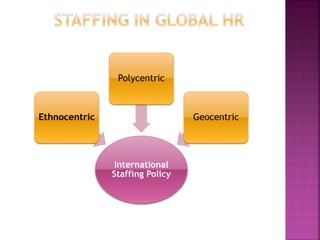
International
Staffing Policy
Ethnocentric
Polycentric
Geocentric
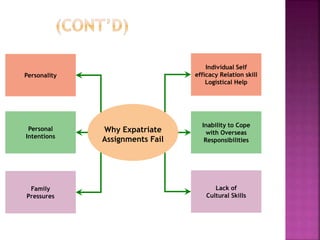
Individual Self
efficacy Relation skill
Logistical Help
Inability to Cope
with Overseas
Responsibilities
Lack of
Cultural Skills
Why Expatriate
Assignments Fail
Personality
Personal
Intentions
Family
Pressures
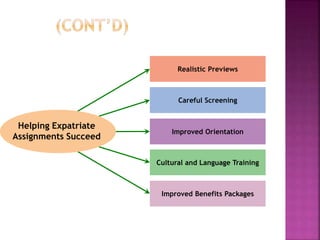
Realistic Previews
Careful Screening
Cultural and Language Training
Improved Benefits Packages
Improved Orientation
Helping Expatriate
Assignments Succeed
 Interviews
For face-to-face interviews found that
interviewers had to be trained in cross-cultural
differences.
 Adaptability Screening
 Assessing the assignee’s (and spouse’s) probable success
in handling the foreign transfer.
 Overseas Assignment Inventory
A test that identifies the characteristics and
attitudes international assignment candidates
should have.
 Realistic Previews
 The problems to expect in the new job, as well as the
cultural benefits, problems, and idiosyncrasies of the
country.
 Psychological Testing
Psychological tests may be seen as a way of
avoiding the subjective bias of other options. I
The greater international mobility of candidates
has increased the demand for tests to be used
on job applicants from different countries.
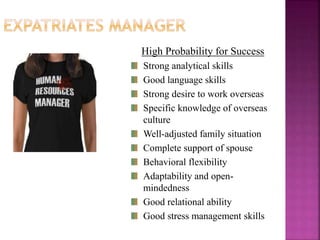
High Probability for Success
Strong analytical skills
Good language skills
Strong desire to work overseas
Specific knowledge of overseas
culture
Well-adjusted family situation
Complete support of spouse
Behavioral flexibility
Adaptability and open-
mindedness
Good relational ability
Good stress management skills
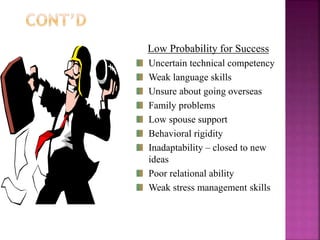
Low Probability for Success
Uncertain technical competency
Weak language skills
Unsure about going overseas
Family problems
Low spouse support
Behavioral rigidity
Inadaptability – closed to new
ideas
Poor relational ability
Weak stress management skills
 Culture Shock – the frustration and confusion that
result from being constantly subjected to strange
and unfamiliar cues about what to do and how to
get it done
Does not typically occur during the earliest days of an
overseas assignment
Communicated to all locations about a common
corporate culture.
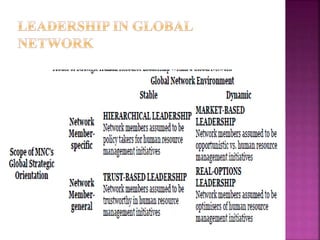
 Managerial issues like the leadership of the
organization is dispersed throughout the global
system top management must recognize the
impact on the organizational hierarchy.
 The top management of the organization must
recognize that strategic initiatives may be
generated by subsidiaries and shared with other
subsidiaries rather than having to come from
headquarters.
 The governance and control mechanism of the
global network organization will need to be
modified to allow localized decision-making.
 The selection process for subsidiary
management must be modified to align it with
the role of the key subsidiary managers and the
modified independence of the subsidiaries
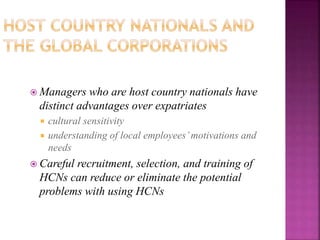
 Managers who are host country nationals have
distinct advantages over expatriates
 cultural sensitivity
 understanding of local employees’motivations and
needs
 Careful recruitment, selection, and training of
HCNs can reduce or eliminate the potential
problems with using HCNs
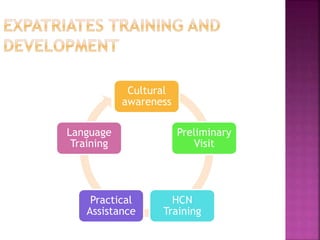
Cultural
awareness
Preliminary
Visit
HCN
Training
Practical
Assistance
Language
Training
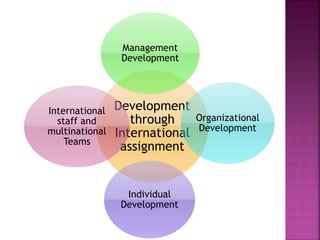
Development
through
International
assignment
Management
Development
Organizational
Development
Individual
Development
International
staff and
multinational
Teams
While developing international compensation
policies, a firms seeks to satisfy several
objectives:
 Policy should be consistent
with the overall strategy,
structure and business need of
the multinational
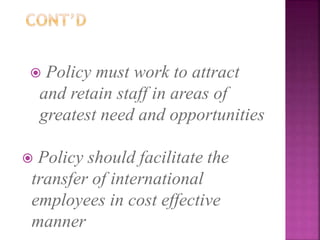
 Policy must work to attract
and retain staff in areas of
greatest need and opportunities
 Policy should facilitate the
transfer of international
employees in cost effective
manner
 The policy must give due
consideration to equity and
ease of administrations.
 The “Balance Sheet Approach”
 Home-country groups of expenses—income taxes,
housing, goods and services, and discretionary
expenses—are the focus of attention.
 The employer estimates what each of these four
expenses is in the expatriate’s home country, and
what each will be in the host country.
 The employer then pays any differences such as
additional income taxes or housing expenses.
Local Going Rate Approach
 This can be desirable in high-paying
countries such as the US of Switzerland
 The market rate is also preferred when the
assignment is likely to be long term or
permanent.
 The main advantage of this method that it
is administratively simpler than the balance
sheet.
 Hybrid Approach
This approach refer variation of
the greater of home or host
system where a balance sheet is
compared to local market rate
equivalent.
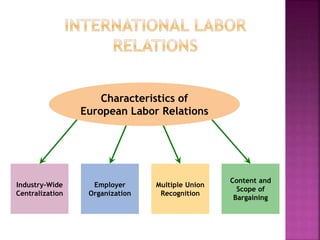
Industry-Wide
Centralization
Content and
Scope of
Bargaining
Employer
Organization
Multiple Union
Recognition
Characteristics of
European Labor Relations
 MNCs faced with the demands of
integration and control, have to always
decide which is most important –the
company as a whole or each
subsidiary’s short term profitability.
 Unpredictable Global Environment.
 Time and distance separation.
Variability in level of maturity.
 Communication Gap.
 Lack of technical knowledge.
 Lack of domestic management's
international experience.
 Operational language used in the firm
 Cultural ‘distance’ based often on the
region of the world.
 Stability of the factors affecting the
expatriate's performance.
 Be objective in evaluation.
 Criteria for evaluation of performance.
 Flexibility in structure strategy to
implement change.
Some vital criteria for successful
performance for manager abroad are:
Inter-personal understanding and
respect.
 Empowerment to share information
and delegate resposibility.
 Team support to help employees
cooperate.
 Versatility to adjust in new
environment.
 Strategic thinking to grasp changing
environment and market possibilities.
 Relationship management to influence
and seek the cooperation of customer,
trade union, government institutions
and lobby activities.
Business practices that are considered
unethical or illegal in the U.S. might be
considered part of the national conduct of
business in other countries
Foreign Corrupt Practices Act of 1977
(FCPA)
Employment discrimination
Global human resource management
is an important component of an
organization’s success in a global
marketplace
Organizations must be sure that their
HRM policies can accommodate a
culturally diverse workforce
My PPT(Global Human Resource).ppt

My PPT(Global Human Resource).ppt

  • 1.
    Presented By Jyoti Verma StrategicRole In Global Environment
  • 2.
    We are livingin a vastly altered world where societal expectations of businesses have changed dramatically. At the cornerstone of the discourses dealing with human resources (HR), corporate social responsibility, corporate governance, and sustainability, are humans—their rights, their aspirations, and advancement. Humans are pivotal to both global corporations‟ survival and the wealth of nations. Never before has the pressure on organizations, to ensure that the basic rights of humans are protected and respected both within them and the communities they operate in, been greater. The purpose of this paper will be to review current worldwide trends and practices of leading corporations (profit and non-profit) in their management of human resources and social responsibility. An examination of the responsibilities of these global corporations will be made, and recommendations for reconciling these dual responsibilities and reshaping global HR practices will be presented.
  • 3.
     International tradeis growing at a more rapid rate than world output  Foreign direct investment (FDI) flows have set record levels in recent years  Cross-border inter-firm agreements have risen dramatically during the last 20 years  Social, economic, and political developments throughout the world have changed the way global business is conducted.
  • 4.
    Global strategic HRMaugments the  Importance of resource flexibility,  Strategic leadership,  Human capital,  Technological and manufacturing advances  Cooperative synergies between organizational culture and structure
  • 6.
    The report examinesthe changing roles the human resource (HR) function plays in a globally competitive marketplace and identifies the challenges of:  Investigate how domestic and international companies conduct HR practices around the world.  Determine the top HR priorities for each organization type.
  • 7.
     Determine thechallenges that organizations face when trying to globalize their HR function, practices and policies to service staffing need abroad.  Determine what organizations are doing to institute a consistent corporate culture across all locations/offices.  Creating organization structures capable of balancing centralized home office control wit adequate autonomy.
  • 8.
    International Human Resource Management Cultural Factors Legal andIndustrial Relations Factors Economic Systems Major Factors Affect IHRM
  • 9.
    International Human Resource Management Training and Development Practices Useof Pay Incentives Purpose of Performance Appraisal Personnel Selection Procedure
  • 10.
    International companies face manychallenges when try to make HR Practices consistent across all the locations/offices.
  • 11.
    Top Three challengesincluded:  Variations in social, political and economic circumstances.  Different locations/offices have their own way of doing things are resistant to change.  The perceived value of the HR function varies across locations/offices.
  • 12.
     Relational competenceto navigate the global network knowledge base through consensus building, accountability charting, conflict management, performance contracting and innovation management.  Managerial competence to design creative human resource allocations, negotiate concerted strategies, and structure multiparty relationships.
  • 13.
     Motivational leadershipin incentivizing units to demonstrate and share skills at joint human resource management problem solving.  Cross-functional competence in auditing managerial loss of control and difficulties in assessing network accountability in terms of human resource management adaptations.
  • 14.
    Developed a long– term HR plan to ensure alignment of HR strategies/objectives with corporate objectives. Created centralized reporting relationships around the globe.
  • 15.
  • 16.
    Standardized assessment, development, and compensation practices. Introduced practices toregions around the globe and allowed the HR function in each region the autonomy to do job.
  • 17.
    Introduced practices to regionsaround the globe and allowed the HR function in each region the autonomy to do job. Created global policies/processes for data management, performance management, compensation, education, and development.
  • 18.
    Tied regional accountability to performance management. SharedHR best practices used in certain locations with all other locations. Developed an HR mission statement.
  • 19.
    Finding, developing, andretaining global leaders tops the priority list of international companies. International, or expatriate, assignments are often used as a way to develop the talent of global leaders.
  • 20.
    Host Country Nationals(HCNs)  employees from the local population.  referred to as local nationals.
  • 21.
     employees sentfrom the country in which the organization is headquartered referred to as expatriates. Host Country Nationals (HCNs) Third Country Nationals (TCNs)  employees from a country other than where the parent organization’s headquarters or operations are located
  • 22.
  • 23.
    Individual Self efficacy Relationskill Logistical Help Inability to Cope with Overseas Responsibilities Lack of Cultural Skills Why Expatriate Assignments Fail Personality Personal Intentions Family Pressures
  • 24.
    Realistic Previews Careful Screening Culturaland Language Training Improved Benefits Packages Improved Orientation Helping Expatriate Assignments Succeed
  • 25.
     Interviews For face-to-faceinterviews found that interviewers had to be trained in cross-cultural differences.  Adaptability Screening  Assessing the assignee’s (and spouse’s) probable success in handling the foreign transfer.  Overseas Assignment Inventory A test that identifies the characteristics and attitudes international assignment candidates should have.
  • 26.
     Realistic Previews The problems to expect in the new job, as well as the cultural benefits, problems, and idiosyncrasies of the country.  Psychological Testing Psychological tests may be seen as a way of avoiding the subjective bias of other options. I The greater international mobility of candidates has increased the demand for tests to be used on job applicants from different countries.
  • 27.
    High Probability forSuccess Strong analytical skills Good language skills Strong desire to work overseas Specific knowledge of overseas culture Well-adjusted family situation Complete support of spouse Behavioral flexibility Adaptability and open- mindedness Good relational ability Good stress management skills
  • 28.
    Low Probability forSuccess Uncertain technical competency Weak language skills Unsure about going overseas Family problems Low spouse support Behavioral rigidity Inadaptability – closed to new ideas Poor relational ability Weak stress management skills
  • 29.
     Culture Shock– the frustration and confusion that result from being constantly subjected to strange and unfamiliar cues about what to do and how to get it done Does not typically occur during the earliest days of an overseas assignment Communicated to all locations about a common corporate culture.
  • 30.
     Managerial issueslike the leadership of the organization is dispersed throughout the global system top management must recognize the impact on the organizational hierarchy.  The top management of the organization must recognize that strategic initiatives may be generated by subsidiaries and shared with other subsidiaries rather than having to come from headquarters.
  • 31.
     The governanceand control mechanism of the global network organization will need to be modified to allow localized decision-making.  The selection process for subsidiary management must be modified to align it with the role of the key subsidiary managers and the modified independence of the subsidiaries
  • 32.
     Managers whoare host country nationals have distinct advantages over expatriates  cultural sensitivity  understanding of local employees’motivations and needs  Careful recruitment, selection, and training of HCNs can reduce or eliminate the potential problems with using HCNs
  • 33.
  • 34.
  • 35.
    While developing internationalcompensation policies, a firms seeks to satisfy several objectives:  Policy should be consistent with the overall strategy, structure and business need of the multinational
  • 36.
     Policy mustwork to attract and retain staff in areas of greatest need and opportunities  Policy should facilitate the transfer of international employees in cost effective manner
  • 37.
     The policymust give due consideration to equity and ease of administrations.
  • 38.
     The “BalanceSheet Approach”  Home-country groups of expenses—income taxes, housing, goods and services, and discretionary expenses—are the focus of attention.  The employer estimates what each of these four expenses is in the expatriate’s home country, and what each will be in the host country.  The employer then pays any differences such as additional income taxes or housing expenses.
  • 39.
    Local Going RateApproach  This can be desirable in high-paying countries such as the US of Switzerland  The market rate is also preferred when the assignment is likely to be long term or permanent.  The main advantage of this method that it is administratively simpler than the balance sheet.
  • 40.
     Hybrid Approach Thisapproach refer variation of the greater of home or host system where a balance sheet is compared to local market rate equivalent.
  • 41.
    Industry-Wide Centralization Content and Scope of Bargaining Employer Organization MultipleUnion Recognition Characteristics of European Labor Relations
  • 42.
     MNCs facedwith the demands of integration and control, have to always decide which is most important –the company as a whole or each subsidiary’s short term profitability.  Unpredictable Global Environment.
  • 43.
     Time anddistance separation. Variability in level of maturity.  Communication Gap.  Lack of technical knowledge.  Lack of domestic management's international experience.
  • 44.
     Operational languageused in the firm  Cultural ‘distance’ based often on the region of the world.  Stability of the factors affecting the expatriate's performance.
  • 45.
     Be objectivein evaluation.  Criteria for evaluation of performance.  Flexibility in structure strategy to implement change. Some vital criteria for successful performance for manager abroad are:
  • 46.
    Inter-personal understanding and respect. Empowerment to share information and delegate resposibility.  Team support to help employees cooperate.
  • 47.
     Versatility toadjust in new environment.  Strategic thinking to grasp changing environment and market possibilities.  Relationship management to influence and seek the cooperation of customer, trade union, government institutions and lobby activities.
  • 48.
    Business practices thatare considered unethical or illegal in the U.S. might be considered part of the national conduct of business in other countries Foreign Corrupt Practices Act of 1977 (FCPA) Employment discrimination
  • 49.
    Global human resourcemanagement is an important component of an organization’s success in a global marketplace Organizations must be sure that their HRM policies can accommodate a culturally diverse workforce