



Marketing
Innovation
Products
Strategy and Strategic
Innovation
 Strategy is the long term plan to achieve the
desired goals and objectives
 Strategic Innovation includes innovative business
models, to make a business more competitive. It
leads to either:
 New business models (including a new value chain
architecture)
 New Markets
 Increased value for both the customer and the
company
 Combination of all the above
Features of Strategic
Innovation
 A frame work of independent content,
process and context dimensions
 Application of creativity and innovation to
strategic management
 Acts as an enabler strategic differentiation
and competitive advantage
 By challenging conventional logic and
redefining the company’s business model,
redrawing market boundaries, creating new
markets and value improvements for
customers and company itself.
Dimensions of Strategic
innovation
 Industry foresight – Top-Down Approach
 Customer insight – Bottom – Up Approach
 Strategic Alignment
 Internal Alignment and External Alignment
 Core technologies
 Disciplined implementation
 Organizational Readiness
 Cultural; Process and Structural readiness
 Managed innovation process
 Divergent and Convergent thinking
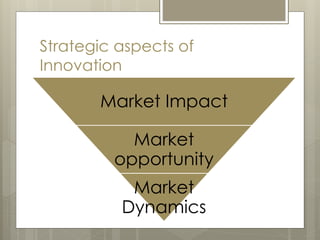
Strategic aspects of
Innovation
Market Impact
Market
opportunity
Market
Dynamics
Market Dynamics
 Change in external environment is very
dynamic and demands the business to
respond dynamically
Market Opportunity
 Understanding Market Dynamics provides
opportunities
 Eg.,
 3M – Scrotch brite
 Odomos mosquito repellent cream
 Amruthanjan comin with gel cream and
sprays
 Iodex changing from brown color cream to
gel and sprays
Market Impact
 How is the market responding to the new
product?
 Is the price-performance equation
perfect?
 Are there any gaps in existing products?
 Is there scope for improvement?
 Is the introduction of new product
triggering action by competitors?
Corporate Strategy
 Cost-Leadership
 Differentiation
 Focus
Innovation Platforms
incorporating NPD
 When business strengths are able to meet
opportunities in the market, becomes a
platform for strategic innovation and
helps a business take actions for
commercialising the business and
forecasting the market impact.
Advantages of Plan of Action
 Faster Decisions
 More autonomy to teams
 Encourages intrapreneurship
 Encourages team ownership
 Economies of scale
 Economies of scope
Case: Apple’s Innovation
Platform
 Apple’s Ipad is a mass-produced product.
Using this as a base other parties can
create and capture value with their own
apps. Apple has maintained greater
control over how something is developed.
Apple is also particular how value is
captured, but apple’s platform has found
wider applications.
New Product Development
 New product are those which are really
innovative and truly unique replacements
for existing products that are significantly
different from the others
Strategic reasons for NPD
 Deviations in consumer demands
 Foundation of competitive advantage
 Provide long term ROI
 Optimum utilisation of existing production and
operations.
 Leads to capitalisation on research and
development
 Influence brand equity
 Enhance corporate image
 Helps in meeting environmental threats
Types of New Products
 Discontinuous Innovation
 Eg., Innovative car, Laptop etc
 Category Extension
 Eg., Dell manufacturing Mobile phones
 Line Extension
 Eg., P&G adding new products to its line
 Product Improvement
 Eg., Toyota Cars
 Repositioned Products
 Eg., Liril comin with modification and repositioning
 Lower Priced Products
 Eg., Nirma, surf excel price wars
DSM’s Innovation Platform
Dutch Life science’s company aims to build an intrinsically
innovative a company using innovation platforms instead of single
projects. This helps in proper estimation of the risks in the
beginning. Opportunities in the market also get defined properly.
Projects are properly grouped in well-defined platforms.
DSM’s Chief innovation officer Rob van Leen says,
“Projects can fail but you can’t kill an opportunity”. The innovation
pipeline in DSM is used for looking at related opportunities. The
burden of innovation is shared by the platforms. Passion,
ownership and drive contribute to success of innovation in DSM.
Even smaller projects get visibility due to the platform approach.
Opportunities are given more importance than projects.
Platforms encourage innovation to think more broadly across the
value chain. They also foster team spirit and energise the team
members to put in their best. Platforms make the organisation
more respective to open source innovation. Collective decision
making increases the chances of success because risks are better
understood. This makes it easy to migrate the risks.
Factors influencing a New
Products success
 Right product, right time and right message
 Concentrate on providing a solution
 Recognize and nurture core capabilities of the
company
 Proper working environment
 Support from top management
 Disciplined new product development process
 Dedicated development teams
 Effective communication to the targeted audience
 Appropriate business strategies
 Understanding the external environment
Factors influencing a New
Products success
 Identifying market opportunities that fit core
competencies
 Proper understanding of consumer needs and
wants
 Wide range of product ideas
 Clear and focused product definition
 Superior and differentiated product and
package
 Effective category and management philosophy
 Well-executed launch
 Effective promotional strategies
New product development
Process
 NPD Strategy
 Generation of New product ideas
 Idea screening and business analysis
 Concept development and testing
 Marketing strategy development
 Business Analysis
 Product development
 Market testing
 Commercialisation
1: New Product strategy
 Focus on new idea/concept generation
and guidelines for establishing screening
criteria keeping company objectives in
mind
 Identifying the strategic business
requirements that the new product should
comply with.
2: Generation of New product
ideas
 Objectives of this stage are:
 Ideas for new products
 New attribute for existing products
 New uses of existing products
 Sources of New Product ideas:
 Customers
 Competitors
 Employees
 R&D
 Licensing
 Marketing research agencies
 Distribution channels
3: Idea screening and Business
analysis
 Criteria for Ide screening
 Market feasibility
 Technical feasibility
 Potential competition
 Compatibility with the promoter
 Consistency with governmental priorities
 Growth potential
 Ensure acceptable growth
 Competitive price
 Should meet company’s objectives and goals
 Availability of resources
 Ensure capital requirements within manageable limits
4: Concept development and
testing
 Concept testing is defined as “ A printed or filmed
representation of a product or service. It is a device
to communicate the subject’s benefits, strengths
and reasons for being”.
 Objectives of Concept testing
 To get customer feedback about new product idea
 To assess relative attractiveness of the ideas
 To understand strengths and weaknesses of each idea
 To know customers product rating
 To direct the development of the project
 To select the most promising concept for product
development
 To ascertain the product potential for its
commercialisation
5: Marketing Strategy
development
 Marketing Plan should consist of three parts:
 First Part
 Target Market size
 Structure
 Behaviour
 Sales volume
 Market share
 Profit goals
 Planned product positioning
 Second Part
 Planned price
 Distribution strategy
 Marketing budget for the year
 Third Part
 Long run sales
 Profit goals
 Marketing mix strategy over time
6: Business analysis
 Forecasting Market opportunity
 Forecasting sales
 Financial forecasting
7: Product Development
 An Organisation must ensure following:
 Establish a product with desired characteristics
 Production at minimal cost
 Produce as per demand forecast
 Product attributes must the customers
requirements
 Adequate testing of product for quality
 Estimate forecasted sales
 Appropriate budgeting
 Satisfactory ROI
 Provide for testing the product
8: Market Testing
 Simulation Testing: Launching a product in few selected areas
to test feasibility and functionality of the product
 The main purpose is to provide final and total validation of the
entire project; the commercial viability of the product, its
production, and its marketing
 Characteristics of Market testing
 High advertising costs
 High manufacturing costs
 Lack of economies of scale
 Low volume of production
 High distribution costs
 Benefits of Market testing
 Helps to determine product’s likely performance
 Helps in understanding product’s functional performance
 Provides information about customer perception
 Helps to understand market response
 Provides opportunity to make necessary changes
 Helps in effective marketing mix plan
9: Commercialisation
 Roles of Marketing Manager
 Product must be channelized appropriately to
support the new product planning
 Recognize the situational aspects of market entry
 Need to decide the introduction timing
 Ensure effective maintenance and servicing facility
 Clarify the strategic importance of market entry
decision
 Ensure intensive selling
 Formulate the market entry decision problem
 Ensure widespread availability of the product
through distribution channel
 Effective promotion to create awareness of the
new product
Process Innovation
 Is the implementation of the new or
significantly improved production or
delivery method
 Includes changes in technique,
equipment or even the software
 Ex: 3D modelling, Automation in
manufacturing process, Robotics,
Scanners, Barcodes, E-tailing, tracking of
parcels, etc.,
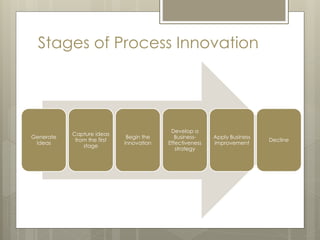
Stages of Process Innovation
Generate
Ideas
Capture ideas
from the first
stage
Begin the
innovation
Develop a
Business-
Effectiveness
strategy
Apply Business
improvement
Decline
Support for Process Innovation
 Policies and procedures
 Performance management frameworks
 Well defined Organization structure
 Use of state-of-the-art technology
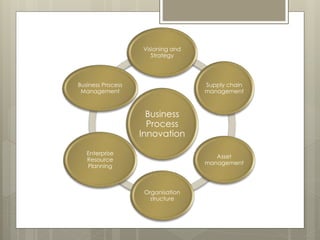
Business
Process
Innovation
Visioning and
Strategy
Supply chain
management
Asset
management
Organisation
structure
Enterprise
Resource
Planning
Business Process
Management
Improving Process Innovation’s
effectiveness
 Streamlining and sharing of existing processes
 Improved service delivery
 Automation of workflows
 A supporting infrastructure
 Strategic approach to managing supply
chains
 Increased operational efficiency
 Reduction in costs
 Increase in revenues
Service Innovation
 Is a new or significantly improved service
concept that is taken into practice
 Types of service innovation
 Innovation in service/Service products
 Innovation in service process
Innovation in services, in
service products
• May include technological elements
• Related to service design and new service
development
• Ex., Retail stores providing home delivery
• Beauty parlour providing services at home
• Bigbasket.com, E-tailers like amazon,
flipkart, delivering products to home
Innovation in service process
• May include service delivery systems
• Technique or expertise based services
• Ex., Doctors introducing appointments to
reduce waiting time of patients
• E-tailers introducing COD system as
customers were scared of using Credit
cards online.
• Air tickets can be booked online much
before the travel date.
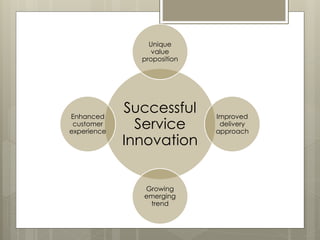
Successful
Service
Innovation
Unique
value
proposition
Improved
delivery
approach
Growing
emerging
trend
Enhanced
customer
experience
Areas of Innovation – Den
Hertog’s model
 The Service Concept
 New types of bank accounts, Information
services, Online auctions etc.,
 The Client interface
 Internet banking, ATM’s, etc.,
 The Service delivery system
 Home delivery system
 B2B delivery is called as Servuction =
Service+Production
 Technological options
 Phone banking, etc.,
Patterns of Service Innovation
 Pattern 1: Supplier-Dominated Service
 These innovations from external suppliers are
disseminated and implemented by service
industry
 Ex., Microwave oven in catering,
 Cash registers POS
 Pattern 2: Innovation within services
 Innovation and implementation is initiated and
takes place at the service firm
 Ex., New shop formulas by retailers
 New pension and savings schemes
Patterns of Service Innovation
 Pattern 3:Client led innovation
 Innovation clearly articulated by the clients
 Ex., Door-to-door public transport aimed at business
traveller
 Green banking services, invest in a socially responsible
way
 Pattern 4: Paradigmatic Innovations
 Arise when complex and pervasive innovations affecting
all actors in a value chain profoundly are involved
 Ex., Very densely populated area, the regular transport
of goods is no longer possible and the decision to switch
to underground transport was taken by both parties
involved in the value chain and have to change
pratices
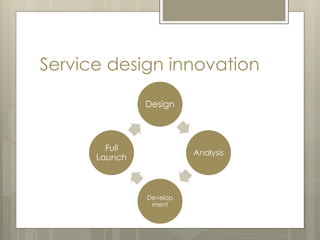
Service design innovation
Design
Analysis
Develop
ment
Full
Launch
Portfolio and Standard
 Portfolio is grouping of financial assets
such as stocks, bonds and cash
equivalents, as well as their mutual,
exchange-traded and closed-fund
counterparts
 Portfolio Evaluation refers to the
evaluation of the performance of the
portfolio

Innovation Management for BU syllabus

  • 1.
  • 2.
    Strategy and Strategic Innovation Strategy is the long term plan to achieve the desired goals and objectives  Strategic Innovation includes innovative business models, to make a business more competitive. It leads to either:  New business models (including a new value chain architecture)  New Markets  Increased value for both the customer and the company  Combination of all the above
  • 3.
    Features of Strategic Innovation A frame work of independent content, process and context dimensions  Application of creativity and innovation to strategic management  Acts as an enabler strategic differentiation and competitive advantage  By challenging conventional logic and redefining the company’s business model, redrawing market boundaries, creating new markets and value improvements for customers and company itself.
  • 4.
    Dimensions of Strategic innovation Industry foresight – Top-Down Approach  Customer insight – Bottom – Up Approach  Strategic Alignment  Internal Alignment and External Alignment  Core technologies  Disciplined implementation  Organizational Readiness  Cultural; Process and Structural readiness  Managed innovation process  Divergent and Convergent thinking
  • 5.
    Strategic aspects of Innovation MarketImpact Market opportunity Market Dynamics
  • 6.
    Market Dynamics  Changein external environment is very dynamic and demands the business to respond dynamically
  • 7.
    Market Opportunity  UnderstandingMarket Dynamics provides opportunities  Eg.,  3M – Scrotch brite  Odomos mosquito repellent cream  Amruthanjan comin with gel cream and sprays  Iodex changing from brown color cream to gel and sprays
  • 8.
    Market Impact  Howis the market responding to the new product?  Is the price-performance equation perfect?  Are there any gaps in existing products?  Is there scope for improvement?  Is the introduction of new product triggering action by competitors?
  • 9.
  • 10.
    Innovation Platforms incorporating NPD When business strengths are able to meet opportunities in the market, becomes a platform for strategic innovation and helps a business take actions for commercialising the business and forecasting the market impact.
  • 11.
    Advantages of Planof Action  Faster Decisions  More autonomy to teams  Encourages intrapreneurship  Encourages team ownership  Economies of scale  Economies of scope
  • 12.
    Case: Apple’s Innovation Platform Apple’s Ipad is a mass-produced product. Using this as a base other parties can create and capture value with their own apps. Apple has maintained greater control over how something is developed. Apple is also particular how value is captured, but apple’s platform has found wider applications.
  • 13.
    New Product Development New product are those which are really innovative and truly unique replacements for existing products that are significantly different from the others
  • 14.
    Strategic reasons forNPD  Deviations in consumer demands  Foundation of competitive advantage  Provide long term ROI  Optimum utilisation of existing production and operations.  Leads to capitalisation on research and development  Influence brand equity  Enhance corporate image  Helps in meeting environmental threats
  • 15.
    Types of NewProducts  Discontinuous Innovation  Eg., Innovative car, Laptop etc  Category Extension  Eg., Dell manufacturing Mobile phones  Line Extension  Eg., P&G adding new products to its line  Product Improvement  Eg., Toyota Cars  Repositioned Products  Eg., Liril comin with modification and repositioning  Lower Priced Products  Eg., Nirma, surf excel price wars
  • 16.
    DSM’s Innovation Platform DutchLife science’s company aims to build an intrinsically innovative a company using innovation platforms instead of single projects. This helps in proper estimation of the risks in the beginning. Opportunities in the market also get defined properly. Projects are properly grouped in well-defined platforms. DSM’s Chief innovation officer Rob van Leen says, “Projects can fail but you can’t kill an opportunity”. The innovation pipeline in DSM is used for looking at related opportunities. The burden of innovation is shared by the platforms. Passion, ownership and drive contribute to success of innovation in DSM. Even smaller projects get visibility due to the platform approach. Opportunities are given more importance than projects. Platforms encourage innovation to think more broadly across the value chain. They also foster team spirit and energise the team members to put in their best. Platforms make the organisation more respective to open source innovation. Collective decision making increases the chances of success because risks are better understood. This makes it easy to migrate the risks.
  • 17.
    Factors influencing aNew Products success  Right product, right time and right message  Concentrate on providing a solution  Recognize and nurture core capabilities of the company  Proper working environment  Support from top management  Disciplined new product development process  Dedicated development teams  Effective communication to the targeted audience  Appropriate business strategies  Understanding the external environment
  • 18.
    Factors influencing aNew Products success  Identifying market opportunities that fit core competencies  Proper understanding of consumer needs and wants  Wide range of product ideas  Clear and focused product definition  Superior and differentiated product and package  Effective category and management philosophy  Well-executed launch  Effective promotional strategies
  • 19.
    New product development Process NPD Strategy  Generation of New product ideas  Idea screening and business analysis  Concept development and testing  Marketing strategy development  Business Analysis  Product development  Market testing  Commercialisation
  • 20.
    1: New Productstrategy  Focus on new idea/concept generation and guidelines for establishing screening criteria keeping company objectives in mind  Identifying the strategic business requirements that the new product should comply with.
  • 21.
    2: Generation ofNew product ideas  Objectives of this stage are:  Ideas for new products  New attribute for existing products  New uses of existing products  Sources of New Product ideas:  Customers  Competitors  Employees  R&D  Licensing  Marketing research agencies  Distribution channels
  • 22.
    3: Idea screeningand Business analysis  Criteria for Ide screening  Market feasibility  Technical feasibility  Potential competition  Compatibility with the promoter  Consistency with governmental priorities  Growth potential  Ensure acceptable growth  Competitive price  Should meet company’s objectives and goals  Availability of resources  Ensure capital requirements within manageable limits
  • 23.
    4: Concept developmentand testing  Concept testing is defined as “ A printed or filmed representation of a product or service. It is a device to communicate the subject’s benefits, strengths and reasons for being”.  Objectives of Concept testing  To get customer feedback about new product idea  To assess relative attractiveness of the ideas  To understand strengths and weaknesses of each idea  To know customers product rating  To direct the development of the project  To select the most promising concept for product development  To ascertain the product potential for its commercialisation
  • 24.
    5: Marketing Strategy development Marketing Plan should consist of three parts:  First Part  Target Market size  Structure  Behaviour  Sales volume  Market share  Profit goals  Planned product positioning  Second Part  Planned price  Distribution strategy  Marketing budget for the year  Third Part  Long run sales  Profit goals  Marketing mix strategy over time
  • 25.
    6: Business analysis Forecasting Market opportunity  Forecasting sales  Financial forecasting
  • 26.
    7: Product Development An Organisation must ensure following:  Establish a product with desired characteristics  Production at minimal cost  Produce as per demand forecast  Product attributes must the customers requirements  Adequate testing of product for quality  Estimate forecasted sales  Appropriate budgeting  Satisfactory ROI  Provide for testing the product
  • 27.
    8: Market Testing Simulation Testing: Launching a product in few selected areas to test feasibility and functionality of the product  The main purpose is to provide final and total validation of the entire project; the commercial viability of the product, its production, and its marketing  Characteristics of Market testing  High advertising costs  High manufacturing costs  Lack of economies of scale  Low volume of production  High distribution costs  Benefits of Market testing  Helps to determine product’s likely performance  Helps in understanding product’s functional performance  Provides information about customer perception  Helps to understand market response  Provides opportunity to make necessary changes  Helps in effective marketing mix plan
  • 28.
    9: Commercialisation  Rolesof Marketing Manager  Product must be channelized appropriately to support the new product planning  Recognize the situational aspects of market entry  Need to decide the introduction timing  Ensure effective maintenance and servicing facility  Clarify the strategic importance of market entry decision  Ensure intensive selling  Formulate the market entry decision problem  Ensure widespread availability of the product through distribution channel  Effective promotion to create awareness of the new product
  • 29.
    Process Innovation  Isthe implementation of the new or significantly improved production or delivery method  Includes changes in technique, equipment or even the software  Ex: 3D modelling, Automation in manufacturing process, Robotics, Scanners, Barcodes, E-tailing, tracking of parcels, etc.,
  • 30.
    Stages of ProcessInnovation Generate Ideas Capture ideas from the first stage Begin the innovation Develop a Business- Effectiveness strategy Apply Business improvement Decline
  • 31.
    Support for ProcessInnovation  Policies and procedures  Performance management frameworks  Well defined Organization structure  Use of state-of-the-art technology
  • 32.
  • 33.
    Improving Process Innovation’s effectiveness Streamlining and sharing of existing processes  Improved service delivery  Automation of workflows  A supporting infrastructure  Strategic approach to managing supply chains  Increased operational efficiency  Reduction in costs  Increase in revenues
  • 34.
    Service Innovation  Isa new or significantly improved service concept that is taken into practice  Types of service innovation  Innovation in service/Service products  Innovation in service process
  • 35.
    Innovation in services,in service products • May include technological elements • Related to service design and new service development • Ex., Retail stores providing home delivery • Beauty parlour providing services at home • Bigbasket.com, E-tailers like amazon, flipkart, delivering products to home
  • 36.
    Innovation in serviceprocess • May include service delivery systems • Technique or expertise based services • Ex., Doctors introducing appointments to reduce waiting time of patients • E-tailers introducing COD system as customers were scared of using Credit cards online. • Air tickets can be booked online much before the travel date.
  • 37.
  • 38.
    Areas of Innovation– Den Hertog’s model  The Service Concept  New types of bank accounts, Information services, Online auctions etc.,  The Client interface  Internet banking, ATM’s, etc.,  The Service delivery system  Home delivery system  B2B delivery is called as Servuction = Service+Production  Technological options  Phone banking, etc.,
  • 39.
    Patterns of ServiceInnovation  Pattern 1: Supplier-Dominated Service  These innovations from external suppliers are disseminated and implemented by service industry  Ex., Microwave oven in catering,  Cash registers POS  Pattern 2: Innovation within services  Innovation and implementation is initiated and takes place at the service firm  Ex., New shop formulas by retailers  New pension and savings schemes
  • 40.
    Patterns of ServiceInnovation  Pattern 3:Client led innovation  Innovation clearly articulated by the clients  Ex., Door-to-door public transport aimed at business traveller  Green banking services, invest in a socially responsible way  Pattern 4: Paradigmatic Innovations  Arise when complex and pervasive innovations affecting all actors in a value chain profoundly are involved  Ex., Very densely populated area, the regular transport of goods is no longer possible and the decision to switch to underground transport was taken by both parties involved in the value chain and have to change pratices
  • 41.
  • 42.
    Portfolio and Standard Portfolio is grouping of financial assets such as stocks, bonds and cash equivalents, as well as their mutual, exchange-traded and closed-fund counterparts  Portfolio Evaluation refers to the evaluation of the performance of the portfolio