
By
Chetan T.R
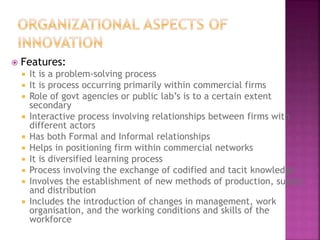
 Features:
 It is a problem-solving process
 It is process occurring primarily within commercial firms
 Role of govt agencies or public lab’s is to a certain extent
secondary
 Interactive process involving relationships between firms with
different actors
 Has both Formal and Informal relationships
 Helps in positioning firm within commercial networks
 It is diversified learning process
 Process involving the exchange of codified and tacit knowledge
 Involves the establishment of new methods of production, supply
and distribution
 Includes the introduction of changes in management, work
organisation, and the working conditions and skills of the
workforce
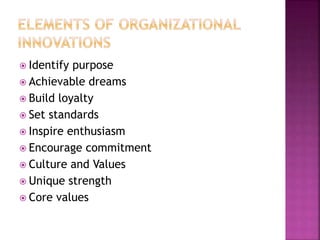
 Identify purpose
 Achievable dreams
 Build loyalty
 Set standards
 Inspire enthusiasm
 Encourage commitment
 Culture and Values
 Unique strength
 Core values
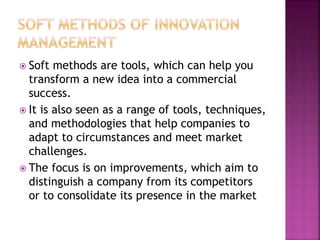
 Soft methods are tools, which can help you
transform a new idea into a commercial
success.
 It is also seen as a range of tools, techniques,
and methodologies that help companies to
adapt to circumstances and meet market
challenges.
 The focus is on improvements, which aim to
distinguish a company from its competitors
or to consolidate its presence in the market
 Ability to cope with co-operation and team
work
 Ability to take advantage or to be compatible
with the internet
 Degree of diffusion and generalization in its
applicability
 Whether copyrighted or patented
 Whether designed to address a specific topic
or a general concern
 Existence of readily accessible information
describing best practice
 Phase of innovation cycle concerned
 Appropriateness of indicators used in its
application and measurements obtained
 Degree of development and availability
 Required competencies, expertise and other
resources for implementation and
maintenance
 Learning curve and organizational learning
 Value perceived by managers within the firm
 Direct impact on the competitiveness
 Usefulness (Cost reduction, Focus on specific
problem solving)
 Promote co-operation and team work
 Encourage entrepreneurial initiative
 Strengthen the Knowledge management within a
firm
 Integrate science, technology, and market in
fluent systems
 Emphasize on global-oriented approach
 Accelerate and shorten the time-to-market in
innovation projects
 Increase efficiency using more advanced
information technologies
 Promote HRM as strategic area within the
business
 Knowledge Management Tools:
 KM is a discipline that integrates management of
people, Processes and technologies in order to
generate, capture and use valuable knowledge in the
organization
 Knowledge Audits
 Analysis of key documents and current information
systems
 Interviews with representative staff
 Knowledge requirements questionnaires
 Analysis of information and knowledge flows
 Development of knowledge maps
 Writing of an action plan.
 Knowledge Mapping
 Knowledge Mapping techniques are part of Audit
process and generates picture of the explicit
information showing the importance of
relationship between knowledge stores and
dynamics
 Knowledge Mapping is worthy practice consisting
of survey, audit and synthesis and aims to track
the acquisition and loss of information.
 Explores personal and group competencies and
proficiencies.
 IPR Management
 Are responsible for the management and protection
of rights over products, corporate intellectual capital
and commercialized results which are obtained out of
a company’s innovation activity.
 Technology Watch
 Is technique to recognize the main technological
advances as they appear on the market, in order to
detect opportunities and threats in a timely fashion.
Stages are:
 Identifying the internal clients
 Determining targets of the watch
 Determining the providers of information
 Organising the information collected
 Organising the use of information
 Assuring Co-ordination
 Patents Analysis
 Enables the researches and business exectutives
to access the competitive patent landscape prior
to engaging in costly R&D, patent execution or
M&A activities
 BIS – Business Intelligence System
 Integrates into a structures system all the
needed mechanisms to capture, filter, analyse
and distribute BI that is useful for an enterprise
 CRM – Customer Relationship Management
 Groupware – to schedule the work of groups
 Team-Building
 SCM – Supply Chain Management
 Industrial Clustering
 Concentration of many inter-dependant
enterprises within the relatively small geographic
area. Key features:
 Strong linkages between firms and supporting
technological and business infrastructure within a
region, to stimulate the innovation process and growth
of cluster
 Larger the cluster, higher the level of self-sufficiency
 Fundamental concepts for all creativity
development techniques are:
 The suspension of premature judgment and reducing
the negative filtering of ideas
 Use of the intermediate possible.
 Creation of analogies and metaphors through symbols,
etc., by finding the similarities between the
situations that we wish to understand and another
situation which we already understand
 Build imaginative and ideal situations(invent the ideal
vision)
 Find ways to make ideal vision happen
 Relate things or ideas which are previously unrelated
 Generate multiple solutions to a problem
 Lateral thinking
Is a way of thinking that seeks a solution to an
intractable problem using unorthodox
methods or elements that would normally be
ignored by logical thinking
 TRIZ – Theory of Inventive Problem Solving
Is a creative method dealing with obstacles to
innovation, complex problems and problem
solving within existing systems.
TRIZ was developed by Altshuller in Soviet
Union in 1956.
 Scamper Method
Is a way to turn one idea into several ideas.
SCAMPER – Substitution, Combination,
Adaptation, Modification, Putting to other
uses, Elimination and Reversing
 Mind Mapping
is an individual brainstorming technique
designed by Tony Buzan, and can be
classified as the exploration of ideas
 Brainstorming
 Rules-
 No Criticism n no prior judgment
 All ideas, even most absurd are also welcome
 Quantity has more value, more the ideas the better
 Sharing and combining ideas,
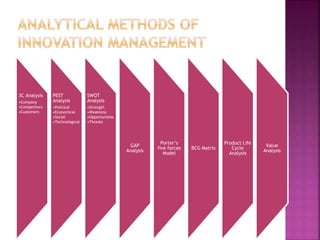
3C Analysis
•Company
•Competitors
•Customers
PEST
Analysis
•Political
•Economical
•Social
•Technological
SWOT
Analysis
•Strength
•Weakness
•Opportunities
•Threats
GAP
Analysis
Porter’s
five forces
Model
BCG Matrix
Product Life
Cycle
Analysis
Value
Analysis
Innovation Management for BU syllabus

Innovation Management for BU syllabus

  • 1.
  • 2.
     Features:  Itis a problem-solving process  It is process occurring primarily within commercial firms  Role of govt agencies or public lab’s is to a certain extent secondary  Interactive process involving relationships between firms with different actors  Has both Formal and Informal relationships  Helps in positioning firm within commercial networks  It is diversified learning process  Process involving the exchange of codified and tacit knowledge  Involves the establishment of new methods of production, supply and distribution  Includes the introduction of changes in management, work organisation, and the working conditions and skills of the workforce
  • 3.
     Identify purpose Achievable dreams  Build loyalty  Set standards  Inspire enthusiasm  Encourage commitment  Culture and Values  Unique strength  Core values
  • 4.
     Soft methodsare tools, which can help you transform a new idea into a commercial success.  It is also seen as a range of tools, techniques, and methodologies that help companies to adapt to circumstances and meet market challenges.  The focus is on improvements, which aim to distinguish a company from its competitors or to consolidate its presence in the market
  • 5.
     Ability tocope with co-operation and team work  Ability to take advantage or to be compatible with the internet  Degree of diffusion and generalization in its applicability  Whether copyrighted or patented  Whether designed to address a specific topic or a general concern  Existence of readily accessible information describing best practice  Phase of innovation cycle concerned
  • 6.
     Appropriateness ofindicators used in its application and measurements obtained  Degree of development and availability  Required competencies, expertise and other resources for implementation and maintenance  Learning curve and organizational learning  Value perceived by managers within the firm  Direct impact on the competitiveness  Usefulness (Cost reduction, Focus on specific problem solving)
  • 7.
     Promote co-operationand team work  Encourage entrepreneurial initiative  Strengthen the Knowledge management within a firm  Integrate science, technology, and market in fluent systems  Emphasize on global-oriented approach  Accelerate and shorten the time-to-market in innovation projects  Increase efficiency using more advanced information technologies  Promote HRM as strategic area within the business
  • 8.
     Knowledge ManagementTools:  KM is a discipline that integrates management of people, Processes and technologies in order to generate, capture and use valuable knowledge in the organization  Knowledge Audits  Analysis of key documents and current information systems  Interviews with representative staff  Knowledge requirements questionnaires  Analysis of information and knowledge flows  Development of knowledge maps  Writing of an action plan.
  • 9.
     Knowledge Mapping Knowledge Mapping techniques are part of Audit process and generates picture of the explicit information showing the importance of relationship between knowledge stores and dynamics  Knowledge Mapping is worthy practice consisting of survey, audit and synthesis and aims to track the acquisition and loss of information.  Explores personal and group competencies and proficiencies.
  • 10.
     IPR Management Are responsible for the management and protection of rights over products, corporate intellectual capital and commercialized results which are obtained out of a company’s innovation activity.  Technology Watch  Is technique to recognize the main technological advances as they appear on the market, in order to detect opportunities and threats in a timely fashion. Stages are:  Identifying the internal clients  Determining targets of the watch  Determining the providers of information  Organising the information collected  Organising the use of information  Assuring Co-ordination
  • 11.
     Patents Analysis Enables the researches and business exectutives to access the competitive patent landscape prior to engaging in costly R&D, patent execution or M&A activities  BIS – Business Intelligence System  Integrates into a structures system all the needed mechanisms to capture, filter, analyse and distribute BI that is useful for an enterprise
  • 12.
     CRM –Customer Relationship Management  Groupware – to schedule the work of groups  Team-Building  SCM – Supply Chain Management  Industrial Clustering  Concentration of many inter-dependant enterprises within the relatively small geographic area. Key features:  Strong linkages between firms and supporting technological and business infrastructure within a region, to stimulate the innovation process and growth of cluster  Larger the cluster, higher the level of self-sufficiency
  • 13.
     Fundamental conceptsfor all creativity development techniques are:  The suspension of premature judgment and reducing the negative filtering of ideas  Use of the intermediate possible.  Creation of analogies and metaphors through symbols, etc., by finding the similarities between the situations that we wish to understand and another situation which we already understand  Build imaginative and ideal situations(invent the ideal vision)  Find ways to make ideal vision happen  Relate things or ideas which are previously unrelated  Generate multiple solutions to a problem
  • 14.
     Lateral thinking Isa way of thinking that seeks a solution to an intractable problem using unorthodox methods or elements that would normally be ignored by logical thinking  TRIZ – Theory of Inventive Problem Solving Is a creative method dealing with obstacles to innovation, complex problems and problem solving within existing systems. TRIZ was developed by Altshuller in Soviet Union in 1956.
  • 15.
     Scamper Method Isa way to turn one idea into several ideas. SCAMPER – Substitution, Combination, Adaptation, Modification, Putting to other uses, Elimination and Reversing  Mind Mapping is an individual brainstorming technique designed by Tony Buzan, and can be classified as the exploration of ideas
  • 16.
     Brainstorming  Rules- No Criticism n no prior judgment  All ideas, even most absurd are also welcome  Quantity has more value, more the ideas the better  Sharing and combining ideas,
  • 17.