Introduction to International HRM
Dr. G C Mohanta, BE(Mech), MSc(Engg), MBA, PhD(Mgt)
Professor
Al-Qurmoshi Institute of Business Management,
Hyderabad - 500005
International HRM
International HRM (IHRM) is the process
of:
Procuring,
Allocating, and
Effectively utilizing human resources
In a multinational corporation, while
Balancing the integration and differentiation of
HR activities in foreign locations
International HRM
Complexity –
Operation of the multinational enterprise units
across diverse national contexts
The employment of workers with different
national characteristics
Objectives of IHRM
To reduce the risk of international human
resource
To avoid cultural risks
To avoid regional disparities
To manage diversifies human capital
Differences between Domestic
HRM and IHRM
 More HR activitiesMore HR activities: taxation, culture orientation,: taxation, culture orientation,
administrative servicesadministrative services
 The need for a broader perspectiveThe need for a broader perspective: cater to multiple needs: cater to multiple needs
 More involvement in employees’ personal livesMore involvement in employees’ personal lives::
adjustment, spouses, childrenadjustment, spouses, children
 Changes in emphasis as the workforce mix of expatriatesChanges in emphasis as the workforce mix of expatriates
and locals variesand locals varies: fairness: fairness
 Risk exposureRisk exposure: expatriate failure, terrorism: expatriate failure, terrorism
 Broader external influencesBroader external influences: government regulations, ways: government regulations, ways
of conductof conduct
Differences between Domestic
HRM and IHRM
Complexity involved in operating in different countries,Complexity involved in operating in different countries,
varied nationalities of employeesvaried nationalities of employees
The different Cultural EnvironmentThe different Cultural Environment
The industry or industries with which the MNC is involvedThe industry or industries with which the MNC is involved
Attitudes of Senior ManagementAttitudes of Senior Management
Extent of reliance of MNC on home country domesticExtent of reliance of MNC on home country domestic
marketmarket
Major Differences Between
Domestic HRM and IHRM
Business activities e.g. taxation, international relocation,
expatriate remuneration, performance appraisals, cross-
cultural training and repatriation
Increased complexities e.g. currency fluctuations, foreign
HR policies and practices, different labor laws
Increased involvement in employee’s personal life e.g.
personal taxation, voter registration, housing, children’s
education, health, recreation and spouse employment
Complex employee mix – cultural, political, religious,
ethical, educational and legal background
Increased risks e.g. emergency exits for serious illness,
personal security, kidnapping and terrorism
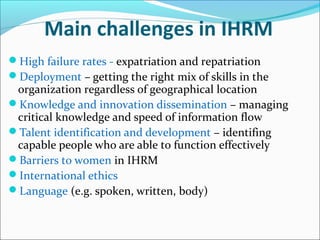
Main challenges in IHRM
High failure rates - expatriation and repatriation
Deployment – getting the right mix of skills in the
organization regardless of geographical location
Knowledge and innovation dissemination – managing
critical knowledge and speed of information flow
Talent identification and development – identifing
capable people who are able to function effectively
Barriers to women in IHRM
International ethics
Language (e.g. spoken, written, body)
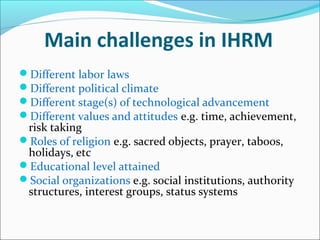
Main challenges in IHRM
Different labor laws
Different political climate
Different stage(s) of technological advancement
Different values and attitudes e.g. time, achievement,
risk taking
Roles of religion e.g. sacred objects, prayer, taboos,
holidays, etc
Educational level attained
Social organizations e.g. social institutions, authority
structures, interest groups, status systems
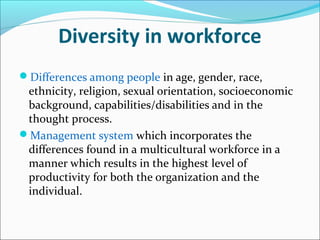
Diversity in workforce
Differences among people in age, gender, race,
ethnicity, religion, sexual orientation, socioeconomic
background, capabilities/disabilities and in the
thought process.
Management system which incorporates the
differences found in a multicultural workforce in a
manner which results in the highest level of
productivity for both the organization and the
individual.

Introduction to international HRM

  • 1.
    Introduction to InternationalHRM Dr. G C Mohanta, BE(Mech), MSc(Engg), MBA, PhD(Mgt) Professor Al-Qurmoshi Institute of Business Management, Hyderabad - 500005
  • 2.
    International HRM International HRM(IHRM) is the process of: Procuring, Allocating, and Effectively utilizing human resources In a multinational corporation, while Balancing the integration and differentiation of HR activities in foreign locations
  • 3.
    International HRM Complexity – Operationof the multinational enterprise units across diverse national contexts The employment of workers with different national characteristics
  • 4.
    Objectives of IHRM Toreduce the risk of international human resource To avoid cultural risks To avoid regional disparities To manage diversifies human capital
  • 5.
    Differences between Domestic HRMand IHRM  More HR activitiesMore HR activities: taxation, culture orientation,: taxation, culture orientation, administrative servicesadministrative services  The need for a broader perspectiveThe need for a broader perspective: cater to multiple needs: cater to multiple needs  More involvement in employees’ personal livesMore involvement in employees’ personal lives:: adjustment, spouses, childrenadjustment, spouses, children  Changes in emphasis as the workforce mix of expatriatesChanges in emphasis as the workforce mix of expatriates and locals variesand locals varies: fairness: fairness  Risk exposureRisk exposure: expatriate failure, terrorism: expatriate failure, terrorism  Broader external influencesBroader external influences: government regulations, ways: government regulations, ways of conductof conduct
  • 6.
    Differences between Domestic HRMand IHRM Complexity involved in operating in different countries,Complexity involved in operating in different countries, varied nationalities of employeesvaried nationalities of employees The different Cultural EnvironmentThe different Cultural Environment The industry or industries with which the MNC is involvedThe industry or industries with which the MNC is involved Attitudes of Senior ManagementAttitudes of Senior Management Extent of reliance of MNC on home country domesticExtent of reliance of MNC on home country domestic marketmarket
  • 7.
    Major Differences Between DomesticHRM and IHRM Business activities e.g. taxation, international relocation, expatriate remuneration, performance appraisals, cross- cultural training and repatriation Increased complexities e.g. currency fluctuations, foreign HR policies and practices, different labor laws Increased involvement in employee’s personal life e.g. personal taxation, voter registration, housing, children’s education, health, recreation and spouse employment Complex employee mix – cultural, political, religious, ethical, educational and legal background Increased risks e.g. emergency exits for serious illness, personal security, kidnapping and terrorism
  • 8.
    Main challenges inIHRM High failure rates - expatriation and repatriation Deployment – getting the right mix of skills in the organization regardless of geographical location Knowledge and innovation dissemination – managing critical knowledge and speed of information flow Talent identification and development – identifing capable people who are able to function effectively Barriers to women in IHRM International ethics Language (e.g. spoken, written, body)
  • 9.
    Main challenges inIHRM Different labor laws Different political climate Different stage(s) of technological advancement Different values and attitudes e.g. time, achievement, risk taking Roles of religion e.g. sacred objects, prayer, taboos, holidays, etc Educational level attained Social organizations e.g. social institutions, authority structures, interest groups, status systems
  • 10.
    Diversity in workforce Differencesamong people in age, gender, race, ethnicity, religion, sexual orientation, socioeconomic background, capabilities/disabilities and in the thought process. Management system which incorporates the differences found in a multicultural workforce in a manner which results in the highest level of productivity for both the organization and the individual.