G.L. Bajaj Institute of Management and Research
Human Resource Management
Presented by:
Shailendra Singh
Shadab Alam
Subhadeep Majumdar
Shyam Sunder Sah
Smita Sharma
Shiv Shanker
Human Resource Management
It refers to the activities an organizationcarries out to use its human resources
effectively.
How different is Global HRM?
i. Different labour markets
ii. Cultural barriers
iii. Different management styles
iv. Varied compensation practices
v. Labour laws.
International comparison of Indian labour laws
Practice required by
law
India China United State
Minimum
Wage (US$/month)
45 182.5 1242.6
Standard work day 8 hours 8 hours 8 hours
Minimum rest while at
work
30 minutes per 5
hour
None None
Maximum overtime li
mit
200 hours per year 432 hours per year None
Premium pay for
overtime
100% 50% 50%
Whatis the role of globalmanager?
The global manager has to play multidimensionalrole
by combining his technical skill, people skill and soft
skill. the manager must have combinationof hard as well
as soft skills. He must be able to organize, analyze and
motivatepeople at internationallevel.
1. IN THECAPACITYOF COUNTRYMANAGER.
The global manager has to deal with clients, legal bodies,
immigration authorities on behalf of his office.
2. IN THE CAPACITYOF FUNCTIONALMANAGER.
The global manager has to select right technique, right resources,
softwareprojects to compete at internationallevel.
3. IN THE CAPACITYOF BUSINESSLEADER.
The global manager has to make changes in the organizationkeeping
in mind
the trend of World and requirement of outsourcing.
GLOBALMANAGERHAS FOLLOWING
ROLES:
Staffing Policy
Staffingpolicy is concerned with the selection of
employeesfor particular jobs.
i. Selectingindividuals who have the skill to do
a particularjob.
ii. Tool for developing and promotingthe
desired corporate culture (norms & value
system) of the firm.
Ch 1 8
Types of staffing policies
There are three types of staffing policies in IB:
Ethnocentric approach
Polycentric approach
Geocentric approach
Ethnocentricapproach
• Ethnocentricis a staffing policy that is used in
companies that has primarily international
strategicorientation.This policy is generally
adopted by headquarters by sending employees
from the home or parent countries to the host
country. This approach is used best in some
situationssuch as, a team is sent from the home
country to help setting up a new plant as well as
trainsubsidiary personnel to use new system
Advantages of Ethnocentric
Effective communication
Effective coordination
May gain experiences worldwide in order to become
higher level in management of their headquarters
Directcontrol of foreign operation
Disadvantages of Ethnocentric
Adaptionof expatriates uncertain
High cost
Inability to utilize fully the talents of non-home
country nationals
Government restriction
Limitsthe promotionopportunitiesof Host
Company Nationals,leading to reduce
productivity
Polycentric Approach
• Polycentric is the policy involved hiring and
promoting employees who are citizens of the host
countries that the subsidiary is operated. This policy
is best used when companies want to keep hiring
cost low. Moreover, employees who are hired at
subsidiary level would not have any problem
adapting to the culture. Communication is smooth
within the operation.
Advantages of the Polycentric Approach
• If managers of subsidiaries are host-country nationals, they will
understandthe cultureand political situation.
• They will not face a language barrier when they communicate
with their employees
• Local appointments are more cost-effective for a global
organization than paying the expenses associated with
expatriate contracts, which may be required if parent-country
nationals are required to live abroad in order to manage
subsidiaries. Plus, the availability of management positions
within the subsidiary provides career advancement
opportunitiesfor lower-levelemployees.
Disadvantages of the Polycentric
Approach
• Managers of subsidiaries may become frustrated by the lack of
career advancement opportunities offered by a polycentric
approach to staffing, as they will be unable to progress in to head
office positions.
• Lack of staff transfers between subsidiaries and head office
can lead to isolation. Also, a gap can develop between head
office and subsidiaries due to cultural differences, language
barriers and national loyalties.
• The result can be a loose federation of business units rather
than a company with consistent competencies and values
15
Geocentric Approach
The company that applies the global integrated business
strategy manages and staffs employees on a global basis.
EX:- Electrolux (the vacuum cleaner company) has for
many years attempted to recruit and develop a group of
international managers from diverse countries. These
people constitute a mobile base of managers who are used
in a variety of facilities as the need arises.
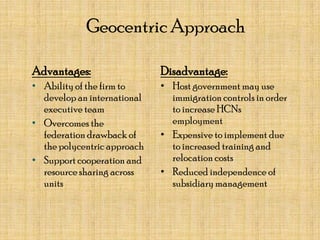
Geocentric Approach
Advantages:
• Ability of the firm to
develop an international
executive team
• Overcomes the
federation drawback of
the polycentric approach
• Support cooperation and
resourcesharing across
units
Disadvantage:
• Host government may use
immigration controls in order
to increase HCNs
employment
• Expensive to implement due
to increased training and
relocation costs
• Reduced independence of
subsidiarymanagement
CONCLUSIONS
Internationalhuman resource management focuses on the management
of human resources on a global basis. An organization’sstrategyon
globalizationstrongly affects the approach it takes to international
human resource management. The approach to international human
resourcemanagement in turn influences the implementation of the major
internationalhuman resource management functions of recruitment and
selection, development and training, performance
evaluation, remuneration and benefits, and labor relations. Companies
taking an ethnocentric approach attempt to impose their home country
methods on their subsidiaries. The polycentric approach follows local
practices. Finally, a geocentric or global approach develops practices for
world-wideuse.

international human resource management

  • 1.
    G.L. Bajaj Instituteof Management and Research Human Resource Management Presented by: Shailendra Singh Shadab Alam Subhadeep Majumdar Shyam Sunder Sah Smita Sharma Shiv Shanker
  • 2.
    Human Resource Management Itrefers to the activities an organizationcarries out to use its human resources effectively.
  • 3.
    How different isGlobal HRM? i. Different labour markets ii. Cultural barriers iii. Different management styles iv. Varied compensation practices v. Labour laws.
  • 4.
    International comparison ofIndian labour laws Practice required by law India China United State Minimum Wage (US$/month) 45 182.5 1242.6 Standard work day 8 hours 8 hours 8 hours Minimum rest while at work 30 minutes per 5 hour None None Maximum overtime li mit 200 hours per year 432 hours per year None Premium pay for overtime 100% 50% 50%
  • 5.
    Whatis the roleof globalmanager? The global manager has to play multidimensionalrole by combining his technical skill, people skill and soft skill. the manager must have combinationof hard as well as soft skills. He must be able to organize, analyze and motivatepeople at internationallevel.
  • 6.
    1. IN THECAPACITYOFCOUNTRYMANAGER. The global manager has to deal with clients, legal bodies, immigration authorities on behalf of his office. 2. IN THE CAPACITYOF FUNCTIONALMANAGER. The global manager has to select right technique, right resources, softwareprojects to compete at internationallevel. 3. IN THE CAPACITYOF BUSINESSLEADER. The global manager has to make changes in the organizationkeeping in mind the trend of World and requirement of outsourcing. GLOBALMANAGERHAS FOLLOWING ROLES:
  • 7.
    Staffing Policy Staffingpolicy isconcerned with the selection of employeesfor particular jobs. i. Selectingindividuals who have the skill to do a particularjob. ii. Tool for developing and promotingthe desired corporate culture (norms & value system) of the firm.
  • 8.
    Ch 1 8 Typesof staffing policies There are three types of staffing policies in IB: Ethnocentric approach Polycentric approach Geocentric approach
  • 9.
    Ethnocentricapproach • Ethnocentricis astaffing policy that is used in companies that has primarily international strategicorientation.This policy is generally adopted by headquarters by sending employees from the home or parent countries to the host country. This approach is used best in some situationssuch as, a team is sent from the home country to help setting up a new plant as well as trainsubsidiary personnel to use new system
  • 10.
    Advantages of Ethnocentric Effectivecommunication Effective coordination May gain experiences worldwide in order to become higher level in management of their headquarters Directcontrol of foreign operation
  • 11.
    Disadvantages of Ethnocentric Adaptionofexpatriates uncertain High cost Inability to utilize fully the talents of non-home country nationals Government restriction Limitsthe promotionopportunitiesof Host Company Nationals,leading to reduce productivity
  • 12.
    Polycentric Approach • Polycentricis the policy involved hiring and promoting employees who are citizens of the host countries that the subsidiary is operated. This policy is best used when companies want to keep hiring cost low. Moreover, employees who are hired at subsidiary level would not have any problem adapting to the culture. Communication is smooth within the operation.
  • 13.
    Advantages of thePolycentric Approach • If managers of subsidiaries are host-country nationals, they will understandthe cultureand political situation. • They will not face a language barrier when they communicate with their employees • Local appointments are more cost-effective for a global organization than paying the expenses associated with expatriate contracts, which may be required if parent-country nationals are required to live abroad in order to manage subsidiaries. Plus, the availability of management positions within the subsidiary provides career advancement opportunitiesfor lower-levelemployees.
  • 14.
    Disadvantages of thePolycentric Approach • Managers of subsidiaries may become frustrated by the lack of career advancement opportunities offered by a polycentric approach to staffing, as they will be unable to progress in to head office positions. • Lack of staff transfers between subsidiaries and head office can lead to isolation. Also, a gap can develop between head office and subsidiaries due to cultural differences, language barriers and national loyalties. • The result can be a loose federation of business units rather than a company with consistent competencies and values
  • 15.
    15 Geocentric Approach The companythat applies the global integrated business strategy manages and staffs employees on a global basis. EX:- Electrolux (the vacuum cleaner company) has for many years attempted to recruit and develop a group of international managers from diverse countries. These people constitute a mobile base of managers who are used in a variety of facilities as the need arises.
  • 16.
    Geocentric Approach Advantages: • Abilityof the firm to develop an international executive team • Overcomes the federation drawback of the polycentric approach • Support cooperation and resourcesharing across units Disadvantage: • Host government may use immigration controls in order to increase HCNs employment • Expensive to implement due to increased training and relocation costs • Reduced independence of subsidiarymanagement
  • 17.
    CONCLUSIONS Internationalhuman resource managementfocuses on the management of human resources on a global basis. An organization’sstrategyon globalizationstrongly affects the approach it takes to international human resource management. The approach to international human resourcemanagement in turn influences the implementation of the major internationalhuman resource management functions of recruitment and selection, development and training, performance evaluation, remuneration and benefits, and labor relations. Companies taking an ethnocentric approach attempt to impose their home country methods on their subsidiaries. The polycentric approach follows local practices. Finally, a geocentric or global approach develops practices for world-wideuse.