Chapter Two
Defining the Marketing Research
Problem and Developing an
Approach
Jamil Ahmed AKASH
2-2
Chapter Outline
1) Overview
2) Importance of Defining a Problem
3) The Process of Defining the Problem and
Developing an Approach
4) Tasks involved in Problem Definition
i. Discussions with Decision Makers
ii. Interviews with Industry Experts
iii. Secondary Data Analysis
iv. Qualitative Research
2-3
Chapter Outline
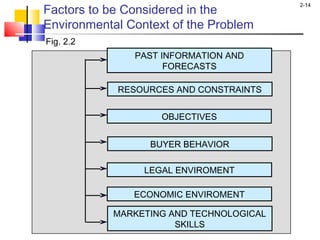
5) Environmental Context of the Problem
i. Past Information and Forecasts
ii. Resources and Constraints
iii. Objectives
iv. Buyer Behavior
v. Legal Environment
vi. Economic Environment
vii. Marketing and Technological Skills
6) Management Decision Problem and
Marketing Research Problem
2-4
Chapter Outline
7) Defining the Marketing Research Problem
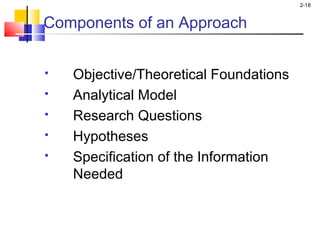
8) Components of an Approach
i. Objective / Theoretical Foundations
ii. Analytical Model
iii. Research Questions
iv. Hypothesis
v. Specification of Information Needed
9) International Marketing Research
10) Ethics in Marketing Research
11) Internet and Computer Applications
2-5
Chapter Outline
12) Focus on Burke
13) Summary
14) Key Terms and Concepts
2-6
Chain Restaurant Study
One day I received a
phone call from a
research analyst who
introduced himself as
one of our alumni.
He was working for a
restaurant chain in town
and wanted help
analyzing the data he
had collected while
conducting a marketing
research study.
2-7
Chain Restaurant Study
When we met, he presented me with a copy of the
questionnaire and asked how he should analyze
the data. My first question to him was,
2-8
Chain Restaurant Study
When he looked
perplexed, I
explained that data
analysis is not an
independent
exercise.
Rather, the goal of data analysis is to PROVIDE
INFORMATION RELATED TO THE PROBLEM
COMPONENTS.
2-9
Chain Restaurant Study
I was surprised to learn that he did
not have a clear understanding of
the marketing research problem
and that a written definition did not
exist. So before going any further, I
had to definedefine the marketing
research problem.
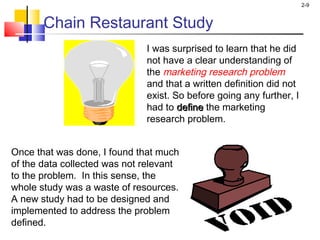
Once that was done, I found that much
of the data collected was not relevant
to the problem. In this sense, the
whole study was a waste of resources.
A new study had to be designed and
implemented to address the problem
defined.
2-10
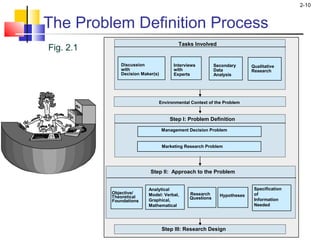
The Problem Definition Process
Fig. 2.1
Discussion
with
Decision Maker(s)
Interviews
with
Experts
Secondary
Data
Analysis
Qualitative
Research
Management Decision Problem
Marketing Research Problem
Tasks Involved
Environmental Context of the Problem
Step I: Problem Definition
Step II: Approach to the Problem
Objective/
Theoretical
Foundations
Research
Questions
Hypotheses
Step III: Research Design
Analytical
Model: Verbal,
Graphical,
Mathematical
Specification
of
Information
Needed
2-11
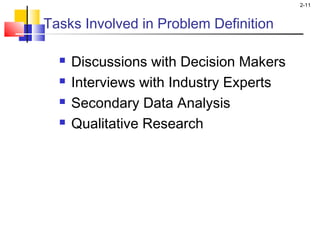
 Discussions with Decision Makers
 Interviews with Industry Experts
 Secondary Data Analysis
 Qualitative Research
Tasks Involved in Problem Definition
2-12
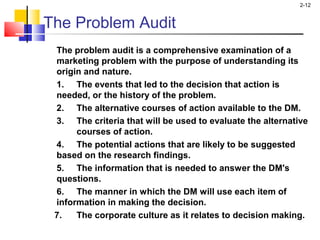
The Problem Audit
The problem audit is a comprehensive examination of a
marketing problem with the purpose of understanding its
origin and nature.
1. The events that led to the decision that action is
needed, or the history of the problem.
2. The alternative courses of action available to the DM.
3. The criteria that will be used to evaluate the alternative
courses of action.
4. The potential actions that are likely to be suggested
based on the research findings.
5. The information that is needed to answer the DM's
questions.
6. The manner in which the DM will use each item of
information in making the decision.
7. The corporate culture as it relates to decision making.
2-13
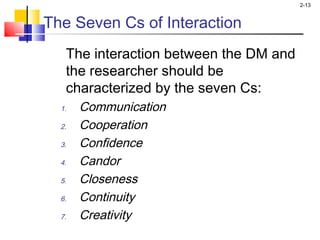
The Seven Cs of Interaction
The interaction between the DM and
the researcher should be
characterized by the seven Cs:
1. Communication
2. Cooperation
3. Confidence
4. Candor
5. Closeness
6. Continuity
7. Creativity
2-14
Factors to be Considered in the
Environmental Context of the Problem
PAST INFORMATION AND
FORECASTS
RESOURCES AND CONSTRAINTS
OBJECTIVES
BUYER BEHAVIOR
LEGAL ENVIROMENT
ECONOMIC ENVIROMENT
MARKETING AND TECHNOLOGICAL
SKILLS
Fig. 2.2
2-15
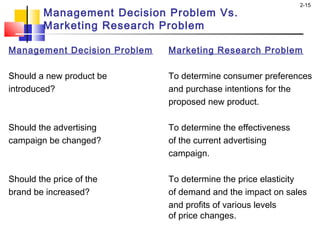
Management Decision Problem Vs.
Marketing Research Problem
Management Decision Problem Marketing Research Problem
 
Should a new product be To determine consumer preferences
introduced? and purchase intentions for the
proposed new product.
 
Should the advertising To determine the effectiveness
campaign be changed? of the current advertising
campaign.
 
Should the price of the To determine the price elasticity
brand be increased? of demand and the impact on sales
and profits of various levels
of price changes.
2-16
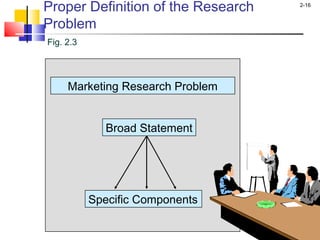
Proper Definition of the Research
Problem
Marketing Research Problem
Broad Statement
Specific Components
Fig. 2.3
2-17
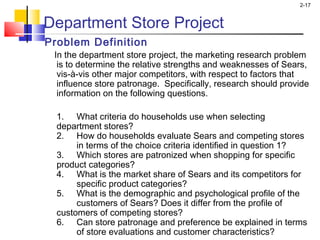
Department Store Project
Problem Definition
  In the department store project, the marketing research problem
is to determine the relative strengths and weaknesses of Sears,
vis-à-vis other major competitors, with respect to factors that
influence store patronage. Specifically, research should provide
information on the following questions.
1. What criteria do households use when selecting
department stores?
2. How do households evaluate Sears and competing stores
in terms of the choice criteria identified in question 1?
3. Which stores are patronized when shopping for specific
product categories?
4. What is the market share of Sears and its competitors for
specific product categories?
5. What is the demographic and psychological profile of the
customers of Sears? Does it differ from the profile of
customers of competing stores?
6. Can store patronage and preference be explained in terms
of store evaluations and customer characteristics?
2-18
Components of an Approach
 Objective/Theoretical Foundations
 Analytical Model
 Research Questions
 Hypotheses
 Specification of the Information
Needed
2-19
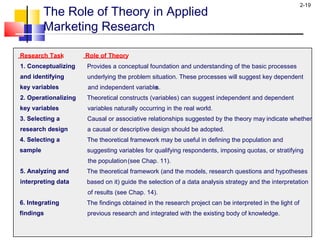
The Role of Theory in Applied
Marketing Research
Research Task Role of Theory
1. Conceptualizing
and identifying
key variables
Provides a conceptual foundation and understanding of the basic processes
underlying the problem situation. These processes will suggest key dependent
and independent variables.
2. Operationalizing
key variables
Theoretical constructs (variables) can suggest independent and dependent
variables naturally occurring in the real world.
3. Selecting a
research design
Causal or associative relationships suggested by the theory may indicate whether
a causal or descriptive design should be adopted.
4. Selecting a
sample
The theoretical framework may be useful in defining the population and
suggesting variables for qualifying respondents, imposing quotas, or stratifying
the population(see Chap. 11).
5. Analyzing and
interpreting data
The theoretical framework (and the models, research questions and hypotheses
based on it) guide the selection of a data analysis strategy and the interpretation
of results (see Chap. 14).
6. Integrating
findings
The findings obtained in the research project can be interpreted in the light of
previous research and integrated with the existing body of knowledge.
2-20
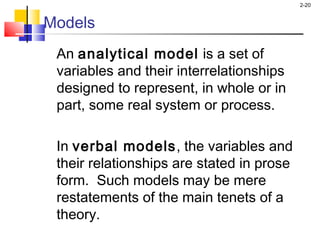
Models
An analytical model is a set of
variables and their interrelationships
designed to represent, in whole or in
part, some real system or process.
In verbal models, the variables and
their relationships are stated in prose
form. Such models may be mere
restatements of the main tenets of a
theory.
2-21
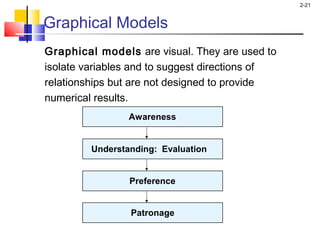
Graphical Models
Graphical models are visual. They are used to
isolate variables and to suggest directions of
relationships but are not designed to provide
numerical results.
Awareness
Understanding: Evaluation
Preference
Patronage
2-22
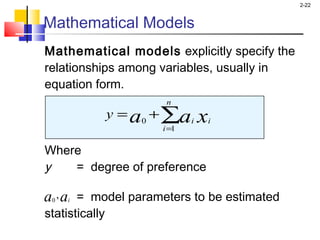
Mathematical models explicitly specify the
relationships among variables, usually in
equation form.
Where
y = degree of preference
= model parameters to be estimated
statistically
Mathematical Models
∑=
+=
n
i
ii xaay
1
0
aa i
,0
2-23
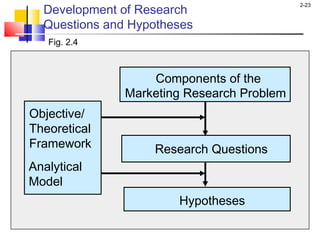
Development of Research
Questions and Hypotheses
Fig. 2.4
Components of the
Research Questions
Hypotheses
Objective/
Theoretical
Framework
Analytical
Model
Marketing Research Problem
2-24
Research Questions and Hypotheses
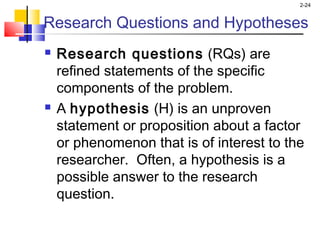
 Research questions (RQs) are
refined statements of the specific
components of the problem.
 A hypothesis (H) is an unproven
statement or proposition about a factor
or phenomenon that is of interest to the
researcher. Often, a hypothesis is a
possible answer to the research
question.
2-25
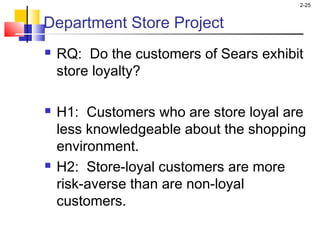
Department Store Project
 RQ: Do the customers of Sears exhibit
store loyalty?
 H1: Customers who are store loyal are
less knowledgeable about the shopping
environment.
 H2: Store-loyal customers are more
risk-averse than are non-loyal
customers.
2-26
Department Store Project
Specification of Information Needed
Component 1
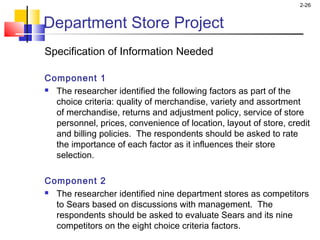
 The researcher identified the following factors as part of the
choice criteria: quality of merchandise, variety and assortment
of merchandise, returns and adjustment policy, service of store
personnel, prices, convenience of location, layout of store, credit
and billing policies. The respondents should be asked to rate
the importance of each factor as it influences their store
selection.
 
Component 2
 The researcher identified nine department stores as competitors
to Sears based on discussions with management. The
respondents should be asked to evaluate Sears and its nine
competitors on the eight choice criteria factors. 
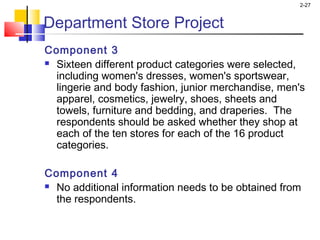
2-27
Component 3
 Sixteen different product categories were selected,
including women's dresses, women's sportswear,
lingerie and body fashion, junior merchandise, men's
apparel, cosmetics, jewelry, shoes, sheets and
towels, furniture and bedding, and draperies. The
respondents should be asked whether they shop at
each of the ten stores for each of the 16 product
categories.
Component 4
 No additional information needs to be obtained from
the respondents.
 
Department Store Project
2-28
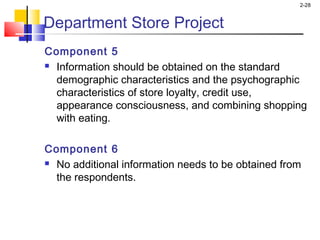
Component 5
 Information should be obtained on the standard
demographic characteristics and the psychographic
characteristics of store loyalty, credit use,
appearance consciousness, and combining shopping
with eating.
 
Component 6
 No additional information needs to be obtained from
the respondents.
Department Store Project
2-29
At United, Food is Uniting the Airline
with Travelers
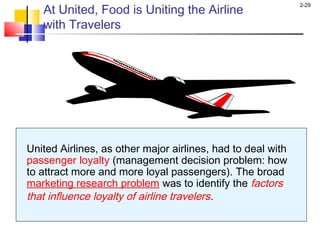
United Airlines, as other major airlines, had to deal with
passenger loyalty (management decision problem: how
to attract more and more loyal passengers). The broad
marketing research problem was to identify the factors
that influence loyalty of airline travelers.
2-30
The basic answer is to improve service. Exploratory
research, theoretical framework, and empirical evidence
revealed that the consumers’ choice of an airline is
influenced by: safety, price of the ticket, frequent-flyer
program, convenience of scheduling, and brand name.
At United, Food is Uniting the Airline
with Travelers
2-31
A graphical model stipulated that
consumers evaluate competing airlines
based on factors of the choice criteria to
select a preferred airline. The problem was
that major airlines were quite similar on
these factors. Indeed, "airlines offer the
same schedules, the same service, and the
same fares.” Consequently, United Airlines
had to find a way to differentiate itself. Food
turned out to be the solution.
At United, Food is Uniting the Airline
with Travelers
2-32
Secondary data, like the J. D Power & Associates'
survey on "current and future trends in airline food
industry," indicated that "food service is a major
contributor to customers’ loyalty." This survey also
emphasized the importance of food brands.
At United, Food is Uniting the Airline
with Travelers
2-33
The airline's Marketrak survey told United Airlines that
"customers wanted more varied and up-to-date food.”
The following research questions and hypotheses may be
posed.
RQ1 How important is food for airline customers?
H1: Food is an important factor for airline travelers.
H2: Travelers value branded food.
H3: Travelers prefer larger food portions, but with
consistent quality.
H4: Travelers prefer exotic food.
At United, Food is Uniting the Airline
with Travelers
2-34
Characteristics which influence the research design
included the identification of competing airlines (Delta,
American, etc.), factors of the choice criteria (already
identified), measurement of airline travel, and loyalty.
At United, Food is Uniting the Airline
with Travelers
2-35
This kind of research helped United Airlines to define their marketing
research problem, and develop the approach. Focus groups and surveys
were conducted to check customers' perceptions of food in United
Airlines' aircraft. The results provided support for all the hypotheses (H1
to H4). United Airlines then made a few changes: new "culinary menus,"
larger portions of food, new coffee, and branded products (e.g., Godiva
chocolates). This resulted in better service, increasing customer
satisfaction and fostering loyalty.
At United, Food is Uniting the Airline
with Travelers
2-36
International Marketing Research
Examining the impact of the Self-Reference Criterion (SRC)
1. Define the marketing research problem in
terms of domestic environmental and cultural
factors.
2. Define the marketing research problem in terms of
foreign environmental and cultural factors. Make no
judgments.  
3. Isolate the self-reference criterion (SRC) influence
on the problem and examine it carefully to see how
it complicates the problem.
4. Redefine the problem without the SRC influence
and address it for the foreign market situation.

Marketing research ch 2_malhotra

  • 1.
    Chapter Two Defining theMarketing Research Problem and Developing an Approach Jamil Ahmed AKASH
  • 2.
    2-2 Chapter Outline 1) Overview 2)Importance of Defining a Problem 3) The Process of Defining the Problem and Developing an Approach 4) Tasks involved in Problem Definition i. Discussions with Decision Makers ii. Interviews with Industry Experts iii. Secondary Data Analysis iv. Qualitative Research
  • 3.
    2-3 Chapter Outline 5) EnvironmentalContext of the Problem i. Past Information and Forecasts ii. Resources and Constraints iii. Objectives iv. Buyer Behavior v. Legal Environment vi. Economic Environment vii. Marketing and Technological Skills 6) Management Decision Problem and Marketing Research Problem
  • 4.
    2-4 Chapter Outline 7) Definingthe Marketing Research Problem 8) Components of an Approach i. Objective / Theoretical Foundations ii. Analytical Model iii. Research Questions iv. Hypothesis v. Specification of Information Needed 9) International Marketing Research 10) Ethics in Marketing Research 11) Internet and Computer Applications
  • 5.
    2-5 Chapter Outline 12) Focuson Burke 13) Summary 14) Key Terms and Concepts
  • 6.
    2-6 Chain Restaurant Study Oneday I received a phone call from a research analyst who introduced himself as one of our alumni. He was working for a restaurant chain in town and wanted help analyzing the data he had collected while conducting a marketing research study.
  • 7.
    2-7 Chain Restaurant Study Whenwe met, he presented me with a copy of the questionnaire and asked how he should analyze the data. My first question to him was,
  • 8.
    2-8 Chain Restaurant Study Whenhe looked perplexed, I explained that data analysis is not an independent exercise. Rather, the goal of data analysis is to PROVIDE INFORMATION RELATED TO THE PROBLEM COMPONENTS.
  • 9.
    2-9 Chain Restaurant Study Iwas surprised to learn that he did not have a clear understanding of the marketing research problem and that a written definition did not exist. So before going any further, I had to definedefine the marketing research problem. Once that was done, I found that much of the data collected was not relevant to the problem. In this sense, the whole study was a waste of resources. A new study had to be designed and implemented to address the problem defined.
  • 10.
    2-10 The Problem DefinitionProcess Fig. 2.1 Discussion with Decision Maker(s) Interviews with Experts Secondary Data Analysis Qualitative Research Management Decision Problem Marketing Research Problem Tasks Involved Environmental Context of the Problem Step I: Problem Definition Step II: Approach to the Problem Objective/ Theoretical Foundations Research Questions Hypotheses Step III: Research Design Analytical Model: Verbal, Graphical, Mathematical Specification of Information Needed
  • 11.
    2-11  Discussions withDecision Makers  Interviews with Industry Experts  Secondary Data Analysis  Qualitative Research Tasks Involved in Problem Definition
  • 12.
    2-12 The Problem Audit Theproblem audit is a comprehensive examination of a marketing problem with the purpose of understanding its origin and nature. 1. The events that led to the decision that action is needed, or the history of the problem. 2. The alternative courses of action available to the DM. 3. The criteria that will be used to evaluate the alternative courses of action. 4. The potential actions that are likely to be suggested based on the research findings. 5. The information that is needed to answer the DM's questions. 6. The manner in which the DM will use each item of information in making the decision. 7. The corporate culture as it relates to decision making.
  • 13.
    2-13 The Seven Csof Interaction The interaction between the DM and the researcher should be characterized by the seven Cs: 1. Communication 2. Cooperation 3. Confidence 4. Candor 5. Closeness 6. Continuity 7. Creativity
  • 14.
    2-14 Factors to beConsidered in the Environmental Context of the Problem PAST INFORMATION AND FORECASTS RESOURCES AND CONSTRAINTS OBJECTIVES BUYER BEHAVIOR LEGAL ENVIROMENT ECONOMIC ENVIROMENT MARKETING AND TECHNOLOGICAL SKILLS Fig. 2.2
  • 15.
    2-15 Management Decision ProblemVs. Marketing Research Problem Management Decision Problem Marketing Research Problem   Should a new product be To determine consumer preferences introduced? and purchase intentions for the proposed new product.   Should the advertising To determine the effectiveness campaign be changed? of the current advertising campaign.   Should the price of the To determine the price elasticity brand be increased? of demand and the impact on sales and profits of various levels of price changes.
  • 16.
    2-16 Proper Definition ofthe Research Problem Marketing Research Problem Broad Statement Specific Components Fig. 2.3
  • 17.
    2-17 Department Store Project ProblemDefinition   In the department store project, the marketing research problem is to determine the relative strengths and weaknesses of Sears, vis-à-vis other major competitors, with respect to factors that influence store patronage. Specifically, research should provide information on the following questions. 1. What criteria do households use when selecting department stores? 2. How do households evaluate Sears and competing stores in terms of the choice criteria identified in question 1? 3. Which stores are patronized when shopping for specific product categories? 4. What is the market share of Sears and its competitors for specific product categories? 5. What is the demographic and psychological profile of the customers of Sears? Does it differ from the profile of customers of competing stores? 6. Can store patronage and preference be explained in terms of store evaluations and customer characteristics?
  • 18.
    2-18 Components of anApproach  Objective/Theoretical Foundations  Analytical Model  Research Questions  Hypotheses  Specification of the Information Needed
  • 19.
    2-19 The Role ofTheory in Applied Marketing Research Research Task Role of Theory 1. Conceptualizing and identifying key variables Provides a conceptual foundation and understanding of the basic processes underlying the problem situation. These processes will suggest key dependent and independent variables. 2. Operationalizing key variables Theoretical constructs (variables) can suggest independent and dependent variables naturally occurring in the real world. 3. Selecting a research design Causal or associative relationships suggested by the theory may indicate whether a causal or descriptive design should be adopted. 4. Selecting a sample The theoretical framework may be useful in defining the population and suggesting variables for qualifying respondents, imposing quotas, or stratifying the population(see Chap. 11). 5. Analyzing and interpreting data The theoretical framework (and the models, research questions and hypotheses based on it) guide the selection of a data analysis strategy and the interpretation of results (see Chap. 14). 6. Integrating findings The findings obtained in the research project can be interpreted in the light of previous research and integrated with the existing body of knowledge.
  • 20.
    2-20 Models An analytical modelis a set of variables and their interrelationships designed to represent, in whole or in part, some real system or process. In verbal models, the variables and their relationships are stated in prose form. Such models may be mere restatements of the main tenets of a theory.
  • 21.
    2-21 Graphical Models Graphical modelsare visual. They are used to isolate variables and to suggest directions of relationships but are not designed to provide numerical results. Awareness Understanding: Evaluation Preference Patronage
  • 22.
    2-22 Mathematical models explicitlyspecify the relationships among variables, usually in equation form. Where y = degree of preference = model parameters to be estimated statistically Mathematical Models ∑= += n i ii xaay 1 0 aa i ,0
  • 23.
    2-23 Development of Research Questionsand Hypotheses Fig. 2.4 Components of the Research Questions Hypotheses Objective/ Theoretical Framework Analytical Model Marketing Research Problem
  • 24.
    2-24 Research Questions andHypotheses  Research questions (RQs) are refined statements of the specific components of the problem.  A hypothesis (H) is an unproven statement or proposition about a factor or phenomenon that is of interest to the researcher. Often, a hypothesis is a possible answer to the research question.
  • 25.
    2-25 Department Store Project RQ: Do the customers of Sears exhibit store loyalty?  H1: Customers who are store loyal are less knowledgeable about the shopping environment.  H2: Store-loyal customers are more risk-averse than are non-loyal customers.
  • 26.
    2-26 Department Store Project Specificationof Information Needed Component 1  The researcher identified the following factors as part of the choice criteria: quality of merchandise, variety and assortment of merchandise, returns and adjustment policy, service of store personnel, prices, convenience of location, layout of store, credit and billing policies. The respondents should be asked to rate the importance of each factor as it influences their store selection.   Component 2  The researcher identified nine department stores as competitors to Sears based on discussions with management. The respondents should be asked to evaluate Sears and its nine competitors on the eight choice criteria factors. 
  • 27.
    2-27 Component 3  Sixteendifferent product categories were selected, including women's dresses, women's sportswear, lingerie and body fashion, junior merchandise, men's apparel, cosmetics, jewelry, shoes, sheets and towels, furniture and bedding, and draperies. The respondents should be asked whether they shop at each of the ten stores for each of the 16 product categories. Component 4  No additional information needs to be obtained from the respondents.   Department Store Project
  • 28.
    2-28 Component 5  Informationshould be obtained on the standard demographic characteristics and the psychographic characteristics of store loyalty, credit use, appearance consciousness, and combining shopping with eating.   Component 6  No additional information needs to be obtained from the respondents. Department Store Project
  • 29.
    2-29 At United, Foodis Uniting the Airline with Travelers United Airlines, as other major airlines, had to deal with passenger loyalty (management decision problem: how to attract more and more loyal passengers). The broad marketing research problem was to identify the factors that influence loyalty of airline travelers.
  • 30.
    2-30 The basic answeris to improve service. Exploratory research, theoretical framework, and empirical evidence revealed that the consumers’ choice of an airline is influenced by: safety, price of the ticket, frequent-flyer program, convenience of scheduling, and brand name. At United, Food is Uniting the Airline with Travelers
  • 31.
    2-31 A graphical modelstipulated that consumers evaluate competing airlines based on factors of the choice criteria to select a preferred airline. The problem was that major airlines were quite similar on these factors. Indeed, "airlines offer the same schedules, the same service, and the same fares.” Consequently, United Airlines had to find a way to differentiate itself. Food turned out to be the solution. At United, Food is Uniting the Airline with Travelers
  • 32.
    2-32 Secondary data, likethe J. D Power & Associates' survey on "current and future trends in airline food industry," indicated that "food service is a major contributor to customers’ loyalty." This survey also emphasized the importance of food brands. At United, Food is Uniting the Airline with Travelers
  • 33.
    2-33 The airline's Marketraksurvey told United Airlines that "customers wanted more varied and up-to-date food.” The following research questions and hypotheses may be posed. RQ1 How important is food for airline customers? H1: Food is an important factor for airline travelers. H2: Travelers value branded food. H3: Travelers prefer larger food portions, but with consistent quality. H4: Travelers prefer exotic food. At United, Food is Uniting the Airline with Travelers
  • 34.
    2-34 Characteristics which influencethe research design included the identification of competing airlines (Delta, American, etc.), factors of the choice criteria (already identified), measurement of airline travel, and loyalty. At United, Food is Uniting the Airline with Travelers
  • 35.
    2-35 This kind ofresearch helped United Airlines to define their marketing research problem, and develop the approach. Focus groups and surveys were conducted to check customers' perceptions of food in United Airlines' aircraft. The results provided support for all the hypotheses (H1 to H4). United Airlines then made a few changes: new "culinary menus," larger portions of food, new coffee, and branded products (e.g., Godiva chocolates). This resulted in better service, increasing customer satisfaction and fostering loyalty. At United, Food is Uniting the Airline with Travelers
  • 36.
    2-36 International Marketing Research Examiningthe impact of the Self-Reference Criterion (SRC) 1. Define the marketing research problem in terms of domestic environmental and cultural factors. 2. Define the marketing research problem in terms of foreign environmental and cultural factors. Make no judgments.   3. Isolate the self-reference criterion (SRC) influence on the problem and examine it carefully to see how it complicates the problem. 4. Redefine the problem without the SRC influence and address it for the foreign market situation.