Learning Objectives:
Describe thefunctions of the
foreign exchange market.
Understand what is meant by
spot exchange rates.
Recognize the role that forward
exchange rates play in insuring
against foreign exchange risk.
LO10 -1
LO10 -2
LO10 -3
3.
Learning Objectives:
LO10 -5
LO10-6
Understand the different theories
explaining how currency exchange rates
are determined and their relative merits.
Identify the merits of different
approaches toward exchange rate
forecasting.
Compare and contrast the differences
among translation, transaction, and
economic exposure, and explain the
implications for management practice.
LO10 -4
4.
Foreign Exchange
Market
The foreignexchange market (forex or FX market) is a global financial
market where currencies are bought, sold, and exchanged. It
facilitates international trade and investment by enabling businesses,
governments, and individuals to convert one currency into another.
The market determines exchange rates, operates 24 hours a day
across major financial centers, and is also used by firms to manage
foreign exchange risks caused by fluctuations in currency values.
5.
Functions of theForeign
Exchange Market
The foreign exchange market (Forex/FX) is a global marketplace where
currencies are bought and sold.
1. Currency Conversion
2. Insurance Against Foreign Exchange Risk
It serves two main functions:
6.
Currency Conversion
Enables conversionof one currency into another.
1.
Essential for:
• International trade (exports & imports)
• Global investment
• Tourism & travel
Example: A U.S. tourist in Europe exchanges dollars for
euros to make purchases.
7.
Insurance Against Risk
2.
Example:A company protects itself to avoid losing money if the euro
weakens against the dollar.
Protects businesses from losses due to exchange rate
fluctuations.
Helps firms reduce uncertainty when trading or investing
internationally.
8.
Spot Exchange
Rate
The spotexchange rate is the current rate at which one currency
can be immediately exchanged for another, with settlement usually
within two business days.
Key Point:
It reflects the real-time price of a currency, based on supply and
demand in the foreign exchange market.
9.
Forward Exchange
Rate
A forwardexchange rate occurs when two parties agree to exchange
currency and execute the deal at some specific date in the future.
The rate is set at the time of the agreement, not at the time of the
actual exchange.
10.
Currency Swap
A currencyswap is the simultaneous purchase and sale of a given
amount of foreign exchange for two different value dates. Swaps
are transacted between international businesses and their banks,
between banks, and between governments when it is desirable to
move out of one currency into another for a limited period without
incurring foreign exchange risk. A common kind of swap is spot
against forward.
11.
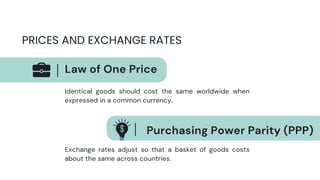
Identical goods shouldcost the same worldwide when
expressed in a common currency.
PRICES AND EXCHANGE RATES
Law of One Price
Purchasing Power Parity (PPP)
Exchange rates adjust so that a basket of goods costs
about the same across countries.
12.
If money supplygrows faster than output, inflation rises
→currency depreciates.
PRICES AND EXCHANGE RATES
Money Supply & Inflation
13.
Economic theory tellsus that interest rates reflect expectations about
likely future inflation rates. In countries where inflation is expected to
be high, interest rates also will be high, because investors want
compensation for the decline in the value of their money.
INTEREST RATES AND
EXCHANGE RATES
14.
INTEREST RATES AND
EXCHANGERATES
The Fisher effect states that a country’s “nominal” interest rate (i) is
the sum of the required “real” rate of interest (r) and the expected rate
of inflation over the period for which the funds are to be lent (π).
i ≈ r + π
The International Fisher effect (IFE) states that for any two countries,
the spot exchange rate should change in an equal amount but in the
opposite direction to the difference in nominal interest rates between
the two countries.
15.
INVESTOR PSYCHOLOGY AND
BANDWAGONEFFECTS
Exchange rates are not always driven by economic fundamentals (inflation,
interest rates).
Traders’ expectations, fears, and confidence strongly influence currency
values.
Expectations often become self-fulfilling prophecies: if enough investors
believe a currency will fall, they sell it, which causes the fall.
Investor Psychology