13
C H A P T E
R

Aggregate Supply and the
Short-run Tradeoff Between
Inflation and Unemployment

 MACROECONOMICS SIXTH EDITION
          N. GREGORY MANKIW
      PowerPoint® Slides by Ron Cronovich
              © 2007 Worth Publishers, all rights reserved
In this chapter, you will learn…

 three models of aggregate supply in which
  output depends positively on the price level in
  the short run
 about the short-run tradeoff between inflation
  and unemployment known as the Phillips curve


CHAPTER 13 Aggregate Supply                         slide 2
Three models of aggregate supply

1. The sticky-wage model
2. The imperfect-information model
3. The sticky-price model
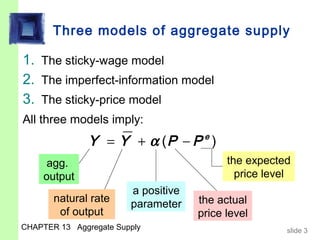
All three models imply:
               Y = Y + α (P − P e )
      agg.                                 the expected
     output                                  price level
                        a positive
       natural rate                  the actual
                        parameter
        of output                    price level
CHAPTER 13 Aggregate Supply                            slide 3
The sticky-wage model

 Assumes that firms and workers negotiate contracts
  and fix the nominal wage before they know what the
  price level will turn out to be.
 The nominal wage they set is the product of a target
  real wage and the expected price level:
                                            Target
                                             real
             Wω= P×           e
                                            wage

                         W     Pe
                       ⇒   =ω×
                         P     P
CHAPTER 13 Aggregate Supply                          slide 4
The sticky-wage model
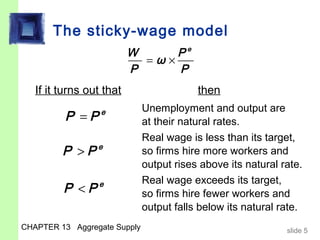
                          W     Pe
                            =ω×
                          P     P
   If it turns out that                   then
                              Unemployment and output are
         P =P     e
                              at their natural rates.
                              Real wage is less than its target,
         P >Pe                so firms hire more workers and
                              output rises above its natural rate.
                              Real wage exceeds its target,
         P <Pe                so firms hire fewer workers and
                              output falls below its natural rate.
CHAPTER 13 Aggregate Supply                                   slide 5
The sticky-wage model

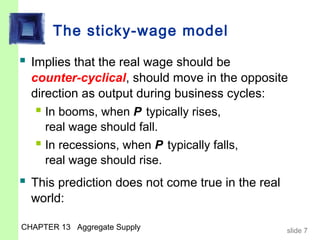
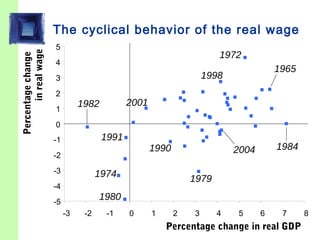
 Implies that the real wage should be
  counter-cyclical, should move in the opposite
  direction as output during business cycles:
    In booms, when P typically rises,
     real wage should fall.
    In recessions, when P typically falls,
     real wage should rise.
 This prediction does not come true in the real
  world:

CHAPTER 13 Aggregate Supply                        slide 7
The cyclical behavior of the real wage
                      5
       in real wage
                                                                       1972
Percentage change


                      4
                                                                                      1965
                      3                                             1998
                      2
                                1982          2001
                      1
                      0
                      -1               1991
                                                     1990                  2004       1984
                      -2
                      -3              1974
                                                                1979
                      -4
                      -5
                                      1980
                           -3    -2     -1    0      1      2   3      4   5      6    7     8
                                                         Percentage change in real GDP
The imperfect-information model

Assumptions:
  All wages and prices are perfectly flexible,
   all markets are clear.
  Each supplier produces one good, consumes
   many goods.
  Each supplier knows the nominal price of the
   good she produces, but does not know the
   overall price level.


CHAPTER 13 Aggregate Supply                       slide 9
The imperfect-information model
 Supply of each good depends on its relative price:
  the nominal price of the good divided by the overall
  price level.
 Supplier does not know price level at the time she
  makes her production decision, so uses the
                          e
  expected price level, P .
 Suppose P rises but P e does not.
    Supplier thinks her relative price has risen,
     so she produces more.
    With many producers thinking this way,
     Y will rise whenever P rises above P e.
CHAPTER 13 Aggregate Supply                            slide 10
The sticky-price model

 Reasons for sticky prices:
   long-term contracts between firms and
     customers
    menu costs
    firms not wishing to annoy customers with
     frequent price changes
 Assumption:
   Firms set their own prices
     (e.g., as in monopolistic competition).
CHAPTER 13 Aggregate Supply                      slide 11
The sticky-price model

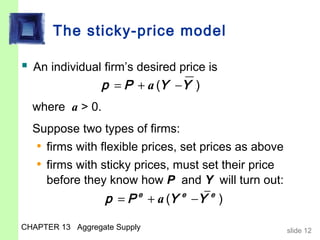
 An individual firm’s desired price is
                  p = P + a (Y −Y )
  where a > 0.
  Suppose two types of firms:
   • firms with flexible prices, set prices as above
   • firms with sticky prices, must set their price
     before they know how P and Y will turn out:
                  p = P + a (Y
                          e      e
                                     −Y )
                                       e


CHAPTER 13 Aggregate Supply                            slide 12
The sticky-price model
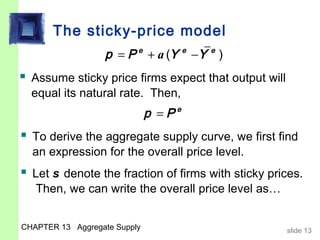
                  p = P e + a (Y e −Y e )
 Assume sticky price firms expect that output will
  equal its natural rate. Then,
                              p =P   e


 To derive the aggregate supply curve, we first find
  an expression for the overall price level.
 Let s denote the fraction of firms with sticky prices.
   Then, we can write the overall price level as…


CHAPTER 13 Aggregate Supply                           slide 13
The sticky-price model
        P = s P + (1 − s )[ P + a( Y −Y )]
                e


     price set by sticky            price set by flexible
         price firms                     price firms

 Subtract (1−s )P from both sides:
            sP = s P e + (1 − s )[ a( Y −Y )]
 Divide both sides by s :
                            (1 − s ) a 
             P = P    e
                          +             ( Y −Y )
                                s      
CHAPTER 13 Aggregate Supply                                 slide 14
The sticky-price model
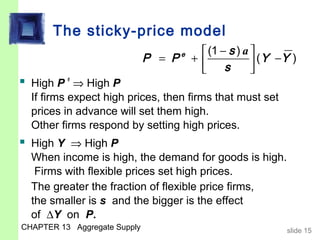
                                             (1 − s ) a 
                              P = P   e
                                          +              ( Y −Y )
                                                 s      
 High P e ⇒ High P
  If firms expect high prices, then firms that must set
  prices in advance will set them high.
  Other firms respond by setting high prices.
 High Y ⇒ High P
  When income is high, the demand for goods is high.
   Firms with flexible prices set high prices.
  The greater the fraction of flexible price firms,
  the smaller is s and the bigger is the effect
  of ∆Y on P.
CHAPTER 13 Aggregate Supply                                     slide 15
The sticky-price model
                                             (1 − s ) a 
                              P = P   e
                                          +              ( Y −Y )
                                                 s      

 Finally, derive AS equation by solving for Y :

        Y = Y + α ( P − P e ),
                       s
         where α =
                   (1 − s )a


CHAPTER 13 Aggregate Supply                                     slide 16
The sticky-price model

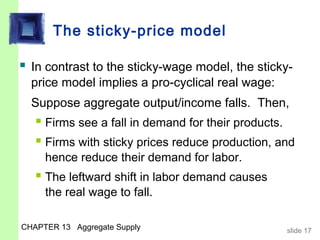
 In contrast to the sticky-wage model, the sticky-
  price model implies a pro-cyclical real wage:
  Suppose aggregate output/income falls. Then,
    Firms see a fall in demand for their products.
    Firms with sticky prices reduce production, and
     hence reduce their demand for labor.
    The leftward shift in labor demand causes
     the real wage to fall.

CHAPTER 13 Aggregate Supply                       slide 17
Summary & implications

            P          LRAS
                              Y = Y + α (P − P e )

P >Pe                                      Each of the
                                            Each of the
                              SRAS         three models
                                            three models
 P =P   e
                                           of agg. supply
                                            of agg. supply
                                           imply the
                                            imply the
P <Pe
                                           relationship
                                            relationship
                                           summarized
                                            summarized
                                   Y
                        Y                  by the SRAS
                                            by the SRAS
                                           curve &
                                            curve &
                                           equation.
                                            equation.
CHAPTER 13 Aggregate Supply                            slide 18
Summary & implications
Suppose a positive       SRAS equation: Y = Y + α ( P − P e )
AD shock moves
                               P                    SRAS2
output above its                          LRAS
natural rate and                                         SRAS1
P above the level
people had             P3 = P3e
expected.
                             P2
Over time,                                               AD2
                  P2e = P1 = P1e
P e rises,
SRAS shifts up,                                          AD1
and output returns                                             Y
to its natural rate.                                Y2
                                     Y 3 = Y1 = Y
CHAPTER 13 Aggregate Supply                                    slide 19
Inflation, Unemployment,
       and the Phillips Curve
The Phillips curve states that π depends on
  expected inflation, π e.
  cyclical unemployment: the deviation of the
   actual rate of unemployment from the natural rate
  supply shocks, ν (Greek letter “nu”).


  where β > 0 is an exogenous constant.

CHAPTER 13 Aggregate Supply                       slide 20
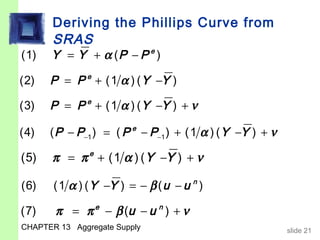
Deriving the Phillips Curve from
       SRAS
(1)   Y = Y + α (P − P e )

(2)   P = P e + (1 α ) ( Y −Y )

(3)   P = P e + (1 α ) ( Y −Y ) + ν

(4)   ( P − P−1 ) = ( P e − P−1 ) + (1 α ) ( Y −Y ) + ν

(5)    π = π e + (1 α ) ( Y −Y ) + ν

(6)    (1 α ) ( Y −Y ) = − β ( u − u n )

(7)    π = π e − β (u − u n ) + ν
CHAPTER 13 Aggregate Supply                               slide 21
The Phillips Curve and SRAS
             SRAS:       Y = Y + α (P − P e )
   Phillips curve:        π = π e − β (u − u n ) + ν

 SRAS curve:
  Output is related to
  unexpected movements in the price level.
 Phillips curve:
  Unemployment is related to
  unexpected movements in the inflation rate.

CHAPTER 13 Aggregate Supply                            slide 22
Adaptive expectations

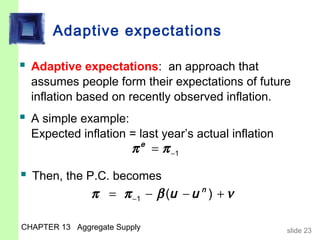
 Adaptive expectations: an approach that
  assumes people form their expectations of future
  inflation based on recently observed inflation.
 A simple example:
  Expected inflation = last year’s actual inflation
                         π e = π −1

 Then, the P.C. becomes
               π = π −1 − β (u − u n ) + ν

CHAPTER 13 Aggregate Supply                           slide 23
Inflation inertia
              π = π −1 − β (u − u n ) + ν

In this form, the Phillips curve implies that
inflation has inertia:
  In the absence of supply shocks or cyclical
    unemployment, inflation will continue
    indefinitely at its current rate.
  Past inflation influences expectations of
    current inflation, which in turn influences the
    wages & prices that people set.

CHAPTER 13 Aggregate Supply                           slide 24
Two causes of rising & falling
       inflation
            π = π −1 − β (u − u n ) + ν
 cost-push inflation:
  inflation resulting from supply shocks
  Adverse supply shocks typically raise production
  costs and induce firms to raise prices,
  “pushing” inflation up.
 demand-pull inflation:
  inflation resulting from demand shocks
  Positive shocks to aggregate demand cause
  unemployment to fall below its natural rate,
  which “pulls” the inflation rate up.
CHAPTER 13 Aggregate Supply                          slide 25
Graphing the Phillips curve

In the short
In the short                π
run, policymakers
run, policymakers
face a tradeoff
face a tradeoff
between π and u.
between π and u.                β
                                    1        The short-run
                    πe +ν                    Phillips curve


                                                          u
                                        un


CHAPTER 13 Aggregate Supply                               slide 26
Shifting the Phillips curve

People adjust
People adjust                     π
their
their
expectations
expectations
over time,
over time,                e
                         π2 +ν
so the tradeoff
so the tradeoff           e
only holds in            π1 + ν
only holds in
the short run.
the short run.
    E.g., an increase
     E.g., an increase
    in π e shifts the
     in π e shifts the
                                           u
    short-run P.C.
     short-run P.C.                   un
    upward.
     upward.

CHAPTER 13 Aggregate Supply                slide 27
The sacrifice ratio

 To reduce inflation, policymakers can
  contract agg. demand, causing
  unemployment to rise above the natural rate.
 The sacrifice ratio measures
  the percentage of a year’s real GDP
  that must be foregone to reduce inflation
  by 1 percentage point.
 A typical estimate of the ratio is 5.

CHAPTER 13 Aggregate Supply                      slide 28
The sacrifice ratio
 Example: To reduce inflation from 6 to 2 percent,
  must sacrifice 20 percent of one year’s GDP:
   GDP loss = (inflation reduction) x (sacrifice ratio)
            =            4          x         5
 This loss could be incurred in one year or spread
  over several, e.g., 5% loss for each of four years.
 The cost of disinflation is lost GDP.
  One could use Okun’s law to translate this cost
  into unemployment.

CHAPTER 13 Aggregate Supply                          slide 29
Rational expectations

Ways of modeling the formation of expectations:
  adaptive expectations:
   People base their expectations of future inflation
   on recently observed inflation.
  rational expectations:
   People base their expectations on all available
   information, including information about current
   and prospective future policies.


CHAPTER 13 Aggregate Supply                        slide 30
Painless disinflation?
 Proponents of rational expectations believe
  that the sacrifice ratio may be very small:
 Suppose u = u n and π = π e = 6%,
  and suppose the Fed announces that it will
  do whatever is necessary to reduce inflation
  from 6 to 2 percent as soon as possible.
 If the announcement is credible,
  then π e will fall, perhaps by the full 4 points.
 Then, π can fall without an increase in u.
CHAPTER 13 Aggregate Supply                           slide 31
Calculating the sacrifice ratio
       for the Volcker disinflation
 1981: π = 9.7%
                         Total disinflation = 6.7%
  1985: π = 3.0%

       year      u            un     u− u n
       1982      9.5%         6.0%   3.5%
       1983      9.5          6.0    3.5
       1984      7.4          6.0    1.4
       1985      7.1          6.0    1.1

                                     Total 9.5%
CHAPTER 13 Aggregate Supply                          slide 32
Calculating the sacrifice ratio
       for the Volcker disinflation
 From previous slide: Inflation fell by 6.7%,
  total cyclical unemployment was 9.5%.
 Okun’s law:
  1% of unemployment = 2% of lost output.
 So, 9.5% cyclical unemployment
  = 19.0% of a year’s real GDP.
 Sacrifice ratio = (lost GDP)/(total disinflation)
  = 19/6.7 = 2.8 percentage points of GDP were lost
  for each 1 percentage point reduction in inflation.
CHAPTER 13 Aggregate Supply                           slide 33
The natural rate hypothesis
Our analysis of the costs of disinflation, and of
economic fluctuations in the preceding chapters,
is based on the natural rate hypothesis:

     Changes in aggregate demand affect output
       and employment only in the short run.
         In the long run, the economy returns to
            the levels of output, employment,
             and unemployment described by
             the classical model (Chaps. 3-8).

CHAPTER 13 Aggregate Supply                         slide 34
An alternative hypothesis:
       Hysteresis
 Hysteresis: the long-lasting influence of history
  on variables such as the natural rate of
  unemployment.
 Negative shocks may increase un,
  so economy may not fully recover.


CHAPTER 13 Aggregate Supply                      slide 35
Hysteresis: Why negative
       shocks may increase the natural
       rate
 The skills of cyclically unemployed workers may
  deteriorate while unemployed, and they may not
  find a job when the recession ends.
 Cyclically unemployed workers may lose
  their influence on wage-setting;
  then, insiders (employed workers)
  may bargain for higher wages for themselves.
  Result: The cyclically unemployed “outsiders”
  may become structurally unemployed when the
  recession ends.
CHAPTER 13 Aggregate Supply                         slide 36
Chapter Summary

1. Three models of aggregate supply in the short run:
     sticky-wage model
     imperfect-information model
     sticky-price model
   All three models imply that output rises above its
   natural rate when the price level rises above the
   expected price level.


CHAPTER 13   Aggregate Supply                       slide 37
Chapter Summary

2. Phillips curve
     derived from the SRAS curve
     states that inflation depends on
        expected inflation
        cyclical unemployment
        supply shocks
     presents policymakers with a short-run tradeoff
      between inflation and unemployment


CHAPTER 13   Aggregate Supply                           slide 38
Chapter Summary

3. How people form expectations of inflation
    adaptive expectations
       based on recently observed inflation
       implies “inertia”
    rational expectations
       based on all available information
       implies that disinflation may be painless


CHAPTER 13   Aggregate Supply                       slide 39
Chapter Summary

4. The natural rate hypothesis and hysteresis
     the natural rate hypotheses
        states that changes in aggregate demand can
         only affect output and employment in the short
         run
     hysteresis
        states that aggregate demand can have
         permanent effects on output and employment


CHAPTER 13   Aggregate Supply                        slide 40

Chap13

  • 1.
    13 C H AP T E R Aggregate Supply and the Short-run Tradeoff Between Inflation and Unemployment MACROECONOMICS SIXTH EDITION N. GREGORY MANKIW PowerPoint® Slides by Ron Cronovich © 2007 Worth Publishers, all rights reserved
  • 2.
    In this chapter,you will learn…  three models of aggregate supply in which output depends positively on the price level in the short run  about the short-run tradeoff between inflation and unemployment known as the Phillips curve CHAPTER 13 Aggregate Supply slide 2
  • 3.
    Three models ofaggregate supply 1. The sticky-wage model 2. The imperfect-information model 3. The sticky-price model All three models imply: Y = Y + α (P − P e ) agg. the expected output price level a positive natural rate the actual parameter of output price level CHAPTER 13 Aggregate Supply slide 3
  • 4.
    The sticky-wage model Assumes that firms and workers negotiate contracts and fix the nominal wage before they know what the price level will turn out to be.  The nominal wage they set is the product of a target real wage and the expected price level: Target real Wω= P× e wage W Pe ⇒ =ω× P P CHAPTER 13 Aggregate Supply slide 4
  • 5.
    The sticky-wage model W Pe =ω× P P If it turns out that then Unemployment and output are P =P e at their natural rates. Real wage is less than its target, P >Pe so firms hire more workers and output rises above its natural rate. Real wage exceeds its target, P <Pe so firms hire fewer workers and output falls below its natural rate. CHAPTER 13 Aggregate Supply slide 5
  • 6.
    The sticky-wage model Implies that the real wage should be counter-cyclical, should move in the opposite direction as output during business cycles:  In booms, when P typically rises, real wage should fall.  In recessions, when P typically falls, real wage should rise.  This prediction does not come true in the real world: CHAPTER 13 Aggregate Supply slide 7
  • 7.
    The cyclical behaviorof the real wage 5 in real wage 1972 Percentage change 4 1965 3 1998 2 1982 2001 1 0 -1 1991 1990 2004 1984 -2 -3 1974 1979 -4 -5 1980 -3 -2 -1 0 1 2 3 4 5 6 7 8 Percentage change in real GDP
  • 8.
    The imperfect-information model Assumptions:  All wages and prices are perfectly flexible, all markets are clear.  Each supplier produces one good, consumes many goods.  Each supplier knows the nominal price of the good she produces, but does not know the overall price level. CHAPTER 13 Aggregate Supply slide 9
  • 9.
    The imperfect-information model Supply of each good depends on its relative price: the nominal price of the good divided by the overall price level.  Supplier does not know price level at the time she makes her production decision, so uses the e expected price level, P .  Suppose P rises but P e does not.  Supplier thinks her relative price has risen, so she produces more.  With many producers thinking this way, Y will rise whenever P rises above P e. CHAPTER 13 Aggregate Supply slide 10
  • 10.
    The sticky-price model Reasons for sticky prices:  long-term contracts between firms and customers  menu costs  firms not wishing to annoy customers with frequent price changes  Assumption:  Firms set their own prices (e.g., as in monopolistic competition). CHAPTER 13 Aggregate Supply slide 11
  • 11.
    The sticky-price model An individual firm’s desired price is p = P + a (Y −Y ) where a > 0. Suppose two types of firms: • firms with flexible prices, set prices as above • firms with sticky prices, must set their price before they know how P and Y will turn out: p = P + a (Y e e −Y ) e CHAPTER 13 Aggregate Supply slide 12
  • 12.
    The sticky-price model p = P e + a (Y e −Y e )  Assume sticky price firms expect that output will equal its natural rate. Then, p =P e  To derive the aggregate supply curve, we first find an expression for the overall price level.  Let s denote the fraction of firms with sticky prices. Then, we can write the overall price level as… CHAPTER 13 Aggregate Supply slide 13
  • 13.
    The sticky-price model P = s P + (1 − s )[ P + a( Y −Y )] e price set by sticky price set by flexible price firms price firms  Subtract (1−s )P from both sides: sP = s P e + (1 − s )[ a( Y −Y )]  Divide both sides by s :  (1 − s ) a  P = P e +  ( Y −Y )  s  CHAPTER 13 Aggregate Supply slide 14
  • 14.
    The sticky-price model  (1 − s ) a  P = P e +   ( Y −Y )  s   High P e ⇒ High P If firms expect high prices, then firms that must set prices in advance will set them high. Other firms respond by setting high prices.  High Y ⇒ High P When income is high, the demand for goods is high. Firms with flexible prices set high prices. The greater the fraction of flexible price firms, the smaller is s and the bigger is the effect of ∆Y on P. CHAPTER 13 Aggregate Supply slide 15
  • 15.
    The sticky-price model  (1 − s ) a  P = P e +   ( Y −Y )  s   Finally, derive AS equation by solving for Y : Y = Y + α ( P − P e ), s where α = (1 − s )a CHAPTER 13 Aggregate Supply slide 16
  • 16.
    The sticky-price model In contrast to the sticky-wage model, the sticky- price model implies a pro-cyclical real wage: Suppose aggregate output/income falls. Then,  Firms see a fall in demand for their products.  Firms with sticky prices reduce production, and hence reduce their demand for labor.  The leftward shift in labor demand causes the real wage to fall. CHAPTER 13 Aggregate Supply slide 17
  • 17.
    Summary & implications P LRAS Y = Y + α (P − P e ) P >Pe Each of the Each of the SRAS three models three models P =P e of agg. supply of agg. supply imply the imply the P <Pe relationship relationship summarized summarized Y Y by the SRAS by the SRAS curve & curve & equation. equation. CHAPTER 13 Aggregate Supply slide 18
  • 18.
    Summary & implications Supposea positive SRAS equation: Y = Y + α ( P − P e ) AD shock moves P SRAS2 output above its LRAS natural rate and SRAS1 P above the level people had P3 = P3e expected. P2 Over time, AD2 P2e = P1 = P1e P e rises, SRAS shifts up, AD1 and output returns Y to its natural rate. Y2 Y 3 = Y1 = Y CHAPTER 13 Aggregate Supply slide 19
  • 19.
    Inflation, Unemployment, and the Phillips Curve The Phillips curve states that π depends on  expected inflation, π e.  cyclical unemployment: the deviation of the actual rate of unemployment from the natural rate  supply shocks, ν (Greek letter “nu”). where β > 0 is an exogenous constant. CHAPTER 13 Aggregate Supply slide 20
  • 20.
    Deriving the PhillipsCurve from SRAS (1) Y = Y + α (P − P e ) (2) P = P e + (1 α ) ( Y −Y ) (3) P = P e + (1 α ) ( Y −Y ) + ν (4) ( P − P−1 ) = ( P e − P−1 ) + (1 α ) ( Y −Y ) + ν (5) π = π e + (1 α ) ( Y −Y ) + ν (6) (1 α ) ( Y −Y ) = − β ( u − u n ) (7) π = π e − β (u − u n ) + ν CHAPTER 13 Aggregate Supply slide 21
  • 21.
    The Phillips Curveand SRAS SRAS: Y = Y + α (P − P e ) Phillips curve: π = π e − β (u − u n ) + ν  SRAS curve: Output is related to unexpected movements in the price level.  Phillips curve: Unemployment is related to unexpected movements in the inflation rate. CHAPTER 13 Aggregate Supply slide 22
  • 22.
    Adaptive expectations  Adaptiveexpectations: an approach that assumes people form their expectations of future inflation based on recently observed inflation.  A simple example: Expected inflation = last year’s actual inflation π e = π −1  Then, the P.C. becomes π = π −1 − β (u − u n ) + ν CHAPTER 13 Aggregate Supply slide 23
  • 23.
    Inflation inertia π = π −1 − β (u − u n ) + ν In this form, the Phillips curve implies that inflation has inertia:  In the absence of supply shocks or cyclical unemployment, inflation will continue indefinitely at its current rate.  Past inflation influences expectations of current inflation, which in turn influences the wages & prices that people set. CHAPTER 13 Aggregate Supply slide 24
  • 24.
    Two causes ofrising & falling inflation π = π −1 − β (u − u n ) + ν  cost-push inflation: inflation resulting from supply shocks Adverse supply shocks typically raise production costs and induce firms to raise prices, “pushing” inflation up.  demand-pull inflation: inflation resulting from demand shocks Positive shocks to aggregate demand cause unemployment to fall below its natural rate, which “pulls” the inflation rate up. CHAPTER 13 Aggregate Supply slide 25
  • 25.
    Graphing the Phillipscurve In the short In the short π run, policymakers run, policymakers face a tradeoff face a tradeoff between π and u. between π and u. β 1 The short-run πe +ν Phillips curve u un CHAPTER 13 Aggregate Supply slide 26
  • 26.
    Shifting the Phillipscurve People adjust People adjust π their their expectations expectations over time, over time, e π2 +ν so the tradeoff so the tradeoff e only holds in π1 + ν only holds in the short run. the short run. E.g., an increase E.g., an increase in π e shifts the in π e shifts the u short-run P.C. short-run P.C. un upward. upward. CHAPTER 13 Aggregate Supply slide 27
  • 27.
    The sacrifice ratio To reduce inflation, policymakers can contract agg. demand, causing unemployment to rise above the natural rate.  The sacrifice ratio measures the percentage of a year’s real GDP that must be foregone to reduce inflation by 1 percentage point.  A typical estimate of the ratio is 5. CHAPTER 13 Aggregate Supply slide 28
  • 28.
    The sacrifice ratio Example: To reduce inflation from 6 to 2 percent, must sacrifice 20 percent of one year’s GDP: GDP loss = (inflation reduction) x (sacrifice ratio) = 4 x 5  This loss could be incurred in one year or spread over several, e.g., 5% loss for each of four years.  The cost of disinflation is lost GDP. One could use Okun’s law to translate this cost into unemployment. CHAPTER 13 Aggregate Supply slide 29
  • 29.
    Rational expectations Ways ofmodeling the formation of expectations:  adaptive expectations: People base their expectations of future inflation on recently observed inflation.  rational expectations: People base their expectations on all available information, including information about current and prospective future policies. CHAPTER 13 Aggregate Supply slide 30
  • 30.
    Painless disinflation?  Proponentsof rational expectations believe that the sacrifice ratio may be very small:  Suppose u = u n and π = π e = 6%, and suppose the Fed announces that it will do whatever is necessary to reduce inflation from 6 to 2 percent as soon as possible.  If the announcement is credible, then π e will fall, perhaps by the full 4 points.  Then, π can fall without an increase in u. CHAPTER 13 Aggregate Supply slide 31
  • 31.
    Calculating the sacrificeratio for the Volcker disinflation  1981: π = 9.7% Total disinflation = 6.7% 1985: π = 3.0% year u un u− u n 1982 9.5% 6.0% 3.5% 1983 9.5 6.0 3.5 1984 7.4 6.0 1.4 1985 7.1 6.0 1.1 Total 9.5% CHAPTER 13 Aggregate Supply slide 32
  • 32.
    Calculating the sacrificeratio for the Volcker disinflation  From previous slide: Inflation fell by 6.7%, total cyclical unemployment was 9.5%.  Okun’s law: 1% of unemployment = 2% of lost output.  So, 9.5% cyclical unemployment = 19.0% of a year’s real GDP.  Sacrifice ratio = (lost GDP)/(total disinflation) = 19/6.7 = 2.8 percentage points of GDP were lost for each 1 percentage point reduction in inflation. CHAPTER 13 Aggregate Supply slide 33
  • 33.
    The natural ratehypothesis Our analysis of the costs of disinflation, and of economic fluctuations in the preceding chapters, is based on the natural rate hypothesis: Changes in aggregate demand affect output and employment only in the short run. In the long run, the economy returns to the levels of output, employment, and unemployment described by the classical model (Chaps. 3-8). CHAPTER 13 Aggregate Supply slide 34
  • 34.
    An alternative hypothesis: Hysteresis  Hysteresis: the long-lasting influence of history on variables such as the natural rate of unemployment.  Negative shocks may increase un, so economy may not fully recover. CHAPTER 13 Aggregate Supply slide 35
  • 35.
    Hysteresis: Why negative shocks may increase the natural rate  The skills of cyclically unemployed workers may deteriorate while unemployed, and they may not find a job when the recession ends.  Cyclically unemployed workers may lose their influence on wage-setting; then, insiders (employed workers) may bargain for higher wages for themselves. Result: The cyclically unemployed “outsiders” may become structurally unemployed when the recession ends. CHAPTER 13 Aggregate Supply slide 36
  • 36.
    Chapter Summary 1. Threemodels of aggregate supply in the short run:  sticky-wage model  imperfect-information model  sticky-price model All three models imply that output rises above its natural rate when the price level rises above the expected price level. CHAPTER 13 Aggregate Supply slide 37
  • 37.
    Chapter Summary 2. Phillipscurve  derived from the SRAS curve  states that inflation depends on  expected inflation  cyclical unemployment  supply shocks  presents policymakers with a short-run tradeoff between inflation and unemployment CHAPTER 13 Aggregate Supply slide 38
  • 38.
    Chapter Summary 3. Howpeople form expectations of inflation  adaptive expectations  based on recently observed inflation  implies “inertia”  rational expectations  based on all available information  implies that disinflation may be painless CHAPTER 13 Aggregate Supply slide 39
  • 39.
    Chapter Summary 4. Thenatural rate hypothesis and hysteresis  the natural rate hypotheses  states that changes in aggregate demand can only affect output and employment in the short run  hysteresis  states that aggregate demand can have permanent effects on output and employment CHAPTER 13 Aggregate Supply slide 40

Editor's Notes

  • #2 Chapter 13 has two parts. The first concerns aggregate supply. In the preceding chapters, we made the simple and extreme assumption that all prices were “stuck” in the short run. This assumption implied a horizontal short-run aggregate supply curve. More realistic models of aggregate supply imply an upward-sloping SRAS curve. Chapter 13 presents three of the most prominent models. The second half of the chapter is devoted to the Phillips curve and related issues. The section uses a few lines of algebra to derives an expression for the Phillips curve from the SRAS equation. This is followed by a discussion of adaptive and rational expectations, and the sacrifice ratio. The chapter concludes by contrasting the notion of hysteresis to the natural rate hypothesis. To help your students master the material, it would be helpful to assign homework or in-class exercises in which students use the models to analyze the effects of policies and shocks. Right before the introduction of the Phillips curve would be a good place to have students work an exercise using the IS-LM-AD-AS model with a postively-sloped SRAS curve. The key difference is that, in the short run, a shift in AD causes P to change, which changes M/P, which shifts LM a bit, which explains why the short-run change in output is smaller when SRAS is upward-sloping than when it is horizontal.
  • #5 At the target real wage, the labor market is in equilibrium, meaning that unemployment equals its natural rate. This implies that output equals its natural rate (aka full-employment output).
  • #6 Intuition for the positive relationship between P and Y, for a given value of the expected price level.
  • #7 I’ve included Figure 13-1 from the text here as a “hidden slide” in case you wish to “unhide” and include it in your presentation. This figure uses graphs to derive the aggregate supply curve under the assumption of sticky wages. As you can see, three-panel diagrams do not translate well to the big screen. Fortunately, though, most students readily grasp the intuition on the preceding slide, which sums up as follows: If the nominal wage is fixed, then increases in the price level cause the real wage to fall, which causes firms to hire more workers and produce more output.
  • #9 Figure 13-2, p.380 The real wage is procyclical in the U.S., contrary to the sticky wage theory.
  • #12 If you don’t like the appearance of the term “monopolistic competition” in this slide, just change the parenthetical comment to “(i.e. firms have some market power)” or something to that effect.
  • #19 The following is not in the text, but you and your students may find it worthwhile: There are good reasons to believe that the SRAS curve is bow-shaped in the real world; that is, the curve is steeper at high levels of output than at low levels of output. And there are good reasons why we should care about this. Why the SRAS curve is bow-shaped: At low levels of output, there are lots of unutilized and under-utilized resources available, so it is not terribly costly for firms to increase output, and therefore firms do not require a big increase in prices to make them willing to increase output by a given amount. In contrast, at very high levels of output, when unemployment is below the natural rate and capital is being used at higher than normal intensity levels, it is relatively costly for firms to increase output further. Hence, a larger increase in prices is required to make firms willing to increase their output. Why the curvature matters: When policymakers increase aggregate demand, output rises (good) and prices rise (not good). An important question arises: how much of the bad thing (price increases) must we tolerate to get some of the good thing (an increase output)? The answer depends on how steep the SRAS curve is. When President Reagan cut taxes in the early 1980s, the economy was just coming out of a severe recession, and was on the flatter part of the SRAS curve; hence, the tax cuts affected output a lot and inflation very little. In contrast, when the current President Bush proposed huge tax cuts during the 2000 election season, we were on the steeper part of the SRAS curve, so the tax cuts would likely have been inflationary. Of course, by the time they were implemented, the economy was in recession, and in any case the bulk of the tax cuts were to be spread out over 10 or 11 years, so they have not proved inflationary. Figure 13-3, p.357 Idiosyncracy alert: If  is constant, then the SRAS curve should be linear, strictly speaking. However, in the text, it is drawn with a bit of curvature (which I have reproduced here).
  • #20 This graph has two lessons for students: First, changes in the expected price level shift the SRAS curve (this should be clear from the equation, as should the fact that a change in the natural rate of output will shift the SRAS curve). The second lesson concerns the adjustment of the economy back to full-employment output.
  • #21  measures the responsiveness of inflation to cyclical unemployment.
  • #22 Explain each equation briefly before displaying the next. Here are the explanations: Equation (1) is the SRAS equation. Solve (1) for P to get (2). To get (3), add the supply shock term to (2). To get (4), subtract last year’s price level (P -1 ) from both sides. To get (5), write  in place of (P- P -1 ) and  e in place of (P e - P -1 ). Note that the change in the price level is not exactly the inflation rate, unless we interpret P as the natural log of the price level. Equation (6) captures the relationship between output and unemployment from Okun’s law (chapter 2): the deviation of output from its natural rate is inversely related to cyclical unemployment. Substituting (6) into (5) gives (7), the Phillips curve equation introduced on the preceding slide.
  • #26 Of course, a favorable supply shock that lowers production costs will “push” inflation down, and a negative demand shock which raises cyclical unemployment will “pull” inflation down.
  • #27 Here, the “short run” is the period until people adjust their expectations of inflation.
  • #28 After displaying this slide, you might consider giving your students an exercise using the P.C. curve. One possibility would be to ask them to draw a graph of the PC curve, then show what happens to it in the face of an adverse supply shock or an increase in the natural rate of unemployment, giving intuition for each. The intuition for why an increase in the natural rate shifts the PC upward (or rightward) is as follows: At any given value of actual unemployment, an increase in the natural rate implies a decrease in cyclical unemployment, which increases inflation by increasing pressures for wages to rise. Thus, each value of unemployment has a higher value of inflation than before.
  • #31 A good example to illustrate the difference between adaptive and rational expectations. Suppose the Fed announces a shift in priorities, from maintaining low inflation to maintaining low unemployment w/o regard to inflation; this shift will start affecting policy next week. If expectations are adaptive, then expected inflation will not change, because it is based on past inflation. The Fed’s announcement pertains to the future, and has no impact on past inflation. If expectations are rational, then expected inflation will increase right away, as people factor this announcement into their forecasts.
  • #32 Here’s an interesting and important implication: Central banks that are politically independent are typically more credible than those that are “puppets” to elected officials. Hence, in countries with central banks that are NOT politically independent, it is usually far costlier to reduce inflation. A very worthwhile reform, therefore, would be for governments to give their central banks independence.
  • #33 The natural rate of unemployment is assumed to be 6.0% during the early 1980s.
  • #35 The natural rate hypothesis allows us to study the long run separately from the short run.