INTERNAL
AUDIT
Rahul Mithia
WHAT IS INTERNAL AUDIT
Internal audit is an independent
management function, which involves a
continuous and critical appraisal of the
functioning of an entity with a view to
suggest improvements thereto and add
value to and strengthen the overall
governance mechanism of the entity,
including the entity's strategic risk
management and internal control system.
Rahul Mithia
Scope And Objective
• Review of accounting system and related internal
controls
• Examination for management of financial and
operating information
• Examination of the economy, efficiency and
effectiveness of operations including non-financial
controls of an organization
• Physical examination and verification
• Adoption of standard accounting practices
• Proper authority on the acquisition and disposal of
assets
• Prevention and detection of fraud
Rahul Mithia
NEED FOR INTERNAL AUDIT
• Increased size and complexity of businesses
• Enhanced compliance requirements
• Focus on risk management and internal controls
to manage them
• Unconventional business models
• Intensive use of information technology
• Stringent norms mandated by regulators to
protect investors
• An increasingly competitive environment
Rahul Mithia
INTERNAL AUDIT ADDING VALUE TO
ORGANISATION
• Risk Management
• Providing Assurance Regarding Internal
Controls
• Compliance
• Fraud Detection
• Consulting and Operations
Rahul Mithia
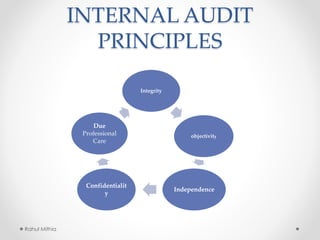
INTERNAL AUDIT
PRINCIPLES
Rahul Mithia
Integrity
objectivity
Independence
Confidentialit
y
Due
Professional
Care
Internal audit as per Companies
Act 2013 section(138)
• The Companies Act 2013 provide statutory
recognition this area has opened a scope of
Chartered Accountants and others professionals
• Section 138(1) of the act provide such class of
companies as may be prescribed shall be required
to appoint an internal auditor, who shall be either
be an Chartered Accountant or a Cost
Accountant Or such other professional as may be
decided by the board to conduct internal audit of
the function and activities of the company
Rahul Mithia
Applicability of Internal
Audit
Public Company
Private
Company
Listed
Company
Unlisted
Company
Rahul Mithia
Listed Company
Public Company
Unlisted Company
Applicable to all listed
Company
Applicable to every unlisted company having
1.Paid up share capital 50 Crore or more
during preceding financial year OR
2.Turnover of rupees of 200 crore or more
during preceding financial year OR
3.Outstanding loan or Borrowings from banks
or Public financial institution exceeding one
100 Cr or more during the preceding financial
year OR
4.Outstanding loan of 25 crore or more at any
time during the preceding financial year
Rahul Mithia
Private Company
1. Turnover of 200 crore rupees or more at ant time during
the preceding financial year OR
2. Outstanding loan or borrowings from banks or public
financial institution exceeding 100 crore or more at any
point of time during the preceding financial year
Rahul Mithia
INTERNAL AUDIT IN TODAYS
ORGANISATION
• Relationship with the Audit Committee
• Relationship with the Management
• Relationship with the External Auditor
• Co-ordination of internal and external audit work
increases economy, efficiency, and effectiveness of
the overall audit process.
Rahul Mithia
Standards on Internal
Audit
1. Planning an Internal Audit
2. Basic principal Governing Internal Audit
3. Documentation
4. Sampling
5. Analytical Procedure
6. Quality Assurance in Internal Audit
7. Terms of Internal Audit Engagement
8. Communication with Management
9. Internal Audit Evidence
10. Consideration of Fraud in Internal Audit
11. Internal Control Evaluation
12. Enterprise Risk Management
13. Internal Audit in an Information Technology Environment
14. Knowledge of the Entity and its Environment
15. Using the Work of an ExpertRahul Mithia
Functions Of Internal
Auditor
• Ensure the correctness and completeness of accounts.
• Examine the accounts to ensure regularity in expenditure.
• Look into the propriety of the financial transaction.
• Ensure that the resources expended by the executive have
produced desired result.
• Keep a constant vigil on all financial dealings and
transactions in the organization.
• Find out whether there have been any financial irregularity or
malpractice in incurring expenditure.
• Point out mistakes and indicate how they can be rectified and
avoided in future.
• Verify the physical achievements of schemes/projects in the
Institutions.
Rahul Mithia
Process of Internal Audit
• Notification
• Planning
• Opening Meeting
• Understanding the Policies and Procedure
• Execution of Internal Audit
• Closing Meeting
• In House Internal Audit Review
• Internal Audit Reporting
• Cover Page
• Table Of Contents
• Executive Summary
• Background of module and Audit
• Methodology
• Purpose and scope of audit
• Scope limitation
• Summary and Detail of audit observation
Rahul Mithia
Rahul Mithia
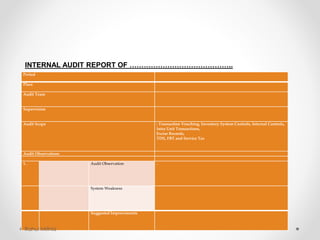
Period
Place
Audit Team
Supervision
Audit Scope : Transaction Vouching, Inventory System Controls, Internal Controls,
Intra Unit Transactions,
Excise Records,
TDS, FBT and Service Tax
Audit Observations
1. Audit Observation .
System Weakness
Suggested Improvements
Rahul Mithia
INTERNAL AUDIT REPORT OF ……………………………………..

Internal audit

  • 1.
  • 2.
    WHAT IS INTERNALAUDIT Internal audit is an independent management function, which involves a continuous and critical appraisal of the functioning of an entity with a view to suggest improvements thereto and add value to and strengthen the overall governance mechanism of the entity, including the entity's strategic risk management and internal control system. Rahul Mithia
  • 3.
    Scope And Objective •Review of accounting system and related internal controls • Examination for management of financial and operating information • Examination of the economy, efficiency and effectiveness of operations including non-financial controls of an organization • Physical examination and verification • Adoption of standard accounting practices • Proper authority on the acquisition and disposal of assets • Prevention and detection of fraud Rahul Mithia
  • 4.
    NEED FOR INTERNALAUDIT • Increased size and complexity of businesses • Enhanced compliance requirements • Focus on risk management and internal controls to manage them • Unconventional business models • Intensive use of information technology • Stringent norms mandated by regulators to protect investors • An increasingly competitive environment Rahul Mithia
  • 5.
    INTERNAL AUDIT ADDINGVALUE TO ORGANISATION • Risk Management • Providing Assurance Regarding Internal Controls • Compliance • Fraud Detection • Consulting and Operations Rahul Mithia
  • 6.
  • 7.
    Internal audit asper Companies Act 2013 section(138) • The Companies Act 2013 provide statutory recognition this area has opened a scope of Chartered Accountants and others professionals • Section 138(1) of the act provide such class of companies as may be prescribed shall be required to appoint an internal auditor, who shall be either be an Chartered Accountant or a Cost Accountant Or such other professional as may be decided by the board to conduct internal audit of the function and activities of the company Rahul Mithia
  • 8.
    Applicability of Internal Audit PublicCompany Private Company Listed Company Unlisted Company Rahul Mithia
  • 9.
    Listed Company Public Company UnlistedCompany Applicable to all listed Company Applicable to every unlisted company having 1.Paid up share capital 50 Crore or more during preceding financial year OR 2.Turnover of rupees of 200 crore or more during preceding financial year OR 3.Outstanding loan or Borrowings from banks or Public financial institution exceeding one 100 Cr or more during the preceding financial year OR 4.Outstanding loan of 25 crore or more at any time during the preceding financial year Rahul Mithia
  • 10.
    Private Company 1. Turnoverof 200 crore rupees or more at ant time during the preceding financial year OR 2. Outstanding loan or borrowings from banks or public financial institution exceeding 100 crore or more at any point of time during the preceding financial year Rahul Mithia
  • 11.
    INTERNAL AUDIT INTODAYS ORGANISATION • Relationship with the Audit Committee • Relationship with the Management • Relationship with the External Auditor • Co-ordination of internal and external audit work increases economy, efficiency, and effectiveness of the overall audit process. Rahul Mithia
  • 12.
    Standards on Internal Audit 1.Planning an Internal Audit 2. Basic principal Governing Internal Audit 3. Documentation 4. Sampling 5. Analytical Procedure 6. Quality Assurance in Internal Audit 7. Terms of Internal Audit Engagement 8. Communication with Management 9. Internal Audit Evidence 10. Consideration of Fraud in Internal Audit 11. Internal Control Evaluation 12. Enterprise Risk Management 13. Internal Audit in an Information Technology Environment 14. Knowledge of the Entity and its Environment 15. Using the Work of an ExpertRahul Mithia
  • 13.
    Functions Of Internal Auditor •Ensure the correctness and completeness of accounts. • Examine the accounts to ensure regularity in expenditure. • Look into the propriety of the financial transaction. • Ensure that the resources expended by the executive have produced desired result. • Keep a constant vigil on all financial dealings and transactions in the organization. • Find out whether there have been any financial irregularity or malpractice in incurring expenditure. • Point out mistakes and indicate how they can be rectified and avoided in future. • Verify the physical achievements of schemes/projects in the Institutions. Rahul Mithia
  • 14.
    Process of InternalAudit • Notification • Planning • Opening Meeting • Understanding the Policies and Procedure • Execution of Internal Audit • Closing Meeting • In House Internal Audit Review • Internal Audit Reporting • Cover Page • Table Of Contents • Executive Summary • Background of module and Audit • Methodology • Purpose and scope of audit • Scope limitation • Summary and Detail of audit observation Rahul Mithia
  • 15.
  • 16.
    Period Place Audit Team Supervision Audit Scope: Transaction Vouching, Inventory System Controls, Internal Controls, Intra Unit Transactions, Excise Records, TDS, FBT and Service Tax Audit Observations 1. Audit Observation . System Weakness Suggested Improvements Rahul Mithia INTERNAL AUDIT REPORT OF ……………………………………..