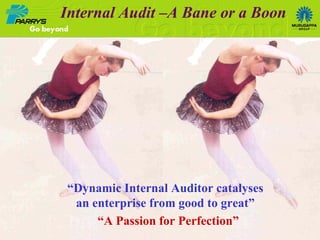



“ Dynamic Internal Auditor catalyses an enterprise from good to great” Internal Audit –A Bane or a Boon “ A Passion for Perfection”
1 st   Module   Introduction to & understanding of title  2 nd  Module   Taking the lead from the ‘new Internal Audit  definition’ 3 rd  Module   How to ‘add’ value to make it a Boon?
1 st   Module   Introduction to & understanding of  title
Bane or a Boon ? A Management Perspective Internal Audit
‘ Value’ like beauty, lies in the eyes of the beholder
“ Bane ?” Nuisance Curse Irritation Annoyance Blight (disease, stain, scar, pain)
“ Boon” benefit bonus godsend gain blessing help
In the normal course, all possibilities exist to perceive it as a “Bane” !  - Customer Making it a “Boon”,  is in the hands of the Internal Auditor! -  Seller’s role Perception
points finger finds fault  is policing is controlling takes on trivial issues only does post mortem analysis is not adding any  value! Internal Audit  will be ‘perceived’ as a bane if it,
helping guiding facilitating suggestive on ‘systems’ advising focused on key issues providing ‘assurance’ raising alarms at the appropriate time (ie. Before & not after)  really adding value! It will be a real ‘boon’ if it is,
‘ Nobody’ at the end wants it to be a  ‘ BANE’ – Then why talk about it? Let’s only talk about how to make it a s a  ‘ BOON’!
PERCEPTION & FEATURE Internal direction is very important What we believe, we practise  If majority perceive the same way , it becomes a feature !
Internal Auditor’s Knowledge & Understanding of his professional role Continuous  effective communication (with audit  customers) before – during & after the audit! Demonstration of capabilities (product delivery) “  Dynamism of an youngster & Wisdom of an elder” What are the deciding Factors?
Why…… ………… Management Perspective ?
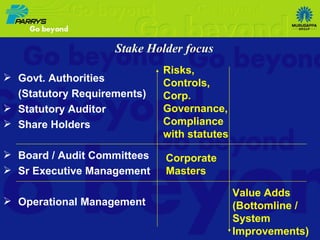
Govt. Authorities  (Statutory Requirements) Statutory Auditor Share Holders Board / Audit Committees Sr Executive Management Operational Management Risks, Controls, Corp. Governance, Compliance with statutes Value Adds (Bottomline / System Improvements) Corporate Masters Stake Holder focus
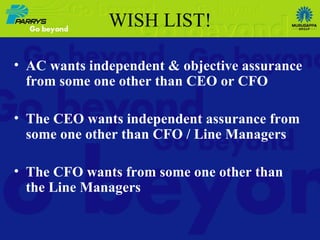
WISH LIST ! AC wants independent & objective assurance from some one other than CEO or CFO The CEO wants independent assurance from some one other than CFO / Line Managers The CFO wants from some one other than the Line Managers
2 nd  Module   Taking the lead from the ‘new Internal Audit  definition’
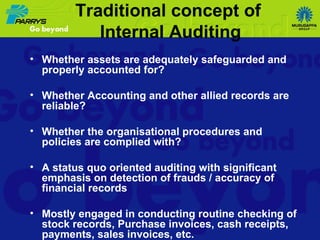
Traditional concept of  Internal Auditing Whether assets are adequately safeguarded and properly accounted for? Whether Accounting and other allied records are reliable? Whether the organisational procedures and policies are complied with? A status quo oriented auditing with significant emphasis on detection of frauds / accuracy of financial records Mostly engaged in conducting routine checking of stock records, Purchase invoices, cash receipts, payments, sales invoices, etc.
First Definition from IIA . Internal Auditing is an independent appraisal function established within the organisation to examine and evaluate its activities as a service to the organisation. The objective of IA is to members of the organisation in the effective discharge of their responsibilities. To this end the IA furnishes them with analyses, appraisals, recommendations, counsel and information concerning the activities reviewed.
“ This new definition” did not come from a theoretical think tank – It came from the practices of the best internal auditors today” (by the Institute of Internal Auditors, Inc, USA – the International Body promoting the profession of Internal Auditing)   “ Internal Auditing is an Independent and Objective  Assurance and Consulting Activity that is Guided by a Philosophy of Adding Value to Improve the Operations of the Organisation. It Assists an Organisation in Accomplishing the Objectives by Bringing a Systematic and Disciplined Approach to Evaluate and Improve the Effectiveness of the Organisation’s Risk Management,  Control, and Governing Processes.”     Internal Audit now redefined
This leads us to have a  CLOSER look at the “ DEFINITION” of  Internal Audit Look up to the “Professional Guidance” from the < Institute of Internal Auditors>
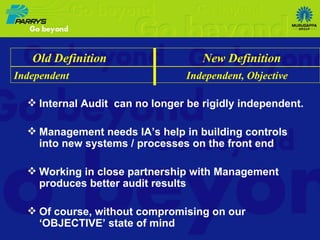
Internal Audit  can no longer be rigidly independent. Management needs IA’s help in building controls into new systems / processes on the front end Working in close partnership with Management produces better audit results Of course, without compromising on our ‘OBJECTIVE’ state of mind Old Definition  New Definition Independent  Independent, Objective
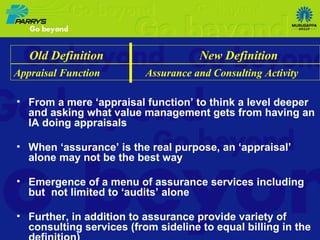
From a mere ‘appraisal function’ to think a level deeper and asking what value management gets from having an IA doing appraisals When ‘assurance’ is the real purpose, an ‘appraisal’ alone may not be the best way Emergence of a menu of assurance services including but  not limited to ‘audits’ alone Further, in addition to assurance provide variety of consulting services (from sideline to equal billing in the definition) Old Definition  New Definition Appraisal Function  Assurance and Consulting Activity
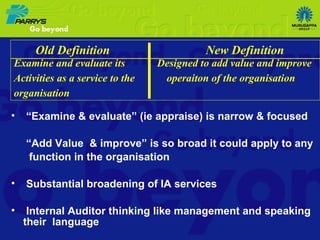
“ Examine & evaluate” (ie appraise) is narrow & focused “ Add Value  & improve” is so broad it could apply to any function in the organisation Substantial broadening of IA services Internal Auditor thinking like management and speaking their  language Old Definition  New Definition Examine and evaluate its  Designed to add value and improve Activities as a service to the  operaiton of the organisation  organisation
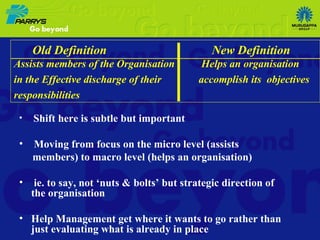
Shift here is subtle but important Moving from focus on the micro level (assists members) to macro level (helps an organisation) ie. to say, not ‘nuts & bolts’ but strategic direction of the organisation Help Management get where it wants to go rather than just evaluating what is already in place Old Definition  New Definition Assists members of the Organisation  Helps an organisation  in the Effective discharge of their  accomplish its  objectives responsibilities
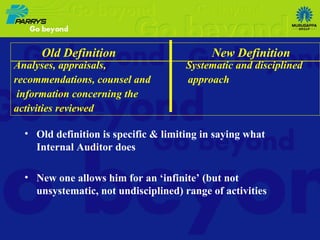
Old definition is specific & limiting in saying what Internal Auditor does New one allows him for an ‘infinite’ (but not unsystematic, not undisciplined) range of activities Old Definition  New Definition Analyses, appraisals,  Systematic and disciplined  recommendations, counsel and  approach information concerning the  activities reviewed
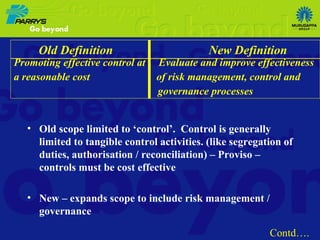
Old scope limited to ‘control’.  Control is generally limited to tangible control activities. (like segregation of duties, authorisation / reconciliation) – Proviso – controls must be cost effective New – expands scope to include risk management / governance Old Definition  New Definition Promoting effective control at  Evaluate and improve effectiveness a reasonable cost  of risk management, control and governance processes Contd….
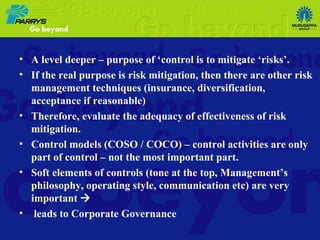
A level deeper – purpose of ‘control is to mitigate ‘risks’.  If the real purpose is risk mitigation, then there are other risk management techniques (insurance, diversification, acceptance if reasonable)  Therefore, evaluate the adequacy of effectiveness of risk mitigation. Control models (COSO / COCO) – control activities are only part of control – not the most important part. Soft elements of controls (tone at the top, Management’s philosophy, operating style, communication etc) are very important   leads to Corporate Governance
3 rd  Module   How to ‘add’ value to make it a Boon?
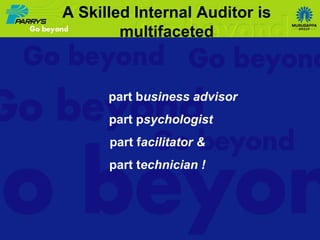
part b usiness advisor part p sychologist part f acilitator & part t echnician ! A Skilled Internal Auditor is multifaceted
IA  Skills / Competency   :  Build competencies &  capabilities  IA Practices   :  Adopt Best Practices &  use successful audit methodologies IA Marketing   :  Effectively market IA How to ‘add’ value to make it a Boon?
IA  Skills / Competency Build competencies &  capabilities
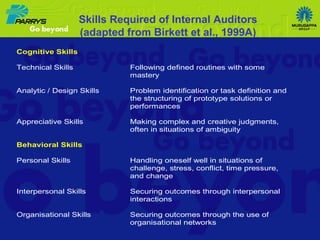
Skills Required of Internal Auditors (adapted from Birkett et al., 1999A)
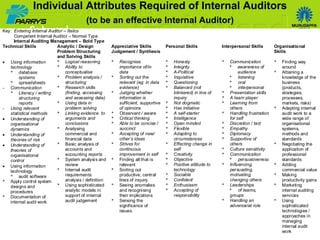
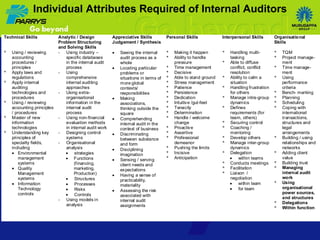
Individual Attributes Required of Internal Auditors (to be an effective Internal Auditor)
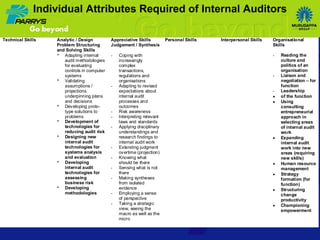
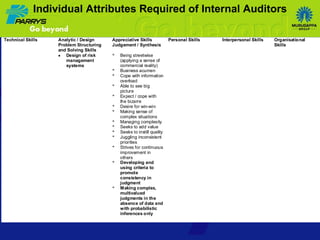
Individual Attributes Required of Internal Auditors
IA Practices   Adopt Best Practices & use successful audit methodologies
Organised along business lines Staffing & work environment – (Non-financial areas – Technical, Operations, Human Resources etc.,) Effective use of computerised  Risk assessment models Risk based / process based participative audits Internal Audit  Practices (From ‘good’ to great!) Contd...
‘ Just-in-time’ approach to audit planning (to include 30% to 40% unallocated time for strategic needs !) ‘ Product Wheel’ Performance Measures Post audit surveys Balanced Score Card Quality Improvement processes Education, Certification, Learning of Team Members Internal Audit  Practices (From ‘good’ to great!)
Other facilitating services Control Self Assessment Program Internal Control Awareness Program Assistance / guidance in Manual developments ‘ Fraud’ awareness programs Installation of ‘Self Audit’ processes for Business Divisions Internal Audit  Practices (From ‘good’ to ‘great’!) Contd...
Shift from ‘Detective’ to ‘Preventive’ audit services Audit Route selection chart One page reporting ‘ CAATS’ usage Adopting IIAs  Internal Audit Standards (PPF) ISO Certification for the IA function Internal Audit  Practices (From ‘good’ to ‘great’!)
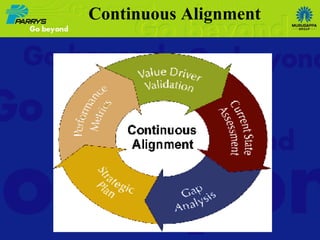
Continuous Alignment
IA Marketing   Effectively market Internal Audit !
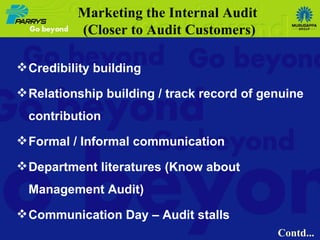
Credibility building Relationship building / track record of genuine contribution Formal / Informal communication Department literatures (Know about Management Audit) Communication Day – Audit stalls Marketing the Internal Audit  (Closer to Audit Customers) Contd...
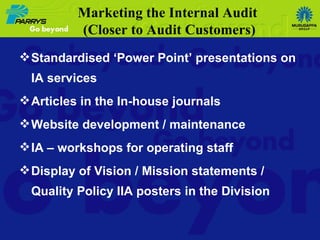
Standardised ‘Power Point’ presentations on IA services Articles in the In-house journals Website development / maintenance IA – workshops for operating staff Display of Vision / Mission statements / Quality Policy IIA posters in the Division Marketing the Internal Audit  (Closer to Audit Customers)
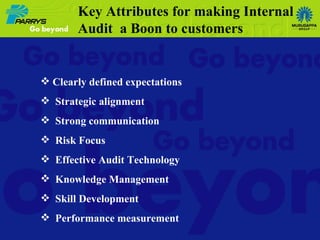
Key Attributes for making Internal Audit  a Boon to customers  Clearly defined expectations Strategic alignment Strong communication Risk Focus Effective Audit Technology Knowledge Management Skill Development Performance measurement
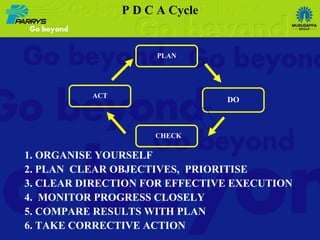
P D C A Cycle PLAN ACT CHECK DO 1. ORGANISE YOURSELF 2. PLAN  CLEAR OBJECTIVES,  PRIORITISE 3. CLEAR DIRECTION FOR EFFECTIVE EXECUTION  4.  MONITOR PROGRESS CLOSELY 5. COMPARE RESULTS WITH PLAN 6. TAKE CORRECTIVE ACTION
Thank You.

3a 2 Internal Audit A Bane Or Boon

  • 1.
    “ Dynamic InternalAuditor catalyses an enterprise from good to great” Internal Audit –A Bane or a Boon “ A Passion for Perfection”
  • 2.
    1 st Module Introduction to & understanding of title 2 nd Module Taking the lead from the ‘new Internal Audit definition’ 3 rd Module How to ‘add’ value to make it a Boon?
  • 3.
    1 st Module Introduction to & understanding of title
  • 4.
    Bane or aBoon ? A Management Perspective Internal Audit
  • 5.
    ‘ Value’ likebeauty, lies in the eyes of the beholder
  • 6.
    “ Bane ?”Nuisance Curse Irritation Annoyance Blight (disease, stain, scar, pain)
  • 7.
    “ Boon” benefitbonus godsend gain blessing help
  • 8.
    In the normalcourse, all possibilities exist to perceive it as a “Bane” ! - Customer Making it a “Boon”, is in the hands of the Internal Auditor! - Seller’s role Perception
  • 9.
    points finger findsfault is policing is controlling takes on trivial issues only does post mortem analysis is not adding any value! Internal Audit will be ‘perceived’ as a bane if it,
  • 10.
    helping guiding facilitatingsuggestive on ‘systems’ advising focused on key issues providing ‘assurance’ raising alarms at the appropriate time (ie. Before & not after) really adding value! It will be a real ‘boon’ if it is,
  • 11.
    ‘ Nobody’ atthe end wants it to be a ‘ BANE’ – Then why talk about it? Let’s only talk about how to make it a s a ‘ BOON’!
  • 12.
    PERCEPTION & FEATUREInternal direction is very important What we believe, we practise If majority perceive the same way , it becomes a feature !
  • 13.
    Internal Auditor’s Knowledge& Understanding of his professional role Continuous effective communication (with audit customers) before – during & after the audit! Demonstration of capabilities (product delivery) “ Dynamism of an youngster & Wisdom of an elder” What are the deciding Factors?
  • 14.
  • 15.
    Govt. Authorities (Statutory Requirements) Statutory Auditor Share Holders Board / Audit Committees Sr Executive Management Operational Management Risks, Controls, Corp. Governance, Compliance with statutes Value Adds (Bottomline / System Improvements) Corporate Masters Stake Holder focus
  • 16.
    WISH LIST !AC wants independent & objective assurance from some one other than CEO or CFO The CEO wants independent assurance from some one other than CFO / Line Managers The CFO wants from some one other than the Line Managers
  • 17.
    2 nd Module Taking the lead from the ‘new Internal Audit definition’
  • 18.
    Traditional concept of Internal Auditing Whether assets are adequately safeguarded and properly accounted for? Whether Accounting and other allied records are reliable? Whether the organisational procedures and policies are complied with? A status quo oriented auditing with significant emphasis on detection of frauds / accuracy of financial records Mostly engaged in conducting routine checking of stock records, Purchase invoices, cash receipts, payments, sales invoices, etc.
  • 19.
    First Definition fromIIA . Internal Auditing is an independent appraisal function established within the organisation to examine and evaluate its activities as a service to the organisation. The objective of IA is to members of the organisation in the effective discharge of their responsibilities. To this end the IA furnishes them with analyses, appraisals, recommendations, counsel and information concerning the activities reviewed.
  • 20.
    “ This newdefinition” did not come from a theoretical think tank – It came from the practices of the best internal auditors today” (by the Institute of Internal Auditors, Inc, USA – the International Body promoting the profession of Internal Auditing)   “ Internal Auditing is an Independent and Objective Assurance and Consulting Activity that is Guided by a Philosophy of Adding Value to Improve the Operations of the Organisation. It Assists an Organisation in Accomplishing the Objectives by Bringing a Systematic and Disciplined Approach to Evaluate and Improve the Effectiveness of the Organisation’s Risk Management, Control, and Governing Processes.”   Internal Audit now redefined
  • 21.
    This leads usto have a CLOSER look at the “ DEFINITION” of Internal Audit Look up to the “Professional Guidance” from the < Institute of Internal Auditors>
  • 22.
    Internal Audit can no longer be rigidly independent. Management needs IA’s help in building controls into new systems / processes on the front end Working in close partnership with Management produces better audit results Of course, without compromising on our ‘OBJECTIVE’ state of mind Old Definition New Definition Independent Independent, Objective
  • 23.
    From a mere‘appraisal function’ to think a level deeper and asking what value management gets from having an IA doing appraisals When ‘assurance’ is the real purpose, an ‘appraisal’ alone may not be the best way Emergence of a menu of assurance services including but not limited to ‘audits’ alone Further, in addition to assurance provide variety of consulting services (from sideline to equal billing in the definition) Old Definition New Definition Appraisal Function Assurance and Consulting Activity
  • 24.
    “ Examine &evaluate” (ie appraise) is narrow & focused “ Add Value & improve” is so broad it could apply to any function in the organisation Substantial broadening of IA services Internal Auditor thinking like management and speaking their language Old Definition New Definition Examine and evaluate its Designed to add value and improve Activities as a service to the operaiton of the organisation organisation
  • 25.
    Shift here issubtle but important Moving from focus on the micro level (assists members) to macro level (helps an organisation) ie. to say, not ‘nuts & bolts’ but strategic direction of the organisation Help Management get where it wants to go rather than just evaluating what is already in place Old Definition New Definition Assists members of the Organisation Helps an organisation in the Effective discharge of their accomplish its objectives responsibilities
  • 26.
    Old definition isspecific & limiting in saying what Internal Auditor does New one allows him for an ‘infinite’ (but not unsystematic, not undisciplined) range of activities Old Definition New Definition Analyses, appraisals, Systematic and disciplined recommendations, counsel and approach information concerning the activities reviewed
  • 27.
    Old scope limitedto ‘control’. Control is generally limited to tangible control activities. (like segregation of duties, authorisation / reconciliation) – Proviso – controls must be cost effective New – expands scope to include risk management / governance Old Definition New Definition Promoting effective control at Evaluate and improve effectiveness a reasonable cost of risk management, control and governance processes Contd….
  • 28.
    A level deeper– purpose of ‘control is to mitigate ‘risks’. If the real purpose is risk mitigation, then there are other risk management techniques (insurance, diversification, acceptance if reasonable) Therefore, evaluate the adequacy of effectiveness of risk mitigation. Control models (COSO / COCO) – control activities are only part of control – not the most important part. Soft elements of controls (tone at the top, Management’s philosophy, operating style, communication etc) are very important  leads to Corporate Governance
  • 29.
    3 rd Module How to ‘add’ value to make it a Boon?
  • 30.
    part b usinessadvisor part p sychologist part f acilitator & part t echnician ! A Skilled Internal Auditor is multifaceted
  • 31.
    IA Skills/ Competency : Build competencies & capabilities IA Practices : Adopt Best Practices & use successful audit methodologies IA Marketing : Effectively market IA How to ‘add’ value to make it a Boon?
  • 32.
    IA Skills/ Competency Build competencies & capabilities
  • 33.
    Skills Required ofInternal Auditors (adapted from Birkett et al., 1999A)
  • 34.
    Individual Attributes Requiredof Internal Auditors (to be an effective Internal Auditor)
  • 35.
    Individual Attributes Requiredof Internal Auditors
  • 36.
    Individual Attributes Requiredof Internal Auditors
  • 37.
    Individual Attributes Requiredof Internal Auditors
  • 38.
    IA Practices Adopt Best Practices & use successful audit methodologies
  • 39.
    Organised along businesslines Staffing & work environment – (Non-financial areas – Technical, Operations, Human Resources etc.,) Effective use of computerised Risk assessment models Risk based / process based participative audits Internal Audit Practices (From ‘good’ to great!) Contd...
  • 40.
    ‘ Just-in-time’ approachto audit planning (to include 30% to 40% unallocated time for strategic needs !) ‘ Product Wheel’ Performance Measures Post audit surveys Balanced Score Card Quality Improvement processes Education, Certification, Learning of Team Members Internal Audit Practices (From ‘good’ to great!)
  • 41.
    Other facilitating servicesControl Self Assessment Program Internal Control Awareness Program Assistance / guidance in Manual developments ‘ Fraud’ awareness programs Installation of ‘Self Audit’ processes for Business Divisions Internal Audit Practices (From ‘good’ to ‘great’!) Contd...
  • 42.
    Shift from ‘Detective’to ‘Preventive’ audit services Audit Route selection chart One page reporting ‘ CAATS’ usage Adopting IIAs Internal Audit Standards (PPF) ISO Certification for the IA function Internal Audit Practices (From ‘good’ to ‘great’!)
  • 43.
  • 44.
    IA Marketing Effectively market Internal Audit !
  • 45.
    Credibility building Relationshipbuilding / track record of genuine contribution Formal / Informal communication Department literatures (Know about Management Audit) Communication Day – Audit stalls Marketing the Internal Audit (Closer to Audit Customers) Contd...
  • 46.
    Standardised ‘Power Point’presentations on IA services Articles in the In-house journals Website development / maintenance IA – workshops for operating staff Display of Vision / Mission statements / Quality Policy IIA posters in the Division Marketing the Internal Audit (Closer to Audit Customers)
  • 47.
    Key Attributes formaking Internal Audit a Boon to customers Clearly defined expectations Strategic alignment Strong communication Risk Focus Effective Audit Technology Knowledge Management Skill Development Performance measurement
  • 48.
    P D CA Cycle PLAN ACT CHECK DO 1. ORGANISE YOURSELF 2. PLAN CLEAR OBJECTIVES, PRIORITISE 3. CLEAR DIRECTION FOR EFFECTIVE EXECUTION 4. MONITOR PROGRESS CLOSELY 5. COMPARE RESULTS WITH PLAN 6. TAKE CORRECTIVE ACTION
  • 49.