Title Lorem
Ipsum
SIT DOLOR AMET
Definition of Internal Auditing
“Internal auditing is an independent, objective assurance and consulting activity designed to
add value and improve an organization's operations.
It helps an organization accomplish its objectives by bringing a systematic, disciplined
approach to evaluate and improve the effectiveness of risk management, control, and
governance processes.”
– The Institute of Internal Auditors (IIA)
Benefits of Internal Audit
 Identifies redundancies in operational and control procedures and
provides recommendations to improve the efficiency and effectiveness
of procedures;
 Serves as an early warning system, enabling deficiencies to be identified
and remediated on a timely basis (e.g. prior to external, regulatory or
compliance audits);
 Internal audits make the organization process-dependent rather than
person-dependent;
 Ultimately increases accountability within the organization
The International Professional
Practices Framework (IPPF)
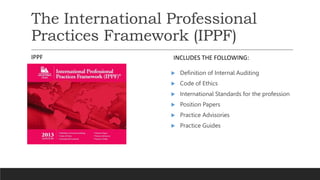
IPPF INCLUDES THE FOLLOWING:
 Definition of Internal Auditing
 Code of Ethics
 International Standards for the profession
 Position Papers
 Practice Advisories
 Practice Guides
IIA Code of Ethics
Integrity - The integrity of Internal Auditors establishes trust and thus provides the basis for
reliance on their judgment.
Objectivity - Internal Auditors exhibit the highest level of professional objectivity in gathering,
evaluating, and communicating information about the activity or process being examined. Internal
Auditors make a balanced assessment of all the relevant circumstances and are not unduly
influenced by their own interests or by others in forming judgments.
Confidentiality - Internal Auditors respect the value and ownership of information they receive and
do not disclose information without appropriate authority unless there is a legal or professional
obligation to do so.
Competency - Internal Auditors apply the knowledge, skills, and experience needed in the
performance of internal auditing services.
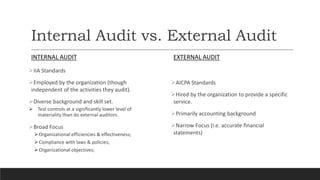
Internal Audit vs. External Audit
INTERNAL AUDIT
IIA Standards
Employed by the organization (though
independent of the activities they audit).
Diverse background and skill set.
 Test controls at a significantly lower level of
materiality than do external auditors.
Broad Focus
Organizational efficiencies & effectiveness;
Compliance with laws & policies;
Organizational objectives;
EXTERNAL AUDIT
AICPA Standards
Hired by the organization to provide a specific
service.
Primarily accounting background
Narrow Focus (i.e. accurate financial
statements)
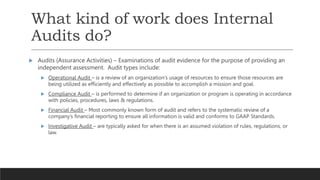
What kind of work does Internal
Audits do?
 Audits (Assurance Activities) – Examinations of audit evidence for the purpose of providing an
independent assessment. Audit types include:
 Operational Audit – is a review of an organization’s usage of resources to ensure those resources are
being utilized as efficiently and effectively as possible to accomplish a mission and goal.
 Compliance Audit – is performed to determine if an organization or program is operating in accordance
with policies, procedures, laws & regulations.
 Financial Audit – Most commonly known form of audit and refers to the systematic review of a
company’s financial reporting to ensure all information is valid and conforms to GAAP Standards.
 Investigative Audit – are typically asked for when there is an assumed violation of rules, regulations, or
law.
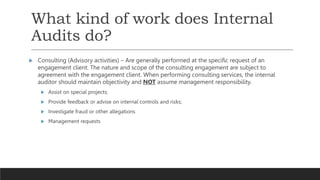
What kind of work does Internal
Audits do?
 Consulting (Advisory activities) – Are generally performed at the specific request of an
engagement client. The nature and scope of the consulting engagement are subject to
agreement with the engagement client. When performing consulting services, the internal
auditor should maintain objectivity and NOT assume management responsibility.
 Assist on special projects;
 Provide feedback or advise on internal controls and risks;
 Investigate fraud or other allegations
 Management requests
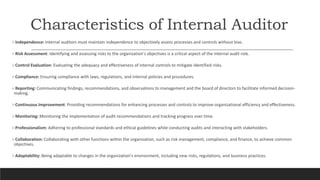
Characteristics of Internal Auditor
Independence: Internal auditors must maintain independence to objectively assess processes and controls without bias.
Risk Assessment: Identifying and assessing risks to the organization's objectives is a critical aspect of the internal audit role.
Control Evaluation: Evaluating the adequacy and effectiveness of internal controls to mitigate identified risks.
Compliance: Ensuring compliance with laws, regulations, and internal policies and procedures.
Reporting: Communicating findings, recommendations, and observations to management and the board of directors to facilitate informed decision-
making.
Continuous Improvement: Providing recommendations for enhancing processes and controls to improve organizational efficiency and effectiveness.
Monitoring: Monitoring the implementation of audit recommendations and tracking progress over time.
Professionalism: Adhering to professional standards and ethical guidelines while conducting audits and interacting with stakeholders.
Collaboration: Collaborating with other functions within the organization, such as risk management, compliance, and finance, to achieve common
objectives.
Adaptability: Being adaptable to changes in the organization's environment, including new risks, regulations, and business practices.
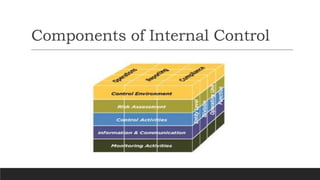
Components of Internal Control
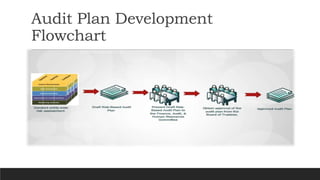
Audit Plan Development
Flowchart
Thank you

internal audit and its characteristic and features .pptx

  • 1.
  • 2.
    Definition of InternalAuditing “Internal auditing is an independent, objective assurance and consulting activity designed to add value and improve an organization's operations. It helps an organization accomplish its objectives by bringing a systematic, disciplined approach to evaluate and improve the effectiveness of risk management, control, and governance processes.” – The Institute of Internal Auditors (IIA)
  • 3.
    Benefits of InternalAudit  Identifies redundancies in operational and control procedures and provides recommendations to improve the efficiency and effectiveness of procedures;  Serves as an early warning system, enabling deficiencies to be identified and remediated on a timely basis (e.g. prior to external, regulatory or compliance audits);  Internal audits make the organization process-dependent rather than person-dependent;  Ultimately increases accountability within the organization
  • 4.
    The International Professional PracticesFramework (IPPF) IPPF INCLUDES THE FOLLOWING:  Definition of Internal Auditing  Code of Ethics  International Standards for the profession  Position Papers  Practice Advisories  Practice Guides
  • 5.
    IIA Code ofEthics Integrity - The integrity of Internal Auditors establishes trust and thus provides the basis for reliance on their judgment. Objectivity - Internal Auditors exhibit the highest level of professional objectivity in gathering, evaluating, and communicating information about the activity or process being examined. Internal Auditors make a balanced assessment of all the relevant circumstances and are not unduly influenced by their own interests or by others in forming judgments. Confidentiality - Internal Auditors respect the value and ownership of information they receive and do not disclose information without appropriate authority unless there is a legal or professional obligation to do so. Competency - Internal Auditors apply the knowledge, skills, and experience needed in the performance of internal auditing services.
  • 6.
    Internal Audit vs.External Audit INTERNAL AUDIT IIA Standards Employed by the organization (though independent of the activities they audit). Diverse background and skill set.  Test controls at a significantly lower level of materiality than do external auditors. Broad Focus Organizational efficiencies & effectiveness; Compliance with laws & policies; Organizational objectives; EXTERNAL AUDIT AICPA Standards Hired by the organization to provide a specific service. Primarily accounting background Narrow Focus (i.e. accurate financial statements)
  • 7.
    What kind ofwork does Internal Audits do?  Audits (Assurance Activities) – Examinations of audit evidence for the purpose of providing an independent assessment. Audit types include:  Operational Audit – is a review of an organization’s usage of resources to ensure those resources are being utilized as efficiently and effectively as possible to accomplish a mission and goal.  Compliance Audit – is performed to determine if an organization or program is operating in accordance with policies, procedures, laws & regulations.  Financial Audit – Most commonly known form of audit and refers to the systematic review of a company’s financial reporting to ensure all information is valid and conforms to GAAP Standards.  Investigative Audit – are typically asked for when there is an assumed violation of rules, regulations, or law.
  • 8.
    What kind ofwork does Internal Audits do?  Consulting (Advisory activities) – Are generally performed at the specific request of an engagement client. The nature and scope of the consulting engagement are subject to agreement with the engagement client. When performing consulting services, the internal auditor should maintain objectivity and NOT assume management responsibility.  Assist on special projects;  Provide feedback or advise on internal controls and risks;  Investigate fraud or other allegations  Management requests
  • 9.
    Characteristics of InternalAuditor Independence: Internal auditors must maintain independence to objectively assess processes and controls without bias. Risk Assessment: Identifying and assessing risks to the organization's objectives is a critical aspect of the internal audit role. Control Evaluation: Evaluating the adequacy and effectiveness of internal controls to mitigate identified risks. Compliance: Ensuring compliance with laws, regulations, and internal policies and procedures. Reporting: Communicating findings, recommendations, and observations to management and the board of directors to facilitate informed decision- making. Continuous Improvement: Providing recommendations for enhancing processes and controls to improve organizational efficiency and effectiveness. Monitoring: Monitoring the implementation of audit recommendations and tracking progress over time. Professionalism: Adhering to professional standards and ethical guidelines while conducting audits and interacting with stakeholders. Collaboration: Collaborating with other functions within the organization, such as risk management, compliance, and finance, to achieve common objectives. Adaptability: Being adaptable to changes in the organization's environment, including new risks, regulations, and business practices.
  • 10.
  • 11.
  • 14.