Internal
Communication
Christine Wandolo
Definition: Internal Communication
Staff communication
Employee relations
Industrial relations
Change management
Transformation management
 Reputation management
Leadership communication – Stephen
Windsor Lewis (2002)
(Smith, 2008)
Definition: Internal Communication
BBC: Internal communication: The act of
communicating internally; internal
communications - the function which
helps deliver it.
Function responsible for effective
communications among participants within
an organization, a strategic focus for
business communication, second only to
leadership concerns (Barnfield, 2003).
Definition: Cont/
Exchange of information and ideas within
an organization (Bovee & Thill, 2000).
Is about creating an atmosphere of respect
for all employees within the organization
(Argenti, (2003).
All formal and informal communication
taking place internally at all levels of an
organization (Kalla, 2005)
History of Internal Communications
“Smaller organizational decisions should be
taken by senior individuals, but large ones
should be decided as a group. Everyone’s
voice must be heard to avoid murmurs and
back-biting.” (Widget Finn, 6th C.)
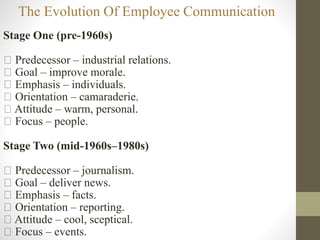
The Evolution Of Employee Communication
Stage One (pre-1960s)
Predecessor – industrial relations.
Goal – improve morale.
Emphasis – individuals.
Orientation – camaraderie.
Attitude – warm, personal.
Focus – people.
Stage Two (mid-1960s–1980s)
Predecessor – journalism.
Goal – deliver news.
Emphasis – facts.
Orientation – reporting.
Attitude – cool, sceptical.
Focus – events.
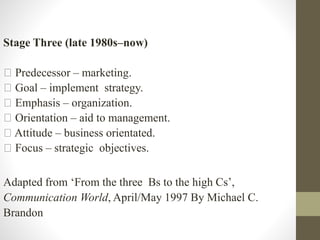
Stage Three (late 1980s–now)
Predecessor – marketing.
Goal – implement strategy.
Emphasis – organization.
Orientation – aid to management.
Attitude – business orientated.
Focus – strategic objectives.
Adapted from ‘From the three Bs to the high Cs’,
Communication World, April/May 1997 By Michael C.
Brandon
Introduction
Two planes of communication activities in
the structure of a company’s
communication system (Zajkowska, 2009):
- internal communication
- external communication
Building Blocks to Internal Communications
(Brad Whitworth - The IABC Handbook of Organizational
Communication, 2006)
Hierarchical communication
Mass media communications
Non-formal networks of invisible
communicators
Internal Communication
Based on relationships between
employees and is an integral part of
corporate communication
Takes various forms of interaction:
- verbal and written
- personal and virtual
- individual and group
(Gavlas 2008)
Objectives of Internal Communication
1. Information is understood and accepted
with respect to the content, intent, relevance,
and merit of the message.
2. The goals of the communications with
regard to motivating, directing, informing, or
gaining the participation of the audience is
achieved among the majority.
Spitzer & Swidler (2003)
3. The end result is achieving improvement
in one or more of the core success
components: product quality, sales,
profitability, workforce performance and
satisfaction, and, ultimately, customer
satisfaction.
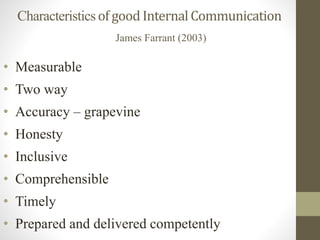
Characteristicsof goodInternalCommunication
• Measurable
• Two way
• Accuracy – grapevine
• Honesty
• Inclusive
• Comprehensible
• Timely
• Prepared and delivered competently
James Farrant (2003)
Communication audit as main tool for
building communication strategy
An organization, which wants to take
seriously the area of internal
communication, should first demonstrate
how the actions taken in the area of
communication support the implementation
of its strategy (Cal, Allyson, 2004).
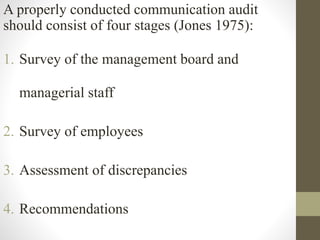
A properly conducted communication audit
should consist of four stages (Jones 1975):
1. Survey of the management board and
managerial staff
2. Survey of employees
3. Assessment of discrepancies
4. Recommendations
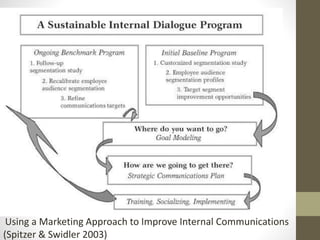
Using a Marketing Approach to Improve Internal Communications
(Spitzer & Swidler 2003)
In Summary: Internal Communications
Moved on from events and people to
sharing corporate goals
Needs to be championed at the very top
Helps the workforce to understand what is
expected of them
Is everyone’s responsibility from CEO to
line manager and supervisor
End

Internal communication

  • 1.
  • 2.
    Definition: Internal Communication Staffcommunication Employee relations Industrial relations Change management Transformation management  Reputation management Leadership communication – Stephen Windsor Lewis (2002) (Smith, 2008)
  • 3.
    Definition: Internal Communication BBC:Internal communication: The act of communicating internally; internal communications - the function which helps deliver it. Function responsible for effective communications among participants within an organization, a strategic focus for business communication, second only to leadership concerns (Barnfield, 2003).
  • 4.
    Definition: Cont/ Exchange ofinformation and ideas within an organization (Bovee & Thill, 2000). Is about creating an atmosphere of respect for all employees within the organization (Argenti, (2003). All formal and informal communication taking place internally at all levels of an organization (Kalla, 2005)
  • 5.
    History of InternalCommunications “Smaller organizational decisions should be taken by senior individuals, but large ones should be decided as a group. Everyone’s voice must be heard to avoid murmurs and back-biting.” (Widget Finn, 6th C.)
  • 6.
    The Evolution OfEmployee Communication Stage One (pre-1960s) Predecessor – industrial relations. Goal – improve morale. Emphasis – individuals. Orientation – camaraderie. Attitude – warm, personal. Focus – people. Stage Two (mid-1960s–1980s) Predecessor – journalism. Goal – deliver news. Emphasis – facts. Orientation – reporting. Attitude – cool, sceptical. Focus – events.
  • 7.
    Stage Three (late1980s–now) Predecessor – marketing. Goal – implement strategy. Emphasis – organization. Orientation – aid to management. Attitude – business orientated. Focus – strategic objectives. Adapted from ‘From the three Bs to the high Cs’, Communication World, April/May 1997 By Michael C. Brandon
  • 8.
    Introduction Two planes ofcommunication activities in the structure of a company’s communication system (Zajkowska, 2009): - internal communication - external communication
  • 9.
    Building Blocks toInternal Communications (Brad Whitworth - The IABC Handbook of Organizational Communication, 2006) Hierarchical communication Mass media communications Non-formal networks of invisible communicators
  • 10.
    Internal Communication Based onrelationships between employees and is an integral part of corporate communication Takes various forms of interaction: - verbal and written - personal and virtual - individual and group (Gavlas 2008)
  • 11.
    Objectives of InternalCommunication 1. Information is understood and accepted with respect to the content, intent, relevance, and merit of the message. 2. The goals of the communications with regard to motivating, directing, informing, or gaining the participation of the audience is achieved among the majority. Spitzer & Swidler (2003)
  • 12.
    3. The endresult is achieving improvement in one or more of the core success components: product quality, sales, profitability, workforce performance and satisfaction, and, ultimately, customer satisfaction.
  • 13.
    Characteristicsof goodInternalCommunication • Measurable •Two way • Accuracy – grapevine • Honesty • Inclusive • Comprehensible • Timely • Prepared and delivered competently James Farrant (2003)
  • 14.
    Communication audit asmain tool for building communication strategy An organization, which wants to take seriously the area of internal communication, should first demonstrate how the actions taken in the area of communication support the implementation of its strategy (Cal, Allyson, 2004).
  • 15.
    A properly conductedcommunication audit should consist of four stages (Jones 1975): 1. Survey of the management board and managerial staff 2. Survey of employees 3. Assessment of discrepancies 4. Recommendations
  • 16.
    Using a MarketingApproach to Improve Internal Communications (Spitzer & Swidler 2003)
  • 17.
    In Summary: InternalCommunications Moved on from events and people to sharing corporate goals Needs to be championed at the very top Helps the workforce to understand what is expected of them Is everyone’s responsibility from CEO to line manager and supervisor
  • 18.

Editor's Notes

  • #2 Play the slide show for this presentation to listen to the audio commentary by Peter Walsh and view slide timings. Or, click the sound icon on a slide for controls that you can use to hear the audio at your own pace. A little organization will go a long way to enhancing your PowerPoint presentation. Your title slide should be catching and relevant to your audience – offer something in the title that your audience wants. Keep some basic principles in mind: Your slides should complement what you have to say, not say it for you. Keep slides direct and to the point - less is more! Choose a background color or design that enhances and complements your presentation rather than competes with it. Don’t get too fancy - a simple font, elegant color scheme and clear message is more important than lots of information (clutter!) on the slide. Keep it simple! The purpose of the PowerPoint slide is to keep the mind of your audience focused – fewer words are better. Note: You understand that Microsoft does not endorse or control the content provided in the following presentation.
  • #9 Consider sub-headings that provide an emotional or action-oriented aspect to your presentation – these can be very motivating to an audience.
  • #10 Consider sub-headings that provide an emotional or action-oriented aspect to your presentation – these can be very motivating to an audience.