Chapter 7

Auditing Internal Control over
     Financial Reporting
Where we are
• Introduction
• Audit basics
  –   Risk
  –   Materiality
  –   Evidence
  –   Documentation
• Audit Phases
  – Planning
  – Internal controls in a financial statement audit
  – Internal controls in an integrated audit
What we’ll cover
• Difference between internal control in
  financial statement audit and internal control
  in integrated audit
• Management’s responsibilities
• Auditor’s responsibilities
• Steps in auditing internal controls
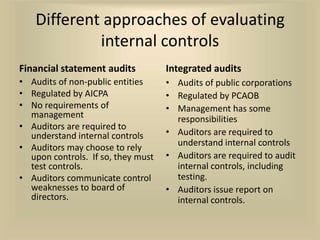
Different approaches of evaluating
             internal controls
Financial statement audits          Integrated audits
• Audits of non-public entities     • Audits of public corporations
• Regulated by AICPA                • Regulated by PCAOB
• No requirements of                • Management has some
  management                          responsibilities
• Auditors are required to
  understand internal controls      • Auditors are required to
                                      understand internal controls
• Auditors may choose to rely
  upon controls. If so, they must   • Auditors are required to audit
  test controls.                      internal controls, including
• Auditors communicate control        testing.
  weaknesses to board of            • Auditors issue report on
  directors.                          internal controls.
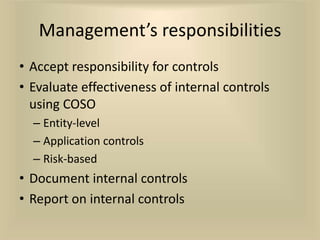
Management’s responsibilities
• Accept responsibility for controls
• Evaluate effectiveness of internal controls
  using COSO
  – Entity-level
  – Application controls
  – Risk-based
• Document internal controls
• Report on internal controls
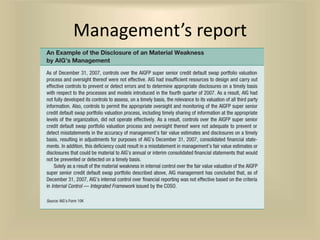
Management’s report
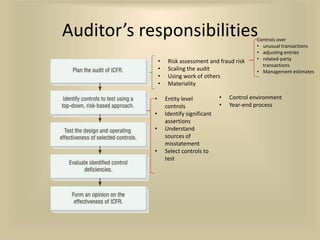
Auditor’s responsibilities                               Controls over
                                                         • unusual transactions
                                                         • adjusting entries
                •    Risk assessment and fraud risk      • related-party
                                                           transactions
                •    Scaling the audit                   • Management estimates
                •    Using work of others
                •    Materiality

            •       Entity level           •   Control environment
                    controls               •   Year-end process
            •       Identify significant
                    assertions
            •       Understand
                    sources of
                    misstatement
            •       Select controls to
                    test
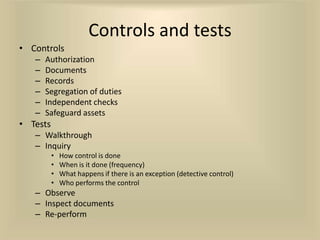
Controls and tests
• Controls
   –   Authorization
   –   Documents
   –   Records
   –   Segregation of duties
   –   Independent checks
   –   Safeguard assets
• Tests
   – Walkthrough
   – Inquiry
          •   How control is done
          •   When is it done (frequency)
          •   What happens if there is an exception (detective control)
          •   Who performs the control
   – Observe
   – Inspect documents
   – Re-perform
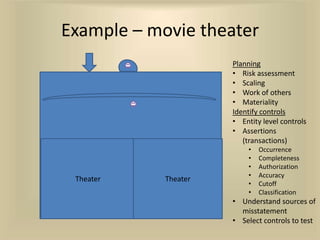
Example – movie theater
                      Planning
                      • Risk assessment
                      • Scaling
                      • Work of others
                      • Materiality
                      Identify controls
                      • Entity level controls
                      • Assertions
                         (transactions)
                          •   Occurrence
                          •   Completeness
                          •   Authorization
                          •   Accuracy
 Theater    Theater
                          •   Cutoff
                          •   Classification
                      • Understand sources of
                        misstatement
                      • Select controls to test
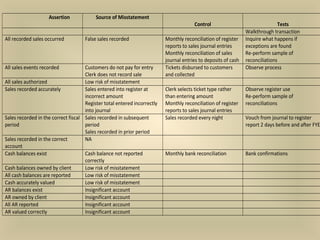
Assertion             Source of Misstatement
                                                                                       Control                                 Tests
                                                                                                                Walkthrough transaction
All recorded sales occurred          False sales recorded                 Monthly reconciliation of register    Inquire what happens if
                                                                          reports to sales journal entries      exceptions are found
                                                                          Monthly reconciliation of sales       Re-perform sample of
                                                                          journal entries to deposits of cash   reconciliations
All sales events recorded            Customers do not pay for entry       Tickets disbursed to customers        Observe process
                                     Clerk does not record sale           and collected
All sales authorized                 Low risk of misstatement
Sales recorded accurately            Sales entered into register at       Clerk selects ticket type rather      Observe register use
                                     incorrect amount                     than entering amount                  Re-perform sample of
                                     Register total entered incorrectly   Monthly reconciliation of register    reconciliations
                                     into journal                         reports to sales journal entries
Sales recorded in the correct fiscal Sales recorded in subsequent         Sales recorded every night            Vouch from journal to register
period                               period                                                                     report 2 days before and after FYE
                                     Sales recorded in prior period
Sales recorded in the correct        NA
account
Cash balances exist                  Cash balance not reported            Monthly bank reconciliation           Bank confirmations
                                     correctly
Cash balances owned by client        Low risk of misstatement
All cash balances are reported       Low risk of misstatement
Cash accurately valued               Low risk of misstatement
AR balances exist                    Insignificant account
AR owned by client                   Insignificant account
All AR reported                      Insignificant account
AR valued correctly                  Insignificant account
Practice
• Problem 7-34
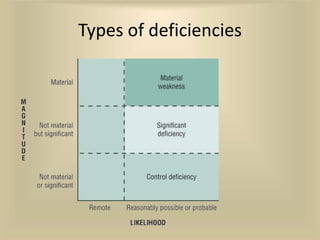
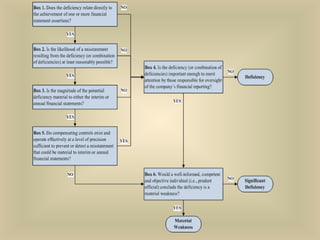
Types of deficiencies
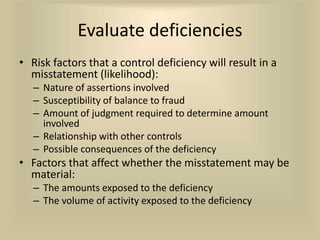
Evaluate deficiencies
• Risk factors that a control deficiency will result in a
  misstatement (likelihood):
   – Nature of assertions involved
   – Susceptibility of balance to fraud
   – Amount of judgment required to determine amount
     involved
   – Relationship with other controls
   – Possible consequences of the deficiency
• Factors that affect whether the misstatement may be
  material:
   – The amounts exposed to the deficiency
   – The volume of activity exposed to the deficiency
Practice
• 7-35
• 7-36
Remediation of deficiencies
• Clients may fix weaknesses-
  - Must be fixed by “as of” date
  - Must be testable before “as of” date
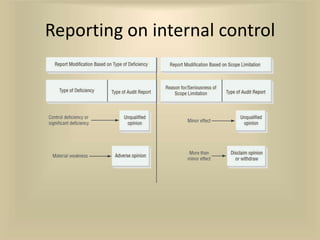
Reporting on internal control
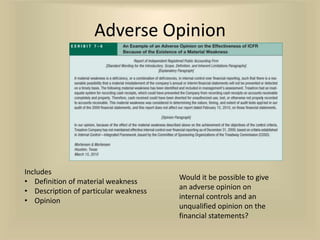
Adverse Opinion


Includes
                                       Would it be possible to give
• Definition of material weakness
                                       an adverse opinion on
• Description of particular weakness
                                       internal controls and an
• Opinion
                                       unqualified opinion on the
                                       financial statements?
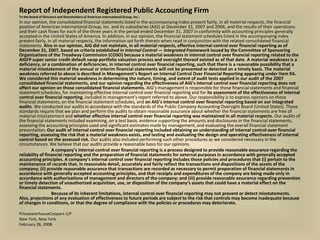
Report of Independent Registered Public Accounting Firm
To the Board of Directors and Shareholders of American International Group, Inc.:
In our opinion, the consolidated financial statements listed in the accompanying index present fairly, in all material respects, the financial
position of American International Group, Inc. and its subsidiaries (AIG) at December 31, 2007 and 2006, and the results of their operations
and their cash flows for each of the three years in the period ended December 31, 2007 in conformity with accounting principles generally
accepted in the United States of America. In addition, in our opinion, the financial statement schedules listed in the accompanying index
present fairly, in all material respects, the information set forth therein when read in conjunction with the related consolidated financial
statements. Also in our opinion, AIG did not maintain, in all material respects, effective internal control over financial reporting as of
December 31, 2007, based on criteria established in Internal Control — Integrated Framework issued by the Committee of Sponsoring
Organizations of the Treadway Commission (COSO) because a material weakness in internal control over financial reporting related to the
AIGFP super senior credit default swap portfolio valuation process and oversight thereof existed as of that date. A material weakness is a
deficiency, or a combination of deficiencies, in internal control over financial reporting, such that there is a reasonable possibility that a
material misstatement of the annual or interim financial statements will not be prevented or detected on a timely basis. The material
weakness referred to above is described in Management’s Report on Internal Control Over Financial Reporting appearing under Item 9A.
We considered this material weakness in determining the nature, timing, and extent of audit tests applied in our audit of the 2007
consolidated financial statements, and our opinion regarding the effectiveness of AIG’s internal control over financial reporting does not
affect our opinion on those consolidated financial statements. AIG’s management is responsible for these financial statements and financial
statement schedules, for maintaining effective internal control over financial reporting and for its assessment of the effectiveness of internal
control over financial reporting, included in management’s report referred to above. Our responsibility is to express opinions on these
financial statements, on the financial statement schedules, and on AIG’s internal control over financial reporting based on our integrated
audits. We conducted our audits in accordance with the standards of the Public Company Accounting Oversight Board (United States). Those
standards require that we plan and perform the audits to obtain reasonable assurance about whether the financial statements are free of
material misstatement and whether effective internal control over financial reporting was maintained in all material respects. Our audits of
the financial statements included examining, on a test basis, evidence supporting the amounts and disclosures in the financial statements,
assessing the accounting principles used and significant estimates made by management, and evaluating the overall financial statement
presentation. Our audit of internal control over financial reporting included obtaining an understanding of internal control over financial
reporting, assessing the risk that a material weakness exists, and testing and evaluating the design and operating effectiveness of internal
control based on the assessed risk. Our audits also included performing such other procedures as we considered necessary in the
circumstances. We believe that our audits provide a reasonable basis for our opinions.
                  A company’s internal control over financial reporting is a process designed to provide reasonable assurance regarding the
reliability of financial reporting and the preparation of financial statements for external purposes in accordance with generally accepted
accounting principles. A company’s internal control over financial reporting includes those policies and procedures that (i) pertain to the
maintenance of records that, in reasonable detail, accurately and fairly reflect the transactions and dispositions of the assets of the
company; (ii) provide reasonable assurance that transactions are recorded as necessary to permit preparation of financial statements in
accordance with generally accepted accounting principles, and that receipts and expenditures of the company are being made only in
accordance with authorizations of management and directors of the company; and (iii) provide reasonable assurance regarding prevention
or timely detection of unauthorized acquisition, use, or disposition of the company’s assets that could have a material effect on the
financial statements.
                  Because of its inherent limitations, internal control over financial reporting may not prevent or detect misstatements.
Also, projections of any evaluation of effectiveness to future periods are subject to the risk that controls may become inadequate because
of changes in conditions, or that the degree of compliance with the policies or procedures may deteriorate.

PricewaterhouseCoopers LLP
New York, New York
February 28, 2008
Communications
From manager to auditor
Management is responsible for IC
Mgt has evaluated IC
Mgt did not rely on work of auditor
Mgt has disclosed all weakness
Any material fraud
Resolution of weaknesses
Changes in IC


From auditor to company

All material weaknesses and significant deficiencies to both
management and the board

Control deficiencies to management
Practice
•   7-37
•   7-38
•   7-39
•   7-43
Computer – Assisted audit techniques
• Generalized audit software
  – File and database access
  – Selection of data
  – Statistical analysis
• Custom audit software
• Test date
Chapter summary
• Difference between internal control in
  financial statement audit and internal control
  in integrated audit
• Management’s responsibilities
• Auditor’s responsibilities
• Steps in auditing internal controls
Review questions
•   7-1
•   7-2
•   7-6
•   7-14

Intergrated Audit

  • 1.
    Chapter 7 Auditing InternalControl over Financial Reporting
  • 2.
    Where we are •Introduction • Audit basics – Risk – Materiality – Evidence – Documentation • Audit Phases – Planning – Internal controls in a financial statement audit – Internal controls in an integrated audit
  • 3.
    What we’ll cover •Difference between internal control in financial statement audit and internal control in integrated audit • Management’s responsibilities • Auditor’s responsibilities • Steps in auditing internal controls
  • 4.
    Different approaches ofevaluating internal controls Financial statement audits Integrated audits • Audits of non-public entities • Audits of public corporations • Regulated by AICPA • Regulated by PCAOB • No requirements of • Management has some management responsibilities • Auditors are required to understand internal controls • Auditors are required to understand internal controls • Auditors may choose to rely upon controls. If so, they must • Auditors are required to audit test controls. internal controls, including • Auditors communicate control testing. weaknesses to board of • Auditors issue report on directors. internal controls.
  • 5.
    Management’s responsibilities • Acceptresponsibility for controls • Evaluate effectiveness of internal controls using COSO – Entity-level – Application controls – Risk-based • Document internal controls • Report on internal controls
  • 6.
  • 7.
    Auditor’s responsibilities Controls over • unusual transactions • adjusting entries • Risk assessment and fraud risk • related-party transactions • Scaling the audit • Management estimates • Using work of others • Materiality • Entity level • Control environment controls • Year-end process • Identify significant assertions • Understand sources of misstatement • Select controls to test
  • 8.
    Controls and tests •Controls – Authorization – Documents – Records – Segregation of duties – Independent checks – Safeguard assets • Tests – Walkthrough – Inquiry • How control is done • When is it done (frequency) • What happens if there is an exception (detective control) • Who performs the control – Observe – Inspect documents – Re-perform
  • 9.
    Example – movietheater Planning • Risk assessment • Scaling • Work of others • Materiality Identify controls • Entity level controls • Assertions (transactions) • Occurrence • Completeness • Authorization • Accuracy Theater Theater • Cutoff • Classification • Understand sources of misstatement • Select controls to test
  • 10.
    Assertion Source of Misstatement Control Tests Walkthrough transaction All recorded sales occurred False sales recorded Monthly reconciliation of register Inquire what happens if reports to sales journal entries exceptions are found Monthly reconciliation of sales Re-perform sample of journal entries to deposits of cash reconciliations All sales events recorded Customers do not pay for entry Tickets disbursed to customers Observe process Clerk does not record sale and collected All sales authorized Low risk of misstatement Sales recorded accurately Sales entered into register at Clerk selects ticket type rather Observe register use incorrect amount than entering amount Re-perform sample of Register total entered incorrectly Monthly reconciliation of register reconciliations into journal reports to sales journal entries Sales recorded in the correct fiscal Sales recorded in subsequent Sales recorded every night Vouch from journal to register period period report 2 days before and after FYE Sales recorded in prior period Sales recorded in the correct NA account Cash balances exist Cash balance not reported Monthly bank reconciliation Bank confirmations correctly Cash balances owned by client Low risk of misstatement All cash balances are reported Low risk of misstatement Cash accurately valued Low risk of misstatement AR balances exist Insignificant account AR owned by client Insignificant account All AR reported Insignificant account AR valued correctly Insignificant account
  • 11.
  • 12.
  • 13.
    Evaluate deficiencies • Riskfactors that a control deficiency will result in a misstatement (likelihood): – Nature of assertions involved – Susceptibility of balance to fraud – Amount of judgment required to determine amount involved – Relationship with other controls – Possible consequences of the deficiency • Factors that affect whether the misstatement may be material: – The amounts exposed to the deficiency – The volume of activity exposed to the deficiency
  • 15.
  • 16.
    Remediation of deficiencies •Clients may fix weaknesses- - Must be fixed by “as of” date - Must be testable before “as of” date
  • 17.
  • 18.
    Adverse Opinion Includes Would it be possible to give • Definition of material weakness an adverse opinion on • Description of particular weakness internal controls and an • Opinion unqualified opinion on the financial statements?
  • 19.
    Report of IndependentRegistered Public Accounting Firm To the Board of Directors and Shareholders of American International Group, Inc.: In our opinion, the consolidated financial statements listed in the accompanying index present fairly, in all material respects, the financial position of American International Group, Inc. and its subsidiaries (AIG) at December 31, 2007 and 2006, and the results of their operations and their cash flows for each of the three years in the period ended December 31, 2007 in conformity with accounting principles generally accepted in the United States of America. In addition, in our opinion, the financial statement schedules listed in the accompanying index present fairly, in all material respects, the information set forth therein when read in conjunction with the related consolidated financial statements. Also in our opinion, AIG did not maintain, in all material respects, effective internal control over financial reporting as of December 31, 2007, based on criteria established in Internal Control — Integrated Framework issued by the Committee of Sponsoring Organizations of the Treadway Commission (COSO) because a material weakness in internal control over financial reporting related to the AIGFP super senior credit default swap portfolio valuation process and oversight thereof existed as of that date. A material weakness is a deficiency, or a combination of deficiencies, in internal control over financial reporting, such that there is a reasonable possibility that a material misstatement of the annual or interim financial statements will not be prevented or detected on a timely basis. The material weakness referred to above is described in Management’s Report on Internal Control Over Financial Reporting appearing under Item 9A. We considered this material weakness in determining the nature, timing, and extent of audit tests applied in our audit of the 2007 consolidated financial statements, and our opinion regarding the effectiveness of AIG’s internal control over financial reporting does not affect our opinion on those consolidated financial statements. AIG’s management is responsible for these financial statements and financial statement schedules, for maintaining effective internal control over financial reporting and for its assessment of the effectiveness of internal control over financial reporting, included in management’s report referred to above. Our responsibility is to express opinions on these financial statements, on the financial statement schedules, and on AIG’s internal control over financial reporting based on our integrated audits. We conducted our audits in accordance with the standards of the Public Company Accounting Oversight Board (United States). Those standards require that we plan and perform the audits to obtain reasonable assurance about whether the financial statements are free of material misstatement and whether effective internal control over financial reporting was maintained in all material respects. Our audits of the financial statements included examining, on a test basis, evidence supporting the amounts and disclosures in the financial statements, assessing the accounting principles used and significant estimates made by management, and evaluating the overall financial statement presentation. Our audit of internal control over financial reporting included obtaining an understanding of internal control over financial reporting, assessing the risk that a material weakness exists, and testing and evaluating the design and operating effectiveness of internal control based on the assessed risk. Our audits also included performing such other procedures as we considered necessary in the circumstances. We believe that our audits provide a reasonable basis for our opinions. A company’s internal control over financial reporting is a process designed to provide reasonable assurance regarding the reliability of financial reporting and the preparation of financial statements for external purposes in accordance with generally accepted accounting principles. A company’s internal control over financial reporting includes those policies and procedures that (i) pertain to the maintenance of records that, in reasonable detail, accurately and fairly reflect the transactions and dispositions of the assets of the company; (ii) provide reasonable assurance that transactions are recorded as necessary to permit preparation of financial statements in accordance with generally accepted accounting principles, and that receipts and expenditures of the company are being made only in accordance with authorizations of management and directors of the company; and (iii) provide reasonable assurance regarding prevention or timely detection of unauthorized acquisition, use, or disposition of the company’s assets that could have a material effect on the financial statements. Because of its inherent limitations, internal control over financial reporting may not prevent or detect misstatements. Also, projections of any evaluation of effectiveness to future periods are subject to the risk that controls may become inadequate because of changes in conditions, or that the degree of compliance with the policies or procedures may deteriorate. PricewaterhouseCoopers LLP New York, New York February 28, 2008
  • 20.
    Communications From manager toauditor Management is responsible for IC Mgt has evaluated IC Mgt did not rely on work of auditor Mgt has disclosed all weakness Any material fraud Resolution of weaknesses Changes in IC From auditor to company All material weaknesses and significant deficiencies to both management and the board Control deficiencies to management
  • 21.
    Practice • 7-37 • 7-38 • 7-39 • 7-43
  • 22.
    Computer – Assistedaudit techniques • Generalized audit software – File and database access – Selection of data – Statistical analysis • Custom audit software • Test date
  • 23.
    Chapter summary • Differencebetween internal control in financial statement audit and internal control in integrated audit • Management’s responsibilities • Auditor’s responsibilities • Steps in auditing internal controls
  • 24.
    Review questions • 7-1 • 7-2 • 7-6 • 7-14

Editor's Notes

  • #8 Sources of misstatement: identify controls at locations of sources, to walkthroughs, find exceptions during walkthroughTesting: Nature, timing, and extent (nature of the control (manual more), frequency of operation, importance of control)