INTERFEROMETRIC MODULATOR DISPLAY
          (IMOD):mirasol


 0501212311
                         BY:
 BY:
                         ANKITA
 SINHA
                         SINHA
ECEBRANCH ,
  :
TALK FLOW
•   INTRODUCTION
•   OVERVIEW OF PORTABLE DISPLAYS
•   WHAT IS IMOD?
•   HOW IT WORKS?
•   COLOR GENERATION
•   HYSTERISIS LOOP
•   ADVANTAGES
•   APPLICATIONS
INTRODUCTION
• Wireless communication is an essential and
  continuously expanding part of modern life.
• Smart phones presents a number of
  challenging requirements on the display
  module, such as low power consumption,
  video quality speed, and viewability in a
  broad range of lighting conditions.
• The QUALCOMM Interferometric Modulator
  display (IMOD) is an electrostatically
  actuated, bistable micro electromechanical
  system (MEMS) device.
WHAT IS IMOD?
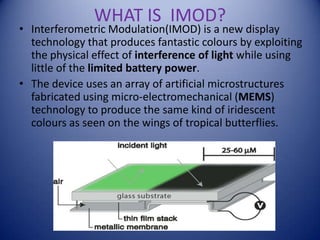
• Interferometric Modulation(IMOD) is a new display
  technology that produces fantastic colours by exploiting
  the physical effect of interference of light while using
  little of the limited battery power.
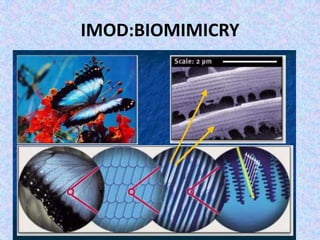
• The device uses an array of artificial microstructures
  fabricated using micro-electromechanical (MEMS)
  technology to produce the same kind of iridescent
  colours as seen on the wings of tropical butterflies.
IMOD:BIOMIMICRY
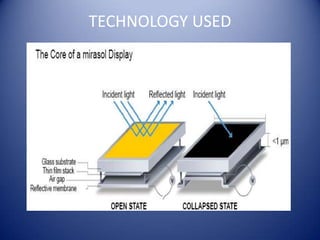
TECHNOLOGY USED
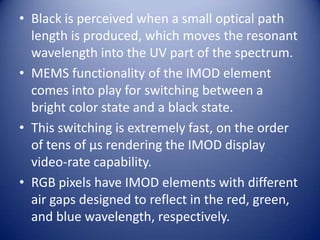
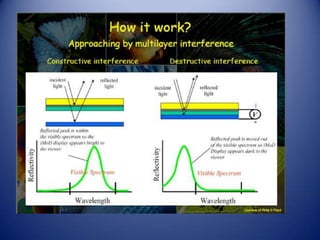
• Black is perceived when a small optical path
  length is produced, which moves the resonant
  wavelength into the UV part of the spectrum.
• MEMS functionality of the IMOD element
  comes into play for switching between a
  bright color state and a black state.
• This switching is extremely fast, on the order
  of tens of μs rendering the IMOD display
  video-rate capability.
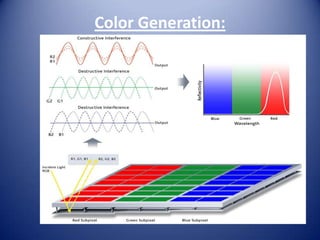
• RGB pixels have IMOD elements with different
  air gaps designed to reflect in the red, green,
  and blue wavelength, respectively.
Color Generation:
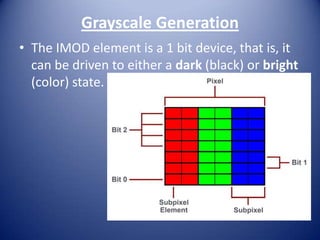
Grayscale Generation
• The IMOD element is a 1 bit device, that is, it
  can be driven to either a dark (black) or bright
  (color) state.
HYSTERISIS LOOP
ADVANTAGES:
•   Speed
•   Ease of Manufacture
•   Robustness
•   Industry Compatibility
•   Readability
•   Less power consumption
•   Consistent contrast quality
APPLICATIONS:
•   Cell phone secondary & main displays
•   MP3 players
•   Portable Bluetooth accessories
•   Handheld/wrist-worn GPS devices
•   Industrial applications
Technology throughout the handset
           value chain:
CONCLUSION
• IMODs are powerful photonic devices that
  can be used as excellent displays for
  manipulation of light not only in cell phones
  but also in camcorders, electronics books,
  computer monitors, wall mounted TVs, etc.

• All in all, in the coming days, IMOD displays
  are likely to replace other devices.
REFERENCES
• Electronics for you(Nov-2008)
• M.W. Miles, “Toward an iMoD ecosystem”
• J. B. Sampsell, "Causes of Color: Especially Interference
  Color"
• J.B. Sampsell, “MEMS-based display technology drives
  next-generation FPDs for mobile applications”
• M. Mitchell Waldrop (November 2007). "Brilliant Displays"
• http://www.smalltimes.com/news/display_news_story.cfm
• http://en.wikipedia.org/wiki/Interferometric_modulator_di
  splay
• http://www.qualcomm.com/common/documents/white_p
  apers/QMT_Technology_Overview_12-07.pdf
Interferometric modulator (imod)

Interferometric modulator (imod)

  • 1.
    INTERFEROMETRIC MODULATOR DISPLAY (IMOD):mirasol 0501212311 BY: BY: ANKITA SINHA SINHA ECEBRANCH , :
  • 2.
    TALK FLOW • INTRODUCTION • OVERVIEW OF PORTABLE DISPLAYS • WHAT IS IMOD? • HOW IT WORKS? • COLOR GENERATION • HYSTERISIS LOOP • ADVANTAGES • APPLICATIONS
  • 3.
    INTRODUCTION • Wireless communicationis an essential and continuously expanding part of modern life. • Smart phones presents a number of challenging requirements on the display module, such as low power consumption, video quality speed, and viewability in a broad range of lighting conditions. • The QUALCOMM Interferometric Modulator display (IMOD) is an electrostatically actuated, bistable micro electromechanical system (MEMS) device.
  • 4.
    WHAT IS IMOD? •Interferometric Modulation(IMOD) is a new display technology that produces fantastic colours by exploiting the physical effect of interference of light while using little of the limited battery power. • The device uses an array of artificial microstructures fabricated using micro-electromechanical (MEMS) technology to produce the same kind of iridescent colours as seen on the wings of tropical butterflies.
  • 5.
  • 6.
  • 7.
    • Black isperceived when a small optical path length is produced, which moves the resonant wavelength into the UV part of the spectrum. • MEMS functionality of the IMOD element comes into play for switching between a bright color state and a black state. • This switching is extremely fast, on the order of tens of μs rendering the IMOD display video-rate capability. • RGB pixels have IMOD elements with different air gaps designed to reflect in the red, green, and blue wavelength, respectively.
  • 9.
  • 10.
    Grayscale Generation • TheIMOD element is a 1 bit device, that is, it can be driven to either a dark (black) or bright (color) state.
  • 11.
  • 12.
    ADVANTAGES: • Speed • Ease of Manufacture • Robustness • Industry Compatibility • Readability • Less power consumption • Consistent contrast quality
  • 16.
    APPLICATIONS: • Cell phone secondary & main displays • MP3 players • Portable Bluetooth accessories • Handheld/wrist-worn GPS devices • Industrial applications
  • 17.
    Technology throughout thehandset value chain:
  • 18.
    CONCLUSION • IMODs arepowerful photonic devices that can be used as excellent displays for manipulation of light not only in cell phones but also in camcorders, electronics books, computer monitors, wall mounted TVs, etc. • All in all, in the coming days, IMOD displays are likely to replace other devices.
  • 19.
    REFERENCES • Electronics foryou(Nov-2008) • M.W. Miles, “Toward an iMoD ecosystem” • J. B. Sampsell, "Causes of Color: Especially Interference Color" • J.B. Sampsell, “MEMS-based display technology drives next-generation FPDs for mobile applications” • M. Mitchell Waldrop (November 2007). "Brilliant Displays" • http://www.smalltimes.com/news/display_news_story.cfm • http://en.wikipedia.org/wiki/Interferometric_modulator_di splay • http://www.qualcomm.com/common/documents/white_p apers/QMT_Technology_Overview_12-07.pdf