Mobile Ecosystems: Current Landscape, Emerging Technologies & TrendsPragati Ogal Raipragatiogal@gmail.comhttp://pragatiogalrai.blogspot.comSilicon Valley Code Camp             October 08, 2011
AgendaMobile EcosystemMobile DevicesCurrent Landscape of Mobile EcosystemWireless NetworksOEMsOperating SystemsDevelopersServices & InfrastructureSilicon Valley Code Camp 20112
What is Mobile Ecosystem?What are mobile devices?Who are the major players driving the mobile market?What role do these players play?Who are the consumers of the mobile market?Where do we stand now?What’s happening next?Silicon Valley Code Camp 20113
Mobile DevicesSilicon Valley Code Camp 20114
Mobile DevicesMember of Consumer Electronics Devices (CED) familySome CEDs are Connected Electronic DevicesComputing capability + runs softwareSilicon Valley Code Camp 20115
Mobile Devices: ExamplesMobile Phones and Smart PhonesTablet computersPDAs, PagersGame ConsolesMobile ComputersInformation AppliancesSilicon Valley Code Camp 20116
Mobile Devices: AttributesPortablePersonalConnectedIt is with you most of the timeConvenient to useSilicon Valley Code Camp 20117
Mobile Devices: ChallengesSmall Form FactorLimited computing resourcesPower consumptionStorage Security viewpointInput FacilitiesUsabilityDevice Independent Security SolutionsSilicon Valley Code Camp 20118
Mobile EcosystemSilicon Valley Code Camp 20119
What does mobile ecosystem look like today?SecurityOS VendorsOEMsConsumersServices & InfrastructureDevelopersCarriersWireless NetworksSilicon Valley Code Camp 201110
Mobile Ecosystem: Major PlayersWireless networks carriersOEMsOperating SystemsDevelopersServices & Infrastructure ProvidersConsumersSecurity  StandardsSilicon Valley Code Camp 201111
Wireless NetworksSilicon Valley Code Camp 201112
Wireless Networks: Current LandscapeWireless LANsCellular NetworksBroadband Wireless AccessProximity TechnologiesSilicon Valley Code Camp 201113
Wireless LANsHome & enterprise hotspots High data rates Easy to use, plug & play componentsIntegrated in hardwareLimited coverage area802.11 family of standardsSilicon Valley Code Camp 201114
Cellular NetworksHigh mobilityInitially designed for voice Real time, always-onExtended to offer Internet & multimediaData rates lower than wifiDeployed successfully all over the worldHigh error ratesWeak and proprietary cryptographic algorithms like COMP128Silicon Valley Code Camp 201115
Broadband Wireless AccessFixed wireless applicationsSpectrum range over 2 GHzProprietary systems802.16/WiMax open standardsSilicon Valley Code Camp 201116
Proximity TechnologiesNear Field Communication (NFC)InchesSecureBluetoothBluetooth versions 3 & 4Security issuesProximity detection & battery powerSilicon Valley Code Camp 201117
Wireless Networks: Use CasesMobile TVMobile GamesVideo/Audio StreamingConferencingContent Download M2M ApplicationsSilicon Valley Code Camp 201118
Wireless Networks: RequirementsHigh data ratesAdvanced radio technologies Lower costsSeamless mobilitySupport for multiple servicesSilicon Valley Code Camp 201119
Cellular Radio TechnologiesSilicon Valley Code Camp 201120
Seamless Mobility: All-IP Based NetworksEnterprise NetworkHotspotBroadband WirelessCellular NetworksSilicon Valley Code Camp 201121
Seamless Mobility: All-IP Based NetworksDual core networks Packet switched core networks for data Circuit switched core networks for voiceSingle core networksAll IP basedOne core networkVoice services by VoIP Seamless mobility & user experienceSilicon Valley Code Camp 201122
All IP Based Networks: Why?http://www.distributednetworks.com/linux-network-administration/module2/tcpip-protocol-layers.phpSilicon Valley Code Camp 201123
Multimedia Broadcast Multicast ServicesPoint to multipoint deliverySingle frequency modelReal time streamingSubscription based model e.g. TVNon-subscription based model e.g. radio or emergency alertsDVB-H/DVB-T, DVB-SH, DMB, ESM-DAB, and MediaFLO, Huawei’s CMBSilicon Valley Code Camp 201124
OEMsSilicon Valley Code Camp 201125
OEMWhy device manufacturer is a key player in mobile ecosystem?OEM decides device characteristicsDevice hardware and specificationsOperating systemProprietary softwareExpose or hide hardware capabilitiesSilicon Valley Code Camp 201126
OEMFragmentation – technology & business levelDevelopers are limited by OEMSecurityMemorySpeedPage renderingColor schemeSilicon Valley Code Camp 201127
Device Hardware: TrendsHighly optimized CPU e.g. ARM processorPower efficientMemory (ROM, RAM, EEPROM, etc.)Solid state disks for high capacity, low power, lightweightTouch ScreensSilicon Valley Code Camp 201128
Operating SystemsSilicon Valley Code Camp 201129
Mobile Device ArchitectureApplicationsSoftware StackOperating SystemDevice HardwareSilicon Valley Code Camp 201130
Operating Systems: CEDsReal Time Operating Systems (RTOS) Limited capacity, minimalSpecific use caseCompactEfficientOpen Source and proprietary RTOS (BeRTOS, FreeRTOS, VxWorks, PikesOS, LynxOS, Nucleus RTOS)Silicon Valley Code Camp 201131
Operating Systems: Smart PhonesFeature rich Modern OSCapabilities and servicesFree and proprietary OS (J2ME, Symbian, FreeBSD, Linux variants like HP WebOS, Maemo)Silicon Valley Code Camp 201132
Operating Systems & OEMsOEMs bake OS into the deviceOS cannot be changedOS defines key features of deviceSecurity characteristicsMultithreadingResource sharingSilicon Valley Code Camp 201133
Software StackSoftware layer put on top of OSMiddleware or mobile platformAPIs exposed to developersOpen source & proprietary (Android, iPhone, Blackberry OS)Silicon Valley Code Camp 201134
Software Stack: why is it important?Stack exposes device capabilitiesUnpublished or private APIsDefines application structureSilicon Valley Code Camp 201135
Android Architecturehttp://developer.android.com/guide/basics/what-is-android.htmlSilicon Valley Code Camp 201136
Symbian Architecture http://www.developer.nokia.com/Community/Wiki/images/7/78/Symbian_Arc.png?20090412093457Silicon Valley Code Camp 201137
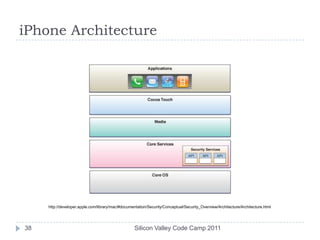
iPhone Architecturehttp://developer.apple.com/library/mac/#documentation/Security/Conceptual/Security_Overview/Architecture/Architecture.htmlSilicon Valley Code Camp 201138
DevelopersSilicon Valley Code Camp 201139
Developers: who?EnterprisesUsSilicon Valley Code Camp 201140
Mobile Device ArchitectureApplicationsSoftware StackOperating SystemDevice HardwareSilicon Valley Code Camp 201141
ApplicationsApplication development depends on:Mobile stackUnderlying OSHardwareCarrierSilicon Valley Code Camp 201142
Content Distribution ChannelsAppStores: coined by AppleOver 125 AppStores todaySingle or multiple platform supportControl over ecosystemEconomical reasonsAppStores to provide broader set of servicesSilicon Valley Code Camp 201143
Content Distribution ChannelsCarriers (VzAppStore, Sprint's Software Store)OEMs (Motorola, Samsung) OS Providers (Palm's AppCatalog, Nokia's Ovistore, Android Market, AppStore,)Third party Companies (GetJar,  AndSpot)AppStores for devices (PlayStation Store, DSi Shop for Nintendo Dsi)Silicon Valley Code Camp 201144
Cross Platform DevelopmentPhoneGap, AppceleratorWrite once run anywhereHTML5, JavascriptEasy to write and useDevice IntegrationUser ExperienceSilicon Valley Code Camp 201145
Mobile WebApps render on browserDeveloped using web technologies (HTML5, JSON, CSS)W3C standards for mobile application developmentNative vs. web applications Economic reasonsSilicon Valley Code Camp 201146
Mobile Web: Application Development PlatformSilicon Valley Code Camp 201147http://www.w3.org/2011/02/mobile-web-app-state.html
TrendsMobile ContentMobile CommerceSocial NetworkingLocation Aware applicationsMobile + Social + local = ConvergenceMobile WidgetsSilicon Valley Code Camp 201148
Services & InfrastructureSilicon Valley Code Camp 201149
Services & InfrastructureCloud ServicesAnalyticsTesting & MonitoringCommerce PlatformsAdvertising Platforms & ServicesSilicon Valley Code Camp 201150
What does mobile ecosystem look like today?SecurityOS VendorsOEMsConsumersServices & InfrastructureDevelopersCarriersWireless NetworksSilicon Valley Code Camp 201151
What does mobile ecosystem look like today?FragileNascentExperimentationFragmentationStandards are evolvingOrganic adoptionSilicon Valley Code Camp 201152
Referenceshttp://developer.android.comhttp://developer.apple.comWikipediaWeb Commerce Security Design and Development by Hadi Nahari & Ronald L. Krutz, Wiley Publishing, Inc.Programming the Mobile Web by Maximiliano Firtman, O’Reilly PublicationsSilicon Valley Code Camp 201153
ImagesDeveloper: www.winceron.com/dotnetdevelopers.aspxCarriers: www.gev.comOS: http://tftscdn.nexus404.com/Blog/wp-content/uploads2/2010/03/Mobile-OS-Logos.jpgOEMs: http://hotcellularphone.com/wp-content/uploads/2008/08/top-five.jpgStandards: whywebstandards.org/Wireless Networks: http://www.tech-faq.com/wp-content/uploads/images/wireless-networks.gifMobile Devices: http://www.w3.org/2006/Talks/1106-MoMoParis/mobilechristmas2004.jpegMobile Ecosystem: http://www.w3.org/2006/Talks/1106-MoMoParis/mobilechristmas2004.jpegSilicon Valley Code Camp 201154

Mobile Ecosystem