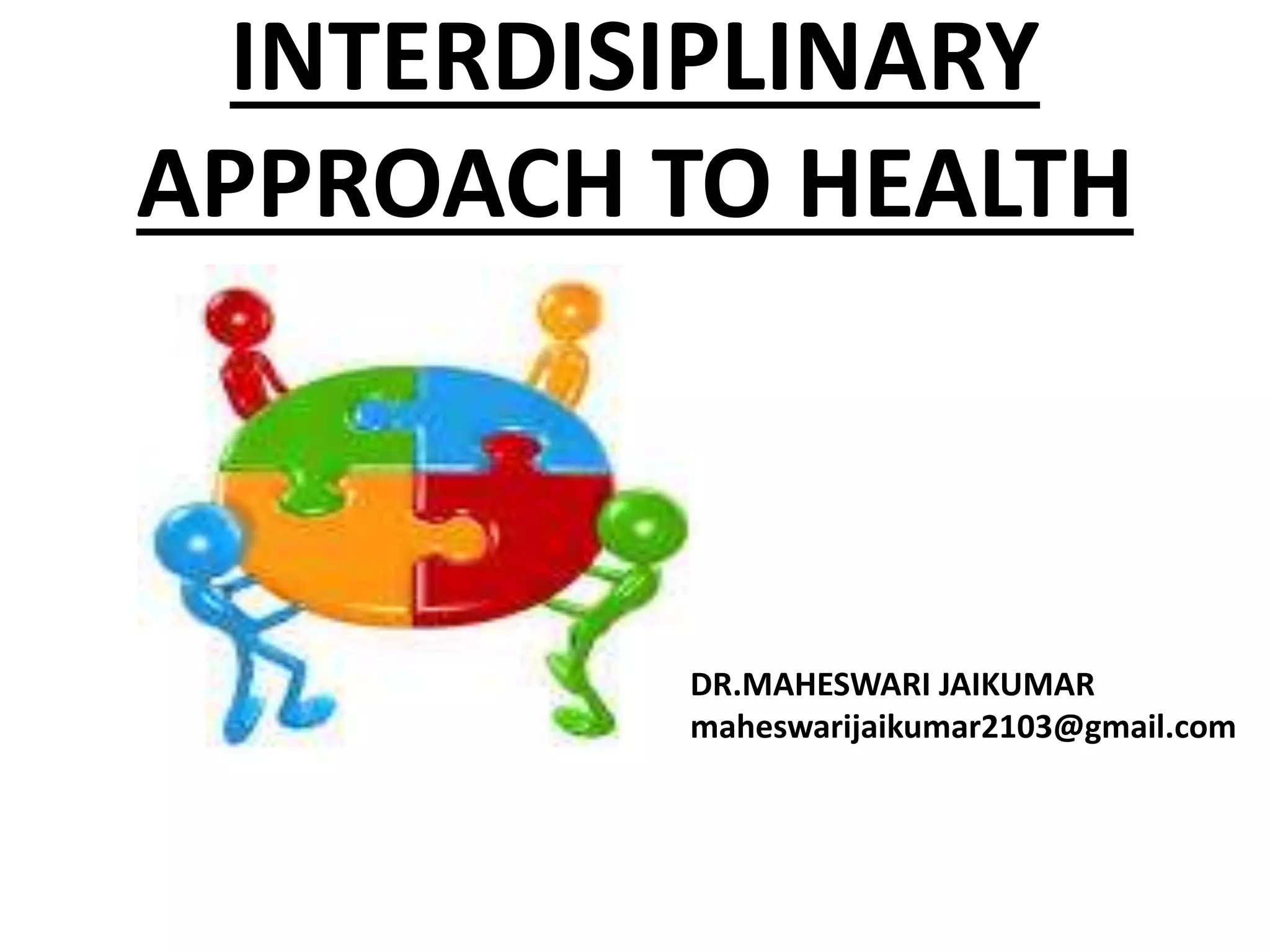
INTERDISIPLINARY
APPROACH TO HEALTH
DR.MAHESWARI JAIKUMAR
maheswarijaikumar2103@gmail.com
THE PEW HEALTH
PROFESSIONS
COMMISSION 1998
•“CHANGE
PROFESIONAL
TRAINING TO MEET THE
DEMANDS OF NEW
HEALTH CARE SYSTEM”
A GLIMPSE
OF
INTERDISIPLINARY
EDUCATION &
PRACTICE
THE FUTURE OF NURSING
EDUCATION: TEN TRENDS
TO WATCH
• Changing demographics &
increasing diversity
• Technological explosion.
• Globalization of the world
economy & the society.
• The Era of educated consumers.
• Shift to population based care &
increasing complexity of patient
care.
• The cost of health care &
managed health care.
• Impact of health policy & health
regulation.
• THE GROWING NEED FOR IDE
& PRACTICE IN PATIENT CARE.
• The current nursing shortage &
opportunities for life long
learning & work force
development.
• Significant advances in Nursing
Science Research
INTERPROFESSIONALITY AS THE FIELD OF
INTERPROFESSIONAL PRACTICE AND
INTERPROFESSIONAL EDUCATION
INTERDISCIPLINARY EDUCATION
• An educational approach in which
two or more disciplines collaborate
in the learning process with the goal
of fostering inter professional
interactions that enhance the
practice of each discipline.
• Such interdisciplinary education
is based on mutual
understanding and respect for
the actual and potential
contributions of the disciplines.
INTERPROFESSIONAL/INTERDIS
-CIPLINARY EDUCATION
“occasions when two or more
professions learn from and
about each other to improve
collaboration and the quality of
care” (CAIPE, 1997 revised)
OPERATIONAL DEFINITIONS
INTERPROFESSIONAL EDUCATION:
“When students from two or more
with each other to enable effective
collaboration and improve health
outcomes” (WHO, 2010)
COLLABORATION
• “An inter professional process of
communication and decision making
that enables the separate and shared
knowledge and skills of health care
providers to synergistically influence the
client/patient care provided” (Way &
Jones 2000)
COLLABORATIVE PATIENT-
CENTRED PRACTICE
• “is designed to promote the active
participation of each discipline in patient
care.
• It enhances patient and family centred goals
and values, provides mechanisms for
continuous communication among care
givers, optimizes staff participation in clinical
decision making within and across disciplines
and fosters respect for contributions of all
professionals” (Health Canada, 2003)
INTERPROFESSIONAL COLLABORATIVE
PRACTICE
“When multiple health workers
from different professional backgrounds
work together with patients, families,
carers, and communities to deliver the
highest quality of care” (WHO, 2010)
INTERPROFESSIONAL TEAMWORK
“levels of cooperation, coordination
and collaboration characterizing the
relationships between professions in
delivering patient-centered care”
INTERPROFESSIONAL TEAM-
BASED CARE
“Care delivered by intentionally created,
usually relatively small work groups in
health care, who are recognized by others
as well as by themselves as having a
collective identity and shared
responsibility for a patient or group of
patients”
E.g.,
rapid response team.
palliative care team.
primary care team.
operating room team.
IN……………Professional competencies in
HEALTH CARE
Integrated enactment of knowledge,
skills, and values/attitudes that define the
domains of work of a particular health
profession applied in specific care
contexts
INTERPROFESSIONAL COMPETENCIES IN
HEALTH CARE
“Integrated enactment of
knowledge, skills, and values/attitudes
the professions, with other health care
workers, and with patients, along with
families and communities, as appropriate
to improve health outcomes in specific
care contexts”
CENTURY: TRANSFORMING
EDUCATION TO STRENGTHEN HEALTH
SYSTEMS IN AN INTERDEPENDENT
WORLD
INTERPROFESSIONAL
COMPETENCY DOMAIN
“A generally identified cluster of more
specific
interprofessionalcompetencies
that are conceptually linked & serve
as theoretical constructs”(Ten Cate &
Scheele, 2007)
CORE COMPETENCIES FOR
INTERPROFESSIONAL
COLLABORATIVE PRACTICE
• create a coordinated effort across
the health professions to embed
essential content in all health
professions education curricula
• Guide professional and
institutional curricular
development of learning
• Approaches and assessment
strategies to achieve productive
outcomes
•
• Provide the foundation for a
learning continuum in inter
professional Competency
development across the professions
and the lifelong learning trajectory
• Acknowledge that evaluation and
research work will strengthen the
scholarship in this area
• prompt dialogue to evaluate the
“fit” between educationally
identified core competencies for
inter professional collaborative
practice and practice
needs/demands
WAYS TO MAXIMIZE
QUALITY OF CLIENT
CARE
• COMPETENCY DOMAIN - I
• COMPETENCY DOMAIN - 2
• COMPETENCY DOMAIN - 3
• COMPETENCY DOMAIN - 4
DOMAINS & TASKS
DOMAIN TASK
COMPETENCY DOMAIN - I VALUES/ETHICS FOR
INTERPROFESSIONAL
PRACTICE
COMPETENCY DOMAIN - 2 ROLES/RESPONSIBILITIES
COMPETENCY DOMAIN - 3 INTER PROFESSIONAL
COMMUNICATION
COMPETENCY DOMAIN - 4 TEAMS AND TEAMWORK
COMPETENCY DOMAIN -I
VALUES/ETHICS FOR
INTERPROFESSIONAL PRACTICE
PRONOVOST & VOHR 2010
• “We all have a moral obligation
to work together to improve care
for patients.”
COMPETENCY DOMAIN 2
• ROLES/RESPONSIBILITIES
WHO 2010
• “It is no longer enough for health
workers to be professional. In the
current global climate, health
workers also need to be inter
professional.”
BAKER ET AL., 2005
• “…Teamwork requires a share
acknowledgement of each
participating member’s roles and
abilities.
• Without this acknowledgement,
adverse outcomes may arise from a
series of seemingly trivial errors that
effective teamwork could have
prevented.”
COMPETENCY DOMAIN 3
INTER PROFESSIONAL
COMMUNICATION
PRONOVOST & VOHR, 2010
• When I was in medical school I spent
hundreds of hours looking into a
microscope…a skill I never needed to
know or ever use.
• Yet, I didn’t have a single class that
taught me communication and
teamwork skills .. something I need
every day I walk into the hospital.
COMPETENCY DOMAIN 4:
TEAMS AND TEAMWORK
DEPARTMENT OF VETERANS
AFFAIRS
• “An essential component of patient-
centered primary care practice is inter
professional teamwork. High-
functioning teams require collaboration
between physicians, nurses,
pharmacists, social workers, clinical
psychologists, case managers, medical
assistants, and clinical administrators…
EVANS & CASHMAN
• preparation for collaborative
practice, the inter professional
education of teams is seen as a key
implementation strategy for certain
phases of the Healthy People 2020
• Inter professional education with an
emphasis on prevention will not
only greatly assist with achieving
the Healthy People objectives …but
• also help prepare the next
generation of health professionals
to better address preventable
health problems
MEDICAL UNIVERSITY OF
SOUTH CAROLINA
CONCEPTUAL FRAME
WORK FOR ADVANCING
IDE
MEDICAL UNIVERSITY SOUTH
CAROLINA CONCEPTUAL
FRAMEWORK FOR ADVANCING IDE
RECOMMENDATIONS
ADOPT A COMMON
LANGUAGE
• Develop terminology
• Define level of training of health
professionals.
• Make explicit the types of outcomes
that are being considered in any
initiative embarked upon.
• Cont….
• Clearly identify types of
interdisciplinary education
initiatives particularly to level of
training.
ADVOCATE AND SUPPORT FOR
THE EDUCATION OF HEALTH
PROFESSIONALS THAT VALUES
COLLABORATIVE
PATIENT-CENTRED CARE.
• Coordinate government activities to
address barriers
• Consult with professional bodies on
and competencies.
• Develop operating principles of
• Coordinate academic institutes a
cross disciplines to enhance
• Review current education and
training programs.
• Identify teaching strategies to be
employed that will define
outcomes.
• Develop Faculty
Development Initiatives.
• Create ways to address
socialization factors.
• Create ways to address
socialization factors.
• Develop role models for
collaborative practice.
ADVOCATE AND
SUPPORT FOR PATIENT-
CENTRED
COLLABORATIVE
PRACTICE
• Research and identify collaborative
practice interventions that achieve
improved patient outcomes.
• Identify determinants that affect
processes of inter professional
collaboration.
• Determine patient’s role in.
• Develop evidence-based inter
professional collaboration inventions
particularly in the primary care
settings.
• Identify the organizational
determinants that impact
collaborative practice.
• Identify role and
responsibilities of health
professionals in
• Explore incentives that will
foster collaboration
EXPLORE POLICY
INITIATIVES THAT
WILL ADVANCE IDE
• Consult and explore with
professional bodies on the
impact of scope of practices in
IDE.
• Review legislation on current
and related IDE initiatives.
• Review current scope of
practice rules and determine
implications for malpractice
• liability within an IDE
framework
• Determine the benefits of
informatics in IDE.
• Explore funding models
for IDE.
USE CHANGE
MANAGEMENT STRATEGIES
THAT WILL FACILITATE
COLLABORATION AMONGS
HEALTH CARE
• Initiate dialogue with stakeholders
in exploring necessary changes to
advance IDE.
• Determine successful models of
change approaches to IDE.
• Identify change management
approaches that can be easily
implemented
• Consider change management
models and determine their
application in the current health
care system.
Develop change management policy
strategies for IDE.
ADDRESS SOCIO-CULTURAL
AND DIVERSITY ISSUES AMONG
POPULATION GROUPS WITH
SPECIAL
CONSIDERATION FOR
ABORIGINAL HEALTH WHEN
ADVANCING IDE
• Address cultural and political
diversity issues among
population groups in advancing
IDE.
• Explore models that will foster
collaboration in culturally
diverse communities
• Develop IDE mandate for
Aboriginal Health.
Provide research funding for
Aboriginal Health in IDE
BUILD UPON CURRENT
FEDERAL/PROVINCIAL/TERR
ITORIAL INITIATIVES THAT
FACILITATE THE
DEVELOPMENT
AND IMPLEMENT OF
IECPCP.
• Identify current federal, provincial
and territorial initiatives that can be
leveraged to achieve and promote
the goals of the IDE initiative.
•
• Solicit feedback from stakeholders
on the impact of IDE in their
environments.
• Develop and implement a policy
process for IDE. with community
leaders and communities to
foster IDE.
• Develop a public awareness
campaign.
CREATE A NATIONAL
CENTRE OF
EXCELLENCE FOR IDE
IN INDIA
• Explore strategies to effectively
develop and support IDE
knowledge transfer.
• Establish a repository or a
central resource to house key
information
• (publications, research,
database) to advance IDE.
• Create a forum for information
exchange and knowledge
transfer.
• Establish a “Research Outcomes
Commission” to aid in
overseeing research conducted,
building a body of knowledge for
IDE.
BUILD BODY OF KNOWLEDGE BY
FUNDING IECPCP RESEARCH
INITIATIVES BASED ON CRITERIA
THAT
WILL FACILITATE AN
UNDERSTANDING OF THE
PROCESSES AND OUTCOMES
RELATED TO MODELS FOR
IECPCP.
• Actively engage in the
establishment of linkages and
partnerships with other health
research stakeholders.
• Build a body of knowledge
related to IDE
• Develop and conduct
randomized control trials of new
interdisciplinary education
• Future Research Priorities
FRAMEWORK FOR ACTION ON IDE & CP
WHO 2010
• The framework highlights
curricular & educational
mechanisms.
• The frame work incorporates
that leaders & policy makers can
adopt.
• The frame work focuses on the
actions that could be taken at local,
state & national levels.
• The health systems & the
educational systems could
synergistically drive the integrated
health workforce planning & policy
making.
OK…..!!!!!!
• WHAT DO YOU MEAN TO SAY
??????????.
TELL US WHO IS RESPONSIBLE
??????????
IT IS IN YOUR HANDS
THANK YOU

INTERDISCIPLINARY APPROACH TO HEALTH CARE

  • 1.
    INTERDISIPLINARY APPROACH TO HEALTH DR.MAHESWARIJAIKUMAR maheswarijaikumar2103@gmail.com
  • 2.
  • 3.
    •“CHANGE PROFESIONAL TRAINING TO MEETTHE DEMANDS OF NEW HEALTH CARE SYSTEM”
  • 4.
  • 5.
    THE FUTURE OFNURSING EDUCATION: TEN TRENDS TO WATCH
  • 6.
    • Changing demographics& increasing diversity • Technological explosion. • Globalization of the world economy & the society.
  • 7.
    • The Eraof educated consumers. • Shift to population based care & increasing complexity of patient care.
  • 8.
    • The costof health care & managed health care. • Impact of health policy & health regulation. • THE GROWING NEED FOR IDE & PRACTICE IN PATIENT CARE.
  • 9.
    • The currentnursing shortage & opportunities for life long learning & work force development. • Significant advances in Nursing Science Research
  • 10.
    INTERPROFESSIONALITY AS THEFIELD OF INTERPROFESSIONAL PRACTICE AND INTERPROFESSIONAL EDUCATION
  • 11.
    INTERDISCIPLINARY EDUCATION • Aneducational approach in which two or more disciplines collaborate in the learning process with the goal of fostering inter professional interactions that enhance the practice of each discipline.
  • 12.
    • Such interdisciplinaryeducation is based on mutual understanding and respect for the actual and potential contributions of the disciplines.
  • 13.
    INTERPROFESSIONAL/INTERDIS -CIPLINARY EDUCATION “occasions whentwo or more professions learn from and about each other to improve collaboration and the quality of care” (CAIPE, 1997 revised)
  • 14.
    OPERATIONAL DEFINITIONS INTERPROFESSIONAL EDUCATION: “Whenstudents from two or more with each other to enable effective collaboration and improve health outcomes” (WHO, 2010)
  • 15.
    COLLABORATION • “An interprofessional process of communication and decision making that enables the separate and shared knowledge and skills of health care providers to synergistically influence the client/patient care provided” (Way & Jones 2000)
  • 16.
    COLLABORATIVE PATIENT- CENTRED PRACTICE •“is designed to promote the active participation of each discipline in patient care. • It enhances patient and family centred goals and values, provides mechanisms for continuous communication among care givers, optimizes staff participation in clinical decision making within and across disciplines and fosters respect for contributions of all professionals” (Health Canada, 2003)
  • 17.
    INTERPROFESSIONAL COLLABORATIVE PRACTICE “When multiplehealth workers from different professional backgrounds work together with patients, families, carers, and communities to deliver the highest quality of care” (WHO, 2010)
  • 18.
    INTERPROFESSIONAL TEAMWORK “levels ofcooperation, coordination and collaboration characterizing the relationships between professions in delivering patient-centered care”
  • 19.
    INTERPROFESSIONAL TEAM- BASED CARE “Caredelivered by intentionally created, usually relatively small work groups in health care, who are recognized by others as well as by themselves as having a collective identity and shared responsibility for a patient or group of patients”
  • 20.
    E.g., rapid response team. palliativecare team. primary care team. operating room team. IN……………Professional competencies in HEALTH CARE
  • 21.
    Integrated enactment ofknowledge, skills, and values/attitudes that define the domains of work of a particular health profession applied in specific care contexts
  • 22.
    INTERPROFESSIONAL COMPETENCIES IN HEALTHCARE “Integrated enactment of knowledge, skills, and values/attitudes the professions, with other health care workers, and with patients, along with families and communities, as appropriate to improve health outcomes in specific care contexts”
  • 23.
    CENTURY: TRANSFORMING EDUCATION TOSTRENGTHEN HEALTH SYSTEMS IN AN INTERDEPENDENT WORLD
  • 24.
    INTERPROFESSIONAL COMPETENCY DOMAIN “A generallyidentified cluster of more specific interprofessionalcompetencies that are conceptually linked & serve as theoretical constructs”(Ten Cate & Scheele, 2007)
  • 25.
    CORE COMPETENCIES FOR INTERPROFESSIONAL COLLABORATIVEPRACTICE • create a coordinated effort across the health professions to embed essential content in all health professions education curricula
  • 26.
    • Guide professionaland institutional curricular development of learning • Approaches and assessment strategies to achieve productive outcomes •
  • 27.
    • Provide thefoundation for a learning continuum in inter professional Competency development across the professions and the lifelong learning trajectory • Acknowledge that evaluation and research work will strengthen the scholarship in this area
  • 28.
    • prompt dialogueto evaluate the “fit” between educationally identified core competencies for inter professional collaborative practice and practice needs/demands
  • 29.
  • 30.
    • COMPETENCY DOMAIN- I • COMPETENCY DOMAIN - 2 • COMPETENCY DOMAIN - 3 • COMPETENCY DOMAIN - 4
  • 31.
    DOMAINS & TASKS DOMAINTASK COMPETENCY DOMAIN - I VALUES/ETHICS FOR INTERPROFESSIONAL PRACTICE COMPETENCY DOMAIN - 2 ROLES/RESPONSIBILITIES COMPETENCY DOMAIN - 3 INTER PROFESSIONAL COMMUNICATION COMPETENCY DOMAIN - 4 TEAMS AND TEAMWORK
  • 32.
    COMPETENCY DOMAIN -I VALUES/ETHICSFOR INTERPROFESSIONAL PRACTICE
  • 33.
    PRONOVOST & VOHR2010 • “We all have a moral obligation to work together to improve care for patients.”
  • 34.
    COMPETENCY DOMAIN 2 •ROLES/RESPONSIBILITIES
  • 35.
    WHO 2010 • “Itis no longer enough for health workers to be professional. In the current global climate, health workers also need to be inter professional.”
  • 36.
    BAKER ET AL.,2005 • “…Teamwork requires a share acknowledgement of each participating member’s roles and abilities. • Without this acknowledgement, adverse outcomes may arise from a series of seemingly trivial errors that effective teamwork could have prevented.”
  • 37.
    COMPETENCY DOMAIN 3 INTERPROFESSIONAL COMMUNICATION
  • 38.
    PRONOVOST & VOHR,2010 • When I was in medical school I spent hundreds of hours looking into a microscope…a skill I never needed to know or ever use. • Yet, I didn’t have a single class that taught me communication and teamwork skills .. something I need every day I walk into the hospital.
  • 39.
  • 40.
    DEPARTMENT OF VETERANS AFFAIRS •“An essential component of patient- centered primary care practice is inter professional teamwork. High- functioning teams require collaboration between physicians, nurses, pharmacists, social workers, clinical psychologists, case managers, medical assistants, and clinical administrators…
  • 41.
    EVANS & CASHMAN •preparation for collaborative practice, the inter professional education of teams is seen as a key implementation strategy for certain phases of the Healthy People 2020
  • 42.
    • Inter professionaleducation with an emphasis on prevention will not only greatly assist with achieving the Healthy People objectives …but • also help prepare the next generation of health professionals to better address preventable health problems
  • 43.
    MEDICAL UNIVERSITY OF SOUTHCAROLINA CONCEPTUAL FRAME WORK FOR ADVANCING IDE
  • 44.
    MEDICAL UNIVERSITY SOUTH CAROLINACONCEPTUAL FRAMEWORK FOR ADVANCING IDE
  • 45.
  • 46.
  • 47.
    • Develop terminology •Define level of training of health professionals. • Make explicit the types of outcomes that are being considered in any initiative embarked upon. • Cont….
  • 48.
    • Clearly identifytypes of interdisciplinary education initiatives particularly to level of training.
  • 49.
    ADVOCATE AND SUPPORTFOR THE EDUCATION OF HEALTH PROFESSIONALS THAT VALUES COLLABORATIVE PATIENT-CENTRED CARE.
  • 50.
    • Coordinate governmentactivities to address barriers • Consult with professional bodies on and competencies. • Develop operating principles of
  • 51.
    • Coordinate academicinstitutes a cross disciplines to enhance • Review current education and training programs. • Identify teaching strategies to be employed that will define outcomes.
  • 52.
    • Develop Faculty DevelopmentInitiatives. • Create ways to address socialization factors.
  • 53.
    • Create waysto address socialization factors. • Develop role models for collaborative practice.
  • 54.
    ADVOCATE AND SUPPORT FORPATIENT- CENTRED COLLABORATIVE PRACTICE
  • 55.
    • Research andidentify collaborative practice interventions that achieve improved patient outcomes. • Identify determinants that affect processes of inter professional collaboration. • Determine patient’s role in.
  • 56.
    • Develop evidence-basedinter professional collaboration inventions particularly in the primary care settings. • Identify the organizational determinants that impact collaborative practice.
  • 57.
    • Identify roleand responsibilities of health professionals in • Explore incentives that will foster collaboration
  • 58.
  • 59.
    • Consult andexplore with professional bodies on the impact of scope of practices in IDE. • Review legislation on current and related IDE initiatives.
  • 60.
    • Review currentscope of practice rules and determine implications for malpractice • liability within an IDE framework
  • 61.
    • Determine thebenefits of informatics in IDE. • Explore funding models for IDE.
  • 62.
    USE CHANGE MANAGEMENT STRATEGIES THATWILL FACILITATE COLLABORATION AMONGS HEALTH CARE
  • 63.
    • Initiate dialoguewith stakeholders in exploring necessary changes to advance IDE. • Determine successful models of change approaches to IDE. • Identify change management approaches that can be easily implemented
  • 64.
    • Consider changemanagement models and determine their application in the current health care system. Develop change management policy strategies for IDE.
  • 65.
    ADDRESS SOCIO-CULTURAL AND DIVERSITYISSUES AMONG POPULATION GROUPS WITH SPECIAL CONSIDERATION FOR ABORIGINAL HEALTH WHEN ADVANCING IDE
  • 66.
    • Address culturaland political diversity issues among population groups in advancing IDE. • Explore models that will foster collaboration in culturally diverse communities
  • 67.
    • Develop IDEmandate for Aboriginal Health. Provide research funding for Aboriginal Health in IDE
  • 68.
    BUILD UPON CURRENT FEDERAL/PROVINCIAL/TERR ITORIALINITIATIVES THAT FACILITATE THE DEVELOPMENT AND IMPLEMENT OF IECPCP.
  • 69.
    • Identify currentfederal, provincial and territorial initiatives that can be leveraged to achieve and promote the goals of the IDE initiative. • • Solicit feedback from stakeholders on the impact of IDE in their environments.
  • 70.
    • Develop andimplement a policy process for IDE. with community leaders and communities to foster IDE. • Develop a public awareness campaign.
  • 71.
    CREATE A NATIONAL CENTREOF EXCELLENCE FOR IDE IN INDIA
  • 72.
    • Explore strategiesto effectively develop and support IDE knowledge transfer. • Establish a repository or a central resource to house key information • (publications, research, database) to advance IDE.
  • 73.
    • Create aforum for information exchange and knowledge transfer. • Establish a “Research Outcomes Commission” to aid in overseeing research conducted, building a body of knowledge for IDE.
  • 74.
    BUILD BODY OFKNOWLEDGE BY FUNDING IECPCP RESEARCH INITIATIVES BASED ON CRITERIA THAT WILL FACILITATE AN UNDERSTANDING OF THE PROCESSES AND OUTCOMES RELATED TO MODELS FOR IECPCP.
  • 75.
    • Actively engagein the establishment of linkages and partnerships with other health research stakeholders. • Build a body of knowledge related to IDE
  • 76.
    • Develop andconduct randomized control trials of new interdisciplinary education • Future Research Priorities
  • 77.
  • 78.
    WHO 2010 • Theframework highlights curricular & educational mechanisms. • The frame work incorporates that leaders & policy makers can adopt.
  • 79.
    • The framework focuses on the actions that could be taken at local, state & national levels. • The health systems & the educational systems could synergistically drive the integrated health workforce planning & policy making.
  • 80.
    OK…..!!!!!! • WHAT DOYOU MEAN TO SAY ??????????. TELL US WHO IS RESPONSIBLE ??????????
  • 81.
    IT IS INYOUR HANDS
  • 82.