RCH - I
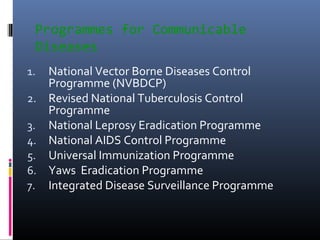
Programmes for Communicable
Diseases
1. National Vector Borne Diseases Control
Programme (NVBDCP)
2. Revised National Tuberculosis Control
Programme
3. National Leprosy Eradication Programme
4. National AIDS Control Programme
5. Universal Immunization Programme
6. Yaws Eradication Programme
7. Integrated Disease Surveillance Programme
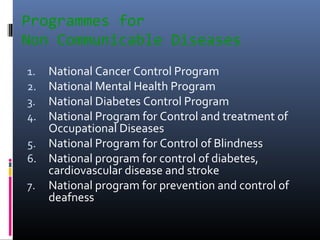
Programmes for
Non Communicable Diseases
1. National Cancer Control Program
2. National Mental Health Program
3. National Diabetes Control Program
4. National Program for Control and treatment of
Occupational Diseases
5. National Program for Control of Blindness
6. National program for control of diabetes,
cardiovascular disease and stroke
7. National program for prevention and control of
deafness
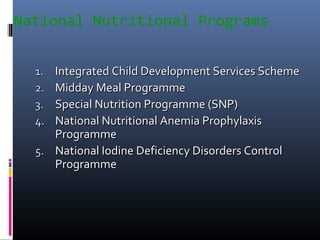
National Nutritional Programs
1.1. Integrated Child Development Services SchemeIntegrated Child Development Services Scheme
2.2. Midday Meal ProgrammeMidday Meal Programme
3.3. Special Nutrition Programme (SNP)Special Nutrition Programme (SNP)
4.4. National Nutritional Anemia ProphylaxisNational Nutritional Anemia Prophylaxis
ProgrammeProgramme
5.5. National Iodine Deficiency Disorders ControlNational Iodine Deficiency Disorders Control
ProgrammeProgramme
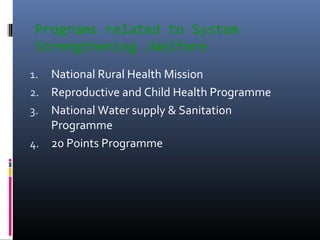
Programs related to System
Strengthening /Welfare
1. National Rural Health Mission
2. Reproductive and Child Health Programme
3. National Water supply & Sanitation
Programme
4. 20 Points Programme
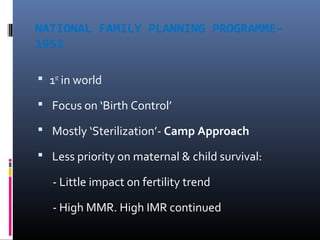
NATIONAL FAMILY PLANNING PROGRAMME-
1952
 1st
in world
 Focus on ‘Birth Control’
 Mostly ‘Sterilization’- Camp Approach
 Less priority on maternal & child survival:
- Little impact on fertility trend
- High MMR. High IMR continued
All India Hospital Post Partum
Programme (AIHPPP)- 1966
 It is a maternity centered, hospital based
approach to Family Welfare Programme
 To motivate the eligible couples for adopting the
small family norm
 Objectives:
1. To improve the health of the mother and
children
2. To reduce IMR and MMR
COMMUNITY NEED ASSESSMENT
 CNA concept means that it would be based
on actual needs of people and not of the
needs as perceived by top level professionals
and administrators.
IMPORTANCE OF CNA
 Setting priorities
 Identifying target as well as high risk groups
 Realistic estimation of services and matching
of resources needed for the same
 Developing realistic action plan
RCH APPROACH
 “People have ability to reproduce and regulate their
fertility,
 Women are able to go through pregnancy and child
birth safely,
 Outcome of pregnancy is successful in terms of
maternal and infant survival and well being and
 Couples are able to have sexual relations free of fear
of pregnancy and of contracting disease”.
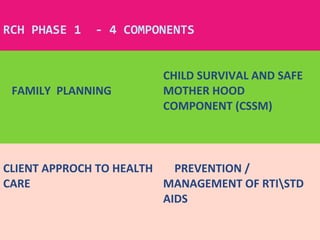
RCH PHASE 1 - 4 COMPONENTS
FAMILY PLANNING
CHILD SURVIVAL AND SAFE
MOTHER HOOD
COMPONENT (CSSM)
CLIENT APPROCH TO HEALTH
CARE
PREVENTION /
MANAGEMENT OF RTISTD
AIDS
MAIN HIGHLIGHTS
 Integrates all interventions of fertility regulation,
maternal and child health reproductive health for
both men and women.
 Client oriented services
 Upgradation of the level of facilities for providing
various interventions and quality of care.
The facilities of obstetric care, MTP and IUD insertion
in the PHC level are improved.
 Specialist facilities for STD and RTI are avaliable in all
district hospitals and in a fair number of sub-district
level hospitals.
 The programme aims at improving the out reach of
services primarily for the vulnerable population.
RCH SERVICES AND MAJOR
INTERVENTIONSESSENTIAL OBSTETRIC CARE:
Early registration of pregnancy ( within 12-16
weeks)
Provision of minimum 3 antenatal checkups by
ANM
Provision of safe delivery at home or institution
Provision of 3 post natal check ups to monitor the
postnatal recovery and to detect complications.
2.EMERGENCY OBSTETRICAL CARE - very essential to
prevent maternal mortality and morbidity traditional birth
attendance should be maintained in conducting the
deliveries.
3. 24 -HOUR DELIVERY SERVICES AT PHCsCHCs -
to promote institutional deliveries ,the staff should be
encourage round the clock delivery facilities at health
centres.
4.MEDICAL TERMINATION OF PREGNANCY
 through the MTP act 1971
the aim is to reduce maternal morbidity and mortality
from unsafe abortions.
the assistance from the central govt. is in the forms of
training of manpower, supply of MTP equipment and
provision for engaging doctors trained in MTP to visit
PHC on fixed dates to perform MTP.
5. CONTROL OF RTI AND STD’S
 Implemented in close collabaration with National
AIDS control organisation (naco).
NACO will provide assistance for setting up RTI/STD
clinics up to the district level.
each district will be assisted by 2 laboratory
technicians on contract basis for testing blood,urine
and RTI/STD tests.
6.IMMUNIZATION –
The universal immunization programme (UIP) became
part of CSSM programme in 1992 and RCH programme
1997.it will continue to provide vaccines for
polio,tetanus.dpt, dt, measles and tuberculosis.
7.DRUG AND EQUIPMENT KITS
equipment kits supplied at various levels as
follows………
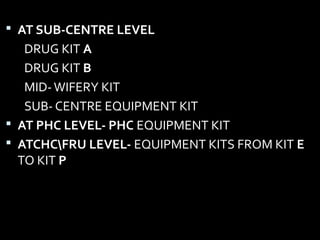
 AT SUB-CENTRE LEVEL
DRUG KIT A
DRUG KIT B
MID-WIFERY KIT
SUB- CENTRE EQUIPMENT KIT
 AT PHC LEVEL- PHC EQUIPMENT KIT
 ATCHCFRU LEVEL- EQUIPMENT KITS FROM KIT E
TO KIT P
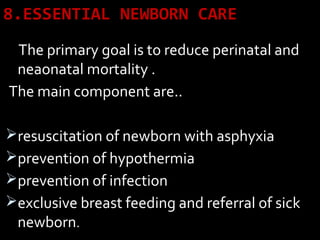
8.ESSENTIAL NEWBORN CARE
The primary goal is to reduce perinatal and
neaonatal mortality .
The main component are..
resuscitation of newborn with asphyxia
prevention of hypothermia
prevention of infection
exclusive breast feeding and referral of sick
newborn.
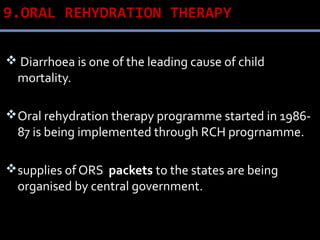
9.ORAL REHYDRATION THERAPY
 Diarrhoea is one of the leading cause of child
mortality.
Oral rehydration therapy programme started in 1986-
87 is being implemented through RCH progrnamme.
supplies of ORS packets to the states are being
organised by central government.
Twice a year 150 packets of ors are provided as part
of drug kit supplied to all sub- centres in country.
adequate nutritional care of the child with
diarrhoea and proper advice to mother on feeding
are important area.
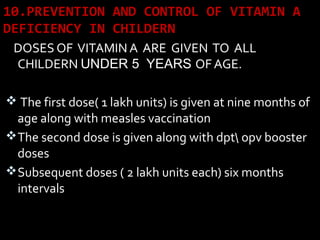
10.PREVENTION AND CONTROL OF VITAMIN A
DEFICIENCY IN CHILDERN
DOSES OF VITAMIN A ARE GIVEN TO ALL
CHILDERN UNDER 5 YEARS OF AGE.
 The first dose( 1 lakh units) is given at nine months of
age along with measles vaccination
The second dose is given along with dpt opv booster
doses
Subsequent doses ( 2 lakh units each) six months
intervals
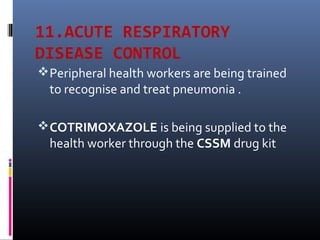
11.ACUTE RESPIRATORY
DISEASE CONTROL
Peripheral health workers are being trained
to recognise and treat pneumonia .
COTRIMOXAZOLE is being supplied to the
health worker through the CSSM drug kit
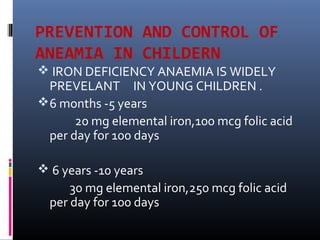
PREVENTION AND CONTROL OF
ANEAMIA IN CHILDERN
 IRON DEFICIENCY ANAEMIA IS WIDELY
PREVELANT IN YOUNG CHILDREN .
6 months -5 years
20 mg elemental iron,100 mcg folic acid
per day for 100 days
 6 years -10 years
30 mg elemental iron,250 mcg folic acid
per day for 100 days
REPRODUCTIVE AND CHILD HEALTH
PROGRAMME -PHASE II
RCH –PHASE II
 RCH –PHASE II BEGAN FROM 1ST
APRIL 2005
 the focus is to reduce maternal and child
mortality and morbidity with emphasis on
rural health care.the major strategies are
ESSENTIAL OBTETRIC CARE
a. Institutional delivery
b. Skilled attendance at delivery
EMERGENCY OBSTETRIC CARE
a. Operationalizing first referral units
b. Operationalizing PHCs and CHCs for
round clock delivery services
 Strengthening referral system
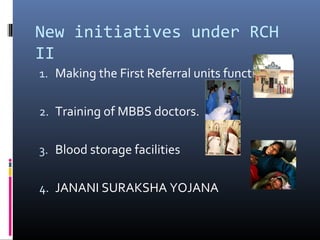
New initiatives under RCH
II
1. Making the First Referral units functional.
2. Training of MBBS doctors.
3. Blood storage facilities
4. JANANI SURAKSHA YOJANA
24 Hrs. Functioning of PHCs
RCH II
• It is planned to establish 2000 FRUs in phases in
RCH-II
• 50% PHCs and all CHCs to be
operationalised in phases
• Availability of Services such as
- 24 Hrs. Delivery services
- New Born care
- Family Planning, Counselling and services
- Availability of RTI, STI services
- Safe abortion services (MVA etc.)
Training in Anaesthesia (LSASEMOC)
RCH II
• Training of MBBS Doctors in Life Saving
Anaesthetic Skills for Emergency Obstetric Care.
• 18 weeks training course
• The First Training Programme
Conducted at AIIMS for Chhattisgarh
• Training to be conducted in phases
and limited to the requirement at
FRUs.
Training In Obstetric Management
RCH II
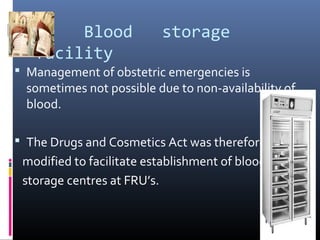
• Training of MBBS doctors in obstetric
management and skills including C.S. in
RCH-II
• Training to be conducted in collaboration
with FOGSI
• Duration of training to be 16 weeks
• Expert Group is considering other details
Blood storage
facility
 Management of obstetric emergencies is
sometimes not possible due to non-availability of
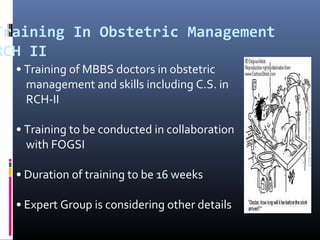
blood.
 The Drugs and Cosmetics Act was therefore
modified to facilitate establishment of blood
storage centres at FRU’s.
JANANI SURAKSHA YOJANA,
RCH II
OBJECTIVES
• REDUCTION IN MMR & IMR
• PREVENTING FEMALE FOETICIDE
FOCUS:
INSTITUTIONAL DELIVERY
GRADED BENEFITS
- HPS & LPS BASED ON RATE OF
INSTITUTIONAL DELIVERY
- RURAL & URBAN DIVIDE
- MALE/FEMALE CHILD
Vandemataram scheme
 It is a voluntary scheme wherein any obstetric and
gynaec specialist, maternity home can volunteer
 Enrolled doctors will display ‘vandemataram logo’
at their clinics.
 Iron and folic acid tablets, oral pills, TT injections, etc
will be provided for free distribution.
 Of late it has been withdrawn.
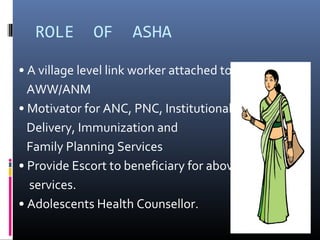
ROLE OF ASHA
• A village level link worker attached to
AWW/ANM
• Motivator for ANC, PNC, Institutional
Delivery, Immunization and
Family Planning Services
• Provide Escort to beneficiary for above
services.
• Adolescents Health Counsellor.
Strategy for addressing Adolescent Reproductive and
Sexual Health
(ARSH) in RCH Phase II
A two-pronged strategy will be supported:
Incorporation of adolescent issues in all the RCH training
programs and all RCH materials developed for communication
and behaviour change.
dedicated days and dedicated timings for adolescents at PHC’s.
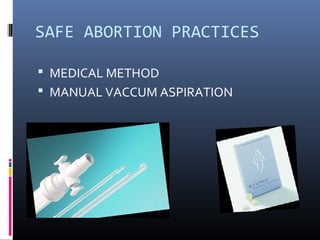
SAFE ABORTION PRACTICES
 MEDICAL METHOD
 MANUAL VACCUM ASPIRATION
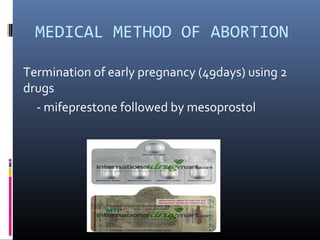
MEDICAL METHOD OF ABORTION
Termination of early pregnancy (49days) using 2
drugs
- mifeprestone followed by mesoprostol
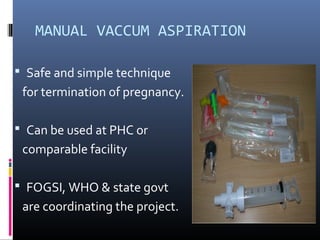
MANUAL VACCUM ASPIRATION
 Safe and simple technique
for termination of pregnancy.
 Can be used at PHC or
comparable facility
 FOGSI, WHO & state govt
are coordinating the project.
Thank you

Rch part i

  • 1.
  • 2.
    Programmes for Communicable Diseases 1.National Vector Borne Diseases Control Programme (NVBDCP) 2. Revised National Tuberculosis Control Programme 3. National Leprosy Eradication Programme 4. National AIDS Control Programme 5. Universal Immunization Programme 6. Yaws Eradication Programme 7. Integrated Disease Surveillance Programme
  • 3.
    Programmes for Non CommunicableDiseases 1. National Cancer Control Program 2. National Mental Health Program 3. National Diabetes Control Program 4. National Program for Control and treatment of Occupational Diseases 5. National Program for Control of Blindness 6. National program for control of diabetes, cardiovascular disease and stroke 7. National program for prevention and control of deafness
  • 4.
    National Nutritional Programs 1.1.Integrated Child Development Services SchemeIntegrated Child Development Services Scheme 2.2. Midday Meal ProgrammeMidday Meal Programme 3.3. Special Nutrition Programme (SNP)Special Nutrition Programme (SNP) 4.4. National Nutritional Anemia ProphylaxisNational Nutritional Anemia Prophylaxis ProgrammeProgramme 5.5. National Iodine Deficiency Disorders ControlNational Iodine Deficiency Disorders Control ProgrammeProgramme
  • 5.
    Programs related toSystem Strengthening /Welfare 1. National Rural Health Mission 2. Reproductive and Child Health Programme 3. National Water supply & Sanitation Programme 4. 20 Points Programme
  • 7.
    NATIONAL FAMILY PLANNINGPROGRAMME- 1952  1st in world  Focus on ‘Birth Control’  Mostly ‘Sterilization’- Camp Approach  Less priority on maternal & child survival: - Little impact on fertility trend - High MMR. High IMR continued
  • 8.
    All India HospitalPost Partum Programme (AIHPPP)- 1966  It is a maternity centered, hospital based approach to Family Welfare Programme  To motivate the eligible couples for adopting the small family norm  Objectives: 1. To improve the health of the mother and children 2. To reduce IMR and MMR
  • 9.
    COMMUNITY NEED ASSESSMENT CNA concept means that it would be based on actual needs of people and not of the needs as perceived by top level professionals and administrators.
  • 10.
    IMPORTANCE OF CNA Setting priorities  Identifying target as well as high risk groups  Realistic estimation of services and matching of resources needed for the same  Developing realistic action plan
  • 11.
    RCH APPROACH  “Peoplehave ability to reproduce and regulate their fertility,  Women are able to go through pregnancy and child birth safely,  Outcome of pregnancy is successful in terms of maternal and infant survival and well being and  Couples are able to have sexual relations free of fear of pregnancy and of contracting disease”.
  • 12.
    RCH PHASE 1- 4 COMPONENTS FAMILY PLANNING CHILD SURVIVAL AND SAFE MOTHER HOOD COMPONENT (CSSM) CLIENT APPROCH TO HEALTH CARE PREVENTION / MANAGEMENT OF RTISTD AIDS
  • 13.
    MAIN HIGHLIGHTS  Integratesall interventions of fertility regulation, maternal and child health reproductive health for both men and women.  Client oriented services  Upgradation of the level of facilities for providing various interventions and quality of care.
  • 14.
    The facilities ofobstetric care, MTP and IUD insertion in the PHC level are improved.  Specialist facilities for STD and RTI are avaliable in all district hospitals and in a fair number of sub-district level hospitals.  The programme aims at improving the out reach of services primarily for the vulnerable population.
  • 15.
    RCH SERVICES ANDMAJOR INTERVENTIONSESSENTIAL OBSTETRIC CARE: Early registration of pregnancy ( within 12-16 weeks) Provision of minimum 3 antenatal checkups by ANM Provision of safe delivery at home or institution Provision of 3 post natal check ups to monitor the postnatal recovery and to detect complications.
  • 16.
    2.EMERGENCY OBSTETRICAL CARE- very essential to prevent maternal mortality and morbidity traditional birth attendance should be maintained in conducting the deliveries. 3. 24 -HOUR DELIVERY SERVICES AT PHCsCHCs - to promote institutional deliveries ,the staff should be encourage round the clock delivery facilities at health centres.
  • 17.
    4.MEDICAL TERMINATION OFPREGNANCY  through the MTP act 1971 the aim is to reduce maternal morbidity and mortality from unsafe abortions. the assistance from the central govt. is in the forms of training of manpower, supply of MTP equipment and provision for engaging doctors trained in MTP to visit PHC on fixed dates to perform MTP.
  • 18.
    5. CONTROL OFRTI AND STD’S  Implemented in close collabaration with National AIDS control organisation (naco). NACO will provide assistance for setting up RTI/STD clinics up to the district level. each district will be assisted by 2 laboratory technicians on contract basis for testing blood,urine and RTI/STD tests.
  • 19.
    6.IMMUNIZATION – The universalimmunization programme (UIP) became part of CSSM programme in 1992 and RCH programme 1997.it will continue to provide vaccines for polio,tetanus.dpt, dt, measles and tuberculosis. 7.DRUG AND EQUIPMENT KITS equipment kits supplied at various levels as follows………
  • 20.
     AT SUB-CENTRELEVEL DRUG KIT A DRUG KIT B MID-WIFERY KIT SUB- CENTRE EQUIPMENT KIT  AT PHC LEVEL- PHC EQUIPMENT KIT  ATCHCFRU LEVEL- EQUIPMENT KITS FROM KIT E TO KIT P
  • 21.
    8.ESSENTIAL NEWBORN CARE Theprimary goal is to reduce perinatal and neaonatal mortality . The main component are.. resuscitation of newborn with asphyxia prevention of hypothermia prevention of infection exclusive breast feeding and referral of sick newborn.
  • 22.
    9.ORAL REHYDRATION THERAPY Diarrhoea is one of the leading cause of child mortality. Oral rehydration therapy programme started in 1986- 87 is being implemented through RCH progrnamme. supplies of ORS packets to the states are being organised by central government.
  • 23.
    Twice a year150 packets of ors are provided as part of drug kit supplied to all sub- centres in country. adequate nutritional care of the child with diarrhoea and proper advice to mother on feeding are important area.
  • 24.
    10.PREVENTION AND CONTROLOF VITAMIN A DEFICIENCY IN CHILDERN DOSES OF VITAMIN A ARE GIVEN TO ALL CHILDERN UNDER 5 YEARS OF AGE.  The first dose( 1 lakh units) is given at nine months of age along with measles vaccination The second dose is given along with dpt opv booster doses Subsequent doses ( 2 lakh units each) six months intervals
  • 25.
    11.ACUTE RESPIRATORY DISEASE CONTROL Peripheralhealth workers are being trained to recognise and treat pneumonia . COTRIMOXAZOLE is being supplied to the health worker through the CSSM drug kit
  • 26.
    PREVENTION AND CONTROLOF ANEAMIA IN CHILDERN  IRON DEFICIENCY ANAEMIA IS WIDELY PREVELANT IN YOUNG CHILDREN . 6 months -5 years 20 mg elemental iron,100 mcg folic acid per day for 100 days  6 years -10 years 30 mg elemental iron,250 mcg folic acid per day for 100 days
  • 28.
    REPRODUCTIVE AND CHILDHEALTH PROGRAMME -PHASE II
  • 29.
    RCH –PHASE II RCH –PHASE II BEGAN FROM 1ST APRIL 2005  the focus is to reduce maternal and child mortality and morbidity with emphasis on rural health care.the major strategies are ESSENTIAL OBTETRIC CARE a. Institutional delivery b. Skilled attendance at delivery EMERGENCY OBSTETRIC CARE a. Operationalizing first referral units b. Operationalizing PHCs and CHCs for round clock delivery services
  • 30.
  • 31.
    New initiatives underRCH II 1. Making the First Referral units functional. 2. Training of MBBS doctors. 3. Blood storage facilities 4. JANANI SURAKSHA YOJANA
  • 32.
    24 Hrs. Functioningof PHCs RCH II • It is planned to establish 2000 FRUs in phases in RCH-II • 50% PHCs and all CHCs to be operationalised in phases • Availability of Services such as - 24 Hrs. Delivery services - New Born care - Family Planning, Counselling and services - Availability of RTI, STI services - Safe abortion services (MVA etc.)
  • 33.
    Training in Anaesthesia(LSASEMOC) RCH II • Training of MBBS Doctors in Life Saving Anaesthetic Skills for Emergency Obstetric Care. • 18 weeks training course • The First Training Programme Conducted at AIIMS for Chhattisgarh • Training to be conducted in phases and limited to the requirement at FRUs.
  • 34.
    Training In ObstetricManagement RCH II • Training of MBBS doctors in obstetric management and skills including C.S. in RCH-II • Training to be conducted in collaboration with FOGSI • Duration of training to be 16 weeks • Expert Group is considering other details
  • 35.
    Blood storage facility  Managementof obstetric emergencies is sometimes not possible due to non-availability of blood.  The Drugs and Cosmetics Act was therefore modified to facilitate establishment of blood storage centres at FRU’s.
  • 36.
    JANANI SURAKSHA YOJANA, RCHII OBJECTIVES • REDUCTION IN MMR & IMR • PREVENTING FEMALE FOETICIDE FOCUS: INSTITUTIONAL DELIVERY GRADED BENEFITS - HPS & LPS BASED ON RATE OF INSTITUTIONAL DELIVERY - RURAL & URBAN DIVIDE - MALE/FEMALE CHILD
  • 39.
    Vandemataram scheme  Itis a voluntary scheme wherein any obstetric and gynaec specialist, maternity home can volunteer  Enrolled doctors will display ‘vandemataram logo’ at their clinics.  Iron and folic acid tablets, oral pills, TT injections, etc will be provided for free distribution.  Of late it has been withdrawn.
  • 40.
    ROLE OF ASHA •A village level link worker attached to AWW/ANM • Motivator for ANC, PNC, Institutional Delivery, Immunization and Family Planning Services • Provide Escort to beneficiary for above services. • Adolescents Health Counsellor.
  • 41.
    Strategy for addressingAdolescent Reproductive and Sexual Health (ARSH) in RCH Phase II A two-pronged strategy will be supported: Incorporation of adolescent issues in all the RCH training programs and all RCH materials developed for communication and behaviour change. dedicated days and dedicated timings for adolescents at PHC’s.
  • 42.
    SAFE ABORTION PRACTICES MEDICAL METHOD  MANUAL VACCUM ASPIRATION
  • 43.
    MEDICAL METHOD OFABORTION Termination of early pregnancy (49days) using 2 drugs - mifeprestone followed by mesoprostol
  • 44.
    MANUAL VACCUM ASPIRATION Safe and simple technique for termination of pregnancy.  Can be used at PHC or comparable facility  FOGSI, WHO & state govt are coordinating the project.
  • 45.

Editor's Notes

  • #34 • Training guidelines giving criteria for certification, selection of trainees & training instt./medical college, minimum procedures etc. finalized
  • #41 • Link between beneficiaries and ANMs.