INTERPROFESSIONAL
 ROUNDING TEAMS
        Group 6
    November 28th, 2012
BACKGROUND
 • Interdisciplinary healthcare teams are defined as
   involving two or more health professions with
   complementary skills assessing, planning, or
   evaluating patient care.


Xyrichis, A. and Ream, E. Teamwork: a concept analysis. Journal of Advanced
Nursing (2008); 61, 232-241.
BACKGROUND
• Teamwork in healthcare can save lives, improve the
  quality of patient care, reduce errors, enhance
  patient flow, improve communication, and increase
  satisfaction.

• THIS IS WHY WE NEED TEAMWORK!!!


Bharwani, Aleem M., MD, MPP, Harris, G. Chad, and Southwick, Frederick S., MD. Perspective: A
Business School View of Medical Interprofessional Rounds: Transforming Rounding Groups Into
Rounding Teams. Acad Med. 2012; 87:00-00.
WHAT DISCIPLINES ARE INVOLVED?

• Medicine           • Respiratory
• Nursing            • Physician Assistants
• Pharmacy           • Nurse Practitioners
• Physical Therapy   • Social Work
• Occupational       • Etc.
  Therapy
• Nutrition
• Case Management
DISCIPLINES FOR THIS PROJECT

• Medicine
• Nursing
• Pharmacy
• PT/OT
• Nutrition
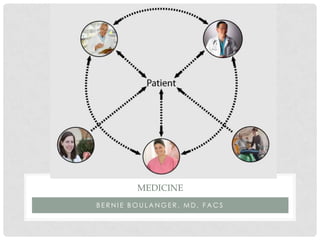
MEDICINE

• Attending Physician
• Medical Resident
 • Medical Intern
• Medical Student
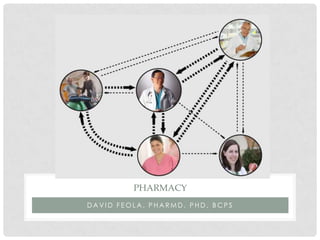
PHARMACY

• Clinical Pharmacist
  • Specialized
• Pharmacy Resident
• Pharmacy Student
NURSING

• Nurse Practitioner
• Floor Manager
• Nurse
• Nursing Tech/Student
OCCUPATIONAL THERAPY,
PHYSICAL THERAPY, AND NUTRITION

• Floor/Department
WHY IS THIS IMPORTANT?

• In 2006, the Joint Commission reported that
  70% of medical errors were caused by lack
  of communication between team
  members.


Joint Commission on Accreditation of Health Care Organizations. Root causes for sentinel
events. http://www.jointcommission.org/Sentinel_Event_Statistics
                                                               /.
COMMUNICATION
(INTERDISCIPLINARY AND INTRADISCIPLINARY)

                 ISSUE
MEDICINE
BERNIE BOULANGER, MD, FACS
PHARMACY
DAVID FEOLA, PHARMD, PHD, BCPS
NURSING
NORA WARSHAWSKY, PHD, RN
COMMUNICATION BREAKDOWN

• Interdisciplinary     • Intradisciplinary
 • Attitudes towards      • Continuity of care
   other disciplines      • Shift changes


               • Both
                 • Paper charts
                 • Handwriting
CHECKLISTS
 SOLUTION #1
SIX FUNCTIONS

•   Provision of detailed case-related information
•   Confirmation of case-specific details
•   Articulation of concern or ambiguity
•   Decision making
•   Team building and camaraderie
•   Education
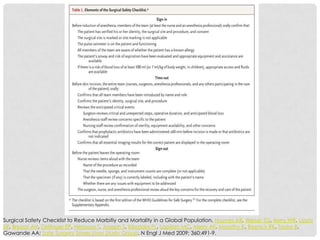
Surgical Safety Checklist to Reduce Morbitiy and Mortality in a Global Population. Haynes AB, Weiser TG, Berry WR, Lipsitz
SR, Breizat AH, Dellinger EP, Herbosa T, Joseph S, Kibatala PL, Lapitan MC, Merry AF, Moorthy K, Reznick RK, Taylor B,
Gawande AA; Safe Surgery Saves Lives Study Group. N Engl J Med 2009; 360:491-9.
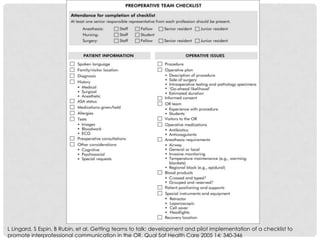
L Lingard, S Espin, B Rubin, et al. Getting teams to talk: development and pilot implementation of a checklist to
promote interprofessional communication in the OR. Qual Saf Health Care 2005 14: 340-346
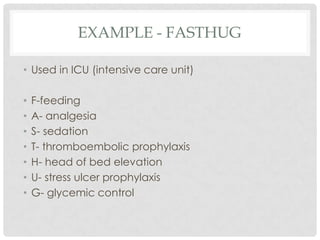
EXAMPLE - FASTHUG

• Used in ICU (intensive care unit)

•   F-feeding
•   A- analgesia
•   S- sedation
•   T- thromboembolic prophylaxis
•   H- head of bed elevation
•   U- stress ulcer prophylaxis
•   G- glycemic control
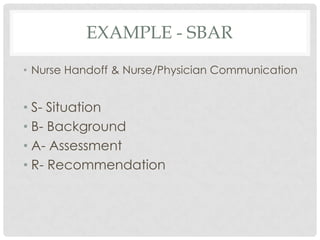
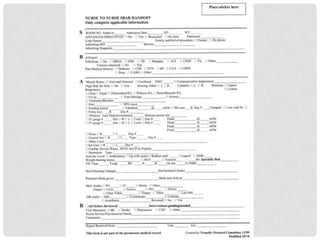
EXAMPLE - SBAR
• Nurse Handoff & Nurse/Physician Communication


• S- Situation
• B- Background
• A- Assessment
• R- Recommendation
OUTCOMES

       • The rate of death was 1.5% before the checklist was
         introduced and declined to 0.8% afterward
         (P=0.003). Inpatient complications occurred in 11.0%
         of patients at baseline and in 7.0% after introduction
         of the checklist (P<0.001).


Surgical Safety Checklist to Reduce Morbitiy and Mortality in a Global Population. Haynes AB, Weiser TG, Berry WR, Lipsitz
SR, Breizat AH, Dellinger EP, Herbosa T, Joseph S, Kibatala PL, Lapitan MC, Merry AF, Moorthy K, Reznick RK, Taylor
B, Gawande AA; Safe Surgery Saves Lives Study Group. N Engl J Med 2009; 360:491-9.
OUTCOMES

• One example aimed to provide timely pain medication by
  having nurses observe every four hours for pain.
  • Reduced the likelihood of a patient’s experiencing untreated pain
    from 41% to 3%

• Another was a checklist for patients on mechanical ventilation
  • Proportion of patients who didn’t receive the recommended care
    dropped from 70% to 4%
  • The occurrence of pneumonias fell by 25%;
     • 21 fewer patients died than in the previous year

• “The research shows that simply having the doctors and nurses
  in the I.C.U. make their own checklists for what they thought
  should be done each day improved the consistency of care to
  the point that, within a few weeks, the average length of patient
  stay in intensive care dropped by half.”
Gawande, Atul. Annals of Medicine: The Checklist. The New Yorker. December 10, 2007.
CARE PATHWAYS
   SOLUTION #2
WHAT IS A CARE PATHWAY?

    • Also known as care map, critical pathways, or
      integrated care pathways.

    • Definition: Complex interventions to organize care
      for patients.

    • Although research shows that implementing care
      pathways can be challenging for teams, the overall
      consensus with proper management customized
      care pathways can improve patient care.

Deneckere S, Euwema M, Van Herck P, Lodewijckx C, Panella M, Sermeus W, Vanhaecht K. Care
pathways lead to better teamwork: results of a systematic review. Soc Sci Med. 2012 Jul;75(2):264-8.
SYSTEMATIC REVIEW

    • Level III evidence from a trial showed that pathways
      significantly reduced prescribing error by 30%
      (p=0.002)

    • CONS- trouble implementing care pathway


Deneckere S, Euwema M, Van Herck P, Lodewijckx C, Panella M, Sermeus W, Vanhaecht K. Care
pathways lead to better teamwork: results of a systematic review. Soc Sci Med. 2012 Jul;75(2):264-8.
HMcD/Steering Group
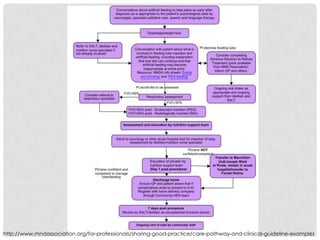
                        Care Pathways for People with MND - In patient diagnosis                                 Northern Ireland
                                                                                                                 July 2003

                                    Referral
                                                                    Screening if potential MND urgent appointment 3-4 weeks


                              Seen at Outpatients


                             Admission (tests etc)

                                                                    Contact made with Care Centre Co-ordinator


                                DIAGNOSIS                           Care Centre Co-ordinator available/present at diagnosis:
                                                                    or referral made to Co-ordinator to follow up immediately
                                                                    after diagnosis.


                             Follow up appointment                                                                         Onward
                             with neurologist (variable                                     GP/Primary Care                Referral to
   Care Centre               to meet needs 2-6 weeks                                        Leaflet to GP                  Services as
   Co-ordinator
                                                                                                                           appropriate
   available at                                                                  Info on MND support
   Outpatients clinic                                                                                        Referral
                                                                                 Via Association             To MDT
                                                                                 Refer to RCA
                                Re-offer services of
                                Care Centre                           Follow up contact within two weeks (telephone or visit)
   Liaise with Care
   Centre                                                 RCA makes initial visit, checking statutory services
   Co-ordinator          If no contact wanted
                                                          and Association services


GNDH/11.8.05                                                     Maintain contact or contact with AV
http://www.mndassociation.org/for-professionals/sharing-good-practice/care-pathway-and-clinical-guideline-examples
EDUCATION
(PRE-PROFESSIONAL AND POST-PROFESSIONAL)

             SOLUTION #3
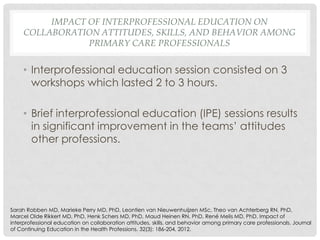
IMPACT OF INTERPROFESSIONAL EDUCATION ON
     COLLABORATION ATTITUDES, SKILLS, AND BEHAVIOR AMONG
                 PRIMARY CARE PROFESSIONALS


     • Interprofessional education session consisted on 3
       workshops which lasted 2 to 3 hours.

     • Brief interprofessional education (IPE) sessions results
       in significant improvement in the teams’ attitudes
       other professions.


Sarah Robben MD, Marieke Perry MD, PhD, Leontien van Nieuwenhuijzen MSc, Theo van Achterberg RN, PhD,
Marcel Olde Rikkert MD, PhD, Henk Schers MD, PhD, Maud Heinen RN, PhD, René Melis MD, PhD. Impact of
interprofessional education on collaboration attitudes, skills, and behavior among primary care professionals. Journal
of Continuing Education in the Health Professions. 32(3): 186-204, 2012.
BUSINESS SCHOOL VIEW OF
                 ROUNDING TEAMS
• Scenario-based situations followed by video
  critiques are also shown to an effective form of
  interprofessional education for healthcare teams.


Bharwani, Aleem M., MD, MPP, Harris, G. Chad, and Southwick, Frederick S., MD. Perspective: A
Business School View of Medical Interprofessional Rounds: Transforming Rounding Groups Into
Rounding Teams. Acad Med. 2012; 87:00-00.
QUESTIONS?

Interprofessional Healthcare Teams

  • 1.
    INTERPROFESSIONAL ROUNDING TEAMS Group 6 November 28th, 2012
  • 2.
    BACKGROUND • Interdisciplinaryhealthcare teams are defined as involving two or more health professions with complementary skills assessing, planning, or evaluating patient care. Xyrichis, A. and Ream, E. Teamwork: a concept analysis. Journal of Advanced Nursing (2008); 61, 232-241.
  • 3.
    BACKGROUND • Teamwork inhealthcare can save lives, improve the quality of patient care, reduce errors, enhance patient flow, improve communication, and increase satisfaction. • THIS IS WHY WE NEED TEAMWORK!!! Bharwani, Aleem M., MD, MPP, Harris, G. Chad, and Southwick, Frederick S., MD. Perspective: A Business School View of Medical Interprofessional Rounds: Transforming Rounding Groups Into Rounding Teams. Acad Med. 2012; 87:00-00.
  • 4.
    WHAT DISCIPLINES AREINVOLVED? • Medicine • Respiratory • Nursing • Physician Assistants • Pharmacy • Nurse Practitioners • Physical Therapy • Social Work • Occupational • Etc. Therapy • Nutrition • Case Management
  • 5.
    DISCIPLINES FOR THISPROJECT • Medicine • Nursing • Pharmacy • PT/OT • Nutrition
  • 6.
    MEDICINE • Attending Physician •Medical Resident • Medical Intern • Medical Student
  • 7.
    PHARMACY • Clinical Pharmacist • Specialized • Pharmacy Resident • Pharmacy Student
  • 8.
    NURSING • Nurse Practitioner •Floor Manager • Nurse • Nursing Tech/Student
  • 9.
    OCCUPATIONAL THERAPY, PHYSICAL THERAPY,AND NUTRITION • Floor/Department
  • 10.
    WHY IS THISIMPORTANT? • In 2006, the Joint Commission reported that 70% of medical errors were caused by lack of communication between team members. Joint Commission on Accreditation of Health Care Organizations. Root causes for sentinel events. http://www.jointcommission.org/Sentinel_Event_Statistics /.
  • 11.
  • 12.
  • 13.
  • 14.
  • 15.
    COMMUNICATION BREAKDOWN • Interdisciplinary • Intradisciplinary • Attitudes towards • Continuity of care other disciplines • Shift changes • Both • Paper charts • Handwriting
  • 16.
  • 17.
    SIX FUNCTIONS • Provision of detailed case-related information • Confirmation of case-specific details • Articulation of concern or ambiguity • Decision making • Team building and camaraderie • Education
  • 18.
    Surgical Safety Checklistto Reduce Morbitiy and Mortality in a Global Population. Haynes AB, Weiser TG, Berry WR, Lipsitz SR, Breizat AH, Dellinger EP, Herbosa T, Joseph S, Kibatala PL, Lapitan MC, Merry AF, Moorthy K, Reznick RK, Taylor B, Gawande AA; Safe Surgery Saves Lives Study Group. N Engl J Med 2009; 360:491-9.
  • 19.
    L Lingard, SEspin, B Rubin, et al. Getting teams to talk: development and pilot implementation of a checklist to promote interprofessional communication in the OR. Qual Saf Health Care 2005 14: 340-346
  • 20.
    EXAMPLE - FASTHUG •Used in ICU (intensive care unit) • F-feeding • A- analgesia • S- sedation • T- thromboembolic prophylaxis • H- head of bed elevation • U- stress ulcer prophylaxis • G- glycemic control
  • 21.
    EXAMPLE - SBAR •Nurse Handoff & Nurse/Physician Communication • S- Situation • B- Background • A- Assessment • R- Recommendation
  • 23.
    OUTCOMES • The rate of death was 1.5% before the checklist was introduced and declined to 0.8% afterward (P=0.003). Inpatient complications occurred in 11.0% of patients at baseline and in 7.0% after introduction of the checklist (P<0.001). Surgical Safety Checklist to Reduce Morbitiy and Mortality in a Global Population. Haynes AB, Weiser TG, Berry WR, Lipsitz SR, Breizat AH, Dellinger EP, Herbosa T, Joseph S, Kibatala PL, Lapitan MC, Merry AF, Moorthy K, Reznick RK, Taylor B, Gawande AA; Safe Surgery Saves Lives Study Group. N Engl J Med 2009; 360:491-9.
  • 24.
    OUTCOMES • One exampleaimed to provide timely pain medication by having nurses observe every four hours for pain. • Reduced the likelihood of a patient’s experiencing untreated pain from 41% to 3% • Another was a checklist for patients on mechanical ventilation • Proportion of patients who didn’t receive the recommended care dropped from 70% to 4% • The occurrence of pneumonias fell by 25%; • 21 fewer patients died than in the previous year • “The research shows that simply having the doctors and nurses in the I.C.U. make their own checklists for what they thought should be done each day improved the consistency of care to the point that, within a few weeks, the average length of patient stay in intensive care dropped by half.” Gawande, Atul. Annals of Medicine: The Checklist. The New Yorker. December 10, 2007.
  • 25.
    CARE PATHWAYS SOLUTION #2
  • 26.
    WHAT IS ACARE PATHWAY? • Also known as care map, critical pathways, or integrated care pathways. • Definition: Complex interventions to organize care for patients. • Although research shows that implementing care pathways can be challenging for teams, the overall consensus with proper management customized care pathways can improve patient care. Deneckere S, Euwema M, Van Herck P, Lodewijckx C, Panella M, Sermeus W, Vanhaecht K. Care pathways lead to better teamwork: results of a systematic review. Soc Sci Med. 2012 Jul;75(2):264-8.
  • 27.
    SYSTEMATIC REVIEW • Level III evidence from a trial showed that pathways significantly reduced prescribing error by 30% (p=0.002) • CONS- trouble implementing care pathway Deneckere S, Euwema M, Van Herck P, Lodewijckx C, Panella M, Sermeus W, Vanhaecht K. Care pathways lead to better teamwork: results of a systematic review. Soc Sci Med. 2012 Jul;75(2):264-8.
  • 28.
    HMcD/Steering Group Care Pathways for People with MND - In patient diagnosis Northern Ireland July 2003 Referral Screening if potential MND urgent appointment 3-4 weeks Seen at Outpatients Admission (tests etc) Contact made with Care Centre Co-ordinator DIAGNOSIS Care Centre Co-ordinator available/present at diagnosis: or referral made to Co-ordinator to follow up immediately after diagnosis. Follow up appointment Onward with neurologist (variable GP/Primary Care Referral to Care Centre to meet needs 2-6 weeks Leaflet to GP Services as Co-ordinator appropriate available at Info on MND support Outpatients clinic Referral Via Association To MDT Refer to RCA Re-offer services of Care Centre Follow up contact within two weeks (telephone or visit) Liaise with Care Centre RCA makes initial visit, checking statutory services Co-ordinator If no contact wanted and Association services GNDH/11.8.05 Maintain contact or contact with AV
  • 29.
  • 30.
  • 31.
    IMPACT OF INTERPROFESSIONALEDUCATION ON COLLABORATION ATTITUDES, SKILLS, AND BEHAVIOR AMONG PRIMARY CARE PROFESSIONALS • Interprofessional education session consisted on 3 workshops which lasted 2 to 3 hours. • Brief interprofessional education (IPE) sessions results in significant improvement in the teams’ attitudes other professions. Sarah Robben MD, Marieke Perry MD, PhD, Leontien van Nieuwenhuijzen MSc, Theo van Achterberg RN, PhD, Marcel Olde Rikkert MD, PhD, Henk Schers MD, PhD, Maud Heinen RN, PhD, René Melis MD, PhD. Impact of interprofessional education on collaboration attitudes, skills, and behavior among primary care professionals. Journal of Continuing Education in the Health Professions. 32(3): 186-204, 2012.
  • 32.
    BUSINESS SCHOOL VIEWOF ROUNDING TEAMS • Scenario-based situations followed by video critiques are also shown to an effective form of interprofessional education for healthcare teams. Bharwani, Aleem M., MD, MPP, Harris, G. Chad, and Southwick, Frederick S., MD. Perspective: A Business School View of Medical Interprofessional Rounds: Transforming Rounding Groups Into Rounding Teams. Acad Med. 2012; 87:00-00.
  • 33.