COLLEGE OF AGRICULTURE , JODHPUR
Department of Ag. Extension education
Course tittle – Capacity Development
Ext -512
Topic- capacity development methods and tools
Submitted by – Durgesh Nandini saras Submitted to – Dr Mahendra Kumar
Class – Msc 1st year 1st sem Associate Professor
Subject - Agriculture extension education at COA , Jodhpur
CAPACITY BUILDING METHOD
AND TOOLS
LECTURE
• A lecture (from Latin: lēctūra 'reading') is
an oral presentation intended to present information or teach
people about a particular subject,
• For example by a university or college teacher. Lectures are
used to convey critical information, history, background,
theories, and equation
• A formal lecture helps in the building up of theoretical
knowledge which can be used as a base for the
participative training sessions and learning of motor or
verbal skills
• One important advantage of the lecture method is that a
relatively large number of people can be instructed at
one time.
• There is no other method that can be used to instruct 50-
100, or more, trainees.
• A lecture can deal with more facts, principles, and
concepts in a shorter time than it would take to teach the
same material in a conference, case study, or other group
method.
• If teaching resources are scarce, then the lecture
method is the best.
Discussion Method
• This is an intensive participation-oriented methodology
• Discussions involve the exchange of ideas between the
trainees and trainers and, also, among the trainees
themselves
• It is a dynamic methodology In discussions, there is an
exchange of ideas and experiences among participants.
Therefore, synergy takes place and powerful ideas and
solutions emerge.
• The trainees get on-the-spot feedback from the co-trainees
about their opinions and experiences
Syndicate Method
• Syndicate Method, the trainees are divided into sub groups,
called as syndicates and each syndicate has to work on various
subjects.
• The syndicates discuss the issues related to the subject and
prepare a report.
• A syndicate can be formed for any topic.
• The topic could be one that involves all the departments in an
organization, and the members of the syndicate are selected
from a cross-section of organizations.
• The syndicate has to complete the task assigned within a
specified date and time
Seminars
• Seminars are short term capacity develpment programmes
arranged for a few days – a day or two or maximum three days.
• This method helps participants to obtain the views, opinions,
research finding, etc. of the experts through the papers presented
by them.
• The method is faster than gathering knowledge by reading books
and holding discussions
• In seminars, the trainees are given the opportunity to listen to
experts from different fields who share their views on specific
issues.
• In seminars, the trainees are given the opportunity to listen to
experts from different fields who share their views on specific
issues.
Conference
• This method suits bigger groups and participants benefit
from listening to senior speakers. They are induced to
think over the problems, issues and solutions.
• Conferences are suited to executives and senior officers
who are dealing with a complex problem which requires
contributions from senior officers for a resolution.
• The delegates present the papers and explain the
various aspects of the problem.
• At the end of the conference, suggestions and
recommendations are made, based on the deliberations
and discussions
Symposium
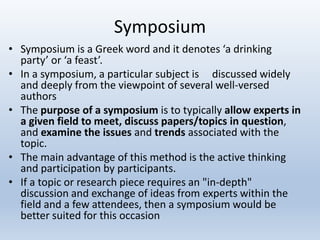
• Symposium is a Greek word and it denotes ‘a drinking
party’ or ‘a feast’.
• In a symposium, a particular subject is discussed widely
and deeply from the viewpoint of several well-versed
authors
• The purpose of a symposium is to typically allow experts in
a given field to meet, discuss papers/topics in question,
and examine the issues and trends associated with the
topic.
• The main advantage of this method is the active thinking
and participation by participants.
• If a topic or research piece requires an "in-depth"
discussion and exchange of ideas from experts within the
field and a few attendees, then a symposium would be
better suited for this occasion
Role Play
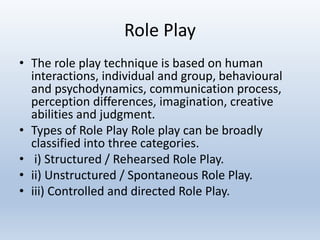
• The role play technique is based on human
interactions, individual and group, behavioural
and psychodynamics, communication process,
perception differences, imagination, creative
abilities and judgment.
• Types of Role Play Role play can be broadly
classified into three categories.
• i) Structured / Rehearsed Role Play.
• ii) Unstructured / Spontaneous Role Play.
• iii) Controlled and directed Role Play.
Case Study
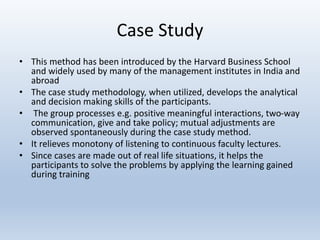
• This method has been introduced by the Harvard Business School
and widely used by many of the management institutes in India and
abroad
• The case study methodology, when utilized, develops the analytical
and decision making skills of the participants.
• The group processes e.g. positive meaningful interactions, two-way
communication, give and take policy; mutual adjustments are
observed spontaneously during the case study method.
• It relieves monotony of listening to continuous faculty lectures.
• Since cases are made out of real life situations, it helps the
participants to solve the problems by applying the learning gained
during training
Programmed Instruction (P.I)
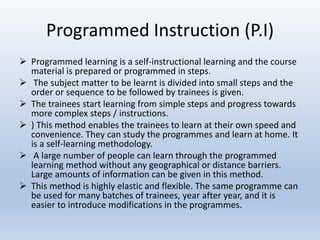
 Programmed learning is a self-instructional learning and the course
material is prepared or programmed in steps.
 The subject matter to be learnt is divided into small steps and the
order or sequence to be followed by trainees is given.
 The trainees start learning from simple steps and progress towards
more complex steps / instructions.
 ) This method enables the trainees to learn at their own speed and
convenience. They can study the programmes and learn at home. It
is a self-learning methodology.
 A large number of people can learn through the programmed
learning method without any geographical or distance barriers.
Large amounts of information can be given in this method.
 This method is highly elastic and flexible. The same programme can
be used for many batches of trainees, year after year, and it is
easier to introduce modifications in the programmes.
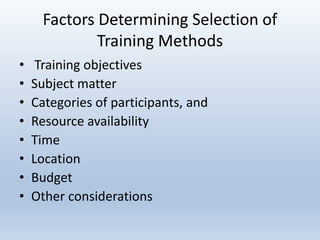
Factors Determining Selection of
Training Methods
• Training objectives
• Subject matter
• Categories of participants, and
• Resource availability
• Time
• Location
• Budget
• Other considerations
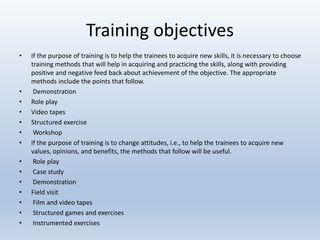
Training objectives
• If the purpose of training is to help the trainees to acquire new skills, it is necessary to choose
training methods that will help in acquiring and practicing the skills, along with providing
positive and negative feed back about achievement of the objective. The appropriate
methods include the points that follow.
• Demonstration
• Role play
• Video tapes
• Structured exercise
• Workshop
• If the purpose of training is to change attitudes, i.e., to help the trainees to acquire new
values, opinions, and benefits, the methods that follow will be useful.
• Role play
• Case study
• Demonstration
• Field visit
• Film and video tapes
• Structured games and exercises
• Instrumented exercises
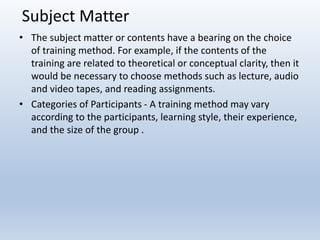
Subject Matter
• The subject matter or contents have a bearing on the choice
of training method. For example, if the contents of the
training are related to theoretical or conceptual clarity, then it
would be necessary to choose methods such as lecture, audio
and video tapes, and reading assignments.
• Categories of Participants - A training method may vary
according to the participants, learning style, their experience,
and the size of the group .
Categories of participants also depend on
number of group which are as follows
Training Methods No of participants
Lecture 10-40
Group discussion 3-10
Case study 3-20
Role play 5-15
Field visits 5-20
Seminars and syndicate 15-40
Demonstration 5-15
Simulation method 8-20
Structured experience 8-20
Instrumented exercise 8-15
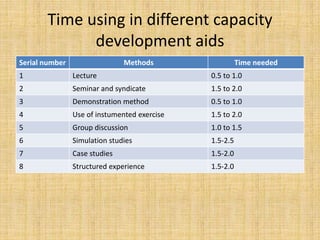
Time using in different capacity
development aids
Serial number Methods Time needed
1 Lecture 0.5 to 1.0
2 Seminar and syndicate 1.5 to 2.0
3 Demonstration method 0.5 to 1.0
4 Use of instumented exercise 1.5 to 2.0
5 Group discussion 1.0 to 1.5
6 Simulation studies 1.5-2.5
7 Case studies 1.5-2.0
8 Structured experience 1.5-2.0
Capacity development aids
• The effectiveness of a capacity is determined by the degree
and diversity of skill he or she has in communicating with the
trainer. The trainer uses various aids to make his teaching and
capacity development effective. The capacity development
aids are supportive to learning.
• They should be carefully and selectively used and
contextualized in order to make teaching learning effective.
• Nowadays, visual and audio-visual aids are extensively used in
training programmes.
• Visual and audio aids offer the trainers unique opportunities
to increase the effectiveness and clarity of ideas expressed to
trainees
Factor use in selecting the audio –
visual aids
Who is your audience
The aid must easy to see
Easy understandable
 Easy to handle
Explain one idea at a time
Attractive and clean

CAPACITY BUILDING METHOD AND TOOLS.pptx.in

  • 1.
    COLLEGE OF AGRICULTURE, JODHPUR Department of Ag. Extension education Course tittle – Capacity Development Ext -512 Topic- capacity development methods and tools Submitted by – Durgesh Nandini saras Submitted to – Dr Mahendra Kumar Class – Msc 1st year 1st sem Associate Professor Subject - Agriculture extension education at COA , Jodhpur
  • 2.
  • 3.
    LECTURE • A lecture(from Latin: lēctūra 'reading') is an oral presentation intended to present information or teach people about a particular subject, • For example by a university or college teacher. Lectures are used to convey critical information, history, background, theories, and equation
  • 4.
    • A formallecture helps in the building up of theoretical knowledge which can be used as a base for the participative training sessions and learning of motor or verbal skills • One important advantage of the lecture method is that a relatively large number of people can be instructed at one time. • There is no other method that can be used to instruct 50- 100, or more, trainees. • A lecture can deal with more facts, principles, and concepts in a shorter time than it would take to teach the same material in a conference, case study, or other group method. • If teaching resources are scarce, then the lecture method is the best.
  • 5.
    Discussion Method • Thisis an intensive participation-oriented methodology • Discussions involve the exchange of ideas between the trainees and trainers and, also, among the trainees themselves • It is a dynamic methodology In discussions, there is an exchange of ideas and experiences among participants. Therefore, synergy takes place and powerful ideas and solutions emerge. • The trainees get on-the-spot feedback from the co-trainees about their opinions and experiences
  • 6.
    Syndicate Method • SyndicateMethod, the trainees are divided into sub groups, called as syndicates and each syndicate has to work on various subjects. • The syndicates discuss the issues related to the subject and prepare a report. • A syndicate can be formed for any topic. • The topic could be one that involves all the departments in an organization, and the members of the syndicate are selected from a cross-section of organizations. • The syndicate has to complete the task assigned within a specified date and time
  • 7.
    Seminars • Seminars areshort term capacity develpment programmes arranged for a few days – a day or two or maximum three days. • This method helps participants to obtain the views, opinions, research finding, etc. of the experts through the papers presented by them. • The method is faster than gathering knowledge by reading books and holding discussions • In seminars, the trainees are given the opportunity to listen to experts from different fields who share their views on specific issues. • In seminars, the trainees are given the opportunity to listen to experts from different fields who share their views on specific issues.
  • 8.
    Conference • This methodsuits bigger groups and participants benefit from listening to senior speakers. They are induced to think over the problems, issues and solutions. • Conferences are suited to executives and senior officers who are dealing with a complex problem which requires contributions from senior officers for a resolution. • The delegates present the papers and explain the various aspects of the problem. • At the end of the conference, suggestions and recommendations are made, based on the deliberations and discussions
  • 9.
    Symposium • Symposium isa Greek word and it denotes ‘a drinking party’ or ‘a feast’. • In a symposium, a particular subject is discussed widely and deeply from the viewpoint of several well-versed authors • The purpose of a symposium is to typically allow experts in a given field to meet, discuss papers/topics in question, and examine the issues and trends associated with the topic. • The main advantage of this method is the active thinking and participation by participants. • If a topic or research piece requires an "in-depth" discussion and exchange of ideas from experts within the field and a few attendees, then a symposium would be better suited for this occasion
  • 10.
    Role Play • Therole play technique is based on human interactions, individual and group, behavioural and psychodynamics, communication process, perception differences, imagination, creative abilities and judgment. • Types of Role Play Role play can be broadly classified into three categories. • i) Structured / Rehearsed Role Play. • ii) Unstructured / Spontaneous Role Play. • iii) Controlled and directed Role Play.
  • 11.
    Case Study • Thismethod has been introduced by the Harvard Business School and widely used by many of the management institutes in India and abroad • The case study methodology, when utilized, develops the analytical and decision making skills of the participants. • The group processes e.g. positive meaningful interactions, two-way communication, give and take policy; mutual adjustments are observed spontaneously during the case study method. • It relieves monotony of listening to continuous faculty lectures. • Since cases are made out of real life situations, it helps the participants to solve the problems by applying the learning gained during training
  • 12.
    Programmed Instruction (P.I) Programmed learning is a self-instructional learning and the course material is prepared or programmed in steps.  The subject matter to be learnt is divided into small steps and the order or sequence to be followed by trainees is given.  The trainees start learning from simple steps and progress towards more complex steps / instructions.  ) This method enables the trainees to learn at their own speed and convenience. They can study the programmes and learn at home. It is a self-learning methodology.  A large number of people can learn through the programmed learning method without any geographical or distance barriers. Large amounts of information can be given in this method.  This method is highly elastic and flexible. The same programme can be used for many batches of trainees, year after year, and it is easier to introduce modifications in the programmes.
  • 13.
    Factors Determining Selectionof Training Methods • Training objectives • Subject matter • Categories of participants, and • Resource availability • Time • Location • Budget • Other considerations
  • 14.
    Training objectives • Ifthe purpose of training is to help the trainees to acquire new skills, it is necessary to choose training methods that will help in acquiring and practicing the skills, along with providing positive and negative feed back about achievement of the objective. The appropriate methods include the points that follow. • Demonstration • Role play • Video tapes • Structured exercise • Workshop • If the purpose of training is to change attitudes, i.e., to help the trainees to acquire new values, opinions, and benefits, the methods that follow will be useful. • Role play • Case study • Demonstration • Field visit • Film and video tapes • Structured games and exercises • Instrumented exercises
  • 15.
    Subject Matter • Thesubject matter or contents have a bearing on the choice of training method. For example, if the contents of the training are related to theoretical or conceptual clarity, then it would be necessary to choose methods such as lecture, audio and video tapes, and reading assignments. • Categories of Participants - A training method may vary according to the participants, learning style, their experience, and the size of the group .
  • 16.
    Categories of participantsalso depend on number of group which are as follows Training Methods No of participants Lecture 10-40 Group discussion 3-10 Case study 3-20 Role play 5-15 Field visits 5-20 Seminars and syndicate 15-40 Demonstration 5-15 Simulation method 8-20 Structured experience 8-20 Instrumented exercise 8-15
  • 17.
    Time using indifferent capacity development aids Serial number Methods Time needed 1 Lecture 0.5 to 1.0 2 Seminar and syndicate 1.5 to 2.0 3 Demonstration method 0.5 to 1.0 4 Use of instumented exercise 1.5 to 2.0 5 Group discussion 1.0 to 1.5 6 Simulation studies 1.5-2.5 7 Case studies 1.5-2.0 8 Structured experience 1.5-2.0
  • 18.
    Capacity development aids •The effectiveness of a capacity is determined by the degree and diversity of skill he or she has in communicating with the trainer. The trainer uses various aids to make his teaching and capacity development effective. The capacity development aids are supportive to learning. • They should be carefully and selectively used and contextualized in order to make teaching learning effective. • Nowadays, visual and audio-visual aids are extensively used in training programmes. • Visual and audio aids offer the trainers unique opportunities to increase the effectiveness and clarity of ideas expressed to trainees
  • 19.
    Factor use inselecting the audio – visual aids Who is your audience The aid must easy to see Easy understandable  Easy to handle Explain one idea at a time Attractive and clean