 Introduction to ITS 
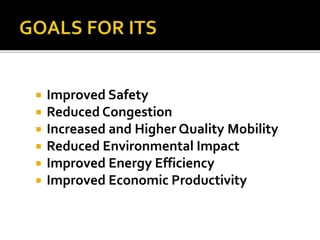
 Goals for ITS 
 Branches of ITS 
 ITS Technologies
 Intelligent Transport Systems (ITS) is an 
umbrella term for a range of 
technologies including processing, 
control, communication and electronics, 
that are applied to a transportation 
system. 
 It also includes an advanced approach 
to traffic management.
 ITS improves transportation safety and 
mobility and enhances productivity 
through the use of advanced 
communications technologies. 
 Intelligent Transportation Systems (ITS) 
apply well-established technologies of 
communications, control, electronics and 
computer hardware & software to the 
surface transportation system.
 Intelligent transportation systems (ITS) 
include a broad range of wireless and wire 
line communications-based information 
and electronics technologies 
 When integrated into the transportation 
system's infrastructure, and in vehicles 
themselves, these technologies reduce 
congestion, improve safety and enhance 
productivity.
 Improved Safety 
 Reduced Congestion 
 Increased and Higher Quality Mobility 
 Reduced Environmental Impact 
 Improved Energy Efficiency 
 Improved Economic Productivity
 ITS is made up of 16 types of technology 
based systems. 
 These systems are divided into 
Intelligent Infrastructure systems and 
Intelligent Vehicle systems.
 Planned arteries, highways, traffic 
signals, signs, their coordination and 
use of latest technologies such as DMS 
(Dynamic Message Sign) and HAR 
(Highway Advisory Radio) enables 
transportation infrastructure for smooth 
and efficient traffic operation.
Arterial 
Management 
Electronic payment 
and pricing 
Emergency 
management 
Transit 
Management 
Incident 
management 
Freeway 
Management
Crash Prevention 
and Safety 
Traveler 
information 
Road Weather 
Management 
Commercial Vehicle 
operation 
Information 
Management 
Roadway Operation 
and Maintenance
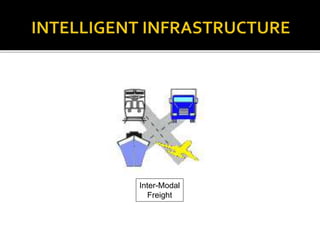
Inter-Modal 
Freight
 Intelligent Vehicle Technologies telematics 
comprise electronic, electromechanical, and 
electromagnetic devices operating in 
conjunction with computer controlled devices 
and radio transceivers to provide precision 
repeatability functions (such as in robotics 
Artificial Intelligence systems)
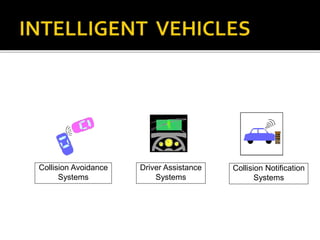
Driver Assistance 
Systems 
Collision Avoidance 
Systems 
Collision Notification 
Systems
 Intelligent infrastructure has attached or 
built-in components that are able to collect 
and transmit information about the state of 
the infrastructure to a central computer, and 
in some cases receive back instruction from 
the computer, which triggers controlling 
devices.
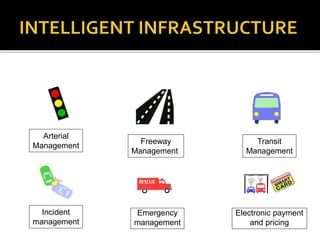
 Arterial Management 
 Freeway Management 
 Transit Management 
 Incident Management 
 Emergency Management 
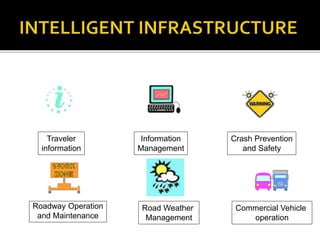
 Traveler Information 
 Information Management
 Crash Prevention & Safety 
 Electronic Payment & Pricing 
 Roadway Operations & Maintenance 
 Road Weather Management 
 Commercial Vehicle Operations 
 Intermodal Freight
 Arterial management systems manage 
traffic along arterial roadways, employing 
traffic detectors, traffic signals, and various 
means of communicating information to 
travelers. 
 These systems make use of information 
collected by traffic surveillance devices to 
smooth the flow of traffic along travel 
corridors. 
 They also disseminate important 
information about travel conditions to 
travelers via technologies such as DMS or 
HAR.
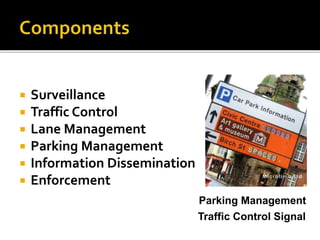
 Surveillance 
 Traffic Control 
 Lane Management 
 Parking Management 
 Information Dissemination 
 Enforcement 
Parking Management 
Traffic Control Signal
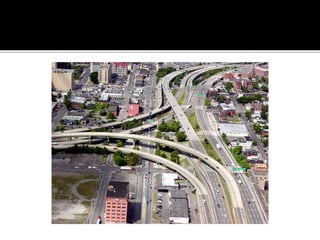
 Freeway management systems’ 
application is found in different forms. 
 Traffic surveillance systems use detectors 
and video equipment to support the most 
advanced freeway management 
applications. 
 Traffic control measures on freeway 
entrance ramps, such as ramp meters, can 
use sensor data to optimize freeway travel 
speeds and ramp meter wait times.
 Lane management applications can 
address effective capacity of freeways and 
promote use of high-occupancy commute 
modes. 
 Special event transportation management 
systems can help control impact of 
congestion.
 In areas with frequent events, large changeable 
destination signs or other lane control equipment 
can be installed. 
 In areas with occasional or one-time events, 
portable equipment can help smooth traffic flow. 
 Advanced communications have improved the 
dissemination of information to the traveling 
public. 
 Motorists are now able to receive relevant 
information on location specific traffic conditions 
in a number of ways, including DMS, HAR, in-vehicle 
signing, or specialized information 
transmitted only to a specific set of vehicles.
Transit ITS services include surveillance and 
communications, such as Automated Vehicle 
Location (AVL) systems, Computer-Aided 
Dispatch (CAD) systems, and remote vehicle 
and facility surveillance cameras, which 
enable transit agencies to improve the 
operational efficiency, safety, and security of 
the nation's public transportation systems.
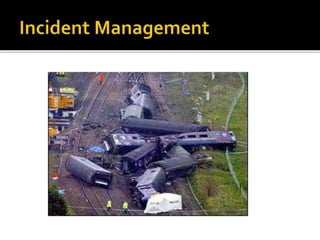
 Incident management systems can reduce the 
effects of incident-related congestion by 
decreasing the time to detect incidents, the time 
for responding vehicles to arrive, and the time 
required for traffic to return to normal 
conditions. 
 Incident management systems make use of a 
variety of surveillance technologies, often shared 
with freeway and arterial management systems, 
as well as enhanced communications and other 
technologies that facilitate coordinated response 
to incidents.
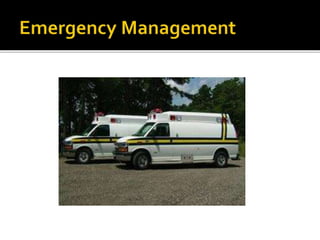
ITS applications in emergency 
management include hazardous 
materials management, the 
deployment of emergency medical 
services, and large and small-scale 
emergency response and evacuation 
operations.
 Traveler information applications use a 
variety of technologies, including 
Internet websites, telephone hotlines, 
as well as television and radio, to allow 
users to make more informed decisions 
regarding trip departures, routes, and 
mode of travel.
 ITS information management supports the 
archiving and retrieval of data generated by 
other ITS applications and enables ITS 
applications that use archived information. 
 Decision support systems, predictive 
information, and performance monitoring are 
some ITS applications enabled by ITS 
information management. 
 In addition, ITS information management 
systems can assist in transportation planning, 
research, and safety management activities.
 Crash prevention and safety systems detect unsafe 
conditions and provide warnings to travelers to take 
action to avoid crashes. 
 These systems provide alerts for traffic approaching 
at dangerous curves, off ramps, restricted 
overpasses, highway-rail crossings, high-volume 
intersections, and also provide warnings of the 
presence of pedestrians, and bicyclists, and even 
animals on the roadway. 
 Crash prevention and safety systems typically 
employ sensors to monitor the speed and 
characteristics of approaching vehicles and also 
monitor roadway conditions and visibility.
 Electronic payment systems employ various 
communication and electronic technologies to 
facilitate commerce between travelers and 
transportation agencies, typically for the 
purpose of paying tolls and transit fares. 
 Pricing refers to charging motorists a fee or 
toll that varies with the level of demand or 
with the time of day.
 Road weather management activities include 
road weather information systems (RWIS), 
winter maintenance technologies, and 
coordination of operations within and between 
state DOTs. 
 ITS applications assist with the monitoring and 
forecasting of roadway and atmospheric 
conditions, dissemination of weather-related 
information to travelers, weather-related traffic 
control measures such as variable speed limits, 
and both fixed and mobile winter maintenance 
activities.
 ITS can facilitate the safe, efficient, secure, and 
seamless movement of freight. 
 Applications being deployed provide for 
tracking of freight and carrier assets such as 
containers and chassis, and improve the 
efficiency of freight terminal processes, drayage 
operations, and international border crossings.
 With the rapid development of the highway in the 
world, traffic accidents are remarkably increasing. 
 They are often caused by drivers themselves, such as 
their sleeping, telephone talking, music 
entertaining, chatting and so on. 
 There is no way to make all drivers obey proper 
driving rules to prevent traffic accidents from 
happening. 
 To solve the problem, the most effective approach is 
to develop a new type of vehicle, which can release 
drivers from its operation, which is named as 
Intelligent Vehicle. 
 In recent years, the research on Intelligent Vehicles is 
very active in some developed countries.
 Collision Avoidance System 
 Driver Assistance System 
 Collision Notification System
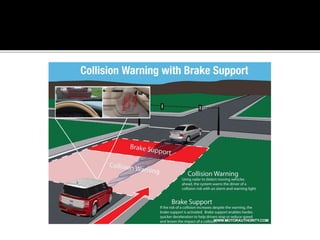
 To improve the ability of drivers to avoid 
accidents, vehicle-mounted collision warning 
systems (CWS) continue to be tested and 
deployed. 
 These applications use a variety of sensors to 
monitor the vehicle's surroundings and alert the 
driver of conditions that could lead to a collision. 
 Examples include forward collision warning, 
obstacle detection systems, and road departure 
warning systems.
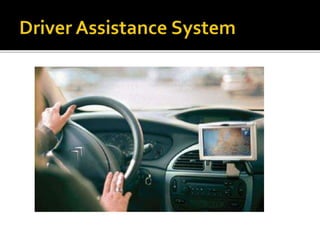
 Numerous intelligent vehicle technologies 
exist to assist the driver in operating the 
vehicle safely. 
 Systems are available to aid with 
navigation, while others, such as vision 
enhancement and speed control systems, 
are intended to facilitate safe driving during 
adverse conditions. 
 Other systems assist with difficult driving 
tasks such as transit and commercial vehicle 
docking.
 In an effort to improve response times and save 
lives, collision notification systems have been 
designed to detect and report the location and 
severity of incidents to agencies and services 
responsible for coordinating appropriate 
emergency response actions. 
 These systems can be activated manually or 
automatically with automatic collision 
notification and advanced systems may transmit 
information on the type of crash, number of 
passengers, and the likelihood of injuries.
 Intelligent Transportation Systems vary in 
technologies applied, from basic management 
systems such as car navigation, traffic signal 
control systems, variable message signs or speed 
cameras to monitoring applications such as 
security CCTV systems, and then to more advanced 
applications which integrate live data and feedback 
from a number of other sources, such as Parking 
Guidance and Information systems, weather 
information, bridge de-icing systems, and the like. 
 Additionally, predictive techniques are being 
developed, to allow advanced modeling and 
comparison with historical baseline data.
 Wireless Communication 
 Computational Technologies 
 Floating Car Data (FCD) 
 Sensing Technologies 
 Inductive Loop Detection 
 Video Vehicle Detection
Various forms of wireless communication 
technologies have been proposed for 
Intelligent Transportation Systems.
 Short Range Wireless Communication 
 Long Range Wireless Communication
 Short range communications are used for less than 
500 yards. 
 They are accomplished using IEEE 802.11 
protocols, specifically Wireless Access in Vehicular 
Environment (WAVE) or the Dedicated Short 
Range Communications (DSRC) standard being 
promoted by the Intelligent Transportation Society 
of America and the United States Department of 
Transportation. 
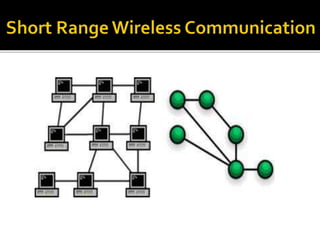
 Theoretically the range of these protocols can be 
extended using Mobile ad-hoc networks or Mesh 
networking.
 Longer range communications have been 
proposed using infrastructure networks such as 
WiMAX (IEEE 802.16), Global System for Mobile 
Communications (GSM) or 3G. 
 Long-range communications using these 
methods are well established, but, unlike the 
short-range protocols, these methods require 
extensive and very expensive infrastructure 
deployment.
 Recent advances in vehicle electronics have led 
to a move toward fewer more capable 
computer processors on a vehicle. 
 A typical vehicle in the early 2000s would have 
between 20 and 100 individual networked 
microcontroller/Programmable logic controller 
modules with non-real-time operating systems. 
 The current trend is toward fewer more costly 
microprocessor modules with hardware 
memory management and Real-Time 
Operating Systems.
 The installation of operational systems and 
processors in transportation vehicles have 
also allowed software applications and 
artificial intelligence systems to be installed. 
 These systems include internal control of 
model based processes, artificial intelligence, 
ubiquitous computing and other programs 
designed to be integrated into a greater 
transportation system. 
 Perhaps the most important of these for 
Intelligent Transportation Systems is artificial 
intelligence.
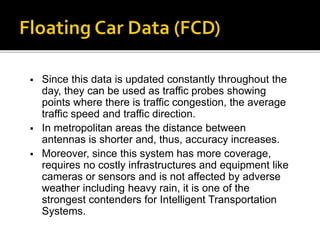
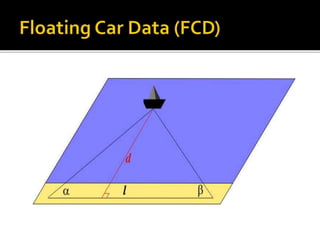
 Virtually every car contains one or more mobile 
phones. 
 These mobile phones routinely transmit their 
location information to the network – even when no 
voice connection is established. 
 These cellular phones in cars are used as anonymous 
traffic probes. 
 As the car moves, so does the signal of the mobile 
phone. 
 By measuring and analyzing triangulation network 
data – in an anonymized format – the data is 
converted into accurate traffic flow information.
 Since this data is updated constantly throughout the 
day, they can be used as traffic probes showing 
points where there is traffic congestion, the average 
traffic speed and traffic direction. 
 In metropolitan areas the distance between 
antennas is shorter and, thus, accuracy increases. 
 Moreover, since this system has more coverage, 
requires no costly infrastructures and equipment like 
cameras or sensors and is not affected by adverse 
weather including heavy rain, it is one of the 
strongest contenders for Intelligent Transportation 
Systems.
 Sensing technologies have greatly enhanced the 
technical capabilities and safety benefits of 
Intelligent Transportation Systems around the 
world. 
 These sensors include inductive loops that can 
sense the vehicles' speed, the number of vehicles 
passing as well as the size of these vehicles.
 Infrastructure Sensors 
 Vehicle Sensors
 Infrastructure sensors are devices that are 
installed or embedded on the road, or 
surrounding the road (buildings, posts, and 
signs for example). 
 These sensing technologies may be 
installed during preventive road 
construction maintenance or by sensor 
injection machinery for rapid deployment of 
road in-ground sensors.
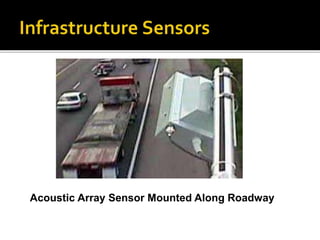
Acoustic Array Sensor Mounted Along Roadway
Vehicle sensors are those devices installed 
on the road or in the vehicle, new 
technology development has also enabled 
cellular phones to become anonymous 
traffic probes, already explained in 
floating car data.
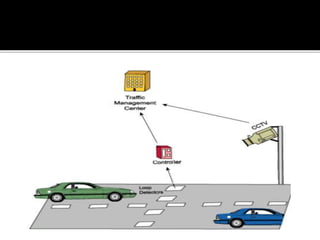
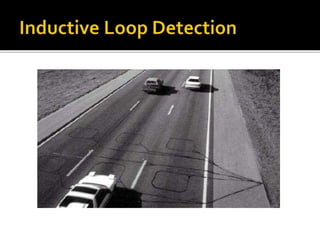
 Inductive loops can be placed in a roadbed to 
detect vehicles as they pass over the loop by 
measuring the vehicle's magnetic field. 
 The simplest detectors simply count the number 
of vehicles during a unit of time (typically 60 
seconds in the United States) that pass over the 
loop, while more sophisticated sensors estimate 
the speed, length and weight of vehicles and the 
distance between them. 
 Loops can be placed in a single lane or across 
multiple lanes, and they work with very slow or 
stopped vehicles as well as vehicles moving at 
high-speed.
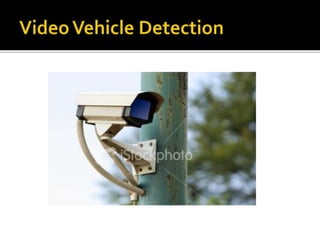
 Traffic flow measurement and Automatic Incident 
Detection using video cameras is another form of 
vehicle detection. 
 Since video detection systems do not involve 
installing any components directly into the road 
surface or roadbed, this type of system is known 
as a "non-intrusive" method of traffic detection. 
 Video from black-and-white or color cameras is 
fed into processors that analyze the changing 
characteristics of the video image as vehicles pass. 
 The cameras are typically mounted on poles or 
structures above or adjacent to the roadway.
 Most video detection systems require some initial 
configuration to teach, processor the baseline 
background image. 
 This usually involves inputting known measurements 
such as the distance between lane lines or the height 
of the camera above the roadway. 
 The typical output from a video detection system is 
lane-by-lane vehicle speeds, counts and lane 
occupancy readings. 
 Some systems provide additional outputs including 
gap, headway, stopped-vehicle detection and wrong-way 
vehicle alarms.
Its technologies

Its technologies

  • 2.
     Introduction toITS  Goals for ITS  Branches of ITS  ITS Technologies
  • 3.
     Intelligent TransportSystems (ITS) is an umbrella term for a range of technologies including processing, control, communication and electronics, that are applied to a transportation system.  It also includes an advanced approach to traffic management.
  • 4.
     ITS improvestransportation safety and mobility and enhances productivity through the use of advanced communications technologies.  Intelligent Transportation Systems (ITS) apply well-established technologies of communications, control, electronics and computer hardware & software to the surface transportation system.
  • 5.
     Intelligent transportationsystems (ITS) include a broad range of wireless and wire line communications-based information and electronics technologies  When integrated into the transportation system's infrastructure, and in vehicles themselves, these technologies reduce congestion, improve safety and enhance productivity.
  • 6.
     Improved Safety  Reduced Congestion  Increased and Higher Quality Mobility  Reduced Environmental Impact  Improved Energy Efficiency  Improved Economic Productivity
  • 7.
     ITS ismade up of 16 types of technology based systems.  These systems are divided into Intelligent Infrastructure systems and Intelligent Vehicle systems.
  • 8.
     Planned arteries,highways, traffic signals, signs, their coordination and use of latest technologies such as DMS (Dynamic Message Sign) and HAR (Highway Advisory Radio) enables transportation infrastructure for smooth and efficient traffic operation.
  • 9.
    Arterial Management Electronicpayment and pricing Emergency management Transit Management Incident management Freeway Management
  • 10.
    Crash Prevention andSafety Traveler information Road Weather Management Commercial Vehicle operation Information Management Roadway Operation and Maintenance
  • 11.
  • 12.
     Intelligent VehicleTechnologies telematics comprise electronic, electromechanical, and electromagnetic devices operating in conjunction with computer controlled devices and radio transceivers to provide precision repeatability functions (such as in robotics Artificial Intelligence systems)
  • 13.
    Driver Assistance Systems Collision Avoidance Systems Collision Notification Systems
  • 14.
     Intelligent infrastructurehas attached or built-in components that are able to collect and transmit information about the state of the infrastructure to a central computer, and in some cases receive back instruction from the computer, which triggers controlling devices.
  • 15.
     Arterial Management  Freeway Management  Transit Management  Incident Management  Emergency Management  Traveler Information  Information Management
  • 16.
     Crash Prevention& Safety  Electronic Payment & Pricing  Roadway Operations & Maintenance  Road Weather Management  Commercial Vehicle Operations  Intermodal Freight
  • 17.
     Arterial managementsystems manage traffic along arterial roadways, employing traffic detectors, traffic signals, and various means of communicating information to travelers.  These systems make use of information collected by traffic surveillance devices to smooth the flow of traffic along travel corridors.  They also disseminate important information about travel conditions to travelers via technologies such as DMS or HAR.
  • 18.
     Surveillance Traffic Control  Lane Management  Parking Management  Information Dissemination  Enforcement Parking Management Traffic Control Signal
  • 19.
     Freeway managementsystems’ application is found in different forms.  Traffic surveillance systems use detectors and video equipment to support the most advanced freeway management applications.  Traffic control measures on freeway entrance ramps, such as ramp meters, can use sensor data to optimize freeway travel speeds and ramp meter wait times.
  • 20.
     Lane managementapplications can address effective capacity of freeways and promote use of high-occupancy commute modes.  Special event transportation management systems can help control impact of congestion.
  • 21.
     In areaswith frequent events, large changeable destination signs or other lane control equipment can be installed.  In areas with occasional or one-time events, portable equipment can help smooth traffic flow.  Advanced communications have improved the dissemination of information to the traveling public.  Motorists are now able to receive relevant information on location specific traffic conditions in a number of ways, including DMS, HAR, in-vehicle signing, or specialized information transmitted only to a specific set of vehicles.
  • 23.
    Transit ITS servicesinclude surveillance and communications, such as Automated Vehicle Location (AVL) systems, Computer-Aided Dispatch (CAD) systems, and remote vehicle and facility surveillance cameras, which enable transit agencies to improve the operational efficiency, safety, and security of the nation's public transportation systems.
  • 24.
     Incident managementsystems can reduce the effects of incident-related congestion by decreasing the time to detect incidents, the time for responding vehicles to arrive, and the time required for traffic to return to normal conditions.  Incident management systems make use of a variety of surveillance technologies, often shared with freeway and arterial management systems, as well as enhanced communications and other technologies that facilitate coordinated response to incidents.
  • 26.
    ITS applications inemergency management include hazardous materials management, the deployment of emergency medical services, and large and small-scale emergency response and evacuation operations.
  • 28.
     Traveler informationapplications use a variety of technologies, including Internet websites, telephone hotlines, as well as television and radio, to allow users to make more informed decisions regarding trip departures, routes, and mode of travel.
  • 29.
     ITS informationmanagement supports the archiving and retrieval of data generated by other ITS applications and enables ITS applications that use archived information.  Decision support systems, predictive information, and performance monitoring are some ITS applications enabled by ITS information management.  In addition, ITS information management systems can assist in transportation planning, research, and safety management activities.
  • 30.
     Crash preventionand safety systems detect unsafe conditions and provide warnings to travelers to take action to avoid crashes.  These systems provide alerts for traffic approaching at dangerous curves, off ramps, restricted overpasses, highway-rail crossings, high-volume intersections, and also provide warnings of the presence of pedestrians, and bicyclists, and even animals on the roadway.  Crash prevention and safety systems typically employ sensors to monitor the speed and characteristics of approaching vehicles and also monitor roadway conditions and visibility.
  • 31.
     Electronic paymentsystems employ various communication and electronic technologies to facilitate commerce between travelers and transportation agencies, typically for the purpose of paying tolls and transit fares.  Pricing refers to charging motorists a fee or toll that varies with the level of demand or with the time of day.
  • 32.
     Road weathermanagement activities include road weather information systems (RWIS), winter maintenance technologies, and coordination of operations within and between state DOTs.  ITS applications assist with the monitoring and forecasting of roadway and atmospheric conditions, dissemination of weather-related information to travelers, weather-related traffic control measures such as variable speed limits, and both fixed and mobile winter maintenance activities.
  • 33.
     ITS canfacilitate the safe, efficient, secure, and seamless movement of freight.  Applications being deployed provide for tracking of freight and carrier assets such as containers and chassis, and improve the efficiency of freight terminal processes, drayage operations, and international border crossings.
  • 35.
     With therapid development of the highway in the world, traffic accidents are remarkably increasing.  They are often caused by drivers themselves, such as their sleeping, telephone talking, music entertaining, chatting and so on.  There is no way to make all drivers obey proper driving rules to prevent traffic accidents from happening.  To solve the problem, the most effective approach is to develop a new type of vehicle, which can release drivers from its operation, which is named as Intelligent Vehicle.  In recent years, the research on Intelligent Vehicles is very active in some developed countries.
  • 36.
     Collision AvoidanceSystem  Driver Assistance System  Collision Notification System
  • 37.
     To improvethe ability of drivers to avoid accidents, vehicle-mounted collision warning systems (CWS) continue to be tested and deployed.  These applications use a variety of sensors to monitor the vehicle's surroundings and alert the driver of conditions that could lead to a collision.  Examples include forward collision warning, obstacle detection systems, and road departure warning systems.
  • 39.
     Numerous intelligentvehicle technologies exist to assist the driver in operating the vehicle safely.  Systems are available to aid with navigation, while others, such as vision enhancement and speed control systems, are intended to facilitate safe driving during adverse conditions.  Other systems assist with difficult driving tasks such as transit and commercial vehicle docking.
  • 41.
     In aneffort to improve response times and save lives, collision notification systems have been designed to detect and report the location and severity of incidents to agencies and services responsible for coordinating appropriate emergency response actions.  These systems can be activated manually or automatically with automatic collision notification and advanced systems may transmit information on the type of crash, number of passengers, and the likelihood of injuries.
  • 42.
     Intelligent TransportationSystems vary in technologies applied, from basic management systems such as car navigation, traffic signal control systems, variable message signs or speed cameras to monitoring applications such as security CCTV systems, and then to more advanced applications which integrate live data and feedback from a number of other sources, such as Parking Guidance and Information systems, weather information, bridge de-icing systems, and the like.  Additionally, predictive techniques are being developed, to allow advanced modeling and comparison with historical baseline data.
  • 43.
     Wireless Communication  Computational Technologies  Floating Car Data (FCD)  Sensing Technologies  Inductive Loop Detection  Video Vehicle Detection
  • 44.
    Various forms ofwireless communication technologies have been proposed for Intelligent Transportation Systems.
  • 45.
     Short RangeWireless Communication  Long Range Wireless Communication
  • 46.
     Short rangecommunications are used for less than 500 yards.  They are accomplished using IEEE 802.11 protocols, specifically Wireless Access in Vehicular Environment (WAVE) or the Dedicated Short Range Communications (DSRC) standard being promoted by the Intelligent Transportation Society of America and the United States Department of Transportation.  Theoretically the range of these protocols can be extended using Mobile ad-hoc networks or Mesh networking.
  • 48.
     Longer rangecommunications have been proposed using infrastructure networks such as WiMAX (IEEE 802.16), Global System for Mobile Communications (GSM) or 3G.  Long-range communications using these methods are well established, but, unlike the short-range protocols, these methods require extensive and very expensive infrastructure deployment.
  • 49.
     Recent advancesin vehicle electronics have led to a move toward fewer more capable computer processors on a vehicle.  A typical vehicle in the early 2000s would have between 20 and 100 individual networked microcontroller/Programmable logic controller modules with non-real-time operating systems.  The current trend is toward fewer more costly microprocessor modules with hardware memory management and Real-Time Operating Systems.
  • 50.
     The installationof operational systems and processors in transportation vehicles have also allowed software applications and artificial intelligence systems to be installed.  These systems include internal control of model based processes, artificial intelligence, ubiquitous computing and other programs designed to be integrated into a greater transportation system.  Perhaps the most important of these for Intelligent Transportation Systems is artificial intelligence.
  • 51.
     Virtually everycar contains one or more mobile phones.  These mobile phones routinely transmit their location information to the network – even when no voice connection is established.  These cellular phones in cars are used as anonymous traffic probes.  As the car moves, so does the signal of the mobile phone.  By measuring and analyzing triangulation network data – in an anonymized format – the data is converted into accurate traffic flow information.
  • 52.
     Since thisdata is updated constantly throughout the day, they can be used as traffic probes showing points where there is traffic congestion, the average traffic speed and traffic direction.  In metropolitan areas the distance between antennas is shorter and, thus, accuracy increases.  Moreover, since this system has more coverage, requires no costly infrastructures and equipment like cameras or sensors and is not affected by adverse weather including heavy rain, it is one of the strongest contenders for Intelligent Transportation Systems.
  • 54.
     Sensing technologieshave greatly enhanced the technical capabilities and safety benefits of Intelligent Transportation Systems around the world.  These sensors include inductive loops that can sense the vehicles' speed, the number of vehicles passing as well as the size of these vehicles.
  • 56.
     Infrastructure Sensors  Vehicle Sensors
  • 57.
     Infrastructure sensorsare devices that are installed or embedded on the road, or surrounding the road (buildings, posts, and signs for example).  These sensing technologies may be installed during preventive road construction maintenance or by sensor injection machinery for rapid deployment of road in-ground sensors.
  • 58.
    Acoustic Array SensorMounted Along Roadway
  • 59.
    Vehicle sensors arethose devices installed on the road or in the vehicle, new technology development has also enabled cellular phones to become anonymous traffic probes, already explained in floating car data.
  • 60.
     Inductive loopscan be placed in a roadbed to detect vehicles as they pass over the loop by measuring the vehicle's magnetic field.  The simplest detectors simply count the number of vehicles during a unit of time (typically 60 seconds in the United States) that pass over the loop, while more sophisticated sensors estimate the speed, length and weight of vehicles and the distance between them.  Loops can be placed in a single lane or across multiple lanes, and they work with very slow or stopped vehicles as well as vehicles moving at high-speed.
  • 62.
     Traffic flowmeasurement and Automatic Incident Detection using video cameras is another form of vehicle detection.  Since video detection systems do not involve installing any components directly into the road surface or roadbed, this type of system is known as a "non-intrusive" method of traffic detection.  Video from black-and-white or color cameras is fed into processors that analyze the changing characteristics of the video image as vehicles pass.  The cameras are typically mounted on poles or structures above or adjacent to the roadway.
  • 63.
     Most videodetection systems require some initial configuration to teach, processor the baseline background image.  This usually involves inputting known measurements such as the distance between lane lines or the height of the camera above the roadway.  The typical output from a video detection system is lane-by-lane vehicle speeds, counts and lane occupancy readings.  Some systems provide additional outputs including gap, headway, stopped-vehicle detection and wrong-way vehicle alarms.