International Journal of Ambient Systems and Applications (IJASA) Vol.2, No.3, September 2014 
INTELLIGENT SOFT COMPUTING BASED 
CRYPTOGRAPHIC TECHNIQUE USING CHAOS 
SYNCHRONIZATION FOR WIRELESS 
COMMUNICATION (CSCT) 
Arindam Sarkar1 and J. K. Mandal2 
Department of Computer Science & Engineering, University of Kalyani, W.B, India 
ABSTRACT 
In this paper a novel intelligent soft computing based cryptographic technique based on synchronization of 
two chaotic systems (CSCT) between sender and receiver has been proposed to generate session key using 
Pecora and Caroll (PC) method. Chaotic system has some unique features like sensitive to initial 
conditions, topologically mixing; and dense periodic orbits. By nature, the Lorenz system is very sensitive 
to initial conditions meaning that the error between attacker and receiver is going to grow exponentially if 
there is a very slight difference between their initial conditions. All these features make chaotic system as 
good alternatives for session key generation. In the proposed CSCT few parameters ( , b , r , x1 ,y2 and z2 ) 
are being exchanged between sender and receiver. Some of the parameter which takes major roles to form 
the session key does not get transmitted via public channel, sender keeps these parameters secret. This way 
of handling parameter passing mechanism prevents any kind of attacks during exchange of parameters like 
sniffing, spoofing or phishing. 
KEYWORDS 
chaos synchronization, soft computing, cryptography, Wireless Communication. 
1. INTRODUCTION 
A variety of session key generation techniques are available to secure data and 
information from eavesdroppers [1, 2, 6, 10] with some merits and demerits. Most of the 
key generation algorithm needs large memory and energy [3, 4, 5, 7, 8, 9]. There are few 
applications where soft computing is used in key generation purpose. In recent days 
cryptographic protocols are also get deployed in wireless communication. Wireless 
devices have the problem of memory and energy constraints. In this paper, a novel soft 
computing based technique has been proposed for energy efficient session key generation 
in wireless communication to address this problem. 
The organization of this paper is as follows. Section 2 of the paper deals with the proposed ACI 
based key generation technique. Encryption and Decryption Process has been discussed in section 
3 and 4 respectively. Example of ACI based key stream generation is discussed in section 5. 
Results are described in section 6. Conclusions are drawn in section 7 and that of references at 
end. 
2. THE TECHNIQUE 
Chaotic system has no closed form solution even though they defined by following simple 
equation that makes unpredictability in chaos system. 
DOI : 10.5121/ijasa.2014.2302 11
International Journal of Ambient Systems and Applications (IJASA) Vol.2, No.3, September 2014 
12 
x=s(x− y) 
y=rx− y−xz 
z=xy−bz 
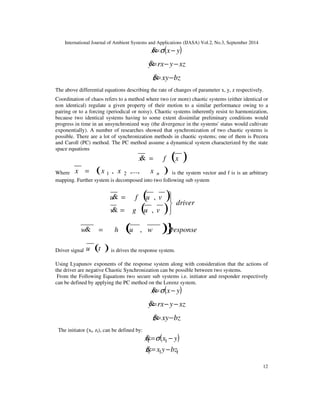
The above differential equations describing the rate of changes of parameter x, y, z respectively. 
Coordination of chaos refers to a method where two (or more) chaotic systems (either identical or 
non identical) regulate a given property of their motion to a similar performance owing to a 
pairing or to a forcing (periodical or noisy). Chaotic systems inherently resist to harmonization, 
because two identical systems having to some extent dissimilar preliminary conditions would 
progress in time in an unsynchronized way (the divergence in the systems' status would cultivate 
exponentially). A number of researches showed that synchronization of two chaotic systems is 
possible. There are a lot of synchronization methods in chaotic systems; one of them is Pecora 
and Caroll (PC) method. The PC method assume a dynamical system characterized by the state 
space equations 
x = f (x ) 
Where ( ) n x x , x ,..., x 1 2 = is the system vector and f is is an arbitrary 
mapping. Further system is decomposed into two following sub system 
( ) 
( ) driver 
 
u = 
f u v 
v g u v 


= 
, 
, 
 
w = h (u , w )}response 
Driver signal u (t ) is drives the response system. 
Using Lyapunov exponents of the response system along with consideration that the actions of 
the driver are negative Chaotic Synchronization can be possible between two systems. 
From the Following Equations two secure sub systems i.e. initiator and responder respectively 
can be defined by applying the PC method on the Lorenz system. 
x=s(x− y) 
y=rx− y−xz 
z=xy−bz 
The initiator xl, zl), can be defined by: 
x = (x − y) 1 1  s 
1 1 1 z= x y −bz
International Journal of Ambient Systems and Applications (IJASA) Vol.2, No.3, September 2014 
13 
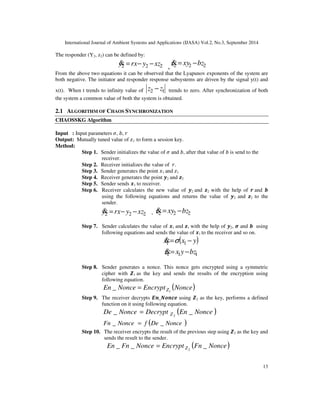
The responder (Y2, z2) can be defined by: 
, 2 2 2 z= xy −bz 
2 2 2 y= rx− y −xz 
From the above two equations it can be observed that the Lyapunov exponents of the system are 
both negative. The initiator and responder response subsystems are driven by the signal y(t) and 
x(t). When t trends to infinity value of 2 1 z − z trends to zero. After synchronization of both 
the system a common value of both the system is obtained. 
2.1 ALGORITHM OF CHAOS SYNCHRONIZATION 
CHAOSSKG Algorithm 
Input : Input parameters, ,  
Output: Mutually tuned value of 1 to form a session key. 
Method: 
Step 1. Sender initializes the value of  and , after that value of  is send to the 
receiver. 
Step 2. Receiver initializes the value of . 
Step 3. Sender generates the point 1 and 1 
Step 4. Receiver generates the point 2and 	2 
Step 5. Sender sends 
1to receiver. 
Step 6. Receiver calculates the new value of 2and 	2 with the help of and
using the following equations and returns the value of 2 and 	2 to the 
sender. 
, 2 2 2 z= xy −bz 
Step 7. Sender calculates the value of 
1 and 	1 with the help of 2, 
 and
using 
following equations and sends the value of 
1 to the receiver and so on. 
x = (x − y) 1 1  s 
1 1 1 z= x y −bz 
Step 8. Sender generates a nonce. This nonce gets encrypted using a symmetric 
cipher with 1as the key and sends the results of the encryption using 
following equation. 
En _ Nonce = 
Encrypt (Nonce) Z1 
Step 9. The receiver decrypts  using 2 as the key, performs a defined 
function on it using following equation. 
De Nonce Decrypt (En Nonce ) Z _ _ 
2 
= 
Fn _ Nonce = f (De _ Nonce ) 
Step 10. The receiver encrypts the result of the previous step using 2 as the key and 
sends the result to the sender. 
En Fn Nonce Encrypt (Fn Nonce) Z _ _ _ 
2 
= 
2 2 2 y= rx− y −xz
International Journal of Ambient Systems and Applications (IJASA) Vol.2, No.3, September 2014 
Step 11. The sender decrypts this message using 1 as the key, performs the inverse 
of the pre-defined function and checks if the original nonce is obtained as 
shown in following equation 
Nonce f (Decrypt (En Fn Nonce )) Z _ _ 
14 
1 
−1 = 
Step 12. If synchronization is not achieved, the process is repeated from step 5. 
Step 13. If synchronization is achieved i.e. 1 2 then 1 is used as a seed for a 
pseudo random number generator to generate the secret key between the 
two systems for a particular session. 
In security engineering, a nonce is an arbitrary number used only once in a cryptographic 
communication. It is often a random or pseudo-random number issued in an authentication 
protocol to ensure that old communications cannot be reused in replay attacks. 
2.2 COMPLEXITY ANALYSIS OF CHAOSSKG ALGORITHM 
Step 1. Sender initialization of the value of  and  takes needs  amount of computation. 
Step 2. Receiver initialization of the value of  also takes  amount of computation. 
Step 3. Generation of the point 1 and 1 takes unit amount of computation. 
Step 4. Generation of the point 2and 2 takes unit amount of computation. 
Step 5. Sending the value of 
1to receiver needs unit amount of computation 
Step 6. Receiver calculates the new value of 2and 	2 with the help of and
and returns the 
value of 2 and 	2 to the sender. This step also takes unit amount of computation. 
Step 7. Sender calculates the value of 
1 and 	1 with the help of 2, 
 and
and sends the 
value of 
1 to the receiver and so on. This step also takes unit amount of computation. 
Step 8. Sender generates a nonce. This nonce gets encrypted using a symmetric cipher with 
1as the key and sends the results of the encryption. This step needs 
 !# amount of computation. 
Step 9. The receiver decrypts  using 2 as the key. It also takes $%'( 
amount of computation. 
Step 10. The receiver encrypts the result of the previous step using2 as the key and sends the 
result to the sender. It takes $)**+%'( amount of computation. 
Step 11. The sender decrypts this message using 1 as the key, performs the inverse of the pre-defined 
function and checks if the original nonce is or not. It takes 
$,'-)**+%'( amount of computation. 
Step 12. If synchronization is not achieved, the process is repeated from step 5. If the loop 
executed for  times then algorithm needs total $ amount of computation. 
Step 13. Synchronization is achieved when 1 2 
From the above complexity analysis it has been seen that CHAOSSKG algorithm need to perform 
at most total $ amount of computation. 
2.3 HOPFIELD NEURAL NETWORKS (HNN) GUIDED PSEUDO RANDOM NUMBER 
GENERATION 
Chaos synchronized 1 values used as a seed of a Hopfield Neural Networks (HNN) guided 
pseudo random number generation. Hopfield Neural Networks (HNN) possesses function 
approximation and generalization capabilities that collectively with unsteadiness and non-
International Journal of Ambient Systems and Applications (IJASA) Vol.2, No.3, September 2014 
convergence possessions can be revealed to be beneficial when dealing with the production of 
random numbers. The learning in a Hopfield network is done by means of a weight adjustment 
mechanism that directly relates to minimization of an energy function that decreases over time in 
each iteration and finally stabilizes in some point of the state space representing the problem. The 
basic idea of Hopfield Neural Networks (HNN) is to memorize some patterns as stable points by 
associating them with specific inputs to the network. That is, after some that relates to the pattern 
that is memorized. Stability, therefore, is the most important features of Hopfield neural 
networks. The ability to converge in Hopfield networks is strongly related to network 
architecture, network initial condition, and updating rule mode. The convergence of the network 
occurs when the weight matrix is symmetric. Thus, there might be some alternatives which cause 
the network not to converge, e.g., by (i) applying an initial asymmetric weight matrix consists of 
large positive numbers in diagonal, (ii) letting two or more neurons active simultaneously, and 
(iii) using large network and training it with orthogonal and uncorrelated patterns. 
15 
In this paper, a HNN has been used with following conditions to guarantee non-convergence: 
• A nonlinear function, .# where  is summation of all inputs of a neuron, as the 
activation function for neurons, 
• Weights matrix of HNN is asymmetric where the upper triangle of weight matrix contains 
positive numbers and lower triangle of matrix contains negative numbers, The diagonal 
of weight matrix contains large positive numbers, 
• Uses of large number (100) of neurons. 
• In selecting the weights if the output of one neuron is close to or more than 1 then in the 
next iteration that neuron amplifies itself by the weight of the corresponding branch 
regardless of other inputs of the neuron. This is also valid for output close to or less than - 
1 with decreasing impact on the neuron. In other word, this makes the neuron to always 
fire with ±1 or bigger than ±1 in all iterations and accordingly amplifying itself. To avoid 
this, we set a condition that the summation of all the weights for inputs to each neuron 
must be less than 1 and greater than -1. 
• The output of each neuron in each iteration is calculated by following equation. 
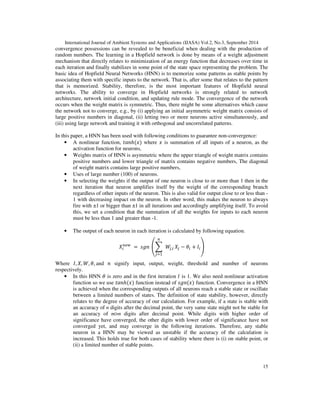
123  4! 56 
/0 
1 
789 
:7;0/7  =0  ?0@ 
Where ?; /;:; =;and  signify input, output, weight, threshold and number of neurons 
respectively. 
• In this HNN = is zero and in the first iteration ? is 1. We also need nonlinear activation 
function so we use .# function instead of 4! function. Convergence in a HNN 
is achieved when the corresponding outputs of all neurons reach a stable state or oscillate 
between a limited numbers of states. The definition of state stability, however, directly 
relates to the degree of accuracy of our calculation. For example, if a state is stable with 
an accuracy of n digits after the decimal point, the very same state might not be stable for 
an accuracy of mn digits after decimal point. While digits with higher order of 
significance have converged, the other digits with lower order of significance have not 
converged yet, and may converge in the following iterations. Therefore, any stable 
neuron in a HNN may be viewed as unstable if the accuracy of the calculation is 
increased. This holds true for both cases of stability where there is (i) on stable point, or 
(ii) a limited number of stable points.
International Journal of Ambient Systems and Applications (IJASA) Vol.2, No.3, September 2014 
3. SECURITY ANALYSIS OF CSCT 
In this section some of the attacks are considered to check the immunity power of the Proposed 
CSCT against the attack. In key exchange protocol the major threat is the attacker who resides in 
the middle of the sender and receiver has access to all the messages exchanged by both 
synchronizing parties, also he/she knows all about the protocol details. Now, some of the 
following question to be raised to analyse the immunity capability of the proposed technique. 
Is the attacker able to know the secret information z? 
16 
Or 
“Is attacker able to synchronize with the system regarding all the information available?” 
Or 
Is the attacker able to guess the key bits by any means of analytical and/or a numerical method? 
To answer these attacks on the system are divided in the following categories: 
Attacks by synchronization attempts: In this type of attack, the attacker tries to synchronize with 
the system by eavesdropping on all the messages exchanged by sender and receiver. This type of 
attack will not work as the attacker does not know the initial conditions of any of the z 
components of any of the systems, and also the parameters a and r are hidden too. By nature, the 
Lorenz system is very sensitive to initial conditions meaning that the error between attacker and 
receiver is going to grow exponentially if there is a very slight difference between their initial 
conditions. The main difference between receiver and attacker is that the output of receiver 2 
influences the system A and hence affects its output 1 resulting in a lack of synchronization 
between sender and attacker. 
Attacks by solving the system differential equations: As the nature of chaotic systems, the 
problem of solving the system of differential equations representing the system is proven to be 
very hard. Numerical solution is of no use due to the approximation nature of the numerical 
methods and the butter fly effect of chaotic systems. Even if the Lorenz system could be solved, 
other more complex chaotic systems can be used. 
4. RESULTS 
A total of eight statistical tests of The NIST Test Suite have been performed to evaluate 
randomness of the key stream. The 8 tests are performed for the proposed CSCT and existing 
TPM [2] (Tree Parity Machine) scheme and results of these tests get compared and analyzed. The 
8 tests are following: 
Statistical Test 1: Frequency (Monobits) Test 
Table 1 Status for Proportion of Passing and Uniformity of distribution 
Technique 
Expected 
Proportion 
Observed 
Proportion 
Status for 
Proportion 
of passing 
P-value of 
P-values 
Status for 
Uniform/ 
Non-uniform 
distribution 
TPM [2] 0.972766 0.973333 Success 2.781309e-08 Non-uniform 
CSCT 0.972766 0.979437 Success 3.122711e-10 Non-uniform 
From the above table it has been observed that proposed CSCT technique passed the Frequency 
(Monobits) Test with higher proportion value along with non-uniform distribution than existing 
TPM method. The outcomes of the test confirm the well distribution of proportion of zeroes and 
ones for the entire sequence.

Intelligent soft computing based

  • 1.
    International Journal ofAmbient Systems and Applications (IJASA) Vol.2, No.3, September 2014 INTELLIGENT SOFT COMPUTING BASED CRYPTOGRAPHIC TECHNIQUE USING CHAOS SYNCHRONIZATION FOR WIRELESS COMMUNICATION (CSCT) Arindam Sarkar1 and J. K. Mandal2 Department of Computer Science & Engineering, University of Kalyani, W.B, India ABSTRACT In this paper a novel intelligent soft computing based cryptographic technique based on synchronization of two chaotic systems (CSCT) between sender and receiver has been proposed to generate session key using Pecora and Caroll (PC) method. Chaotic system has some unique features like sensitive to initial conditions, topologically mixing; and dense periodic orbits. By nature, the Lorenz system is very sensitive to initial conditions meaning that the error between attacker and receiver is going to grow exponentially if there is a very slight difference between their initial conditions. All these features make chaotic system as good alternatives for session key generation. In the proposed CSCT few parameters ( , b , r , x1 ,y2 and z2 ) are being exchanged between sender and receiver. Some of the parameter which takes major roles to form the session key does not get transmitted via public channel, sender keeps these parameters secret. This way of handling parameter passing mechanism prevents any kind of attacks during exchange of parameters like sniffing, spoofing or phishing. KEYWORDS chaos synchronization, soft computing, cryptography, Wireless Communication. 1. INTRODUCTION A variety of session key generation techniques are available to secure data and information from eavesdroppers [1, 2, 6, 10] with some merits and demerits. Most of the key generation algorithm needs large memory and energy [3, 4, 5, 7, 8, 9]. There are few applications where soft computing is used in key generation purpose. In recent days cryptographic protocols are also get deployed in wireless communication. Wireless devices have the problem of memory and energy constraints. In this paper, a novel soft computing based technique has been proposed for energy efficient session key generation in wireless communication to address this problem. The organization of this paper is as follows. Section 2 of the paper deals with the proposed ACI based key generation technique. Encryption and Decryption Process has been discussed in section 3 and 4 respectively. Example of ACI based key stream generation is discussed in section 5. Results are described in section 6. Conclusions are drawn in section 7 and that of references at end. 2. THE TECHNIQUE Chaotic system has no closed form solution even though they defined by following simple equation that makes unpredictability in chaos system. DOI : 10.5121/ijasa.2014.2302 11
  • 2.
    International Journal ofAmbient Systems and Applications (IJASA) Vol.2, No.3, September 2014 12 x=s(x− y) y=rx− y−xz z=xy−bz The above differential equations describing the rate of changes of parameter x, y, z respectively. Coordination of chaos refers to a method where two (or more) chaotic systems (either identical or non identical) regulate a given property of their motion to a similar performance owing to a pairing or to a forcing (periodical or noisy). Chaotic systems inherently resist to harmonization, because two identical systems having to some extent dissimilar preliminary conditions would progress in time in an unsynchronized way (the divergence in the systems' status would cultivate exponentially). A number of researches showed that synchronization of two chaotic systems is possible. There are a lot of synchronization methods in chaotic systems; one of them is Pecora and Caroll (PC) method. The PC method assume a dynamical system characterized by the state space equations x = f (x ) Where ( ) n x x , x ,..., x 1 2 = is the system vector and f is is an arbitrary mapping. Further system is decomposed into two following sub system ( ) ( ) driver u = f u v v g u v = , , w = h (u , w )}response Driver signal u (t ) is drives the response system. Using Lyapunov exponents of the response system along with consideration that the actions of the driver are negative Chaotic Synchronization can be possible between two systems. From the Following Equations two secure sub systems i.e. initiator and responder respectively can be defined by applying the PC method on the Lorenz system. x=s(x− y) y=rx− y−xz z=xy−bz The initiator xl, zl), can be defined by: x = (x − y) 1 1 s 1 1 1 z= x y −bz
  • 3.
    International Journal ofAmbient Systems and Applications (IJASA) Vol.2, No.3, September 2014 13 The responder (Y2, z2) can be defined by: , 2 2 2 z= xy −bz 2 2 2 y= rx− y −xz From the above two equations it can be observed that the Lyapunov exponents of the system are both negative. The initiator and responder response subsystems are driven by the signal y(t) and x(t). When t trends to infinity value of 2 1 z − z trends to zero. After synchronization of both the system a common value of both the system is obtained. 2.1 ALGORITHM OF CHAOS SYNCHRONIZATION CHAOSSKG Algorithm Input : Input parameters, , Output: Mutually tuned value of 1 to form a session key. Method: Step 1. Sender initializes the value of and , after that value of is send to the receiver. Step 2. Receiver initializes the value of . Step 3. Sender generates the point 1 and 1 Step 4. Receiver generates the point 2and 2 Step 5. Sender sends 1to receiver. Step 6. Receiver calculates the new value of 2and 2 with the help of and
  • 4.
    using the followingequations and returns the value of 2 and 2 to the sender. , 2 2 2 z= xy −bz Step 7. Sender calculates the value of 1 and 1 with the help of 2, and
  • 5.
    using following equationsand sends the value of 1 to the receiver and so on. x = (x − y) 1 1 s 1 1 1 z= x y −bz Step 8. Sender generates a nonce. This nonce gets encrypted using a symmetric cipher with 1as the key and sends the results of the encryption using following equation. En _ Nonce = Encrypt (Nonce) Z1 Step 9. The receiver decrypts using 2 as the key, performs a defined function on it using following equation. De Nonce Decrypt (En Nonce ) Z _ _ 2 = Fn _ Nonce = f (De _ Nonce ) Step 10. The receiver encrypts the result of the previous step using 2 as the key and sends the result to the sender. En Fn Nonce Encrypt (Fn Nonce) Z _ _ _ 2 = 2 2 2 y= rx− y −xz
  • 6.
    International Journal ofAmbient Systems and Applications (IJASA) Vol.2, No.3, September 2014 Step 11. The sender decrypts this message using 1 as the key, performs the inverse of the pre-defined function and checks if the original nonce is obtained as shown in following equation Nonce f (Decrypt (En Fn Nonce )) Z _ _ 14 1 −1 = Step 12. If synchronization is not achieved, the process is repeated from step 5. Step 13. If synchronization is achieved i.e. 1 2 then 1 is used as a seed for a pseudo random number generator to generate the secret key between the two systems for a particular session. In security engineering, a nonce is an arbitrary number used only once in a cryptographic communication. It is often a random or pseudo-random number issued in an authentication protocol to ensure that old communications cannot be reused in replay attacks. 2.2 COMPLEXITY ANALYSIS OF CHAOSSKG ALGORITHM Step 1. Sender initialization of the value of and takes needs amount of computation. Step 2. Receiver initialization of the value of also takes amount of computation. Step 3. Generation of the point 1 and 1 takes unit amount of computation. Step 4. Generation of the point 2and 2 takes unit amount of computation. Step 5. Sending the value of 1to receiver needs unit amount of computation Step 6. Receiver calculates the new value of 2and 2 with the help of and
  • 7.
    and returns the value of 2 and 2 to the sender. This step also takes unit amount of computation. Step 7. Sender calculates the value of 1 and 1 with the help of 2, and
  • 8.
    and sends the value of 1 to the receiver and so on. This step also takes unit amount of computation. Step 8. Sender generates a nonce. This nonce gets encrypted using a symmetric cipher with 1as the key and sends the results of the encryption. This step needs !# amount of computation. Step 9. The receiver decrypts using 2 as the key. It also takes $%'( amount of computation. Step 10. The receiver encrypts the result of the previous step using2 as the key and sends the result to the sender. It takes $)**+%'( amount of computation. Step 11. The sender decrypts this message using 1 as the key, performs the inverse of the pre-defined function and checks if the original nonce is or not. It takes $,'-)**+%'( amount of computation. Step 12. If synchronization is not achieved, the process is repeated from step 5. If the loop executed for times then algorithm needs total $ amount of computation. Step 13. Synchronization is achieved when 1 2 From the above complexity analysis it has been seen that CHAOSSKG algorithm need to perform at most total $ amount of computation. 2.3 HOPFIELD NEURAL NETWORKS (HNN) GUIDED PSEUDO RANDOM NUMBER GENERATION Chaos synchronized 1 values used as a seed of a Hopfield Neural Networks (HNN) guided pseudo random number generation. Hopfield Neural Networks (HNN) possesses function approximation and generalization capabilities that collectively with unsteadiness and non-
  • 9.
    International Journal ofAmbient Systems and Applications (IJASA) Vol.2, No.3, September 2014 convergence possessions can be revealed to be beneficial when dealing with the production of random numbers. The learning in a Hopfield network is done by means of a weight adjustment mechanism that directly relates to minimization of an energy function that decreases over time in each iteration and finally stabilizes in some point of the state space representing the problem. The basic idea of Hopfield Neural Networks (HNN) is to memorize some patterns as stable points by associating them with specific inputs to the network. That is, after some that relates to the pattern that is memorized. Stability, therefore, is the most important features of Hopfield neural networks. The ability to converge in Hopfield networks is strongly related to network architecture, network initial condition, and updating rule mode. The convergence of the network occurs when the weight matrix is symmetric. Thus, there might be some alternatives which cause the network not to converge, e.g., by (i) applying an initial asymmetric weight matrix consists of large positive numbers in diagonal, (ii) letting two or more neurons active simultaneously, and (iii) using large network and training it with orthogonal and uncorrelated patterns. 15 In this paper, a HNN has been used with following conditions to guarantee non-convergence: • A nonlinear function, .# where is summation of all inputs of a neuron, as the activation function for neurons, • Weights matrix of HNN is asymmetric where the upper triangle of weight matrix contains positive numbers and lower triangle of matrix contains negative numbers, The diagonal of weight matrix contains large positive numbers, • Uses of large number (100) of neurons. • In selecting the weights if the output of one neuron is close to or more than 1 then in the next iteration that neuron amplifies itself by the weight of the corresponding branch regardless of other inputs of the neuron. This is also valid for output close to or less than - 1 with decreasing impact on the neuron. In other word, this makes the neuron to always fire with ±1 or bigger than ±1 in all iterations and accordingly amplifying itself. To avoid this, we set a condition that the summation of all the weights for inputs to each neuron must be less than 1 and greater than -1. • The output of each neuron in each iteration is calculated by following equation. 123 4! 56 /0 1 789 :7;0/7 =0 ?0@ Where ?; /;:; =;and signify input, output, weight, threshold and number of neurons respectively. • In this HNN = is zero and in the first iteration ? is 1. We also need nonlinear activation function so we use .# function instead of 4! function. Convergence in a HNN is achieved when the corresponding outputs of all neurons reach a stable state or oscillate between a limited numbers of states. The definition of state stability, however, directly relates to the degree of accuracy of our calculation. For example, if a state is stable with an accuracy of n digits after the decimal point, the very same state might not be stable for an accuracy of mn digits after decimal point. While digits with higher order of significance have converged, the other digits with lower order of significance have not converged yet, and may converge in the following iterations. Therefore, any stable neuron in a HNN may be viewed as unstable if the accuracy of the calculation is increased. This holds true for both cases of stability where there is (i) on stable point, or (ii) a limited number of stable points.
  • 10.
    International Journal ofAmbient Systems and Applications (IJASA) Vol.2, No.3, September 2014 3. SECURITY ANALYSIS OF CSCT In this section some of the attacks are considered to check the immunity power of the Proposed CSCT against the attack. In key exchange protocol the major threat is the attacker who resides in the middle of the sender and receiver has access to all the messages exchanged by both synchronizing parties, also he/she knows all about the protocol details. Now, some of the following question to be raised to analyse the immunity capability of the proposed technique. Is the attacker able to know the secret information z? 16 Or “Is attacker able to synchronize with the system regarding all the information available?” Or Is the attacker able to guess the key bits by any means of analytical and/or a numerical method? To answer these attacks on the system are divided in the following categories: Attacks by synchronization attempts: In this type of attack, the attacker tries to synchronize with the system by eavesdropping on all the messages exchanged by sender and receiver. This type of attack will not work as the attacker does not know the initial conditions of any of the z components of any of the systems, and also the parameters a and r are hidden too. By nature, the Lorenz system is very sensitive to initial conditions meaning that the error between attacker and receiver is going to grow exponentially if there is a very slight difference between their initial conditions. The main difference between receiver and attacker is that the output of receiver 2 influences the system A and hence affects its output 1 resulting in a lack of synchronization between sender and attacker. Attacks by solving the system differential equations: As the nature of chaotic systems, the problem of solving the system of differential equations representing the system is proven to be very hard. Numerical solution is of no use due to the approximation nature of the numerical methods and the butter fly effect of chaotic systems. Even if the Lorenz system could be solved, other more complex chaotic systems can be used. 4. RESULTS A total of eight statistical tests of The NIST Test Suite have been performed to evaluate randomness of the key stream. The 8 tests are performed for the proposed CSCT and existing TPM [2] (Tree Parity Machine) scheme and results of these tests get compared and analyzed. The 8 tests are following: Statistical Test 1: Frequency (Monobits) Test Table 1 Status for Proportion of Passing and Uniformity of distribution Technique Expected Proportion Observed Proportion Status for Proportion of passing P-value of P-values Status for Uniform/ Non-uniform distribution TPM [2] 0.972766 0.973333 Success 2.781309e-08 Non-uniform CSCT 0.972766 0.979437 Success 3.122711e-10 Non-uniform From the above table it has been observed that proposed CSCT technique passed the Frequency (Monobits) Test with higher proportion value along with non-uniform distribution than existing TPM method. The outcomes of the test confirm the well distribution of proportion of zeroes and ones for the entire sequence.