IInntteelllliiggeenntt NNeettwwoorrkk SSeerrvviicceess 
tthhrroouugghh 
AAccttiivvee FFllooww MMaanniippuullaattiioonn 
TT.. LLaavviiaann,, PP.. WWaanngg,, FF.. TTrraavvoossttiinnoo,, 
SS.. SSuubbrraammaanniiaann,, DD.. HHooaanngg,, VV.. SSeetthhaappuutt 
NNoorrtteell NNeettwwoorrkkss,, UUCC BBeerrkkeelleeyy,, HHaarrvvaarrdd UU
Outline 
• Introduction 
• Network Element – Control Plane/Forwarding 
Plane 
• Active Flow Manipulation (AFM) abstractions 
• OPENET 
• Examples 
• Conclusion
Programmability 
• A significant challenge in today’s Internet is the 
ability to efficiently incorporate customizable 
network intelligence in commercial high 
performance network devices. 
— Framework for introducing services 
— API for programming network devices
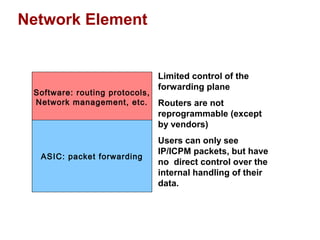
Network Element 
• Limited control of the 
forwarding plane 
• Routers are not 
reprogrammable (except 
by vendors) 
• Users can only see 
IP/ICPM packets, but have 
no direct control over the 
internal handling of their 
data. 
Software: routing protocols, 
Network management, etc. 
ASIC: packet forwarding
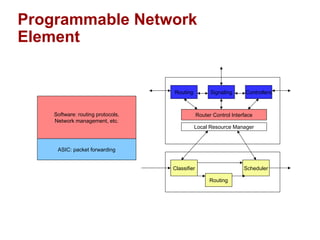
Programmable Network 
Element 
Software: routing protocols, 
Network management, etc. 
ASIC: packet forwarding 
Routing Signaling Controllers 
Router Control Interface 
Local Resource Manager 
Classifier 
Routing 
Scheduler
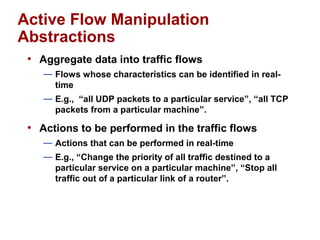
Active Flow Manipulation 
Abstractions 
• Aggregate data into traffic flows 
— Flows whose characteristics can be identified in real-time 
— E.g., “all UDP packets to a particular service”, “all TCP 
packets from a particular machine”. 
• Actions to be performed in the traffic flows 
— Actions that can be performed in real-time 
— E.g., “Change the priority of all traffic destined to a 
particular service on a particular machine”, “Stop all 
traffic out of a particular link of a router”.
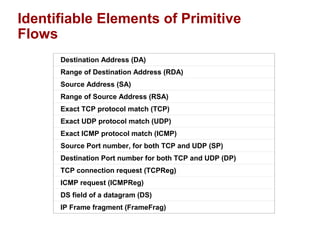
Identifiable Elements of Primitive 
Flows 
Destination Address (DA) 
Range of Destination Address (RDA) 
Source Address (SA) 
Range of Source Address (RSA) 
Exact TCP protocol match (TCP) 
Exact UDP protocol match (UDP) 
Exact ICMP protocol match (ICMP) 
Source Port number, for both TCP and UDP (SP) 
Destination Port number for both TCP and UDP (DP) 
TCP connection request (TCPReg) 
ICMP request (ICMPReg) 
DS field of a datagram (DS) 
IP Frame fragment (FrameFrag)
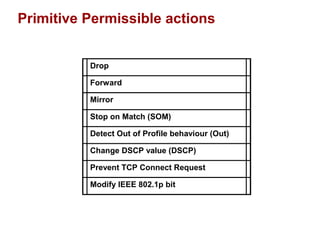
Primitive Permissible actions 
Drop 
Forward 
Mirror 
Stop on Match (SOM) 
Detect Out of Profile behaviour (Out) 
Change DSCP value (DSCP) 
Prevent TCP Connect Request 
Modify IEEE 802.1p bit
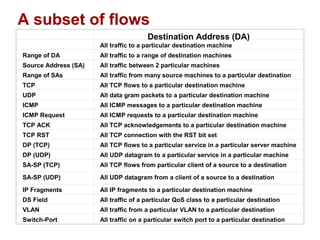
A subset of flows 
Destination Address (DA) 
All traffic to a particular destination machine 
Range of DA All traffic to a range of destination machines 
Source Address (SA) All traffic between 2 particular machines 
Range of SAs All traffic from many source machines to a particular destination 
TCP All TCP flows to a particular destination machine 
UDP All data gram packets to a particular destination machine 
ICMP All ICMP messages to a particular destination machine 
ICMP Request All ICMP requests to a particular destination machine 
TCP ACK All TCP acknowledgements to a particular destination machine 
TCP RST All TCP connection with the RST bit set 
DP (TCP) All TCP flows to a particular service in a particular server machine 
DP (UDP) All UDP datagram to a particular service in a particular machine 
SA-SP (TCP) All TCP flows from particular client of a source to a destination 
SA-SP (UDP) All UDP datagram from a client of a source to a destination 
IP Fragments All IP fragments to a particular destination machine 
DS Field All traffic of a particular QoS class to a particular destination 
VLAN All traffic from a particular VLAN to a particular destination 
Switch-Port All traffic on a particular switch port to a particular destination
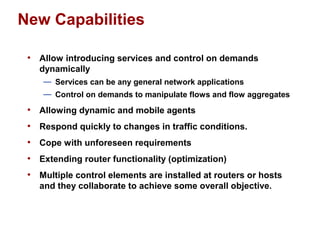
New Capabilities 
• Allow introducing services and control on demands 
dynamically 
— Services can be any general network applications 
— Control on demands to manipulate flows and flow aggregates 
• Allowing dynamic and mobile agents 
• Respond quickly to changes in traffic conditions. 
• Cope with unforeseen requirements 
• Extending router functionality (optimization) 
• Multiple control elements are installed at routers or hosts 
and they collaborate to achieve some overall objective.
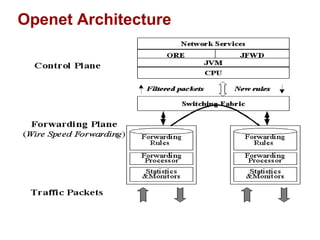
Openet Architecture
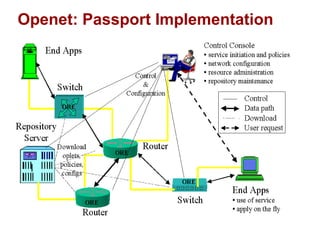
Openet: Passport Implementation
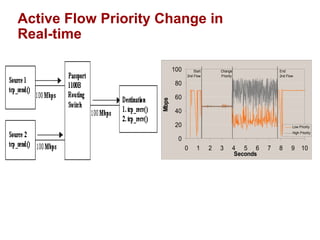
Active Flow Priority Change in 
Real-time 
100 
80 
60 
40 
20 
0 
0 1 2 3 4 5 6 7 8 9 10 
Seconds 
Mbps 
Low Priority 
High Priority 
Start 
2nd Flow 
Change 
Priority 
End 
2nd Flow
AIACE 
Number of flows (log) 
8 6 
100000 
10000 
1000 
100 
10 
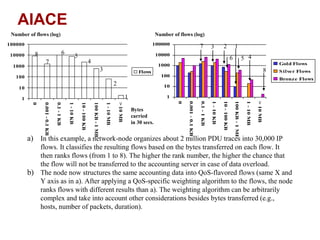
a) In this example, a network-node organizes about 2 million PDU traces into 30,000 IP 
flows. It classifies the resulting flows based on the bytes transferred on each flow. It 
then ranks flows (from 1 to 8). The higher the rank number, the higher the chance that 
the flow will not be transferred to the accounting server in case of data overload. 
b) The node now structures the same accounting data into QoS-flavored flows (same X and 
Y axis as in a). After applying a QoS-specific weighting algorithm to the flows, the node 
ranks flows with different results than a). The weighting algorithm can be arbitrarily 
complex and take into account other considerations besides bytes transferred (e.g., 
hosts, number of packets, duration). 
100000 
10000 
1000 
100 
10 
1 
0 
0.001 - 0.1 KB 
0.1 - 1 KB 
1 - 10 KB 
10 - 100 KB 
100 KB - 1 MB 
1 - 10 MB 
> 10 MB 
Flows 
1 
2 
3 
4 
5 
7 
Bytes 
carried 
in 30 secs. 
1 
0 
0.001 - 0.1 KB 
0.1 - 1 KB 
1 - 10 KB 
10 - 100 KB 
100 KB - 1 MB 
1 - 10 MB 
> 10 MB 
Gold Flows 
Silver Flows 
Bronze Flows 
3 2 1 
6 5 4 
7 
8 
Number of flows (log)
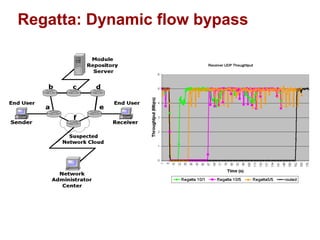
Regatta: Dynamic flow bypass
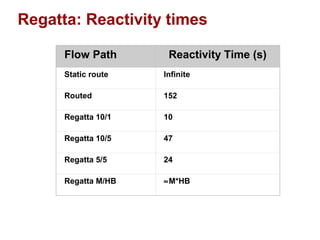
Regatta: Reactivity times 
Flow Path Reactivity Time (s) 
Static route Infinite 
Routed 152 
Regatta 10/1 10 
Regatta 10/5 47 
Regatta 5/5 24 
Regatta M/HB »M*HB
Conclusions 
• AFM enables dynamic introduction of services 
• AFM enables rapid network response to changing 
conditions 
• AFM in a powerful control plane can lead to 
sophisticated control over forward plane 
• AFM allows practical implementation of 
programmability in a real world network device

Intelligent Network Services through Active Flow Manipulation

  • 1.
    IInntteelllliiggeenntt NNeettwwoorrkk SSeerrvviicceess tthhrroouugghh AAccttiivvee FFllooww MMaanniippuullaattiioonn TT.. LLaavviiaann,, PP.. WWaanngg,, FF.. TTrraavvoossttiinnoo,, SS.. SSuubbrraammaanniiaann,, DD.. HHooaanngg,, VV.. SSeetthhaappuutt NNoorrtteell NNeettwwoorrkkss,, UUCC BBeerrkkeelleeyy,, HHaarrvvaarrdd UU
  • 2.
    Outline • Introduction • Network Element – Control Plane/Forwarding Plane • Active Flow Manipulation (AFM) abstractions • OPENET • Examples • Conclusion
  • 3.
    Programmability • Asignificant challenge in today’s Internet is the ability to efficiently incorporate customizable network intelligence in commercial high performance network devices. — Framework for introducing services — API for programming network devices
  • 4.
    Network Element •Limited control of the forwarding plane • Routers are not reprogrammable (except by vendors) • Users can only see IP/ICPM packets, but have no direct control over the internal handling of their data. Software: routing protocols, Network management, etc. ASIC: packet forwarding
  • 5.
    Programmable Network Element Software: routing protocols, Network management, etc. ASIC: packet forwarding Routing Signaling Controllers Router Control Interface Local Resource Manager Classifier Routing Scheduler
  • 6.
    Active Flow Manipulation Abstractions • Aggregate data into traffic flows — Flows whose characteristics can be identified in real-time — E.g., “all UDP packets to a particular service”, “all TCP packets from a particular machine”. • Actions to be performed in the traffic flows — Actions that can be performed in real-time — E.g., “Change the priority of all traffic destined to a particular service on a particular machine”, “Stop all traffic out of a particular link of a router”.
  • 7.
    Identifiable Elements ofPrimitive Flows Destination Address (DA) Range of Destination Address (RDA) Source Address (SA) Range of Source Address (RSA) Exact TCP protocol match (TCP) Exact UDP protocol match (UDP) Exact ICMP protocol match (ICMP) Source Port number, for both TCP and UDP (SP) Destination Port number for both TCP and UDP (DP) TCP connection request (TCPReg) ICMP request (ICMPReg) DS field of a datagram (DS) IP Frame fragment (FrameFrag)
  • 8.
    Primitive Permissible actions Drop Forward Mirror Stop on Match (SOM) Detect Out of Profile behaviour (Out) Change DSCP value (DSCP) Prevent TCP Connect Request Modify IEEE 802.1p bit
  • 9.
    A subset offlows Destination Address (DA) All traffic to a particular destination machine Range of DA All traffic to a range of destination machines Source Address (SA) All traffic between 2 particular machines Range of SAs All traffic from many source machines to a particular destination TCP All TCP flows to a particular destination machine UDP All data gram packets to a particular destination machine ICMP All ICMP messages to a particular destination machine ICMP Request All ICMP requests to a particular destination machine TCP ACK All TCP acknowledgements to a particular destination machine TCP RST All TCP connection with the RST bit set DP (TCP) All TCP flows to a particular service in a particular server machine DP (UDP) All UDP datagram to a particular service in a particular machine SA-SP (TCP) All TCP flows from particular client of a source to a destination SA-SP (UDP) All UDP datagram from a client of a source to a destination IP Fragments All IP fragments to a particular destination machine DS Field All traffic of a particular QoS class to a particular destination VLAN All traffic from a particular VLAN to a particular destination Switch-Port All traffic on a particular switch port to a particular destination
  • 10.
    New Capabilities •Allow introducing services and control on demands dynamically — Services can be any general network applications — Control on demands to manipulate flows and flow aggregates • Allowing dynamic and mobile agents • Respond quickly to changes in traffic conditions. • Cope with unforeseen requirements • Extending router functionality (optimization) • Multiple control elements are installed at routers or hosts and they collaborate to achieve some overall objective.
  • 11.
  • 12.
  • 13.
    Active Flow PriorityChange in Real-time 100 80 60 40 20 0 0 1 2 3 4 5 6 7 8 9 10 Seconds Mbps Low Priority High Priority Start 2nd Flow Change Priority End 2nd Flow
  • 14.
    AIACE Number offlows (log) 8 6 100000 10000 1000 100 10 a) In this example, a network-node organizes about 2 million PDU traces into 30,000 IP flows. It classifies the resulting flows based on the bytes transferred on each flow. It then ranks flows (from 1 to 8). The higher the rank number, the higher the chance that the flow will not be transferred to the accounting server in case of data overload. b) The node now structures the same accounting data into QoS-flavored flows (same X and Y axis as in a). After applying a QoS-specific weighting algorithm to the flows, the node ranks flows with different results than a). The weighting algorithm can be arbitrarily complex and take into account other considerations besides bytes transferred (e.g., hosts, number of packets, duration). 100000 10000 1000 100 10 1 0 0.001 - 0.1 KB 0.1 - 1 KB 1 - 10 KB 10 - 100 KB 100 KB - 1 MB 1 - 10 MB > 10 MB Flows 1 2 3 4 5 7 Bytes carried in 30 secs. 1 0 0.001 - 0.1 KB 0.1 - 1 KB 1 - 10 KB 10 - 100 KB 100 KB - 1 MB 1 - 10 MB > 10 MB Gold Flows Silver Flows Bronze Flows 3 2 1 6 5 4 7 8 Number of flows (log)
  • 15.
  • 16.
    Regatta: Reactivity times Flow Path Reactivity Time (s) Static route Infinite Routed 152 Regatta 10/1 10 Regatta 10/5 47 Regatta 5/5 24 Regatta M/HB »M*HB
  • 17.
    Conclusions • AFMenables dynamic introduction of services • AFM enables rapid network response to changing conditions • AFM in a powerful control plane can lead to sophisticated control over forward plane • AFM allows practical implementation of programmability in a real world network device

Editor's Notes

  • #2 Intelligent Network Services through Active Flow Manipulation T. Lavian, P. Wang, F. Travostino, S. Subramanian, D. Hoang, V. Sethaput NORTEL Networks ABSTRACT A significant challenge in today's Internet is the ability to efficiently introduce intelligent network services into commercial high performance network devices. This paper tackles the challenge by intro-ducing the Active Flow Manipulation (AFM) mechanism, a key enabling technology of the programmable networking platform Openet. AFM enhances the control functionality of network devices through programmability. With AFM, customer network services can exercise intelligent network control by identifying specific flows and applying particular actions thereby altering their behavior in real-time. These services are dynamically deployed in the CPU-based control plane and are closely cou-pled with the silicon-based forwarding plane of the network node, without negatively impacting forwarding performance. The effectiveness of our approach is demonstrated by several experimental applications on a commercial network node.