SDN, OpenFlow and the ONF


OpenFlow/Software-Defined Networking (SDN)
“OpenFlow/SDN is emerging as one of the most promising and
disruptive networking technologies of recent years. It has the potential
to enable network innovation and create choice, and thus help realize
new capabilities and address persistent problems with networking. It
also promises to give network operators more control of their
infrastructure, allowing customization and optimization, therefore
reducing overall capital and operational costs. “
                                              Source: http://opennetsummit.org/why.html
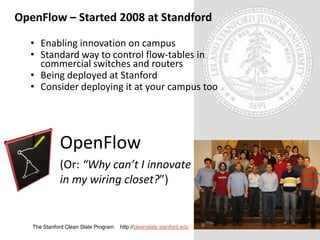
OpenFlow – Started 2008 at Standford

  • Enabling innovation on campus
  • Standard way to control flow-tables in
    commercial switches and routers
  • Being deployed at Stanford
  • Consider deploying it at your campus too


             OpenFlow
             (Or: “Why can’t I innovate
             in my wiring closet?”)


   The Stanford Clean Slate Program   http://cleanslate.stanford.edu
ONF and Community grows fast!
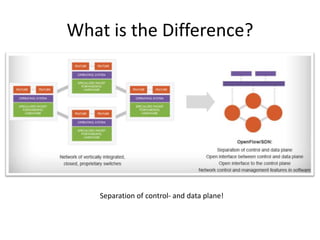
What is the Difference?


    Separation of control- and data plane!
How to configure your network?
•   Static – Ask you Network Admin
•   Automatic – Write some scripts
•   Automatic – via Netconf, SNMP Protocols
•   Dynamic – via Network Protocols
•   Dynamic – via RADIUS, DIAMETER Protocols

                  Whats next?
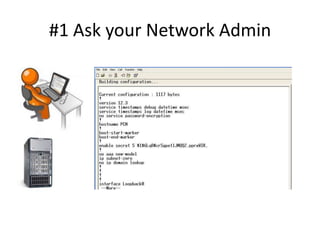
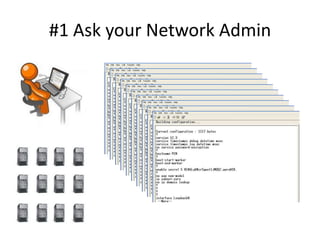
#1 Ask your Network Admin
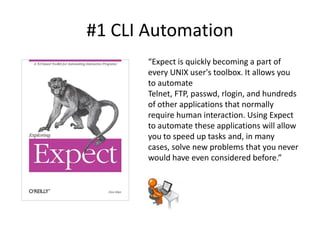
#1 CLI Automation
       “Expect is quickly becoming a part of
       every UNIX user's toolbox. It allows you
       to automate
       Telnet, FTP, passwd, rlogin, and hundreds
       of other applications that normally
       require human interaction. Using Expect
       to automate these applications will allow
       you to speed up tasks and, in many
       cases, solve new problems that you never
       would have even considered before.”
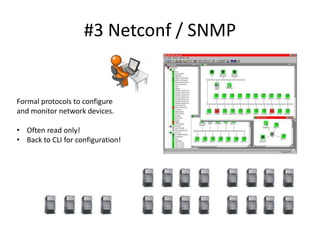
#3 Netconf / SNMP


Formal protocols to configure
and monitor network devices.

• Often read only!
• Back to CLI for configuration!
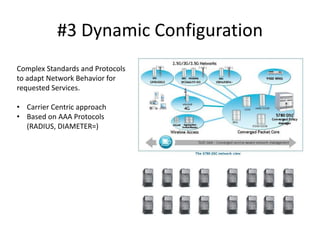
#3 Dynamic Configuration
Complex Standards and Protocols
to adapt Network Behavior for
requested Services.

• Carrier Centric approach
• Based on AAA Protocols
  (RADIUS, DIAMETER=)
Conclusion!

   You always Configure existing
          Functionality!

There is no common API to Program
    the network functionality!
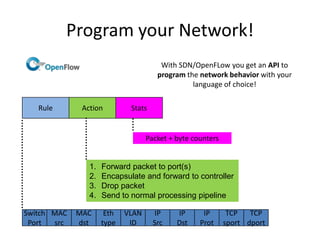
Program your Network!
                                       With SDN/OpenFLow you get an API to
                                      program the network behavior with your
                                                language of choice!

   Rule       Action         Stats


                                   Packet + byte counters


                1.   Forward packet to port(s)
                2.   Encapsulate and forward to controller
                3.   Drop packet
                4.   Send to normal processing pipeline

Switch MAC   MAC      Eth   VLAN     IP     IP      IP       TCP   TCP
 Port  src   dst     type    ID      Src    Dst    Prot     sport dport
#1 Cellubi m2m Network
• Production Network for
  m2m Communication
• Overlay Network over
  four 3G provider across
  the globe
• Fine granular policy
  control and 1:1 NAT
  funtionality
#2 Distributed BRAS
• Proof of Concept implementation
• Distributed PPPoE Termination close to the
  Edge of a Carrier FTTH Network
• Eliminates huge, central, costly BRAS
  installations
• Multicast Replication point is pushed to the
  edge for IPTV optimisation
FlowER

Openflow Controller in Erlang
Classic Switch
             vs.
Software Defined Networking
           (SDN)
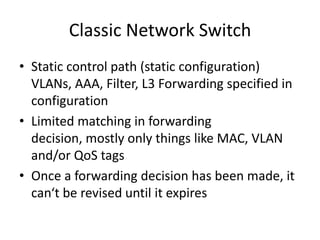
Classic Network Switch
• Static control path (static configuration)
  VLANs, AAA, Filter, L3 Forwarding specified in
  configuration
• Limited matching in forwarding
  decision, mostly only things like MAC, VLAN
  and/or QoS tags
• Once a forwarding decision has been made, it
  can‘t be revised until it expires
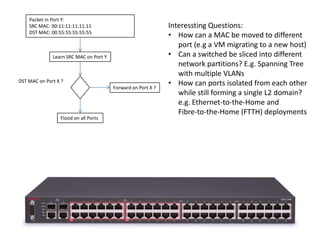
Packet in Port Y:
    SRC MAC: 00:11:11:11:11:11                                Interessting Questions:
    DST MAC: 00:55:55:55:55:55
                                                              • How can a MAC be moved to different
                                                                 port (e.g a VM migrating to a new host)
              Learn SRC MAC on Port Y                         • Can a switched be sliced into different
                                                                 network partitions? E.g. Spanning Tree
                                                                 with multiple VLANs
DST MAC on Port X ?
                                        Forward on Port X ?
                                                              • How can ports isolated from each other
                                                                 while still forming a single L2 domain?
                                                                 e.g. Ethernet-to-the-Home and
                                                                 Fibre-to-the-Home (FTTH) deployments
                 Flood on all Ports
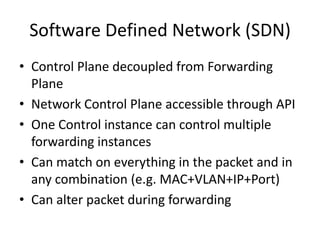
Software Defined Network (SDN)
• Control Plane decoupled from Forwarding
  Plane
• Network Control Plane accessible through API
• One Control instance can control multiple
  forwarding instances
• Can match on everything in the packet and in
  any combination (e.g. MAC+VLAN+IP+Port)
• Can alter packet during forwarding
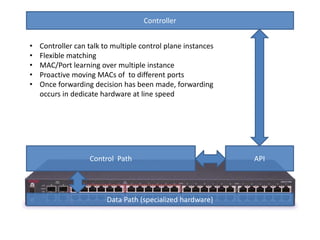
Controller


•   Controller can talk to multiple control plane instances
•   Flexible matching
•   MAC/Port learning over multiple instance
•   Proactive moving MACs of to different ports
•   Once forwarding decision has been made, forwarding
    occurs in dedicate hardware at line speed


                   Control Path                               API


                         Data Path (specialized hardware)
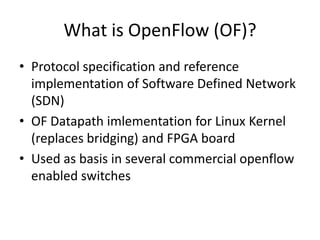
What is OpenFlow (OF)?
• Protocol specification and reference
  implementation of Software Defined Network
  (SDN)
• OF Datapath imlementation for Linux Kernel
  (replaces bridging) and FPGA board
• Used as basis in several commercial openflow
  enabled switches
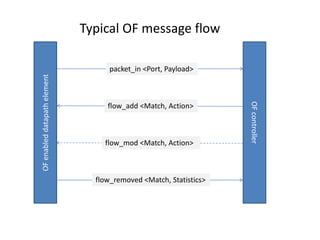
Typical OF message flow

                                    packet_in <Port, Payload>
OF enabled datapath element


                                                                   OF controller
                                   flow_add <Match, Action>


                                  flow_mod <Match, Action>


                                flow_removed <Match, Statistics>
OpenVSwitch
• Linux Kernel Datapath, Controller and
  Configuration Database
• Can control OF enable hardware switch
• Used as software switch in Xen
• Supports for many standard management
  interfaces and protocols (e.g.
  NetFlow, sFlow, SPAN, RSPAN, CLI, LACP, 802.1
  ag)
• Extensions over OpenFlow 1.0 Protocol
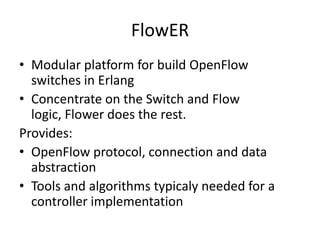
FlowER
• Modular platform for build OpenFlow
  switches in Erlang
• Concentrate on the Switch and Flow
  logic, Flower does the rest.
Provides:
• OpenFlow protocol, connection and data
  abstraction
• Tools and algorithms typicaly needed for a
  controller implementation
Why Erlang?
You probably already know?!?


 •   Flexible binary matching
 •   Fault isolation
 •   Concurrency
 •   ….
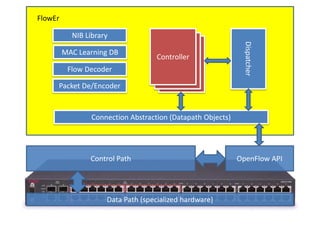
FlowEr

           NIB Library


                                                              Dispatcher
         MAC Learning DB
                                    Controller
          Flow Decoder

     Packet De/Encoder


                 Connection Abstraction (Datapath Objects)


                Control Path                                 OpenFlow API


                     Data Path (specialized hardware)
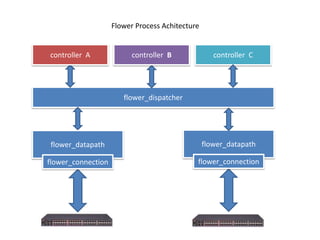
Flower Process Achitecture


controller A              controller B              controller C


                       flower_dispatcher


flower_datapath                                  flower_datapath

flower_connection                            flower_connection
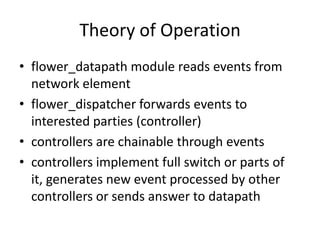
Theory of Operation
• flower_datapath module reads events from
  network element
• flower_dispatcher forwards events to
  interested parties (controller)
• controllers are chainable through events
• controllers implement full switch or parts of
  it, generates new event processed by other
  controllers or sends answer to datapath
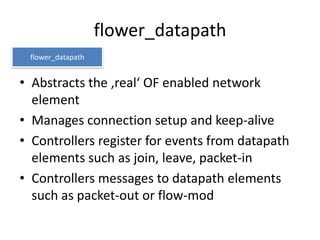
flower_datapath
 flower_datapath


• Abstracts the ‚real‘ OF enabled network
  element
• Manages connection setup and keep-alive
• Controllers register for events from datapath
  elements such as join, leave, packet-in
• Controllers messages to datapath elements
  such as packet-out or flow-mod
OpenFlow Packet Decoder
{[#ovs_msg{version = 1,type = features_reply,xid = 3,
       msg = #ofp_switch_features{datapath_id = 150876804345,
                      n_buffers = 256,n_tables = 2,
                      capabilities = [arp_match_ip,port_stats,table_stats,
                              flow_stats],
                      actions = [enqueue,set_tp_dst,set_tp_src,set_nw_tos,
                         set_nw_dst,set_nw_src,set_dl_dst,set_dl_src,strip_vlan,
                         set_vlan_pcp,set_vlan_vid,output],
                      ports = [#ofp_phy_port{port_no = 2,
                                 hw_addr = <<0,80,86,174,0,20>>,
                                 name = <<"eth2">>,config = [],
                                 state = [link_down],
                                 curr = [autoneg,copper],
                                 advertised =
[autoneg,copper,'1gb_fd','100mb_fd','100mb_hd',
                                       '10mb_fd','10mb_hd'],
                                 supported =
[autoneg,copper,'1gb_fd','100mb_fd','100mb_hd',
                                      '10mb_fd','10mb_hd'],
                                 peer = []},
                                     ....
                                    ]}}],
 <<>>}
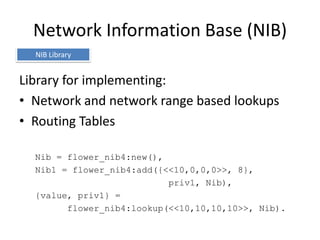
Network Information Base (NIB)
  NIB Library


Library for implementing:
• Network and network range based lookups
• Routing Tables

  Nib = flower_nib4:new(),
  Nib1 = flower_nib4:add({<<10,0,0,0>>, 8},
                           priv1, Nib),
  {value, priv1} =
        flower_nib4:lookup(<<10,10,10,10>>, Nib).
MAC Learning DB
    MAC Learning DB


•    MAC address learning and lookup table
•    Addres expiry
•    Filter for special MAC addresses
•    MAC to string formater
Flow Decoder
  Flow Decoder


• Raw packet decoded into all matchable fields:
  – Src and Dst MAC Address
  – VLAN Id
  – L2 Protocol Type: IP, IPv6, ARP, LACP, ...
  – IP Protocol Type: UDP, TCP, ...
  – Src and Dst IP Address
  – Src and Dst Port
  – .....
De/encoder for network protocols
Packet De/Encoder


Decodes and build packet fragments for:
• IP, TCP and UDP header
• ICMP
• ARP
• more to come...

   make_icmp({dest_unreach, pkt_filtered}, VLAN,
            DstMAC, SrcMAC, IPSrc, IPDst, Payload).
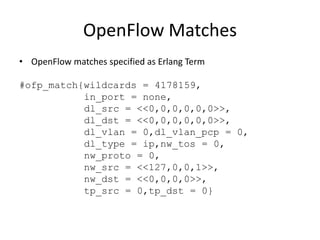
OpenFlow Matches
• OpenFlow matches specified as Erlang Term

#ofp_match{wildcards = 4178159,
           in_port = none,
           dl_src = <<0,0,0,0,0,0>>,
           dl_dst = <<0,0,0,0,0,0>>,
           dl_vlan = 0,dl_vlan_pcp = 0,
           dl_type = ip,nw_tos = 0,
           nw_proto = 0,
           nw_src = <<127,0,0,1>>,
           nw_dst = <<0,0,0,0>>,
           tp_src = 0,tp_dst = 0}
Given a decoded flow construct a match on IP
Protocol and Src IP:
IP = <<127,0,0,1>>,
Flow = #flow{dl_type = ip,
             nw_src = IP, nw_dst = IP},
encode_ofp_matchflow([{nw_src_mask,32}, dl_type],
                      Flow).
Controller Implementations
flower_simple_switch:
• Sample learning Layer 2 switch
• Implements MAC learning only
• Less than 50 LOC!

flsc (not included):
• production ready Layer 3 switch and router
   in about 1100 LOC
Further Work
• IPv6 support
• Replace the MAC learning database with
  something much faster
• Improve and extend NIB Library
• Add load distribution in dispatcher
• …
• Extend Documentation ;-)
Available on Github
Repo: https://github.com/travelping/flower

FlowER Erlang Openflow Controller

  • 1.
    SDN, OpenFlow andthe ONF OpenFlow/Software-Defined Networking (SDN) “OpenFlow/SDN is emerging as one of the most promising and disruptive networking technologies of recent years. It has the potential to enable network innovation and create choice, and thus help realize new capabilities and address persistent problems with networking. It also promises to give network operators more control of their infrastructure, allowing customization and optimization, therefore reducing overall capital and operational costs. “ Source: http://opennetsummit.org/why.html
  • 2.
    OpenFlow – Started2008 at Standford • Enabling innovation on campus • Standard way to control flow-tables in commercial switches and routers • Being deployed at Stanford • Consider deploying it at your campus too OpenFlow (Or: “Why can’t I innovate in my wiring closet?”) The Stanford Clean Slate Program http://cleanslate.stanford.edu
  • 3.
    ONF and Communitygrows fast!
  • 4.
    What is theDifference? Separation of control- and data plane!
  • 5.
    How to configureyour network? • Static – Ask you Network Admin • Automatic – Write some scripts • Automatic – via Netconf, SNMP Protocols • Dynamic – via Network Protocols • Dynamic – via RADIUS, DIAMETER Protocols Whats next?
  • 6.
    #1 Ask yourNetwork Admin
  • 7.
    #1 Ask yourNetwork Admin
  • 8.
    #1 CLI Automation “Expect is quickly becoming a part of every UNIX user's toolbox. It allows you to automate Telnet, FTP, passwd, rlogin, and hundreds of other applications that normally require human interaction. Using Expect to automate these applications will allow you to speed up tasks and, in many cases, solve new problems that you never would have even considered before.”
  • 9.
    #3 Netconf /SNMP Formal protocols to configure and monitor network devices. • Often read only! • Back to CLI for configuration!
  • 10.
    #3 Dynamic Configuration ComplexStandards and Protocols to adapt Network Behavior for requested Services. • Carrier Centric approach • Based on AAA Protocols (RADIUS, DIAMETER=)
  • 11.
    Conclusion! You always Configure existing Functionality! There is no common API to Program the network functionality!
  • 12.
    Program your Network! With SDN/OpenFLow you get an API to program the network behavior with your language of choice! Rule Action Stats Packet + byte counters 1. Forward packet to port(s) 2. Encapsulate and forward to controller 3. Drop packet 4. Send to normal processing pipeline Switch MAC MAC Eth VLAN IP IP IP TCP TCP Port src dst type ID Src Dst Prot sport dport
  • 13.
    #1 Cellubi m2mNetwork • Production Network for m2m Communication • Overlay Network over four 3G provider across the globe • Fine granular policy control and 1:1 NAT funtionality
  • 14.
    #2 Distributed BRAS •Proof of Concept implementation • Distributed PPPoE Termination close to the Edge of a Carrier FTTH Network • Eliminates huge, central, costly BRAS installations • Multicast Replication point is pushed to the edge for IPTV optimisation
  • 15.
  • 16.
    Classic Switch vs. Software Defined Networking (SDN)
  • 17.
    Classic Network Switch •Static control path (static configuration) VLANs, AAA, Filter, L3 Forwarding specified in configuration • Limited matching in forwarding decision, mostly only things like MAC, VLAN and/or QoS tags • Once a forwarding decision has been made, it can‘t be revised until it expires
  • 18.
    Packet in PortY: SRC MAC: 00:11:11:11:11:11 Interessting Questions: DST MAC: 00:55:55:55:55:55 • How can a MAC be moved to different port (e.g a VM migrating to a new host) Learn SRC MAC on Port Y • Can a switched be sliced into different network partitions? E.g. Spanning Tree with multiple VLANs DST MAC on Port X ? Forward on Port X ? • How can ports isolated from each other while still forming a single L2 domain? e.g. Ethernet-to-the-Home and Fibre-to-the-Home (FTTH) deployments Flood on all Ports
  • 19.
    Software Defined Network(SDN) • Control Plane decoupled from Forwarding Plane • Network Control Plane accessible through API • One Control instance can control multiple forwarding instances • Can match on everything in the packet and in any combination (e.g. MAC+VLAN+IP+Port) • Can alter packet during forwarding
  • 20.
    Controller • Controller can talk to multiple control plane instances • Flexible matching • MAC/Port learning over multiple instance • Proactive moving MACs of to different ports • Once forwarding decision has been made, forwarding occurs in dedicate hardware at line speed Control Path API Data Path (specialized hardware)
  • 21.
    What is OpenFlow(OF)? • Protocol specification and reference implementation of Software Defined Network (SDN) • OF Datapath imlementation for Linux Kernel (replaces bridging) and FPGA board • Used as basis in several commercial openflow enabled switches
  • 22.
    Typical OF messageflow packet_in <Port, Payload> OF enabled datapath element OF controller flow_add <Match, Action> flow_mod <Match, Action> flow_removed <Match, Statistics>
  • 23.
    OpenVSwitch • Linux KernelDatapath, Controller and Configuration Database • Can control OF enable hardware switch • Used as software switch in Xen • Supports for many standard management interfaces and protocols (e.g. NetFlow, sFlow, SPAN, RSPAN, CLI, LACP, 802.1 ag) • Extensions over OpenFlow 1.0 Protocol
  • 24.
    FlowER • Modular platformfor build OpenFlow switches in Erlang • Concentrate on the Switch and Flow logic, Flower does the rest. Provides: • OpenFlow protocol, connection and data abstraction • Tools and algorithms typicaly needed for a controller implementation
  • 25.
    Why Erlang? You probablyalready know?!? • Flexible binary matching • Fault isolation • Concurrency • ….
  • 26.
    FlowEr NIB Library Dispatcher MAC Learning DB Controller Flow Decoder Packet De/Encoder Connection Abstraction (Datapath Objects) Control Path OpenFlow API Data Path (specialized hardware)
  • 27.
    Flower Process Achitecture controllerA controller B controller C flower_dispatcher flower_datapath flower_datapath flower_connection flower_connection
  • 28.
    Theory of Operation •flower_datapath module reads events from network element • flower_dispatcher forwards events to interested parties (controller) • controllers are chainable through events • controllers implement full switch or parts of it, generates new event processed by other controllers or sends answer to datapath
  • 29.
    flower_datapath flower_datapath • Abstractsthe ‚real‘ OF enabled network element • Manages connection setup and keep-alive • Controllers register for events from datapath elements such as join, leave, packet-in • Controllers messages to datapath elements such as packet-out or flow-mod
  • 30.
    OpenFlow Packet Decoder {[#ovs_msg{version= 1,type = features_reply,xid = 3, msg = #ofp_switch_features{datapath_id = 150876804345, n_buffers = 256,n_tables = 2, capabilities = [arp_match_ip,port_stats,table_stats, flow_stats], actions = [enqueue,set_tp_dst,set_tp_src,set_nw_tos, set_nw_dst,set_nw_src,set_dl_dst,set_dl_src,strip_vlan, set_vlan_pcp,set_vlan_vid,output], ports = [#ofp_phy_port{port_no = 2, hw_addr = <<0,80,86,174,0,20>>, name = <<"eth2">>,config = [], state = [link_down], curr = [autoneg,copper], advertised = [autoneg,copper,'1gb_fd','100mb_fd','100mb_hd', '10mb_fd','10mb_hd'], supported = [autoneg,copper,'1gb_fd','100mb_fd','100mb_hd', '10mb_fd','10mb_hd'], peer = []}, .... ]}}], <<>>}
  • 31.
    Network Information Base(NIB) NIB Library Library for implementing: • Network and network range based lookups • Routing Tables Nib = flower_nib4:new(), Nib1 = flower_nib4:add({<<10,0,0,0>>, 8}, priv1, Nib), {value, priv1} = flower_nib4:lookup(<<10,10,10,10>>, Nib).
  • 32.
    MAC Learning DB MAC Learning DB • MAC address learning and lookup table • Addres expiry • Filter for special MAC addresses • MAC to string formater
  • 33.
    Flow Decoder Flow Decoder • Raw packet decoded into all matchable fields: – Src and Dst MAC Address – VLAN Id – L2 Protocol Type: IP, IPv6, ARP, LACP, ... – IP Protocol Type: UDP, TCP, ... – Src and Dst IP Address – Src and Dst Port – .....
  • 34.
    De/encoder for networkprotocols Packet De/Encoder Decodes and build packet fragments for: • IP, TCP and UDP header • ICMP • ARP • more to come... make_icmp({dest_unreach, pkt_filtered}, VLAN, DstMAC, SrcMAC, IPSrc, IPDst, Payload).
  • 35.
    OpenFlow Matches • OpenFlowmatches specified as Erlang Term #ofp_match{wildcards = 4178159, in_port = none, dl_src = <<0,0,0,0,0,0>>, dl_dst = <<0,0,0,0,0,0>>, dl_vlan = 0,dl_vlan_pcp = 0, dl_type = ip,nw_tos = 0, nw_proto = 0, nw_src = <<127,0,0,1>>, nw_dst = <<0,0,0,0>>, tp_src = 0,tp_dst = 0}
  • 36.
    Given a decodedflow construct a match on IP Protocol and Src IP: IP = <<127,0,0,1>>, Flow = #flow{dl_type = ip, nw_src = IP, nw_dst = IP}, encode_ofp_matchflow([{nw_src_mask,32}, dl_type], Flow).
  • 37.
    Controller Implementations flower_simple_switch: • Samplelearning Layer 2 switch • Implements MAC learning only • Less than 50 LOC! flsc (not included): • production ready Layer 3 switch and router in about 1100 LOC
  • 38.
    Further Work • IPv6support • Replace the MAC learning database with something much faster • Improve and extend NIB Library • Add load distribution in dispatcher • … • Extend Documentation ;-)
  • 39.
    Available on Github Repo:https://github.com/travelping/flower

Editor's Notes

  • #39 MAC learning and lookup slows down switch by a factor of 100
  • #40 MAC learning and lookup slows down switch by a factor of 100